Micro-L15-Cellular Adhesion- UPEC
 Call Kai
 Learn
Learn Practice Test
 Spaced Repetition
 Match
Match Flashcards
 Knowt Play
1/18

There's no tags or description
Looks like no tags are added yet.
Name | Mastery | Learn | Test | Matching | Spaced | Call with Kai | Chat |
|---|
No analytics yet
Send a link to your students to track their progress
19 Terms
what is the role of adhesins in bacterial surface? how is the expression shown?
adhesins are proteins that confer attachment to surfaces or host cells
can be always expressed or induced in response to surface sensing
discuss filamentous adhesins: what they are, and examples- what bacteria are these present in: name some examples TTC
filamentous- gram pos and neg
long, thin appendages contacting host receptors
chaperone usher pili: E.coli, Salmonella
Type IV pilli- gram 4 pos, retraction, surface contact and DNA transfer
T4SS conjugative pill: DNA uptake from other bacteria
flagella: interact with TLRs
discuss non filamentous adhesins: what they are, and examples- what bacteria are these present in—>sf
large surface proteins
EHEC- attaches to intestinal epithelial cells
Siie in Salmonella- largest adhesin
staphylococcus- FnBPA- for clumping
gram positive- extends past peptidoglycan
gram negative- extend beyond LPS
what are barriers to bacterial adhesion? 5
epithelium/spidermis
mucus layer- trap bacteria
physical forces- in the cilia, coughing, sneezing
secretion- stomach acid, AMPs, IgA
microbiota- comp for space and receptors
what is UPEC? how it related to E.coli? describe genetics, where it resides, infection type, what kind of bacteria and diagnosis
not different fromE.coli in the gut but carries type I fimbriae
lives in the gut normally and synthesises vitamin K
in disease: colonises and disease in the urinary tract
gram negative!!!!
diagnosed by dipstick test which tests nitrides from bacteria, blood in urine, pH changes
what are the virulence factors of UPEC? 5 factors
Chaperone-usher pili, LPS, haemolysins
how does UPEC initiate infection in the urinary tract?
because the urethra is close to the rectum- it can cause colonisation
type I pili attach to the receptors on bladder epithelial cells
- targets umbrella cells on surface cells of the bladder and shed during infectiontransitional cells- under the umbrella cells and replenish it
mechanism: adhesion by type I pili and then destroys epithelial cells. colonises and invades tissues
structure of UPEC pili, what type is it? and what is the assembly process?
type I chaperone usher pili
assembly:
chaperone FimC delivers plus subunits to the surface
usher FimD- mediates export to the cell surface
tip adhesin- FimH binds host receptor
first subunit exported is FimFGH and then 1000 copies of FimA
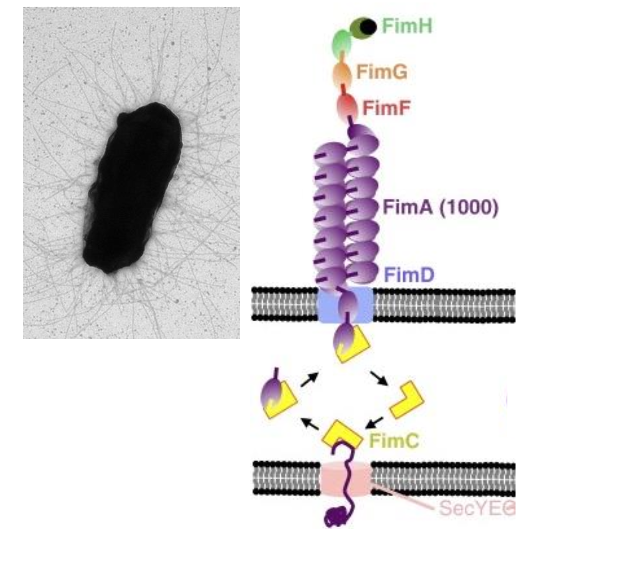
describe the donor strand complementation in UPEC pili assembly? why’s it needed? and the mechanism
pilus subunits have an incomplete immunoglobulin folds and are unstable
incoming strand complement folds and stabilises subunit
protease DegP degrades misfiled pilins
chaperones FimC stabilise subunits
how does UPEC interact with host glycans? in urinary tract and kidneys, and innate barriers
type I fimbriae- bind branched mannose sugars on the epithelial cells
kidney attachment- secondary pili Pap binds Gb3
innate barriers: GAGs glycosaminoglycans - mucin like structures
describe the UPEC cellular lifestyle? how it invades, and what it induces.
once bacteria have attached to umbrella cells- they’re taken up by endocytosis
bacteria then invades and replicates and make a community callused IBC which is biofilm like and make complex structure
induce neutrophils by TLR4/TLR5 and get IL6, IL8 and caspases
what form of adhesion do UPEC display? diff between low and strong forces
catch-bond- more stronger under force!
multiple piles mean stronger attachment under shear stress of urine flowA
- fimH has 2 domains: lectin domain for mannose/carbs and c terminal pilin domain anchors FimH to FimG: FimG completes the missing groove of FimHlocks it onto the entire pilus
- no shear: interacts with lectin and keeps low affinity
- high shear: induces change that separates the lectin and pilin domains cmamps to mannose now!
describe the cost vs benefits(4 and 3) of adhesins
benefits:
attachment from adhesins are critical for early stage
some adhesins are specific and allows it to target particular receptors- FimH binding mannose
can form biofilms and make a community- intracellular bacteria community in UPEC
can sense mechanosensing
costs:
immunogenicity and can be recognised by host immune system by TLR4/5 and trigger Ab and complement
producing long filaments is metabolically expensive and needs energy and resources
expressing ahdesins in incorrect location can be detrimental and attract immune attention. expression is regulated by environment cues