law 101 final
 Call Kai
 Learn
Learn Practice Test
 Spaced Repetition
 Match
Match Flashcards
 Knowt Play
1/24

There's no tags or description
Looks like no tags are added yet.
Name | Mastery | Learn | Test | Matching | Spaced | Call with Kai |
|---|
No analytics yet
Send a link to your students to track their progress
25 Terms
Marx view of law
Does not believe in law being able to generate social change
Law reflection of material conditions in society
Law lacks autonomous power
In common with Libertarians
Pashukanis view of law (marxist)
Most important marxist legal theorist
Believes law will become unnecessary under socialism
Coercion mediated by law, in socialism coercion would remain but no check
Social revolution then legal revolution
Law becomes irrelevant to generate its own social change
Western Marxism view of law
lead by Gramsci
Goal to make socialism compatible with forms of western social democracy
Diverts from typical thoughts on marxism, disagrees that only thing that matters is ones class
Believes culture must be considered as well
Notices that class traitors vote against class due to other factors in their identity
Class extremely important but many other important things to consider
Explains why important issues shift so frequently
Law is another open battleground; law relevant for social change
Emphasizes law’s role in giving consent for social change, mirrors struggle of people
Ducan Kennedy (modern marxist) view of law
Legal reasoning and law has power
Evidenced by how much powerful stakeholders care about it
Legal reasoning creates stabilization in capitalism and believes it has the power to destabilize it
Law enables reformist social change while limiting radical changes
You can make some social change through law but it is still protected
Central libertarian view of law
lead by Hyek
Law evolved order, not assigned instrument
Distinction between law and legislation
Law general abstract evolved rules
Legislation top down commands
Legislation reflects the social role law represents
Law should be an automatic reflection of what is happening between people
Not the place of the state to determine social roles
SNatural rights libertarianisttates it as cautionary tale while marxist views law as inevitable evil
Marx describes law being irrelevant while Hayek argues law should be irrelevant
Natural rights libertarian view of law
Lead by Nosek
Law only justified if protects and prevents attempts of affecting natural rights
Once social norms established spontaneously, outliers attempting to make aggressive change individually should be controlled
Law beyond minimal state is dangerous
Libertarian Legal Theory
Law and social change understood through
Law primarily constraining, not able to improve conditions
Bottom up change, not top down reform
General abstract rules, not specific legislation
Should facilitate change, not direct it
Legal attempts at social change are morally suspicious
Theorists
Richard Epstain
Constitutional and private law should preserve baseline of entitlements
Any attempts to regulate or redistribute is viewed skeptically
Not very consistent in libertarianism
Spontaneous order should work without having to rely on governmental change
Rodney Barnett
Law grounded in natural rights and consent
Social change through legal form only permissible if restoring liberty
Law should aim to limit state power
Liberal view of law
Relationship between law and social change understood as a legitimate and central instrument for structuring and sometimes advancing social change
Should be done through proper legal channels
Several commitments shared
Relative autonomy from economics and social change
Legitimate when substantively justified
Rights constrain and enable change, possibly at once
Institutions and procedures central, must be able to publicly justify social change
John Rawls
Social change legitimate when improves position of least advantaged
Jürgen Habermas
Social change legitimate when produced through proper institutions and procedures
Enables social change
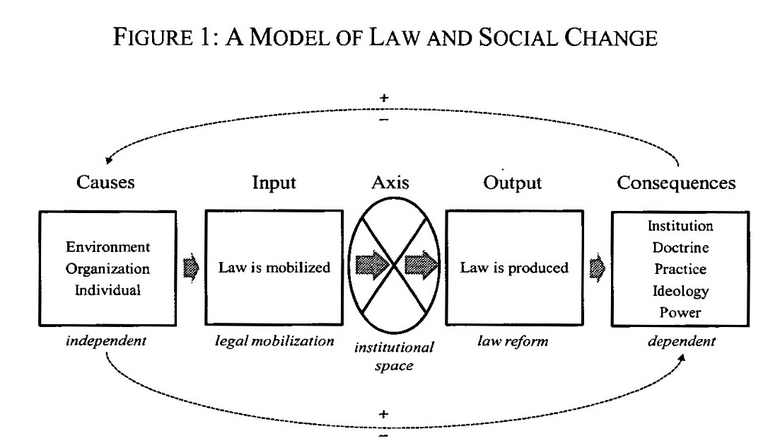
Empirical Studies of Law Reading Notes
key argument to move Away from Theory
Legal scholarship is shifting away from theoretical models based on rule compliance and toward descriptive and normative accounts rooted in the actual decision-making processes of real people
= New Legal Realism
law in action, data driven approach analyzing if law is making intended political change
Law is a dual force: it can be a tool to resist oppression and constitute justice, but it can also be a defender of the status quo that instantiates inequality
Systematic framework for law research
input= activation and mobilization of law
Bargaining in shadow of law; threats in conference room
Economic development; building own power
Policy and advocacy
output= measuring actual societal reform
Goal to unify disparate scholarly threads into a cohesive understanding of the law's transformative potential
Approaches
Top-down approach driven by lawyers
Law more protagonist role, guides the movement
Bottom-up approach driven by grass roots organizations
Law responds to force of social change
What Democracy Is. . . and Is Not
defines democracy
Modern political democracy is a system of governance in which rulers are held accountable for their actions in the public realm by citizens, acting indirectly through the competition and cooperation of their elected representative
To work properly, the ensemble must be institutionalized, that is to say, the various patterns must be habitually known, practiced, and accepted by most, if not all, actors
public realm encompasses the making of collective norms and choices that are binding on the society and backed by state coercion
Procedures that Make Democracies Possible
7 typical principals + last 2 from this author
Control
Frequent and fair elections
Almost all adults have right to vote
Almost all adults able to run for office
Expression without severe punishment
Able to seek out alt info
Independent citizens from organizations
Officials able to use power without overriding opposition from unelected officials
Polity self governed
What Democracy is NOT
not necessarily more efficient, agreeable, or orderly,
Democratization will not necessarily bring in its wake economic growth, social peace, administrative efficiency, political harmony, free markets, or the end of ideology. Least of all will it bring about the end of history
stand a better chance of eventually doing so than do autocracies
Goal= emergence of peaceful competition in institutions
Procedural Democracy
Proceduralism defines democracy as the very political process that it puts in motion; democracy’s normative value resides in the process’ unbeatable capacity to protect and promote equal political liberty
Proceduralism insists equal liberty is the MOST important thing a democracy should strive for
Equal liberty implies not only the right to participate in politics via voting and freely expressing one’s mind but doing so under equal conditions of opportunity, which entails protecting civil, political, and basic social rights with the aim of ensuring a meaningful equal participation
Comparisons
Compared to epistemic stance → proceduralism = democracy NOT evaluated based on the truth/correctness of outcomes, but based on its fair procedure that ensures equal liberty
Compared to populism → populism denies disagreement, while proceduralism recognizes it/make dissent central to social relations, sees it as inherent within democracy, and expect politics and procedures to reflect dissent meaningfully
Compared to minimalist concepts - proceduralism imposes normative standards for democracy that is MORE than just overcoming violence within society (?) + believe disagreement is a necessary process to ensure freedom
critics of proceduralism
procedural democracy theory is marginalized within the think tank
evaluates democracy based on the morals of participants (aka participants should be smart/rational) and the quality of outcomes → less and less on procedural
Rationally motivated consensus + quality outcomes + freedom of discussion → deliberative democracy
BUT procedural democracy arguing for the same goal as deliberative democracy via its dedication to equal liberty
Differences: deliberative democracy - need an ideal situation for discussing and reaching consensus >< procedural democracy
don’t need to be ideal due to various reasons AND reaching consensus can be achieved via voting when there’s deep disagreement BUT then deliberative democracy recognizes that yeah life isn’t ideal, discussion via non ideal situation is fine too
⇒ deliberative democracy and procedural democracy ARE compatible → procedural democracy just got mischaracterized and therefore neglected in the 20th century
Procedural approach is also most adequate because it does not demand from democracy anything other than the protection of equal freedom
Low bar lol
Prevent critiques on far-reaching promises that are often left unfulfilled
best because
For them, the democratic procedure is the best form of collective decision making, above all, because of its potential for expanding and strengthening political freedom, so as to assure it equally to all those concerned
Majority rule maximizes freedom because it chooses decisions that satisfy the opinions of the greater number of participants, while offering those who disagree the easiest path to change those decisions and providing power-limitation mechanisms that protect them in the meantime. Under this view, political minorities are crucial actors, not mere subjects of lawmaking.
inherently liberal and egalitarian; its foundational value and guiding principle is equal liberty
minimalist in the sense that it refers only to the procedure and not the outcomes it may achieve; the only relevant traits of these outcomes are their compliance with procedural rules.
BASICALLY emphasize how necessary it is to have equal liberty
Liberty is made possible through equality in political rights, which entails the right to participate through voicing opinions and organizing to make them effective, and a basic equality of opportunities that can make that participation matter evenly
Democracy - tool for power constrainment via Equal distribution of political power
Peace pivot not only to liberty but also equality
Epistemic democracy
democracy used as a truth-seeking tool ⇒ make correct decisions
critique on procedural
Epistemic democracy critiques proceduralism by saying proceduralism value the protection of equal liberty OVER the correctness of outcomes
Critiques
CRITIQUE of Epistemic 1st prong: truth-seeking/wise people rule
democracy emerges as a tool for everyone to participate, not to ensure correct outcomes → the point is NOT having experts voting, is to ensure all have the equality to vote and participate in law making
rooted in assumptions
CRITIQUE of Epistemic 2nd prong: judge quality outcome based on independent standard
Inherently incompatible with democracy → the reason why people follow rules is because they are guaranteed a procedural process that ideally would product the correct/majority opinion
Democracy as Populism
Populism = MOBILIZING ability + unite a mass under a charismatic leader
suspicious of electoral representation and the multiparty system
MAIN DIFFERENCE from proecduralism
Procedural democracy treats elections and parties as the essential mechanism through which the people govern
Populism treats those mechanisms as secondary or even dispensable, because legitimacy is thought to come directly from the people themselves
Representative institutions lack independent justification because they stand between the people and power
Populism seeks to collapse sovereignty and government into a unified expression of the people’s will
Populism is INCOMPATIBLE with procedural democracy because it disregards the rules of the game in the name of the mythical the people
Populism - need a charismatic leader to unite the voice of the people (and ignore/stigmatize those with opposing opinions/conflicts)
Here, representation means adherence to the leader NOT legal representation of citizens
BUT disagreements will always exist → you can’t eliminate pluralism ⇒ the core of this idea is BS
Can be dangerous - lead to power (who want to get into power quickly without waiting for elections) concentrated in the hands of the elite who wrongly promise the good of the power
jeopardizing constitutional democracy without necessarily promoting the interests of the many.
Minimalist Democracy
Membership as a social good
Membership in political community is primary social good
Socially constructed
Political communities have always drawn boundaries and they distribute life chances
Membership determines who can claim justice → precondition for distributive justice
Rejects
Cosmopolitan universalism
Impossible to assume one cares as much about every person as one does people they know or care for
Abstract individualism
Collective self determination outweighs
Believes in importance social practices, humans social creatures
Obligations to political community stronger
Identities matter
Community Examples
Gentrification
Rejected since it destroys the community built upon by the people being pushed out
Affinity groups
Self preservation prioritized
People going against core purpose of group exclude
Boundaries socially constructed
Membership in group defined differently per person
Rules fairly open
Admission and Exclusion
Political communities have a qualified moral right to control immigration, naturalization, and exclusion
Not open-ended but not overly specific on individual basis
Moral limits on exclusion
Refugees and asylum seekers
Special moral obligations for admission
Component which is cosmopolitan and universalist
Guest workers and long-term residents
If profiting from someones continued entry through work or tax, must offer membership
Internal exclusion
Caste like systems, denying full membership when living under state authority morally indefensible
Way in which the law creates internal exclusion
Jim Crow laws
Public education
Value based on class of neighborhood
Membership and Equality
Justice requires full members be treated as equals
Even if societies legitimately differentiate between members and nonmembers
Creating second-class or permanent quasi-members undermines the moral basis of political community
Democratic legitimacy depends on aligning social membership with political voice
Membership in name not enough, must have influence over rules subjected to
Membership as First Sphere
Broader theory on complex equality
Social good belongs in its own sphere and should be distributed according to its own social meaning
Should not use power in one area for great advantage in other
Ex. can be rich and buy lots of things but cannot use power to buy elections
Each sphere should be independent from other
Membership is gatekeeping sphere
Injustice here contaminates all other distributions
Domination begins when access to membership is used to monopolize power or resources across spheres
Liberal Communitarianism
Defends bounded political communities and right to exclude
Rejects closed, ethnically pure, or permanently hierarchical membership regimes
Justice requires membership rules reflect shared meanings, historical responsibility, and democratic equality
Members and Strangers view of Community
Membership as a social good
Membership in political community is primary social good
Socially constructed
Political communities have always drawn boundaries and they distribute life chances
Membership determines who can claim justice → precondition for distributive justice
Rejects
Cosmopolitan universalism
Impossible to assume one cares as much about every person as one does people they know or care for
Abstract individualism
Collective self determination outweighs
Believes in importance social practices, humans social creatures
Obligations to political community stronger
Identities matter
Boundaries socially constructed
Membership in group defined differently per person
Rules fairly open
Admission and Exclusion
Political communities have a qualified moral right to control immigration, naturalization, and exclusion
Not open-ended but not overly specific on individual basis
Moral limits on exclusion
Refugees and asylum seekers
Special moral obligations for admission
Component which is cosmopolitan and universalist
Guest workers and long-term residents
If profiting from someones continued entry through work or tax, must offer membership
Internal exclusion
Caste like systems, denying full membership when living under state authority morally indefensible
Way in which the law creates internal exclusion
Jim Crow laws
Public education
Value based on class of neighborhood
Membership and Equality
Justice requires full members be treated as equals
Even if societies legitimately differentiate between members and nonmembers
Creating second-class or permanent quasi-members undermines the moral basis of political community
Democratic legitimacy depends on aligning social membership with political voice
Membership in name not enough, must have influence over rules subjected to
Membership as First Sphere
Broader theory on complex equality
Social good belongs in its own sphere and should be distributed according to its own social meaning
Should not use power in one area for great advantage in other
Ex. can be rich and buy lots of things but cannot use power to buy elections
Each sphere should be independent from other
Membership is gatekeeping sphere
Injustice here contaminates all other distributions
Domination begins when access to membership is used to monopolize power or resources across spheres
Imagined Communities
Nations are imagined communities
Nations exist since people imagine themselves as part of shared collective
Imagined bond produces sense of connection and solidarity which feels real and meaningful
Boosts sense of belonging
Does not resolve what is the problem with it being it fake
Colonial bureaucracies help produce national identities
Nationalism culturally powerful but politically flexible
Modular spread of nationalism
Basic starter pack for nation states
Indoctrination vs. Education
Emotional depth of national belonging
Justice and Politics of Difference (Young)
Social groups not same aggregates vs. associations
Aggregates- choice in social group
Association- happen to be in same social group, lacks choice
Social groups= particular sense of history, affinity, and separateness, even the person’s mode of reasoning, evaluating, and expressing feeling
Face-to-face relations vs. mediated relations
More mediated interactions in modern day
Still interacting with people even without face-to-face
Make assumptions based on social grouping
Argues cannot pretend social groups do not exist since the differences are real
Young presents theory as rejection of liberalism and communitarianism
Liberal impartiality is incapable of acknowledging group difference
Demands us to adopt impartiality to deliberate on justice
Commands detached and objective
Eliminates emotion from deliberation
Young argues emotion justified and necessary
Aims for a consensus of justice that everyone should agree on
Young argues this is impossible
Rejection of the ideal community
Desire for unity and mutual understanding can repress difference among the social group
Communities have to interact with other communities and those relations
Politics of Difference
Relationship of strangers who do not understand one another in subjective and immediate sense who relate across time and distance
But still capable of living together under conditions of justice
Easier for law to say treat everyone equally than affirmative action
Would have to legally recognize different social groups
Differences are publicly recognized and acknowledged as irreducible
Dominated and oppressed should have specific voice in diverse public
Discourse Rights for Groups
Relevance of subgroups
Deciding which voices within groups receive representation and deference
Smallest minority on earth is the individual
Young struggles to address when the narrowing down becomes redundant and individualistic
For social groups to be considered as political subjects need definition and protection; preventing flexibility
Mediation, Group Representation, and Public Perspective
Socioeconomic mediation problem
Cosmopolitan turn and its tension
Need for universal rules despite anti-essentialism
Argues nothing universal while also calling for universal rules → contradicting
Views democracy as tool to manage difference
But can only handle so much difference
Nationalism and Global Federalism
Neutral rules not = to neutral outcomes
Applying same rule to people who are different gives different outcomes per group
Formal equality can reproduce inequality
Neutral standards reflect majority standards
Social groups and relational difference
Young argues groups are fluid and changing, anti-essentialist
Essentialism- built in unchangeable characteristics
Argues not all members share same traits or characteristics
Democracy manages differences, institution job to determine rules of coexistence within diversity
Group autonomy and voice
Groups should have ability to preserve level of autonomy
Marginalized groups need separate space to develop own perspective
Ex. tribal self-governance, affinity based bar associations
Without protection of voices they will be captured and disintegrated
Anti-essentialism vs nationalism debate
Young views nationalism as a way to dissolve opposition through force
Oppression and domination
Argues nationalism is inherently essentialist, lacks fluidity
But national sovereignty does not have to be essentialist
Polycentric nationalism
Global democracy; local autonomy + global regulation
Goal for Young
Equally valuable democratic societies; global federalism
International version of federalism
Non-domination vs. sovereignty
Sovereignty argued to be only way to protect self from external domination
Does not acknowledge internal conflict, nationalism creating pressure on inside according to Young
Young may be more accepting of a nationalism based on externalized nationalism, not wanting a country to be dominating of self
Friendly competition welcome
Domination not welcome
Who is enemy of nation? Internal or external?
Polycentric nationalism as alternative
Polycentric nationalism- identity built through same struggle
Peace and Conflict
Peace as Absence of Violence
Peace = absence of violence
Violence = gap between actual and potential
Avoidable suffering
Unavoitable - for Gultung that is NOT violence
ex. Earthquake
Avoidable - violence → but standard for avoidable is constantly evolving
TB - unavailable then but can be avoidable now
The law has to CHOOSE what kind of violence they protect or not
Certain of freedom/suffering that the law is allowing
You can’t ban people drinking Coke Zero but you can ban hard drug because it’s more detrimental
We allow cars for economic efficiency (getting to work faster for example) WHILE KNOWING THAT people will die if cars are allowed.
The law is just saying you need to suck it. It does value economy more than life
Galtung: There are certain things we are sacrificing but we DON’T realize because our definition of violence is so narrow
Personal vs. Structural violence – Galtung is bringing to the table
Personal (direct) violence
There is an identifiable actor
Structural violence (indirect) violence
No identifiable actor
Social injustice
Agency and system
If no one is responsible - it’s harder for the law to do something
You care FIRST about whether the suffering is happening THEN you care about who is responsible
Law think about violence is something actionable
If you can’t ask someone to be responsible for it – law is irrelevant
Hard to See
normalized
Also it’s not as newsworthy as personal violence → the news emphasises dramatic cases rather than critique of the system
It appears natural
It is sable
NOWADAYS problem: everything is presented as violence → makes people so unsanitized that nothing is violence anymore
Once we recognize structural violence, we start seeing EVERYTHING through structural violence → is it really the case that everything is from racism, xenophobia
Mechanisms
Inequality
Wealth transforms to political influence, legal interest, and media influence → overlap between different types of power
6 dimensions of Violence
Physical vs. psychological
Negative vs. positive influence
Negative peace – absence of direct violence
Positive peace
Absence of structural violence
Presence of justice
MLK It’s not the absence of conflict, it’s the presence of justice
With or without object
Personal vs. structural
Intended vs. unintended
Intent vs. outcome – Galtung cares more about outcome than intent because structural violence is about outcome, not the intent – shifting from the perpetrator to the victim
Manifest vs. latent
Manifest - observable
Latent - there in the system but not fully triggered → goes under the radar easily
Why should we treat this differently
Policymakers are often victims of news cycle
Putting down fire but not wondering why we have fire every year
What’s urgent vs. what’s important → the law always making this decision
If you have 100k, how much go into putting out the fire that’s happening right now, how much go into preventative measures
We all know that if we more money to preventive medicine, less burden on the ER/urgency
Should we consider manifest vs. latent violence the same? Why and why not?
Why do people accept legal decisions
Immediate and long term compliance
Immediate- Compliance in front of authority
Long term- Continued law abiding behavior after authority leave
Authorities seek voluntary buy-in, not mere acquiescence
Procedural justice predicts both short-term and long-term compliance
Instrumental rational accounts
Risk/Deterrence model
Certainty and severity of punishment
Certainty matters more than severity
Certainty more difficult to increase
Severity can be changed through law
Certainty has to be revamped to increase; reform
Effects generally small
→ Legal system unable to rely on alone
Enforcement limited
Financial and political costly
Outcome Favorability / Distributive Justice
People prefer favorable outcomes
People willing to lose, they just want to lose fair
But outcome fairness is not primary driver
What builds legitimacy
Procedural justice judgements
Trust in authority motives
Fair exercise of discretion
Rooted in perceived fairness of procedures and not primarily in performance or sanction threat
Procedural Justice Model
People defer when procedures are perceived as fair
Procedural justice > Outcome favorability in predicting acceptance
Fairness judgements drive:
Decision acceptance
Satisfaction with authorities
Long-term law-abiding behavior
No amount of coercive capacity able to replace legitimacy of procedure
Definition of legitimacy varies per nation
Core Procedural Elements
Quality of Decision Making
Neutrality, objectivity, rule-based decision processes
Quality of Interpersonal Treatment
Dignity, respect, acknowledgement of rights
Participation/Voice
Opportunity to state one’s perspective
Indirectly strengthens fairness perceptions
ex. American jury trials
Effective rule of law depends on
Process-based regulation
Attention to fairness in daily authority exercise
Style of policing and adjudication not just substance

