Biodiversity L2
 Studied by 0 people
 Call with Kai
 Learn
Learn Practice Test
 Spaced Repetition
 Match
Match Flashcards
 Knowt Play
1/13

There's no tags or description
Looks like no tags are added yet.
Name | Mastery | Learn | Test | Matching | Spaced | Call with Kai |
|---|
No analytics yet
Send a link to your students to track their progress
14 Terms
Biological species concept
A group of
organisms that can interbreed and produce
fertile offspring (Mayr)
Morphological species concept:
Organisms
are grouped by appearance or physiology
Phylogenetic species concept:
Organisms
with a shared evolutionary lineage that can be
differentiated from others based on a
common trait or gene
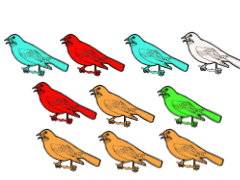
What is the species richness of the
community below?
5
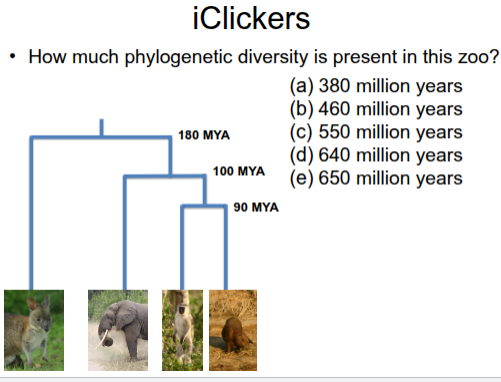
180+(180-100)+100+(100-90)+90+90 = 550
how many species should go extinct per year assuming 5 million species on earth. 1- 10 million years of persistence
1/1 million years * 5 million species = 5 species per year
1/10 million years * 5 million species = 0.5 species per year
overkill hypothesis
humans could be responsible for pleistocene extinctions across the world - human arrival correlates w/ dramatic wildlife declines esp in size (megafauna)
4 notable modern extinctions
thylacine (dog/zebra)
passenger pigeon
lyalls wren
golden toad
what traits do vulnerable species share
large body size
small range size
small pop size
habitat or diet specialist
species area approach
more habitat = more species
S=CA^Z
s = number of species
a = area of the land form
c and z are constants
c= 1
z= 0.25
find s for species area approach when A=10
s = 1×10^0.25 = 1.8
why do larger areas have more S
s = number of species
More resources, varying environment & niches, separation of environments (speciation)
extinction debt
predicted eventual loss of unviable populations
name two problems with Species area approach
extinctino may be slower than habitat restoration
species can often persist once habitats are converted (farms)
 Note
Note  Flashcards (39)