AP World Midterm Period 1
 Studied by 28 people
 Call Kai
 Learn
Learn Practice Test
 Spaced Repetition
 Match
Match Flashcards
 Knowt Play
1/51

There's no tags or description
Looks like no tags are added yet.
Name | Mastery | Learn | Test | Matching | Spaced | Call with Kai |
|---|
No analytics yet
Send a link to your students to track their progress
52 Terms
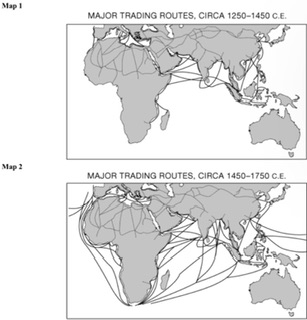
Which of the following best explains the continuity in the trade routes between East Africa, the Arabian Peninsula, and India as shown on the maps?
A. Trade along the routes depended on the activities of Chinese merchants.
B. Trade along the routes relied on sailors’ knowledge of the monsoon winds.
C. Trade along the routes depended on silver from the Americas.
D. Trade along the routes relied on sailors’ knowledge of longitude from classical maps.
B. Trade along the routes relied on sailors’ knowledge of the monsoon winds.
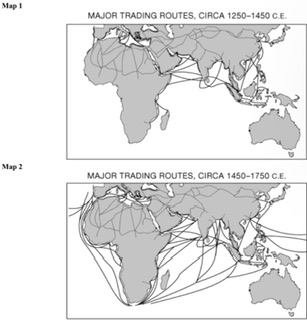
The maritime trade connections involving East Africa shown on Map 1 provided a setting for which of the following developments?
A. The emergence of commercial credit through banks
B. The development of the compass
C. The spread of Islam
D. The appearance of social structures privileging men over women
C. The spread of Islam
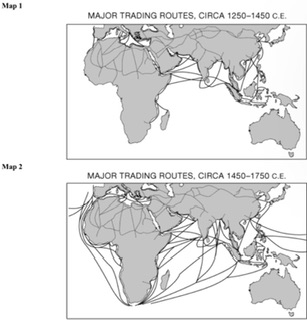
The key difference between Map 2 and Map 1 is that
A. Europeans had entered the sea trade.
B. the Chinese dominated trade.
C. trade in the Indian Ocean had diminished.
D. land trade routes had become obsolete.
A. Europeans had entered the sea trade.

The excerpt above exemplifies the continued influence on eighteenth-century Japan of which of the following? A. The Christian tradition of children respecting their parents
B. The Buddhist encouragement of female spirituality
C. The Islamic practice of women appearing modestly in public
D. The Confucian emphasis on filial submission
D. The Confucian emphasis on filial submission

Which of the following best supports the conclusion that Japan borrowed extensively from Tang and Song China?
A. Japan had established a decentralized power structure under a shogun by the eleventh century C.E.
B. Warriors or samurai gained substantial power and social status in Japan.
C. Societal relations in Japan were based on Confucian principles of hierarchy.
D. The Shinto religion continued to exert a strong influence on Japanese culture.
C. Societal relations in Japan were based on Confucian principles of hierarchy.

Which of the following is NOT true in terms of the position of women in Japanese society circa 1200-1450?
A. Japanese women could inherit property.
B. Japanese women could divorce and remarry.
C. Japanese women began to lose status with the rise of the warrior culture.
D. Japanese women were secluded in the home.
D. Japanese women were secluded in the home.
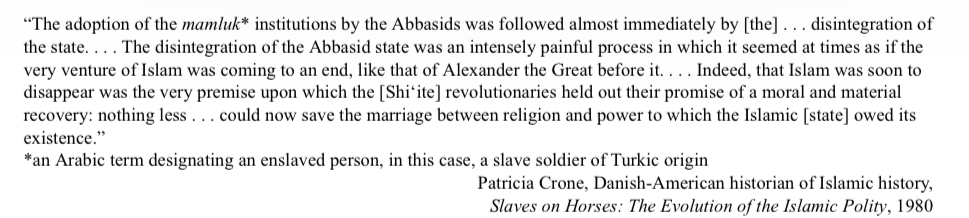
7. The disintegration of the Abbasid Caliphate most directly led to which of the following political developments in the Islamic world in the thirteenth century?
A. The Russian conquest of Central Asia
B. The rise of Turkic states
C. The conversion of most of the Islamic world to Shi‘a Islam
D. The collapse of trade along the Silk Road networks
B. The rise of Turkic states
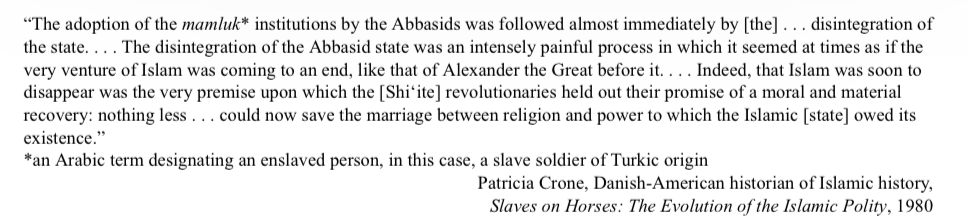
Despite the disintegration of the Abbasid Caliphate, Islam continued to spread across Afro-Eurasia in the period 1200–1450 primarily because of which of the following?
A. The conquest of the Christian Crusader States in the Levant
B. The activities of Sufi missionaries
C. The voyages of the Muslim eunuch Zheng He D. The translation activities of Muslim scholars
B. The activities of Sufi missionaries
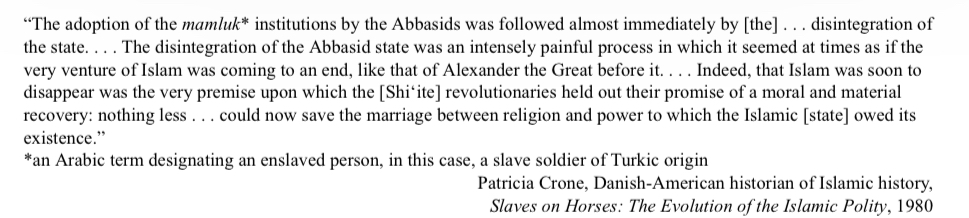
The combination between religious and political aspects in the Abbasid state’s concept of governance is best reflected in which of the following?
A. The Abbasid state had an influential Sunni religious class that often came into conflict with the state.
B. The Abbasid state often allowed local rulers considerable autonomy.
C. The Abbasid state patronized the construction of religious buildings such as mosques.
D. The Abbasid state was headed by a caliph who was both the state’s supreme religious and political leader.
D. The Abbasid state was headed by a caliph who was both the state’s supreme religious and political leader.
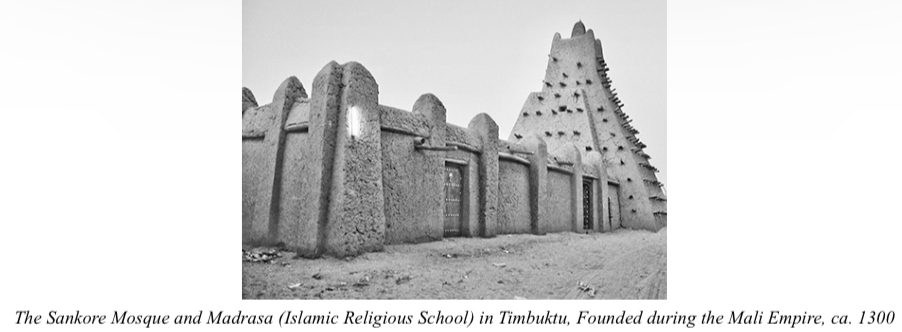
The founding of the institution shown in the image is best understood in the context of which of the following? A. The fragmentation of the Abbasid Caliphate
B. The migration of Arabic-speaking peoples to the Swahili coast
C. The diffusion of Islamic practices across the Indian Ocean trade networks
D. The spread of Islam from northern Africa
D. The spread of Islam from northern Africa
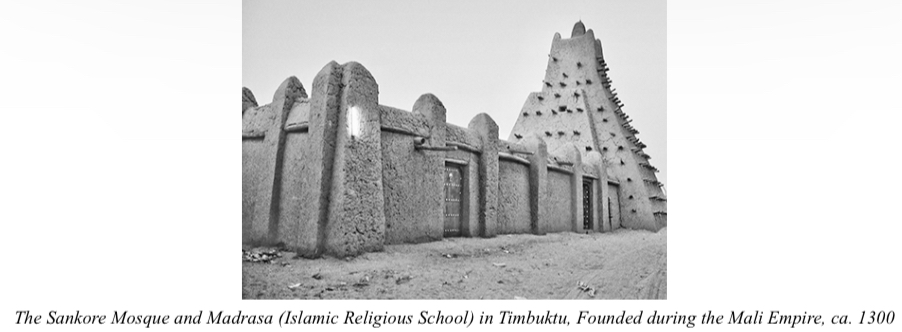
Which of the following developments contributed most directly to the construction of the structure shown in the image?
A. Population growth made possible by new crops from the Americas
B. Conquests by Turkic peoples in Afro-Eurasia
C. Trade in gold and salt across trans-Saharan trade routes
D. The spread of technological innovations following the Crusades
C. Tarde in gold and salt across trans-Saharan trade routes
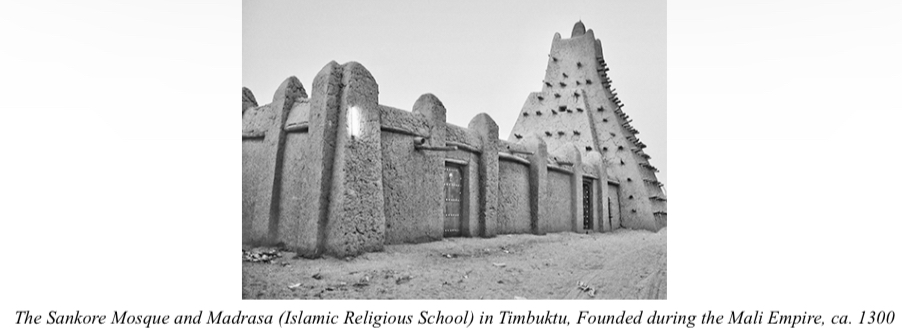
The building materials and design features of the structure in the image best illustrate which the following?
A. Adaptation of religious practices to local traditions
B. The spread of Mongol culture through conquest and trade
C. Conflict between Muslim and Christian communities in the Mediterranean
D. The role of Indian merchant communities in Indian Ocean trade
A. Adaptation of religious practices to local traditions
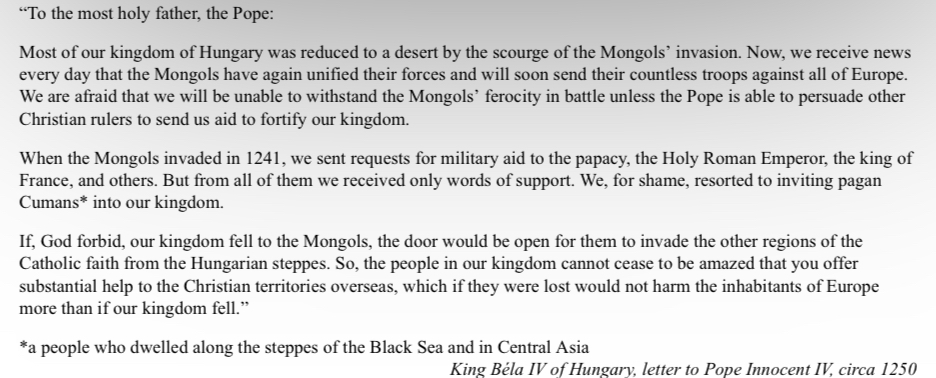
Which of the following features of Europe in the period circa 1200–1450 most directly contributed to the fact that the king of Hungary did not receive the military assistance that he requested in 1241, as mentioned in the third paragraph?
A. The existence of numerous feudal states that were frequently in conflict with one another
B. The development of parliaments that could check royal authority
C. The growing political power of regional trade organizations such as the Hanseatic League
D. The religious divisions of Europe into Protestants and Catholics as a result of the Reformation
A. The existence of numerous feudal states that were frequently in conflict with one another
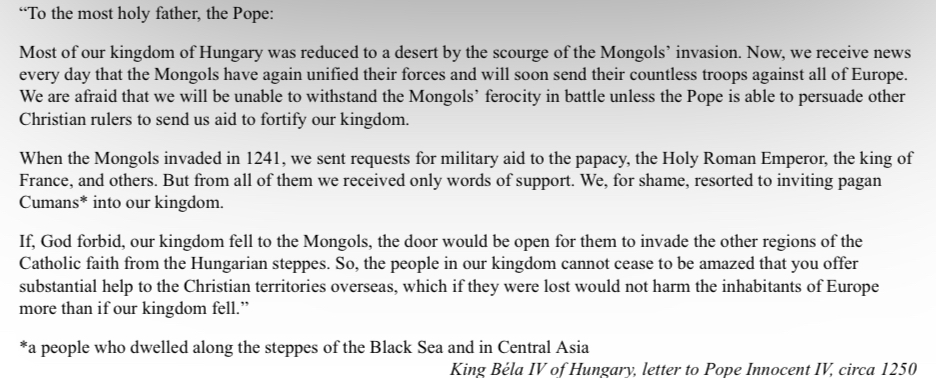
Béla IV’s statement in the fourth paragraph that the Hungarian people “cannot cease to be amazed” by the actions of the papacy most directly refers to the papacy’s failure to aid the Hungarians while
A. sending missionaries to China
B. supporting Christian conquests in the Iberian Peninsula
C. initiating European military campaigns in the Middle East
D. encouraging maritime exploration in the Indian Ocean
C. initiating European military campaigns in the Middle East
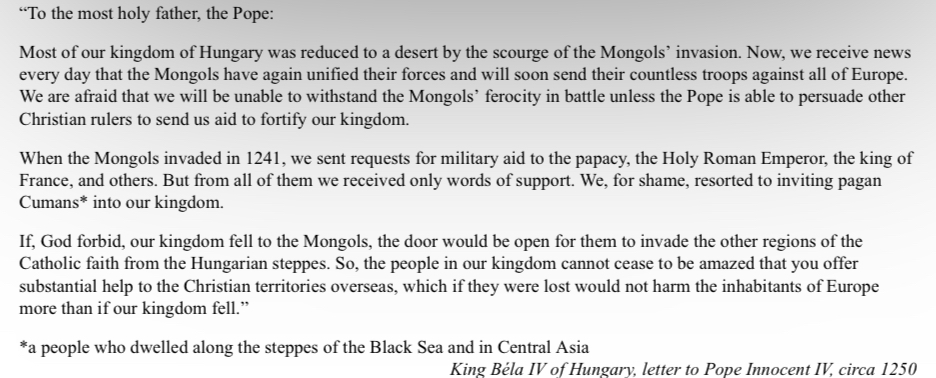
All of the following statements are factually accurate. Which would best explain Béla IV’s reasoning for inviting the Cumans into Hungary as mentioned in the third paragraph?
A. Cumans had settled in Hungary and had been granted local autonomy.
B. Cuman slave soldiers had become the rulers of the Mamluk Sultanate of Egypt.
C. Cumans were ethnic Turks who spoke a language intelligible to the Mongols.
D. Cumans were nomadic warriors and were familiar with the Mongols’ military tactics.
D. Cumans were nomadic warriors and were familiar with the Mongols’ military tactics.
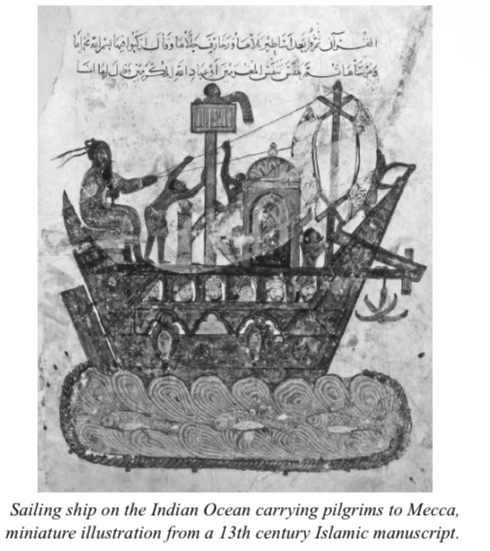
The illustration would be most useful to a historian studying which of the following?
A. Transportation and maritime technologies
B. Large-scale trading organizations
C. Geographic patterns of currents and winds in the Indian Ocean
D. The expansion of the Umayyad Caliphate
A. Transportation and maritime technologies
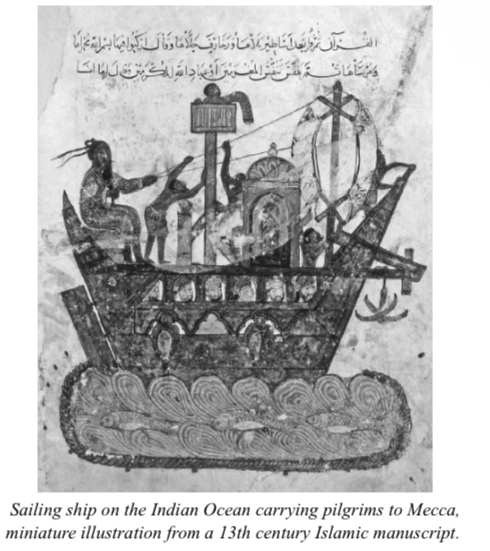
Which of the following best describes the primary purpose of the travel depicted in the illustration?
A. To convert peoples of other faiths to Islam.
B. To create diasporic merchant communities.
C. To recruit soldiers for the Caliphate.
D. To bind diverse communities to a common tradition.
D. To bind diverse communities to a common tradition.
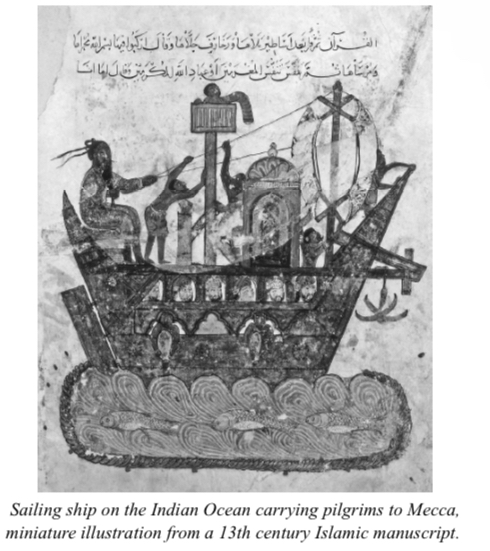
Which of the following is true of commerce in the Indian Ocean during the time period 1000-1450?
A. Chinese merchants dominated the trade routes of the Indian Ocean.
B. There was very little commercial activity in the Indian Ocean.
C. Merchants from Europe dominated the trade routes of the Indian Ocean.
D. Indian Ocean commerce flourished and was conducted by a mixture of Asian, Middle Eastern, and East African merchants.
D. Indian Ocean commerce flourished and was conducted by a mixture of Asian, Middle Eastern, and East African merchants.
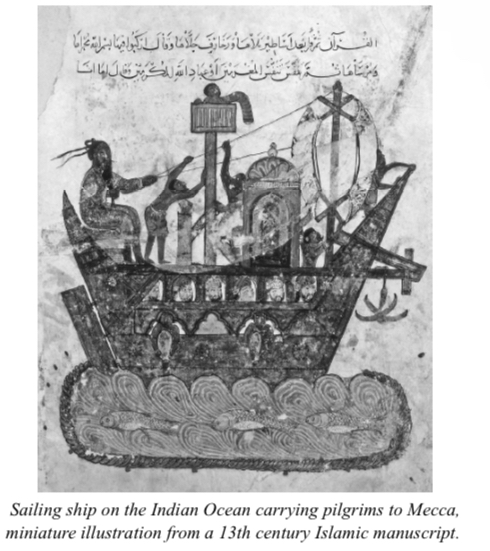
Which of the following best describes the effect of the spread of Islam on Indian Ocean trade?
A. It led to the expansion and intensification of commerce along already existing trade routes.
B. It led to the disappearance of previously established trade networks.
C. It led to an expansion of land-based caravan trade but also to a decline of maritime trade.
D. It led to the first creation of trade links between previously isolated world regions
A. It led to the expansion and intensification of commerce along already existing trade routes.
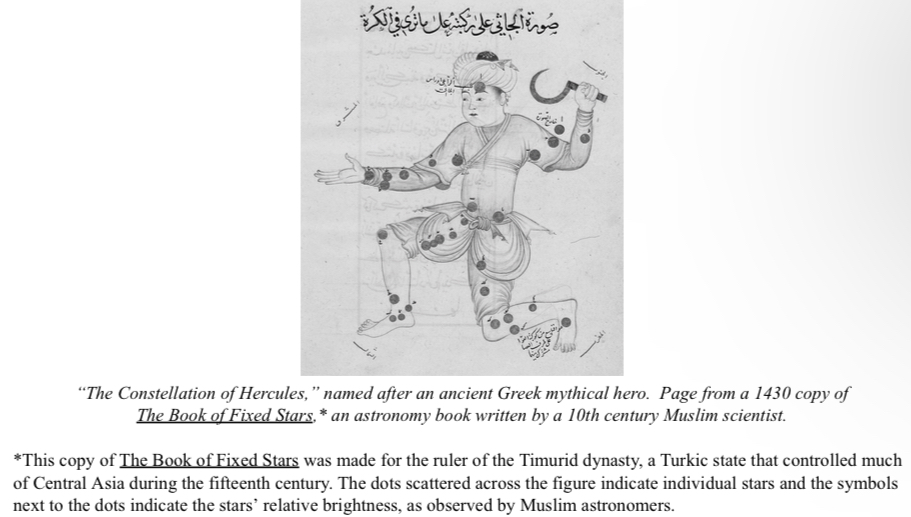
The sponsoring of scholarship by Turkic dynasties, such as the Timurids, best shows that, in the period circa 1200–1450, scholarly activities in the Muslim world continued despite the
A. conquest of Baghdad by the European Crusaders
B. expansion of the Song dynasty into Muslim Central Asia
C. Byzantine reconquest of Palestine and Lebanon
D. fragmentation of the Abbasid Caliphate
D. fragmentation of the Abbasid Caliphate
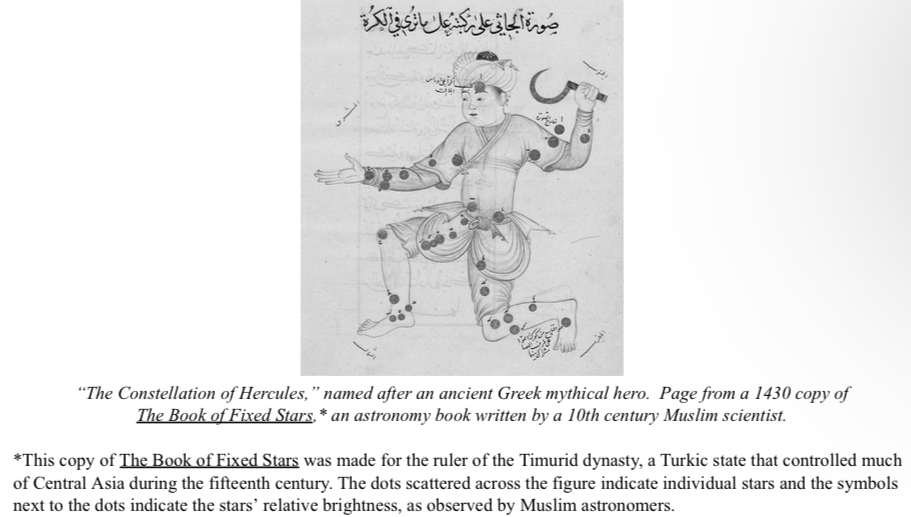
Muslim scholars’ incorporation of cultural and intellectual influences from pre-Islamic societies can best be used as evidence that
A. most educated Muslims continued to speak European languages well into the fifteenth century
B. European merchants had established trade outposts throughout Muslim Central Asia
C. Muslim scientists rejected the contributions of scientists from other cultures as heretical
D. Muslim states and empires were central to the processes of intellectual transfer in Eurasia
D. Muslim states and empires were central to the processes of intellectual transfer in Eurasia
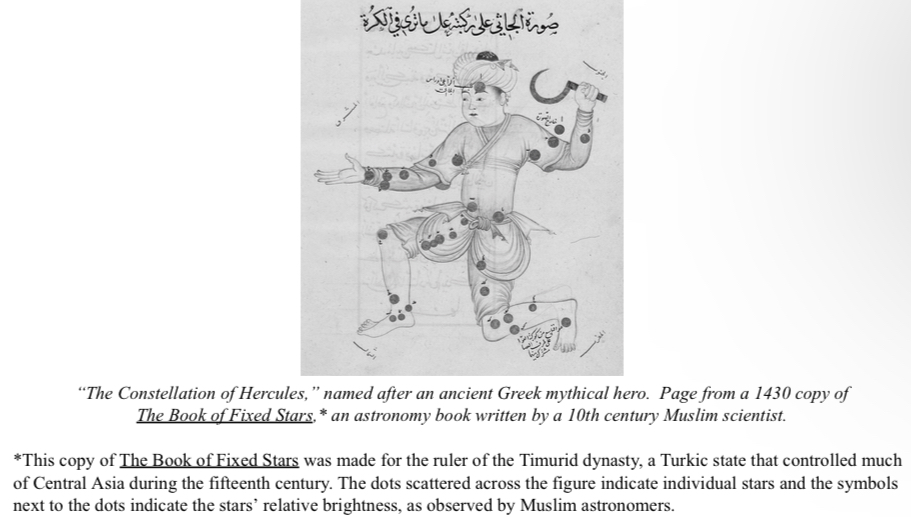
Muslim scientists in the period before 1450 C.E. generally participated in intellectual and scholarly exchanges with neighboring cultures by
A. being the recipients of funding from foreign rulers
B. serving strictly as copyists of earlier works that otherwise would have been lost
C. expanding upon the legacy of earlier scientific works by conducting their own research
D. learning from the superior scientific knowledge of medieval western European scientists
C. expanding upon the legacy of earlier scientific works by conducting their own research
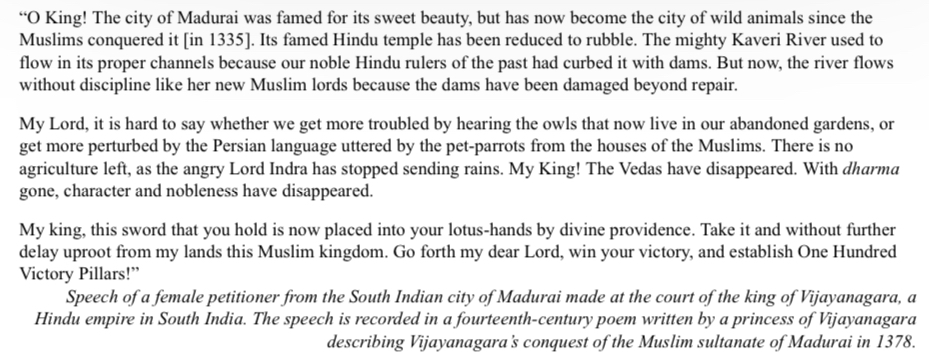
Which of the following best describes a claim made in the first paragraph?
A. Indian rulers had constructed irrigation works to control the Kaveri River.
B. Wild animals destroyed Madurai’s Hindu temple.
C. The Kaveri River flooded and destroyed the city of Madurai.
D. The city of Madurai’s Hindu temple was renowned for its beauty
A. Indian rulers had constructed irrigation works to control the Kaveri River.
A historian would most likely cite which of the following claims made in the second paragraph to demonstrate that Hindu teachings influenced the development of South Asian societies?
A. There is no agriculture left because Indra now supports the Muslims.
B. The absence of dharma has caused nobleness and character to disappear.
C. The citizens of Madurai are perturbed by hearing parrots speaking Persian.
D. The citizens of Madurai protect the owls in their gardens because they are considered to be sacred birds.
B. The absence of dharma has caused nobleness and character to disappear.
Which of the following is a claim made by the petitioner in the third paragraph?
A. The gods will directly accompany the king in his conquest of the Madurai Sultanate.
B. A prophecy has shown that the king will conquer the Madurai Sultanate.
C. The king has the support of the gods in his efforts to drive Muslims out of Madurai.
D. The king should establish victory pillars after his conquest.
C. The king has the support of the gods in his efforts to drive Muslims out of Madurai.
Which of the following religions did the female petitioner most likely follow?
A. Buddhism
B. Confucianism
C. Hinduism
D. Islam
C. Hinduism
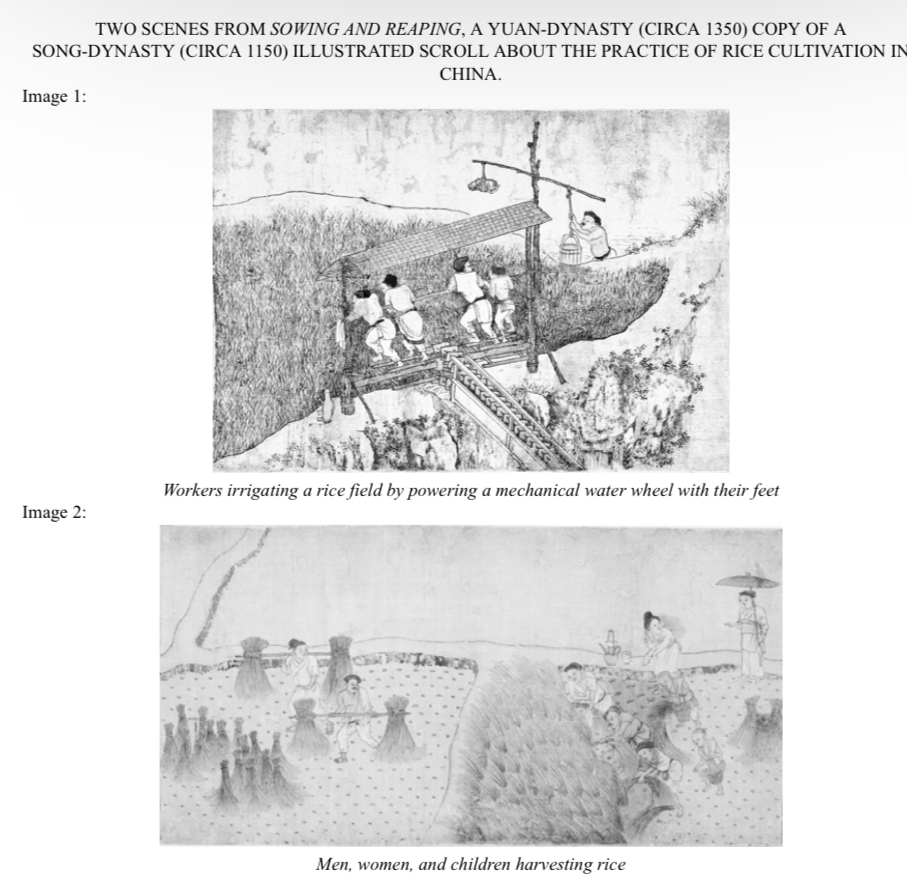
Image 1 best illustrates which of the following features of the Chinese economy in the period 1200 to 1450 ?
A. Technological innovations increased agricultural yields.
B. The government sponsored land reforms.
C. Confucian policies guided the way agrarian labor was performed.
D. Improvements in manufacturing techniques resulted in increased handicraft production.
A. Technological innovations increased agricultural yields.
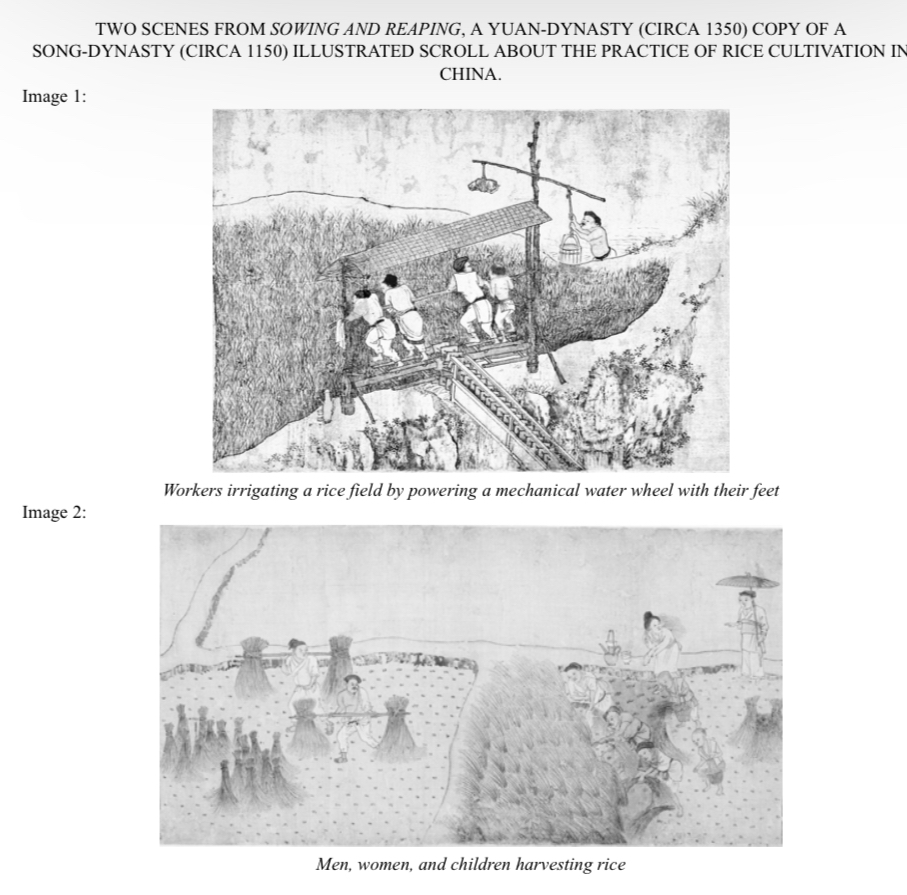
Which of the following most likely explains why the scroll was copied for a new audience in the 1350s?
A. The Mongol conquests caused widespread destruction to China's irrigation system.
B. The artist wanted to demonstrate the superiority of the Song dynasty over the Yuan dynasty.
C. Mongols adopted and spread technological innovations from regions within their empire.
D. Chinese culture had a significant influence on neighboring countries, such as Korea and Vietnam.
C. Mongols adopted and spread technological innovations from regions within their empire.
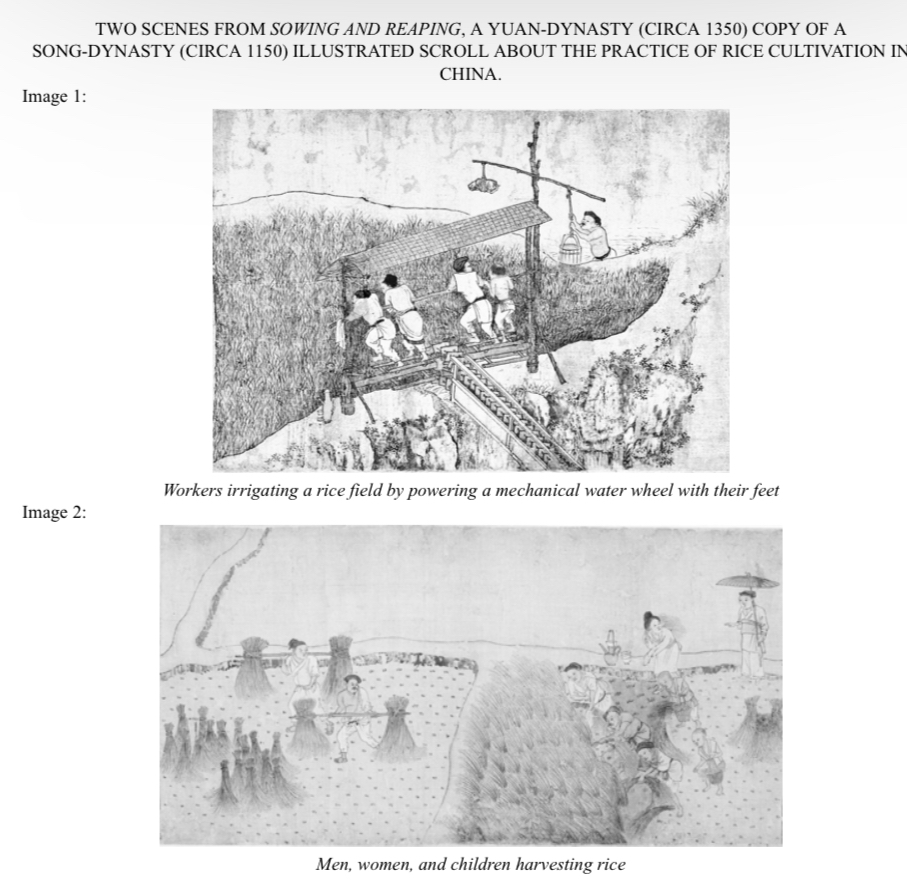
The activity depicted in Image 2 best illustrates which of the following characteristics of China’s economy pre-1450 ? A. The influence of Confucian labor policies
B. The impact of innovations borrowed from surrounding states
C. The reliance on systems of peasant labor
D. The dependence on trade along the Silk Roads
C. The reliance on systems of peasant labor
Which of the following best describes how European labor systems before 1450 differed from the Chinese labor system depicted in the two images?
A. European labor systems did not rely as much on women and children.
B. European labor systems placed a greater emphasis on plantation cash crops.
C. European labor systems were dominated by urban artisans.
D. European labor systems were more likely to utilize serfdom.
D. European labor systems were more likely to utilize serfdom.
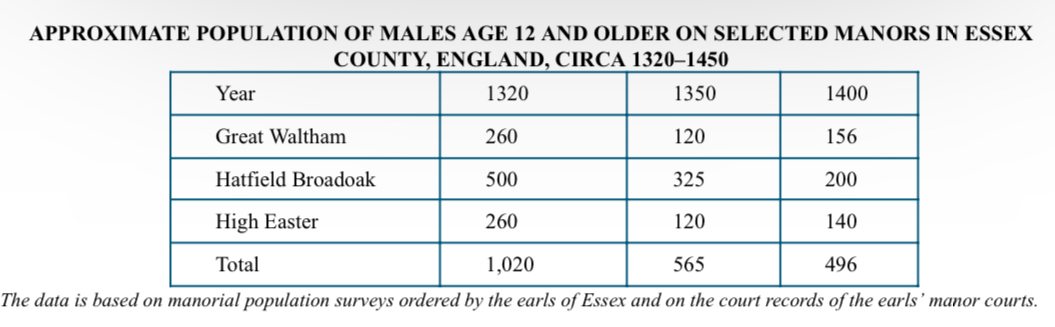
Based on the information in the table, the Black Death outbreak of the bubonic plague struck Essex County in which of the following periods?
A. Before 1320
B. Between 1320 and 1350
C. Between 1350 and 1400
D. After 1400
B. Between 1320 and 1350
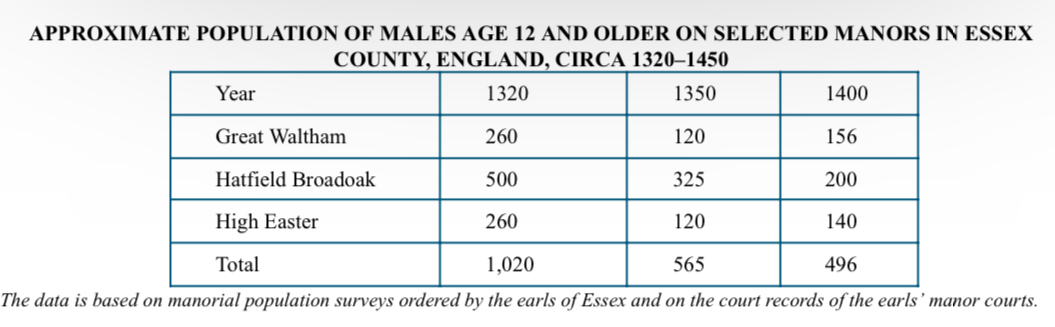
A comparison between the data for the three manors shown in the table best illustrates which of the following about the bubonic plague?
A. It was equally devastating across all areas of western Europe.
B. It had virtually no effect on the populations of some regions of England.
C. In some but not all areas, the population was beginning to recover by 1400.
D. In most areas, the population reverted to pre-1320 levels by 1400.
C. In some but not all areas, the population was beginning to recover by 1400.
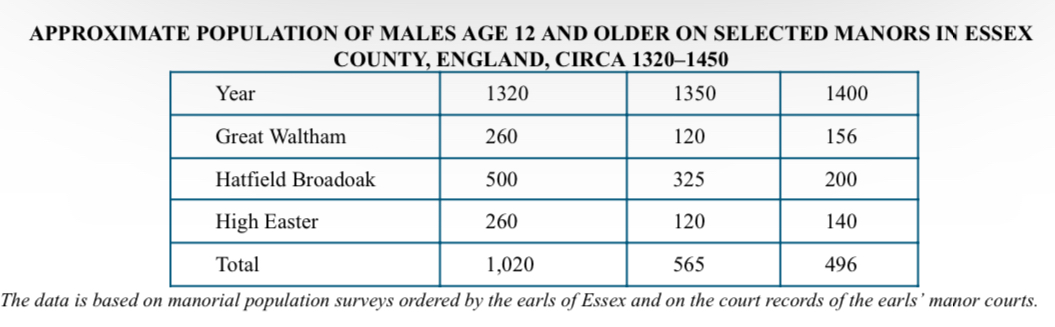
Which of the following best describes the change in the total population of males age 12 and older in the three manors shown in the table from 1320 to 1400 ?
A. It declined to less than a quarter of its 1320 level (over 75% decline).
B. It increased to more than double its 1320 level (over 50% increase).
C. It declined to less than a half of its 1320 level (over 50% decline).
D. It stayed virtually unchanged compared to its 1320 level.
C. It declined to less than a half of its 1320 level (over 50% decline).
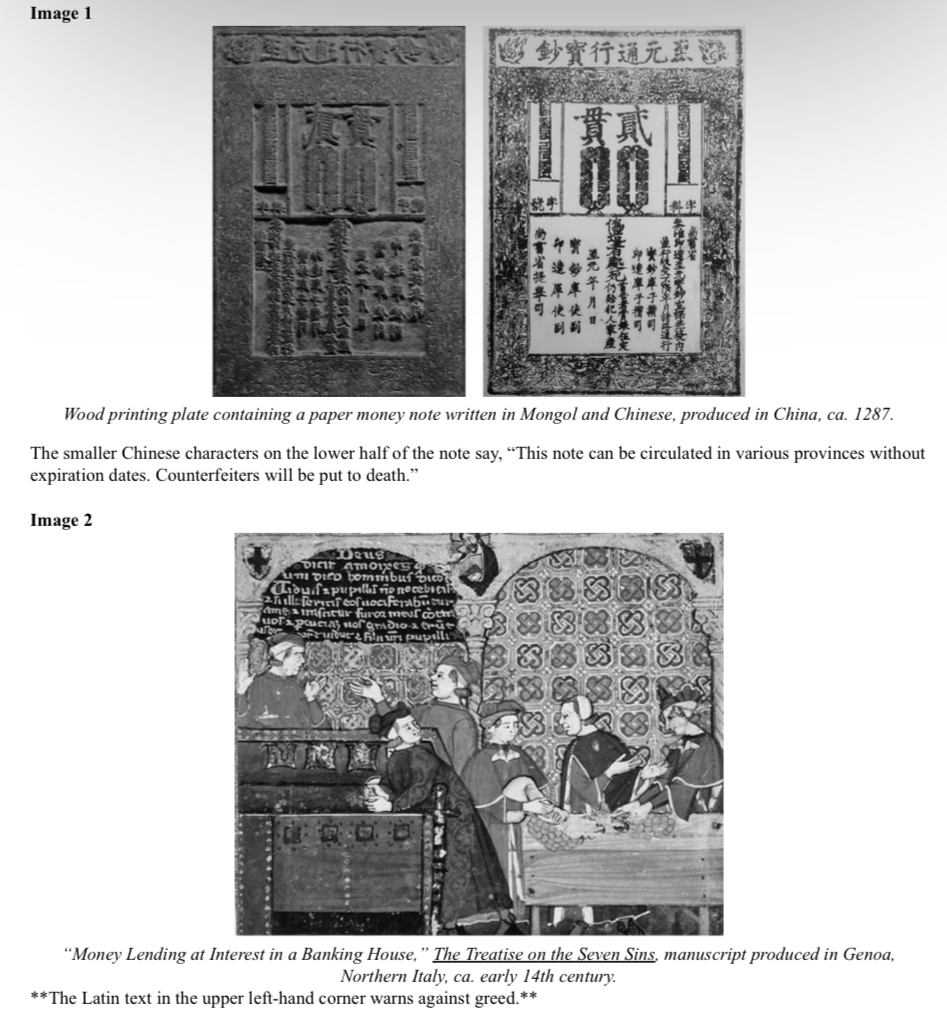
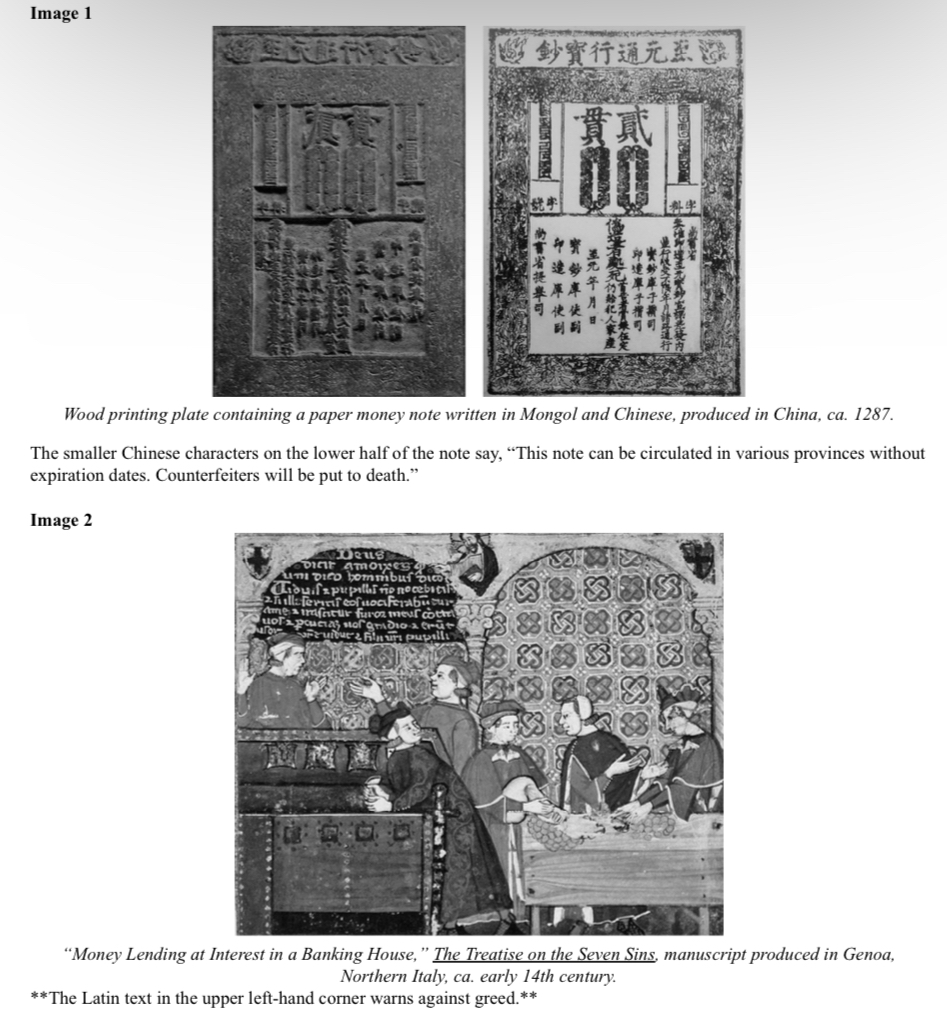
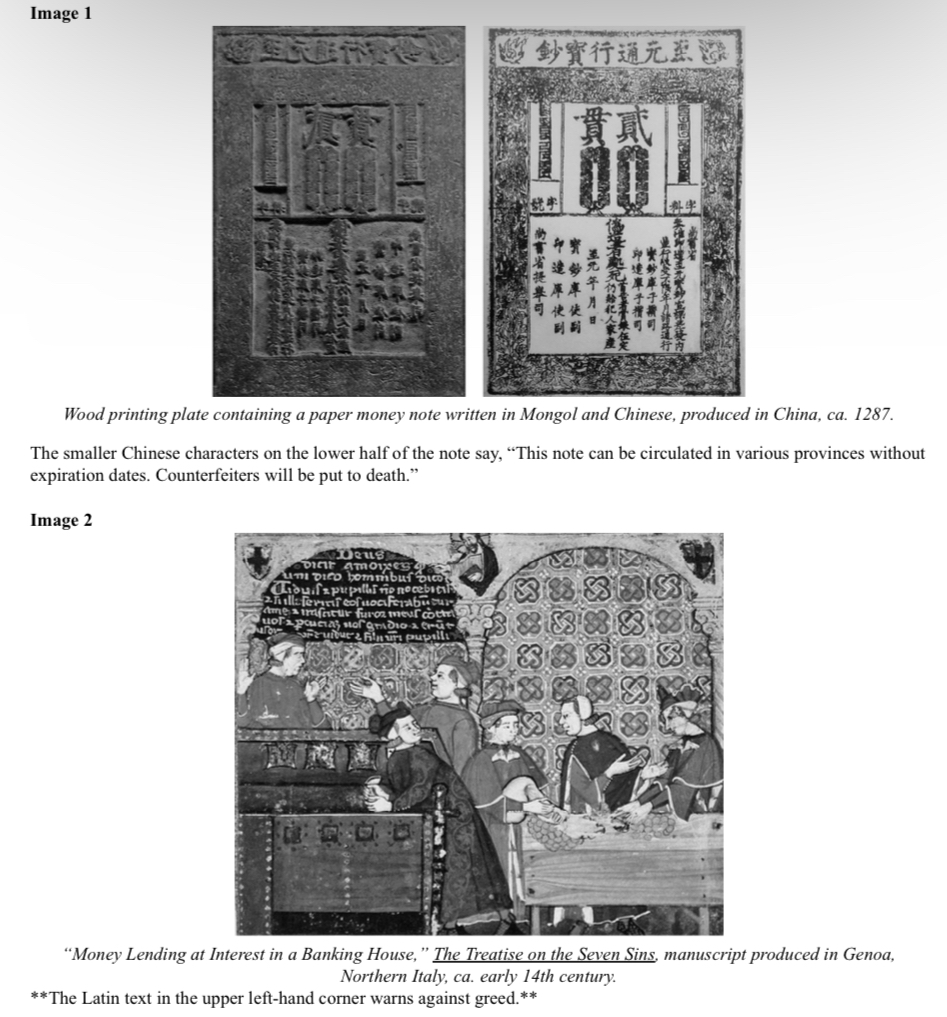
The commercial practices shown in the images emerged in order to
A. facilitate the development of regional trade networks by creating uniform currencies and systems of credit.
B. finance imperial conquests by supplying credit and currency for purchasing weapons.
C. facilitate a growing trade in luxury goods by providing greater access to credit and currency.
D. finance transnational Chinese artisan businesses across Eurasia by diversifying sources of credit and currency.
C. facilitate a growing trade in luxury goods by providing greater access to credit and currency.
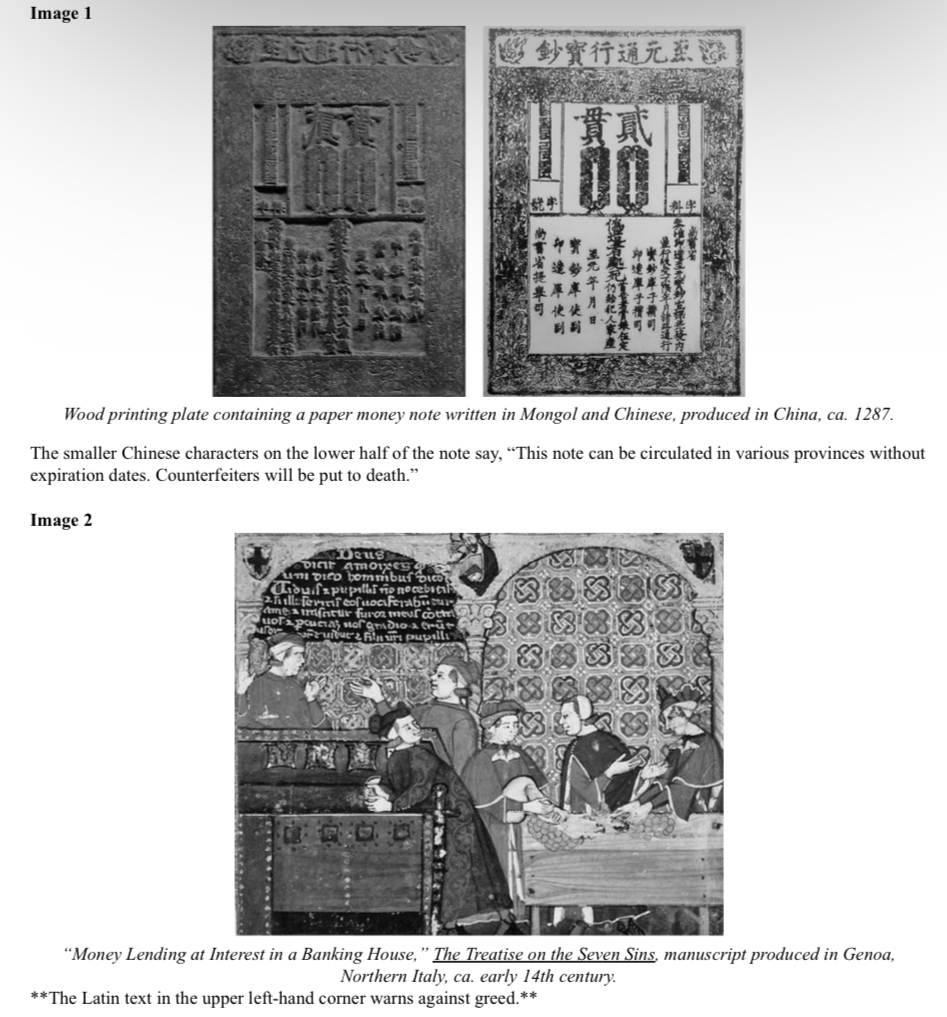
Image 1 could best be used as evidence of the ways in which
A.the introduction of new commercial practices fostered urban expansion.
B. imperial states attempted to expand commercial activity.
C. commerce fostered cultural unity in some politically fragmented regions.
D. new commercial technologies helped expand literacy.
B. imperial states attempted to expand commercial activity.
The author’s portrayal of the activities shown in Image 2 was most directly informed by
A. aristocratic resentment of peasants
B. royal concern about the growing wealth of merchants
C. aristocratic ideals of chivalry and valor
D. Christian religious ideals
D. Christian religious ideals
All of the following statements about the use of the currency shown in Image 1 in China under the Yuan dynasty are factually accurate. Which best explains why the currency often led to hyperinflation?
A. Excessive amounts of currency were printed in order to fund military expeditions and reward local elites.
B. The Yuan government forced private citizens to surrender gold and silver and accept paper currency in its place.
C. The Mongol Ilkhanate in Persia also modeled its monetary policy on the paper currency printed in Yuan China.
D. Travelers to Yuan China noted that only paper currency was accepted for business transactions.
A. Excessive amounts of currency were printed in order to fund military expeditions and reward local elites.
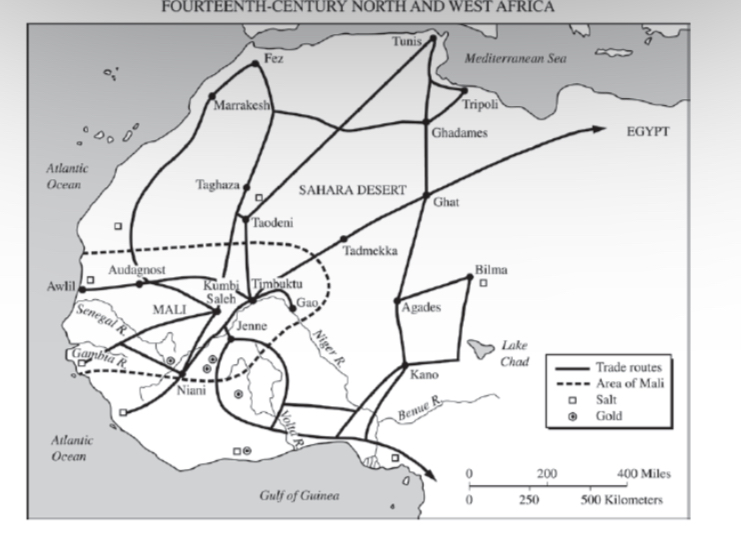
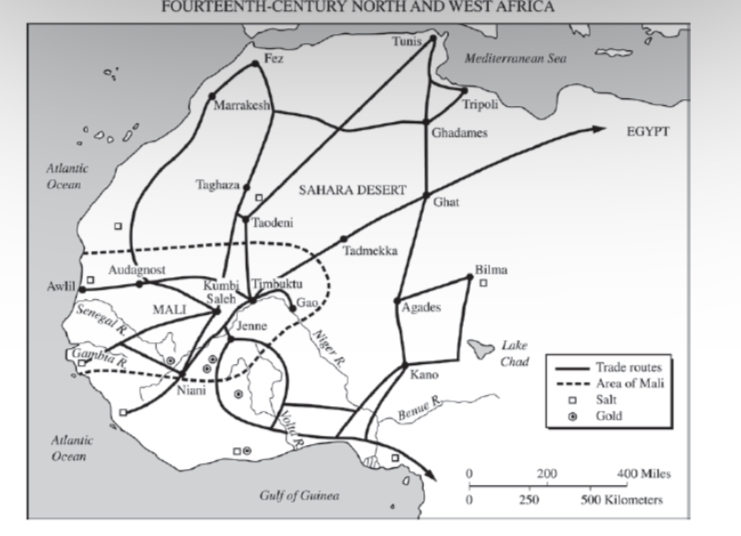
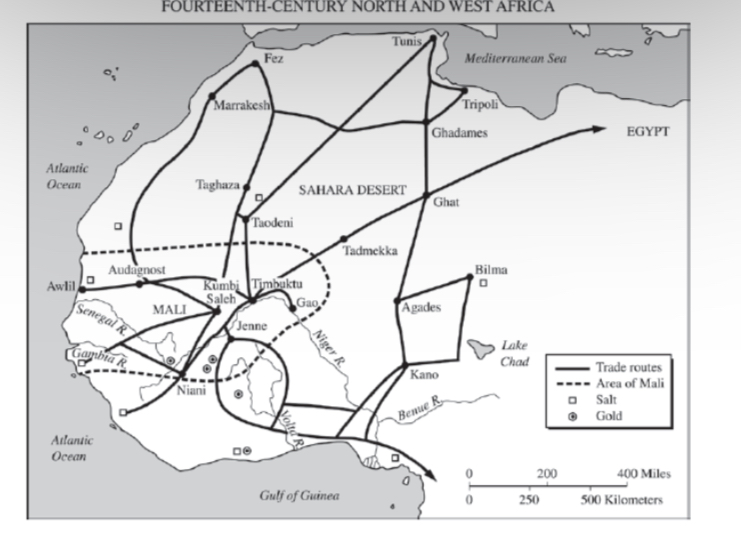
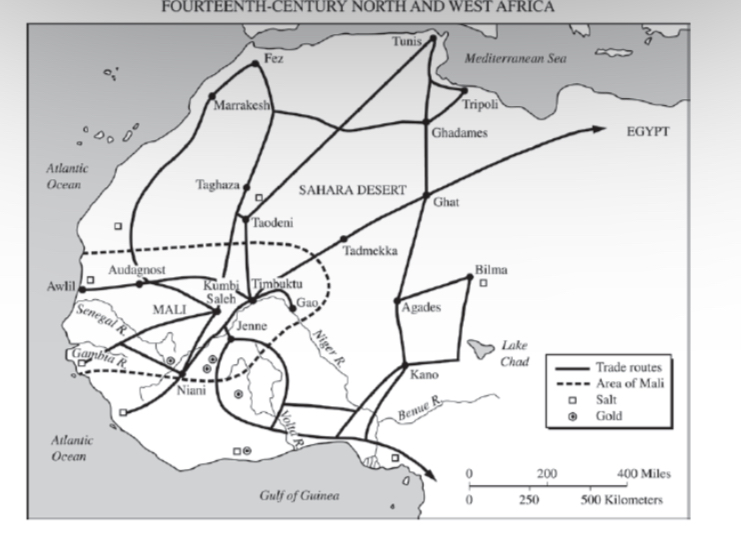
The map above indicates that
A. Mali was a major source and hub of the gold trade
B. Europeans had begun to make inroads in West Africa
C. Mali remained isolated from Europe and the Middle East
D. Atlantic ports were crucial for the transportation of salt and gold
A. Mali was a major source and hub of the gold trade
Malian Emperor Mansa Musa’s pilgrimage to Mecca in 1324 can best be understood in the context of which of the following?
A. The development of new transportation technologies
B. The diffusion of African culture to the Middle East
C. The territorial expansion of West African empires
D. The expansion of Islam throughout Afro-Eurasia
D. The expansion of Islam throughout Afro-Eurasia
Which of the following is most accurate in describing the city of Timbuktu?
A. It became the center of trade throughout West Africa after the 14th century.
B. It remained a center of Christian learning, even as Islam expanded throughout West Africa.
C. It became a renowned center of learning, boasting more than 150 lower-level Quranic schools and several
major centers of higher education.
D. It was a center of Islamic religious and intellectual life, but was minor in comparison with other cities such as Malacca.
C. It became a renowned center of learning, boasting more than 150 lower-level Quranic schools and several major centers of higher education.
Most of the architecture found in West Africa from this era, such as the Great Mosque of Jenne, demonstrate which of the following?
A. Dominance of Islamic traditions.
B. Dominance of West Africa traditions.
C. Blending of West African and Islamic traditions.
D. Blending of West Africa and Christian traditions.
C. Blending of West African and Islamic traditions.
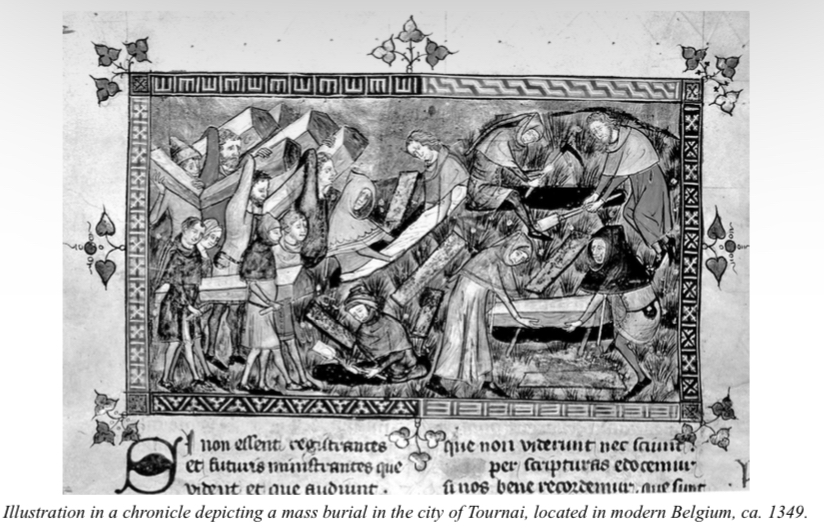
The burial depicted in the image most likely resulted from the spread of which of the following? A. Influenza
B. Malaria
C. Smallpox
D. Bubonic plague
D. Bubonic plague
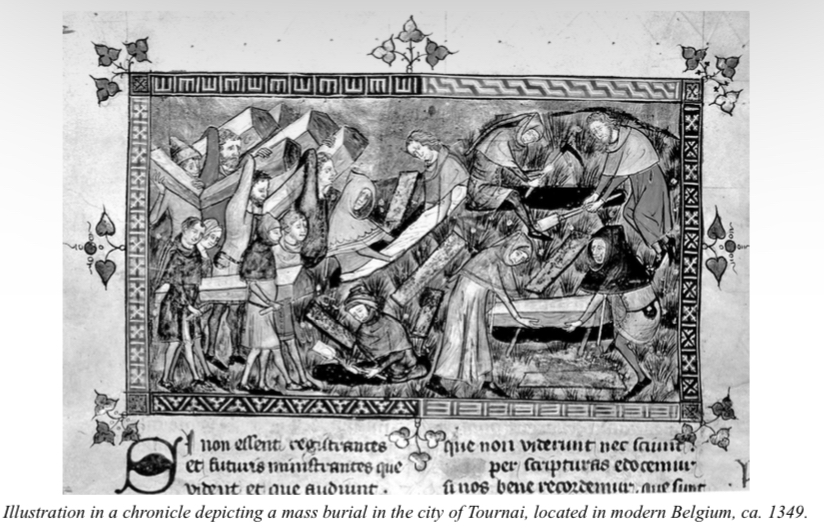
Which of the following best explains why, in the mid fourteenth century, events of the type depicted in the image were more common in urban areas of Afro-Eurasia than in rural or mountainous regions?
A. The disease principally spread along trade routes, and most commerce occurred in urban areas.
B. People in rural and mountainous regions had greater access to natural medicines that could fight the disease.
C. People in rural and mountainous regions were better able to flee to the safety of their lords’ castles.
D. The disease principally spread among religious missionaries, and most missionaries traveled to cities.
A. The disease principally spread along trade routes, and most commerce occurred in urban areas.
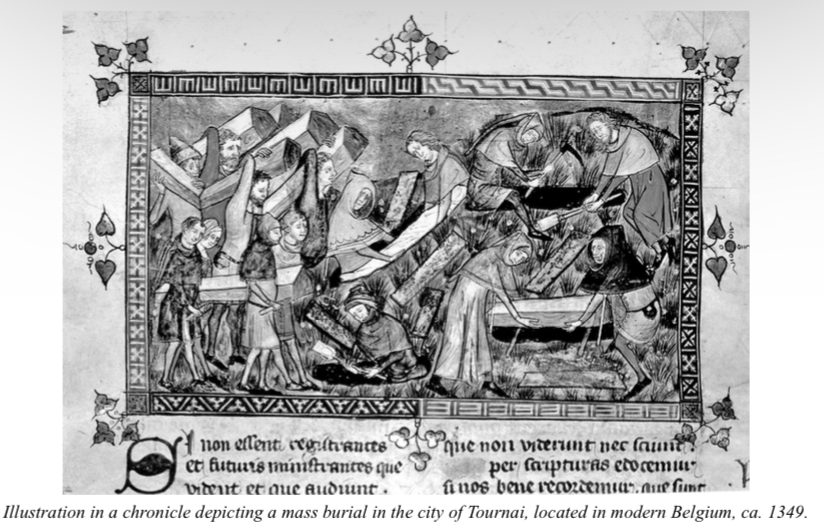
The mortality depicted in the image most directly contributed to which of the following changes in Europe in the late fourteenth and fifteenth centuries?
A. The end of feudalism
B. The decline of serfdom
C. The collapse of the Byzantine Empire
D. The Protestant Reformation
B. The decline of serfdom
The establishment of the Mongol Empire directly facilitated which of the following?
A. The development of Mongolian as the primary written language of administration across most of Eurasia
B. The spread of Persian culture into Central Asia
C. Improved ship designs and navigation techniques for oceanic commerce
D. Increased cultural and technological exchange between the Islamic world and China
D. Increased cultural and technological exchange between the Islamic world and China
Which of the following accurately describes the Mongol Empire’s role in facilitating trans-Eurasian trade?
A. It imposed Mongol religious beliefs and practices on conquered peoples.
B. It reestablished the Silk Roads between East Asia and Europe.
C. It created a self-contained economic system by banning non-Mongol merchants from its territories.
D. It developed a sophisticated bureaucracy staffed by talented Mongols.
B. It reestablished the Silk Roads between East Asia and Europe.
Which of the following statements about the Mongol Empire of the thirteenth century is true?
A. The invasion of Japan was attempted but was unsuccessful.
B. The number of Buddhists and Muslims in Asia dropped significantly as a result of Mongol persecution.
C. In China the Mongols eliminated the Chinese scholar-official class.
D. Ibn Battuta’s writings described in detail life in the court of Genghis Khan.
A. The invasion of Japan was attempted but was unsuccessful.
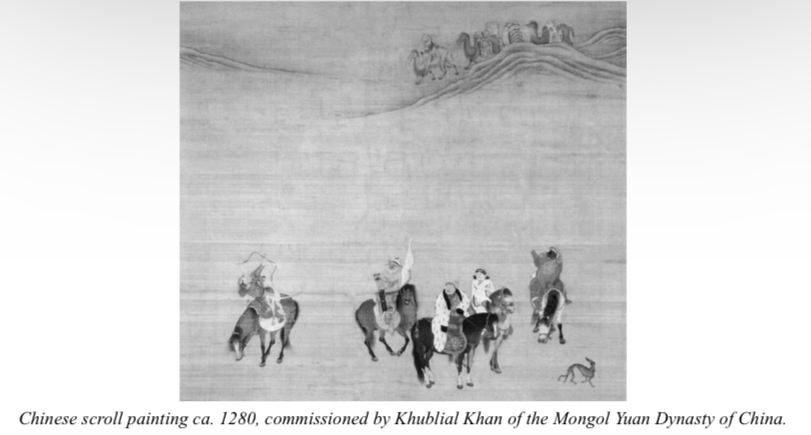
Which of the following is NOT .accurate in terms of Mongol rule over China?
A. The Mongols made use of Chinese administrative practices and taxation.
B. The Mongols were given a Chinese dynastic name by the previous Chinese emperor.
C. The Mongols transferred the capital from Karakorum to what is now Beijing.
D. The Mongols improved roads, built canals and patronized scholars and artists.
B. The Mongols were given a Chinese dynastic name by the previous Chinese emperor
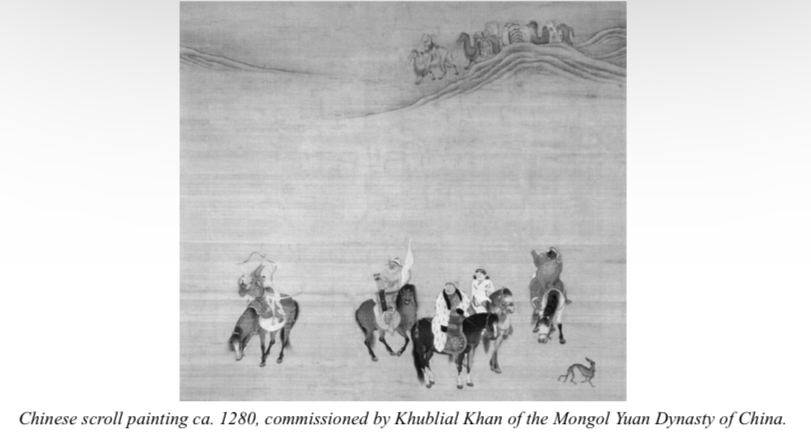
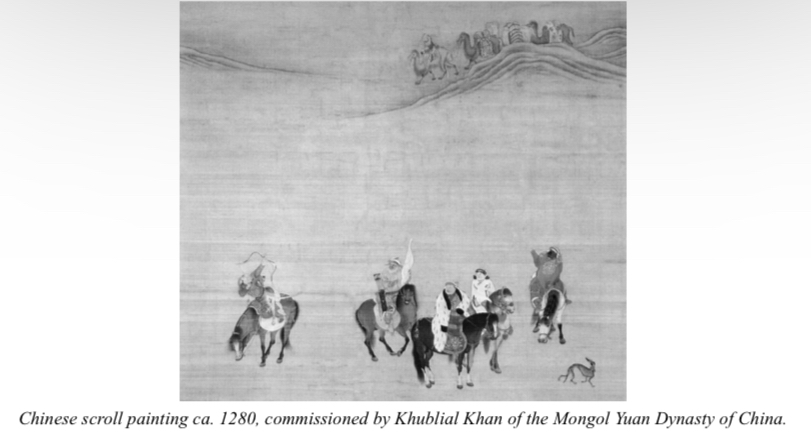
. The inclusion of the caravan in the painting’s background could best be used as evidence that Yuan rulers
A. favored some commercial trading organizations over others
B. portrayed themselves as promoters of commerce
C. shifted the trade in luxury goods from overland to the maritime trade routes
D. restricted trade between nomadic and sedentary societies
B. portrayed themselves as promoters of commerce
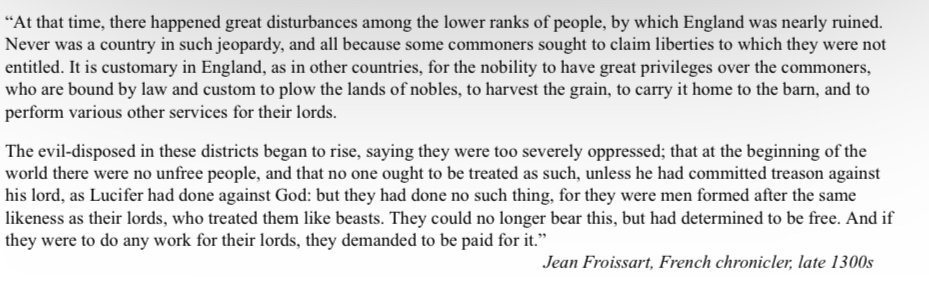
English nobles resisted peasant demands such as those described in the passage because agricultural labor in many parts of fourteenth-century Afro-Eurasia had become scarce as a result of which of the following developments?
A. The migration of peasants to cities in search of industrial employment
B. Significant increase in mortality due to the spread of epidemic diseases
C. The development of wage-based economies with the emergence of capitalism
D. Widespread famine resulting from rising global temperatures
B. Significant increase in mortality due to the spread of epidemic diseases
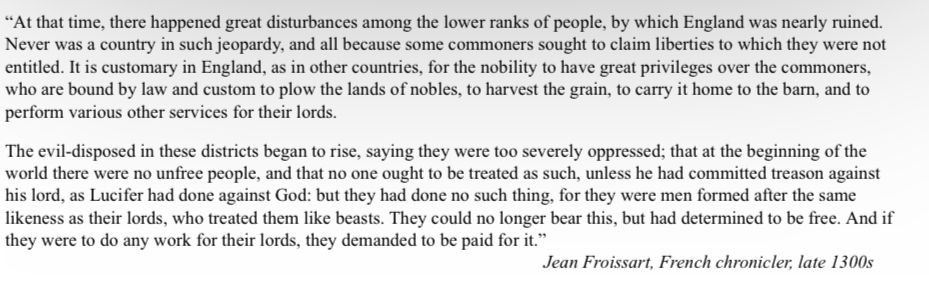
All of the following statements are factually accurate. Which most likely explains Froissart’s view of the peasants’ grievances discussed in the passage?
A. Even though he was French, Froissart traveled to England to collect information for his chronicles.
B. Peasant revolts were fairly common in medieval Europe.
C. History writing in medieval Europe was aimed primarily at elite audiences.
D. In addition to his chronicles, Froissart wrote a work of romance based on the legend of King Arthur
C. History writing in medieval Europe was aimed primarily at elite audiences.
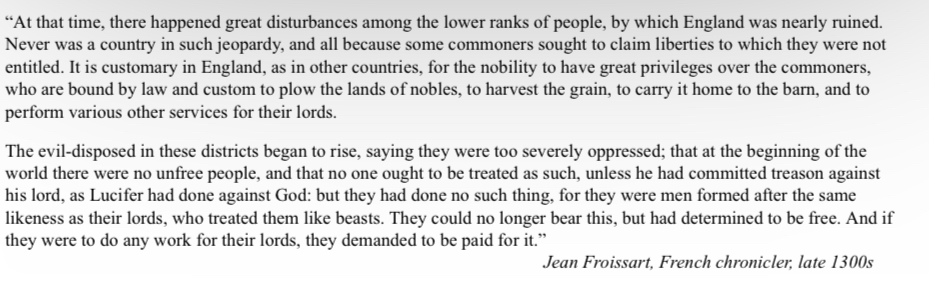
The events described in the passage represent a reaction against which of the following forms of coerced labor?
A. Slavery
B. Military conscription
C. Indentured servitude
D. Serfdom
D. Serfdom
 Note
Note  Flashcards (106)