7(4)-scientific processes (reporting conventions and peer review)
 Studied by 0 people
 Call with Kai
 Learn
Learn Practice Test
 Spaced Repetition
 Match
Match Flashcards
 Knowt Play
1/11

There's no tags or description
Looks like no tags are added yet.
Name | Mastery | Learn | Test | Matching | Spaced | Call with Kai |
|---|
No analytics yet
Send a link to your students to track their progress
12 Terms
Title
All research report begins with this.
Needs to be clear and precise (usually 12-15 words) as to what the research is investigating.
This is important because anyone who reads it will know exactly what the report is about before they decide to read further.
Abstract
This is a short summary of the whole study (about 150 to 200 words).
The report covers the aims/ hypothesis, introduction, method/procedures, results and the conclusion.
The abstract appears first but it written after all the other sections have been written- last.
Introduction
This section is a literature review of theories, and previous studies, including the issues surrounding this topic.
The aim of introduction is to provide a rationale for your research study.
This section should follow a logical progression, using a funnel technique starts off broadly, with theories and studies, then narrows down to precise studies related to your study. This then leads into the aims and hypothesis of the study.
Method
This section describes how the study was conducted. It should be clear and detailed enough for others to replicate. It is divided number of sections:
- Design: type of research method used, IV and DV
- Participants: sampling technique, age, gender etc
- Apparatus: material used to carry out study
- Procedure: step-by-step how it was carried out
Results
This section is where the results are presented—what the researchers found.
They typically include descriptive statistics; this is when the data is summarised by using the appropriate tables, averages and graphs.
Then there is the inferential statistics; section show if the results are significant —whether the hypothesis has been accepted or rejected.
Discussion
This section explains what the results show. This covers a number of elements (although not broken into subheading such as below).
-Summary of the findings – whether you hypothesis is accepted /rejected.
-Relationship to previous research – compare the findings studies mentioned in the introduction and possible reasons for differences in results (e.g. difference in design used).
-Limitation and modification – A discussion of the study’s limitations by looking at the methodology and design which may have affected the validity of the study (e.g. lack of controls, poor sampling) and how this could have been corrected for future study.
-Implications– Finally there is some discussion of the implications of the research such practical and/or theoretical implication.
For example, How can the findings be used real life? Or have the findings contributed further knowledge to this topic
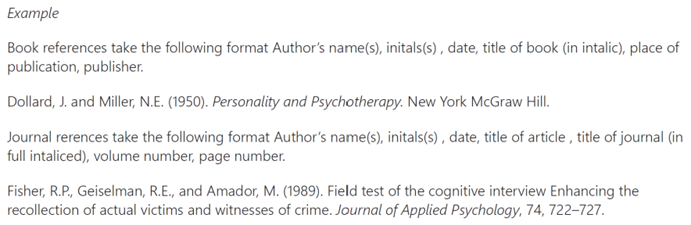
References
This section is a reference list. The full details of any journal articles, books and websites that you used in their report. Must follow a certain format. For example:
Appendices
This is for additional material that would interrupt the flow of the research report if it were presented within any of the major sections.
For example, in this section the researcher would place things like raw data, calculations, standard instructions, present lists of stimulus words, questionnaires, observation schedules and so on.
Peer review
The assessment of scientific work by others who are experts in the field. This is to ensure that any research for publication is of the highest quality.
- Experts should be objective and unknown to the author.
Main aim of peer review:
-Allocation of research funding
Benefits of peer review:
-Assess quality and relevance (hypothesis, methods etc)
-Suggest improvements
-Assess University department ratings (funding linked to ratings)
-Criticisms
Evaluation of peer review:
-Finding an expert (hard to find appropriate viewers)
-Anonymity (promotes honesty but can lead to bias or rivalry, open review… identities known)
-Publication bias (preference for significant results, false impression, established scientists in favour of conventional findings)
 Note
Note  Flashcards (39)