BIOL214 Exam 2 - Genes (Ch. 7+8)
 Call Kai
 Learn
Learn Practice Test
 Spaced Repetition
 Match
Match Flashcards
 Knowt Play
1/53

There's no tags or description
Looks like no tags are added yet.
Name | Mastery | Learn | Test | Matching | Spaced | Call with Kai |
|---|
No analytics yet
Send a link to your students to track their progress
54 Terms
Polygenic Trait
influenced by many genetic loci
tend to vary continuously among individuals (ex. human height)
epistasis
phenotypic plasticity
Epistasis
interaction between alleles
Phenotypic Plasticity
interaction with environment
Quantitative Genetics
study of the genetic mechanisms and evolution of continuous phenotypic traits
Population Genetics vs. Quantitative Genetics
Population Genetics
focused on understanding the subtle signals left in genetic data by selection over longer time scales
Quantitative Genetics
focused either on mapping the genetic basis of relatively simple traits, or in the absence of any such knowledge
Complex Traits Vary Continuously
traits that vary widely about the mean value have bigger variance
those that are identical have smaller variance
Components of Phenotypic Variation
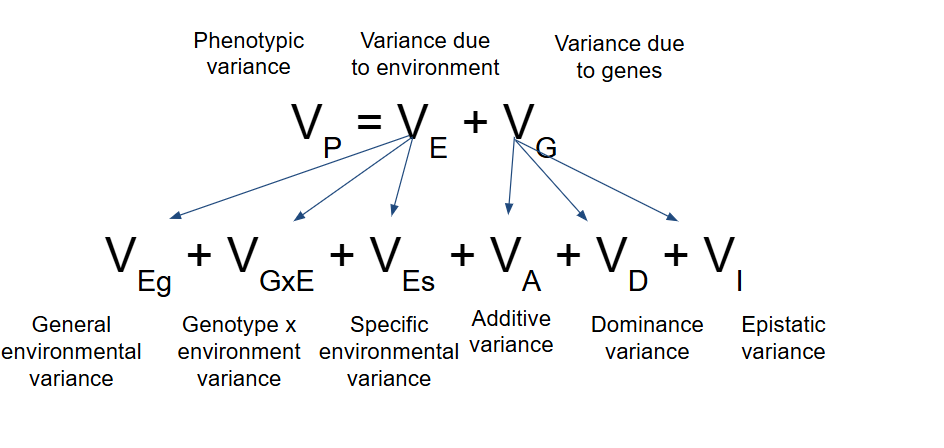
VP = VG + VE
VP = total phenotypic variance in population
VG = variance due to genetic differences
VE = variance due to environmental differences
Notes on Phenotypic Variation
in cases where environmental factors play a bigger role in phenotypic variations that do alleles, we have
VE > VG
likewise, when environmental factors are neglibible we have:
VP ~ VG
Genetic Sources of Variation
genetic sources of variation can themselves be divided into several subcategories
additive variance (VA)
dominance variance (VD)
epistatic variance (VI)
together, the values for each of these subcategories yield the total amount of genetic variation (VG) responsible for a particular phenotypic trait
VG = VA + VD + VI
Additive Genetic Variance
deviation from the mean phenotype due to the inheritance of a particular allele and this allele’s relative effect on phenotype
Dominance Genetic Variance
deviation due to interactions between alternative alleles at a specific locus
Dominance Variance
if there is an interaction between the alleles such that their expression is not equal, then the phenotype of the heterozygote would not be an approximate midpoint
it would more closely resemble one of the homozygotes
Epistatic Variable
involves an interaction between alleles
alleles are associated with different loci
Hypostatic Genes
they have their expression controlled by
Trait Heritability
Heritability: a measure of the proportion of phenotypic variance attributable to genetic variance
important predictor of the degree to which a population can respond to artificial or natural selection
Waldmann (2001)
Scabiosa canescens
found in small populations → low genetic diversity → limited ability to adapt
in this study, genetic lines of S. canescens from both a small and large population were used to estimate additive and dominance genetic variation
did not find a lower level of additive genetic variance in offspring from smaller population
the smaller population still had the ability to evolve
Broad Sense Heritability (H2)
proportion of the total phenotypic variation of a trait that is attributable to genetic differences among individuals
H2 = VG/VP = VG/(VG + VE)
Environmental Sources of Variation
subcategories:
specific environmental variance (VEs)
general environmental variance (VEg)
genotype by environment interaction (VGxE)
together, these values yield the total amount of environmental variance (VE) responsible for a particular phenotypic trait
VE = VEg + VGxE + VEs
Specific Environmental Variance (VEs)
deviation from the population mean due to the environmental conditions that are uniquely experienced by each individual
called the error or residual variance
random noise in the expression of the true phenotype, and it can interfere with the artificial selection of traits of commercial interest by weakening the correlation between genotype and phenotype
General Environmental Variance (VEg)
nongenetic sources of variation between individuals that are experienced by multiple individuals that are experienced by multiple individuals in a population
largest component of variation in populations in natural conditions
replicates of each genetic lines need to be assessed in each natural or experimental environment of interest
if one environmental treatment is used, then all nongenetic sources of variation are due to the specific environment
Estimating VEg
estimates of general environmental variance can be determined by growing or raising the same set of genetic lines in all environments of interest
for instance, water is required for all plants, but the amount that promotes the maximum growth differs among both species and genetic lines of a species
changes in growth rate due to the different water treatments = general environmental variance
Genotype by Environment Interaction (VGxE)
involves the unique or different responses of genetic lines to general environmental variation
Variance with Components
VP = VE + VG
VEg + VGxE + VEs + VA + VD + VI
Narrow Sense Heritability
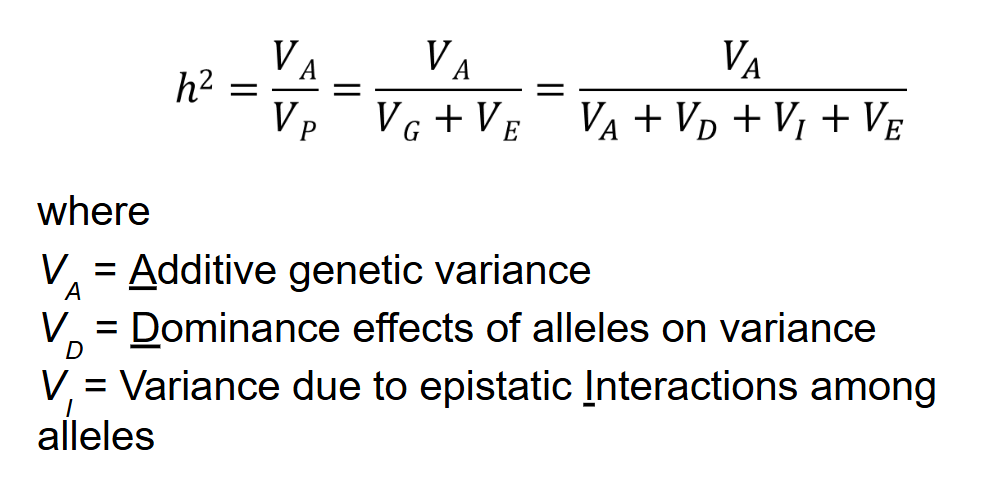
proportion of phenotypic variance explained by the additive effects of alleles
Are selection and evolution the same thing?
NO!
populations can experience selection even if they cannot evolve in response to it
Quantitative Trait Locus (QTL) Analysis
statistical method that links two types of information
phenotypic data (trait measurements)
genotypic data (usually molecular markers)
allows researchers in fields as diverse as agriculture, evolution, and medicine to link certain complex phenotypes to specific regions of chromosomes
goal is to identify the action, interaction, number, and precise location of these regions
Evolutionary Response to Selection
the degree to which populations change in response to selection depends on
selection differential
heritability of a trait
Selection Differential (S)
the difference in the mean of a trait in reproducing individuals and the mean of the trait for the general population
Heritability of a Trait (h2)
the proportion of phenotypic variance due to genetic differences (additive effects) among individuals
Calculating the Evolutionary Response to Selection
R = h2 x S
R = evolutionary response
h2 = heritability (narrow sense)
S = selection differential