Cardiac + action potentials
 Call Kai
 Learn
Learn Practice Test
 Spaced Repetition
 Match
Match Flashcards
 Knowt Play
1/3

There's no tags or description
Looks like no tags are added yet.
Name | Mastery | Learn | Test | Matching | Spaced | Call with Kai |
|---|
No analytics yet
Send a link to your students to track their progress
4 Terms
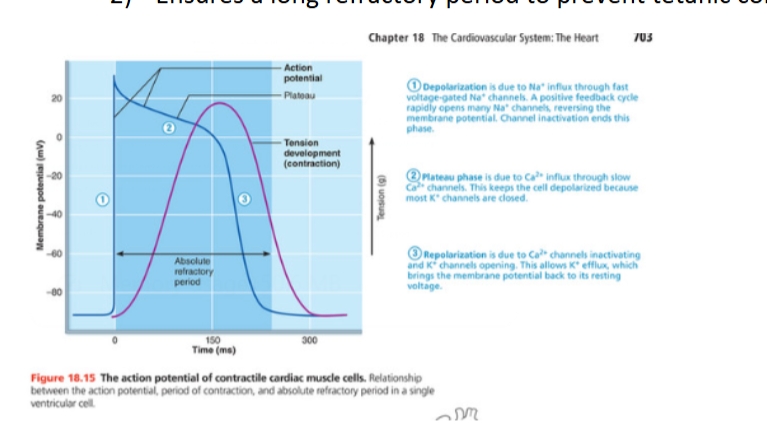
AP of contractile cells
threshold -(-70), RMP- (-90)
depolarization- fast V-gated Na+ channels open activating negative feed back cycle, inactivating Na+ channel while opening Ca+ and K+ channels (K+ leaks out, Ca+ leaks in)
plateau phase- (absolute refractory period)- Caused by Ca+ slowly enters through Ca+ channels which keeps the cell depolarized as most K+ channels become closed.
repolarization- inactivation of Ca+ channels, opening of voltage gated K+ channels
AP of Pacemaker cells
pacemaker potential slow depolarization caused by the opening of Na+ channels while closing K+ channels
depolarization- action potential beings when pacemaker potential hits -40MV, this opens V-gated calicum channels, depolarization is caused by the entrance of Ca+ and closed K+ channels.
repolarization (get more negative)- happens at 10mV opens K+ channels by calcium channels inactivating, K+ brings the membrane potential to negative through K+ entering and stops Ca+ channels
purposes of plateau
ensures sustained contraction for complete blood ejection
ensures a long refractory period to prevent tetanic contractions
sequence of depolarization
modulated by the ANS
sinoatrial node→ right atrial wall- hearts pacemaker is called sinus rhythm, 75x/min
Atrioventricular node→ junction of atria and ventricles; short delay because atria is completing contraction, wave moves to ventriculus without the sinoatrial node 50x/min
atrioventricular bundle→ bundle of HIS splits into R and L bundle branches and around into the subendocardial network

