Diffusion & Facilitated Diffusion
 Studied by 2 people
 Call Kai
 Learn
Learn Practice Test
 Spaced Repetition
 Match
Match Flashcards
 Knowt Play
1/13

There's no tags or description
Looks like no tags are added yet.
Name | Mastery | Learn | Test | Matching | Spaced |
|---|
No study sessions yet.
14 Terms
What is diffusion?
Diffusion is the movement of molecules or ions from an area of high concentration to an area of low concentration until equilibrium is reached.
Molecules move down a concentration gradient.
Explain what is meant by the statement: “Diffusion is a passive process.”
Diffusion does not require energy (ATP) from aerobic respiration.
What is a concentration gradient?
A concentration gradient is the difference in concentration between two areas, e.g. outside and inside a cell.
What happens when equilibrium is reached?
At equilibrium, molecules and particles continue to cross the membrane in both directions, but there is no net movement in a particular direction.
List some factors that affect the rate of diffusion.
Concentration gradient
Distance of travel- The shorter the distance of travel the greater the rate of diffusion.
Surface area of membrane- The larger the surface area the greater the rate of diffusion (more space for molecules to diffuse across the membrane.)
Thickness of membrane- The thinner the membrane, the greater the rate of diffusion (short diffusion path).
Temperature
Size of particle- Small particles diffuse faster than larger molecules.
How does the concentration gradient affect the rate of diffusion?
The greater the concentration gradient (the difference in concentration of ions of molecules in two areas), the greater the rate of diffusion. The steeper the triangle, the faster diffusion will occur.
How does the temperature affect the rate of diffusion?
An increase in temperature increases molecular kinetic energy which means the molecules move faster. As a result, the rate of diffusion increases.
What molecules are able to pass through the membrane by simple diffusion?
Lipid soluble / non-polar molecules such as some hormones, oxygen and carbon dioxide.
How are polar molecules able to pass through the membrane?
Polar molecules cannot cross the phospholipid bilayer and therefore must use an intrinsic (membrane spanning) protein to facilitate transport across the membrane, this is called facilitated diffusion.
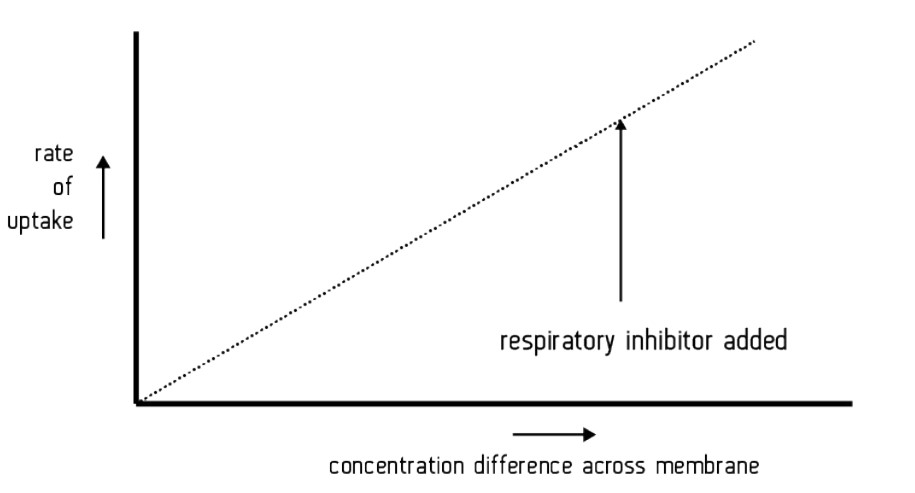
Explain the graph depicting the simple diffusion of non-polar molecules across the membrane.
As the concentration gradient increases, the rate of diffusion will also increase; the rate of uptake is directly proportional to the concentration difference across the membrane.
Stopping respiration using a respiratory inhibitor (which stops ATP production), will not stop diffusion as it needs no ATP from the cell.
What is facilitated diffusion?
Facilitated diffusion requires channel proteins or carrier proteins in the cell membrane to transport polar molecules, charged and water soluble molecules across the membrane.
How do channel proteins facilitate diffusion of polar molecules across the membrane?
Channel proteins consist of pores lined with polar groups (hydrophilic). This allows charged ions to pass through (such as Na+ ).
Each channel protein is specific for one type of ion. They can also open and close depending on the needs of the cell (these are called gated channels).
How do carrier proteins facilitate diffusion of polar molecules across the membrane?
Carrier proteins allow the facilitated diffusion across the membrane of larger polar molecules such as sugars and amino acids.
A particular molecule attaches to a carrier protein at its binding site and causes the carrier protein to change shape or rotate within the membrane; this action releases the molecule on the other side of the membrane.
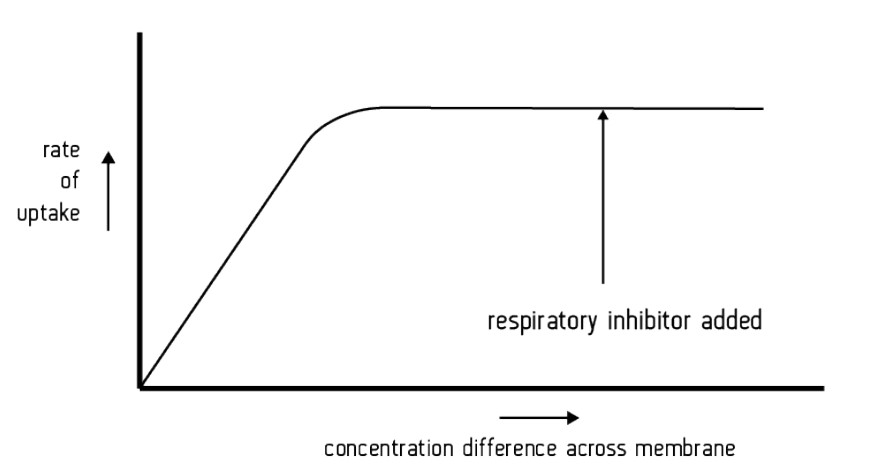
Explain the graph depicting the facilitated diffusion of polar molecules across the membrane.
There is an initial increased rate of diffusion as the concentration gradient becomes steeper. This is due to the channel and carrier proteins facilitating (helping) the process.
Rate of diffusion levels off at higher concentration differences. This is due to the channel or carrier proteins being occupied – this limits the rate of diffusion.
Facilitated diffusion is not affected by respiratory inhibitors (which stop ATP production) as ATP is not required.
 Note
Note  Flashcards (30)