unit 4: social psychology and personality
 Studied by 8 people
 Call with Kai
 Learn
Learn Practice Test
 Spaced Repetition
 Match
Match Flashcards
 Knowt Play
1/116

There's no tags or description
Looks like no tags are added yet.
Name | Mastery | Learn | Test | Matching | Spaced | Call with Kai |
|---|
No study sessions yet.
117 Terms
compare and contrast personality psychologists and social psychologists
personality psychology focuses on individual differences in traits and behaviors, while social psychology examines how situational and social influences affect everyone's behavior
attributions
how we explain the causes of events; (if you do well in class, to what will you attribute your success?)
explanatory style
predictable pattern of attributions, interpreting good and/or bad events in a pessimistic or optimistic way
pessimistic explanatory style
type of explanatory style; “it’s all my fault!”
optimistic explanatory style
type of explanatory style; “i did the best i could, and i’ll do better next time”
attribution theory
we explain someone’s behavior by crediting either the situation (situational attribution) or the person’s stable, enduring traits (dispositional attribution)
fundamental attribution error
the tendency for observers, when analyzing others’ behavior, to underestimate the impact of the situation and overestimate the impact of personal disposition
what is a factor that influence our attributions?
culture
actor-observer bias
when we explain our own behavior, we are sensitive to how behavior changes with the situation
prejudice
“prejudgment,” is an unjustifiable and usually negative attitude toward a group and its members — who often are people of a particular racial or ethnic group, gender, or sexual orientation;
what is in prejudice and makes us it?
negative emotions, such as hostility or fear
stereotypes, which are generalized beliefs about a group of people. Our stereotypes sometimes reflect reality. Stereotypes can reduce the effort, or cognitive load, it takes to make decisions or judgments
a predisposition to discriminate — to act in negative and unjustifiable ways toward members of the group
implicit prejudice
an unthinking knee-jerk response operating below the radar, leaving us unaware of how our attitudes are influencing our behavior
explicit prejudice
involves conscious, deliberate beliefs and attitudes, often expressed openly through words and actions
just-world phenomenon
reflects an idea we commonly teach our children — that good is rewarded and evil is punished; the world is fair and that people therefore get what they deserve and deserve what they get
ingroup bias
the tendency to favor one's own group and its members over other groups; (ex) boys vs girls, religion vs religion, race vs race
ethnocentrism
the tendency to view our own ethnic or racial group as superior
out-group homogeneity
uniformity of attitudes, personality, and appearance
other-race effect
“cross-race effect" or own-race bias”; our greater recognition for individual own-race faces; emerges during infancy, between 3 and 9 months of age
social comparison
the tendency for individuals to evaluate their own abilities and opinions by comparing themselves to others
foot in the door phenomenon
people who agree to a small request find it easier to comply with a larger one; (ex) the captors began with harmless request, such as copying a trivial statement, but gradually escalated their demands
door in the face effect
to get people to agree with something big, start small and build; (ex) approach someone with an unreasonable request— “could you volunteer for 2 weeks" after you get turned down, a follow up request becomes more acceptable: “could you volunteer for 30 minutes?”
what can affect attitude?
role play
who conducted the stanford prison experiment and its purpose?
philip zimbardo; to test attitude and roleplay
the researchers who conducted the stanford prison experiment believed that the participants designated as guards acted harshly toward those designated as prisoners the..
guards responded to situational factors
in the stanford prison simulation, participants were randomly assigned to one of two groups, guards or prisoners. after a few days, the prisoners staged a failed revolt and were consequently punished and humiliated by the guards, how did the researchers explain the abusive behavior of the guard?
the guards were influenced by situation and attitude
cognitive dissonance theory
we may adjust our actions to match our attitudes; (ex) a smoker knowing cigarettes are harmful but continuing to smoke, a person who believes in being healthy but eats junk food, or a student who values honesty but still lie to avoid consequences
persuasion
others are trying to convince us something or we’re trying to convince ourselves
elaboration likelihood model
when we actively process a message, we more often retain it—advertisements; ads can be peripheral or central persuasion
peripheral route persuasion
uses attention-getting cues to trigger speedy, emotion-based judgements; (ex) using a celebrity endorsement for a product, where the persuasive power comes from the celebrity's attractiveness or fame rather than the product's features like using a famous athlete to promote protein shakes
halo effect
we may believe beautiful or famous people (celebs) are especially smart or trustworthy
central route persuasion
offers logical evidence and arguments that aim to trigger careful thinking
social norm
a society's understood rules for accepted and expected behaviors
social contagion
the spontaneous spread of behaviors; (ex) trends, popular and famous things, or seeing others do it
chameleon effect
the unconscious tendency for people to mimic the postures, mannerisms, and expressions of those around them; (ex) if you see someone shaking their foot, you may shake your foot too
conformity
adjusting our behavior or thinking to coincide with a group standard
asch conformity experiment; social conformity
showed how people's behavior is influenced by group pressure, even when the group is obviously wrong; however, if the person knew the answer was wrong but nervous to comply to the right answer but given the opportunity to write on their paper down and didn’t have to say what they wrote there would be less pressure therefore they would say the correct answer
normative social influence
we conform to avoid rejection or to gain social approval; (ex) drinking at a party to fit in or dressing a certain way to adhere to office culture— conforming to social norms
informational social influence
we conform because we want to be accurate; (ex) following the crowd in an unfamiliar train station or looking to others to see how to react to a potential emergency
obedience
complying with an order or command
social facilitation
strengthened performance in others’ presence because the presence of others can arouse people; if one does well, you will do well but if they don’t do well you won’t do well
social loafing
the tendency for individuals to exert less effort when working in a group than when working alone— diminish feeling of responsibility due to not being individually accountable
deindividuation
process of losing self-awareness and self-restraint, often occurs when group participation makes people both aroused and anonymous
group polarization
the beliefs and attitudes we bring to a group grow stronger as we discuss them with like-minded others
groupthink
harmonious but unrealistic group thinking
collectivism
situations focus on “we,” on meeting group standards and accommodating others
individualism
they more often focus on “me” as an independent, separate self
multiculturalism
places value on cultural and ethnic groups’ maintenance of their unique identities, beliefs, and practices
prosocial behavior
behavior that intends to help or benefit someone
mere exposure effect
repeated exposure to novel visual stimuli increases our liking for them
what 3 things attracts us to people?
similarity
proximity
attractiveness (physical appearance)
diffusion of responsibility
when more people share the responsibility for helping
bystander effect
the tendency for any given bystander to be less likely to give aid if other bystanders are present
social reciprocity norm
the expectation that we should return help, not harm, to those who have helped us
social responsibility norm
the expectation that we should help those who need our help
self-fulfilling prophecies
beliefs that confirm themselves by influencing the other country to react in ways that seem to justify those beliefs
superordinate goals
shared goals that override differences among people and require their cooperation; (ex) a student believing they will fail a test, so they don't study, which then leads to them performing poorly and confirming their initial belief
industrial-organizational (I/O) psychologists
a branch of psychology that applies psychological principles to the workplace to improve productivity and employee well-being
burnout
a state of emotional, mental, and physical exhaustion caused by prolonged and excessive stress
personality
an individual’s characteristic pattern of thinking, feeling, and acting
psychodynamic theory
theories that view personality with a focus on the unconscious mind and the importance of childhood experiences (or conscious mind)
unconscious mind
a reservoir of mostly unacceptable thoughts, wishes, feelings, and memories
preconscious mind
a reservoir that stores some unacceptable thoughts and can be retrieved into conscious awareness
freud’s 3 personality
id; gratification principle - unconscious need for pleasure, displays itself as selfish and need for gratification (pleasure)
ego; reality principle - reduces superego and id conflict, brings you back to reality
superego; morality principle, internal conscience that forces the ego to consider the ideal, not just real
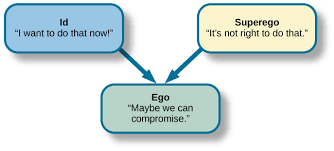
ego
the partly conscious, 'executive' part of personality— the decision you ultimately make after listening to the id and superego; operates on the reality principle
defense mechanism
tactics that reduce or redirect anxiety by distorting reality
repression
the basic defense mechanism that banishes from consciousness anxiety-arousing thoughts, feelings, and memories; (ex) s person may have no conscious memory of a traumatic childhood event, like abuse, yet later have symptoms like depression without understanding why
regression
retreating to an earlier psychosexual stage, where some psychic energy remains fixated; (ex) an adult in a heated argument with their partner stops communicating and slams the door, instead of working to resolve the conflict
displacement
shifting sexual or aggressive impulses toward a more acceptable or less threatening object or person; (ex) a person is angry with their boss for giving them a bad review. they come home and yell at their spouse or children, even though they have not done anything to deserve it
denial
refusing to believe or even perceive painful realities
sublimation
transferring of unacceptable impulses into socially valued motives; (ex) channeling aggressive impulses into a competitive sport like football or boxing
rationalization
offering self-justifying explanations in place of the real, more threatening unconscious reasons for one's actions; (ex) a student who receives a bad grade on an exam and claims the professor graded unfairly or the test was too difficult, rather than admitting they didn't study enough
reaction formation
switching unacceptable impulses into their opposites; (ex) a person who is secretly attracted to someone but acts hostile or cruel toward them to hide their true feelings or a person who secretly struggles with alcoholism and publicly becomes an extreme advocate for abstinence
projection
disguising one's own threatening impulses by attributing them to others; (ex) person who is jealous of a friend may accuse the friend of being jealous of them instead
unconditional regard
a caring, accepting, non-judgemental attitude that helps people develop self-awareness and self-acceptance; an attitude of grace that values us even knowing our failings
projective test
a personality test that provides ambiguous images designed to trigger projection of one's inner dynamics and explore the preconscious and unconscious mind
humanistic psychology
theories that view personality with a focus on the potential for healthy personal growth
self-actualization tendency
the belief that people are basically good and want to be better and improve; self-improvement
traits
people’s characteristic behaviors and conscious motives
factor analysis
a statistical procedure that identifies clusters (factors) of test items that tap basic components of a trait
personality inventories
longer questionnaires covering a wide range of feelings and behaviors; used to evaluate certain personality traits
what are the big 5 factors? (hint; OCEAN)
openness
conscientiousness
extraversion
agreeableness
neuroticism
openness
practical, prefers routine, conforming OR imaginative, prefers variety, independent,
conscientiousness
disorganized, careless, impulsive OR organized, careful, disciplined
extraversion
retiring, sober, reserve OR sociable, fun-loving, affectionate
agreeableness
ruthless, suspicious, uncooperative OR soft-hearted, trusting, helpful
neuroticism (emotional stability vs. unstability)
calm, secure, self-satisfied OR anxious, insecure, self-pitying
social cognitive perspective
emphasizes the interaction of our traits with our situations— influenced by the interaction between people's traits and their social context
reciprocal determinism
the interacting influences of behavior, internal cognition, and environment
self-esteem
our feelings of high or low self-worth
self-efficacy
our sense of competence and effectiveness
self-concept
all our thoughts and feelings about ourselves in answer to the question, “who am i"
drive-reduction theory
how we respond to innerr pushes and external pulls; the idea that a physiological need creates an aroused state that motivates an organism to satisfy the need
sensation seeking theory
theory that sensation seekers display traits such as experience seeking, thrill or adventure seeking, disinhibition, and boredom susceptibility
self-determination theory
the theory that we feel motivated to satisfy our needs for competence, autonomy, and relatedness
grehlin
hormone secreted by the empty stomach; sends "I'm hungry" signal to the brain
leptin
hormone secreted by fat cells; when abundant, causes the brain to increase metabolism and decrease hunger
facial feedback hypothesis
the tendency of facial muscle states to trigger corresponding feelings such as fear, anger, and happiness
yerkes-dodson law
the principle that performance increases with arousal only up to a point, beyond which performance decreases
arousal theory
focuses on finding the right level of stimulation
 Note
Note  Flashcards (72)