Types of Chemical Reactions
 View linked note
 Call Kai
 Learn
Learn Practice Test
 Spaced Repetition
 Match
Match Flashcards
 Knowt Play
1/4

Earn XP
Description and Tags
3/4/25 assignment for chemistry by Izzy Campbell
Name | Mastery | Learn | Test | Matching | Spaced | Call with Kai |
|---|
No analytics yet
Send a link to your students to track their progress
5 Terms
Combination Reaction (Synthesis)
A reaction where two or more reactants come together to form one product.
Combination reactions are unique because they have two or more reactants and one product.
A + B 🡪 AB
Example: 2Mg (s) + O2 (g) 🡪 2MgO (s)
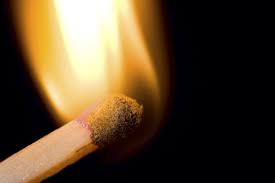
A reaction where a single compound breaks down into two or more simpler products
Decomposition reactions are unique because the have one reactant and two products.
Require some form of energy to break the initial compound
XY X+ Y
Example: 2HgO (s) 2Hg (l) + O2 (g)
A reaction where one element replaces a second element in a compound
Single replacement reactions have products and reactants consisting of one element and one compound and the switch of one element for another in a compound
C + DE 🡪 CE + D
Example: Zn (s) + Cu(NO3)2 (aq) 🡪Cu (s) + Zn(NO3)2 (aq)
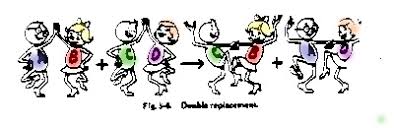
Double Replacement Reaction
A chemical reaction with a chemical change involving an exchange of positive ions between two compounds
Generally take place in aqueous solutions
This can only occur if one of the product is only slightly soluble and forms a ppt, one product is a gas, or one product is a molecular compound.
Double-replacement reactions have the above products and switching of two cations.
AB + XY 🡪 XB + AY
Example: Na2S(aq) + Cd(NO3)2 (aq) 🡪 CdS (s) + 2NaNO3
A chemical reaction of a carbon-based compound with oxygen that produces carbon dioxide and water vapor
Used to produce energy, like in power plants
Combustion reactions have production of CO2 (g) and H2O (g) and a reaction with O2 (g).
C2H2 (g)+ O2 (g) 🡪 CO2 (g) + H2O (g)