POLS 3302 Judicial Process and Behavior Final
 Call Kai
 Learn
Learn Practice Test
 Spaced Repetition
 Match
Match Flashcards
 Knowt Play
1/90

There's no tags or description
Looks like no tags are added yet.
Name | Mastery | Learn | Test | Matching | Spaced | Call with Kai |
|---|
No analytics yet
Send a link to your students to track their progress
91 Terms
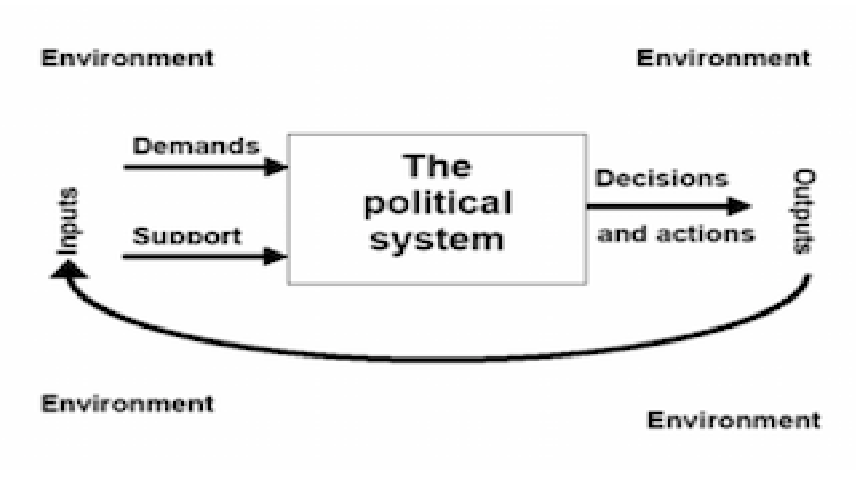
The Systems Model
define compliance
the degree to which individuals, groups, or institutions conform behavior to the dictates of a court ruling
the extent to which individuals or entities adhere to laws, regulations, or court decisions
inter partes
between parties
binding only on the parties to the case
erga omnes
towards all
binding on everyone
Mandatory vs. Anticipatory compliance
Mandatory: compliance that is enforced by law or court order
Anticipatory: proactive adherence to expected rulings or legal standards before they are formally mandated
T/F: Legal decisions are technically binding ONLY on the parties to the lawsuit
T
Non-compliance is the _____
Exception
What accounts for Compliance?
Belief in Rule of Law
Concern for Legal Liability
Respect of Court’s Legitimacy
Belief in Rule of Law
in the long run, people have more to gain than lose by following court decisions
even decisions that happen to be against them today
Concern for legal Liability
fear that you will be sued and have to engage in a costly legal defense
Respect for the Court’s Legitimacy
courts in the US enjoy high levels of “diffuse” or general support
high respect for court’s authority to rule
T/F: Degree of Compliance (Low or High) does not correspond to Level of Diffuse Support (Low or High)
F
T/F: Erosion of confidence will lead to increased defiance to US Supreme Court’s decisions
T
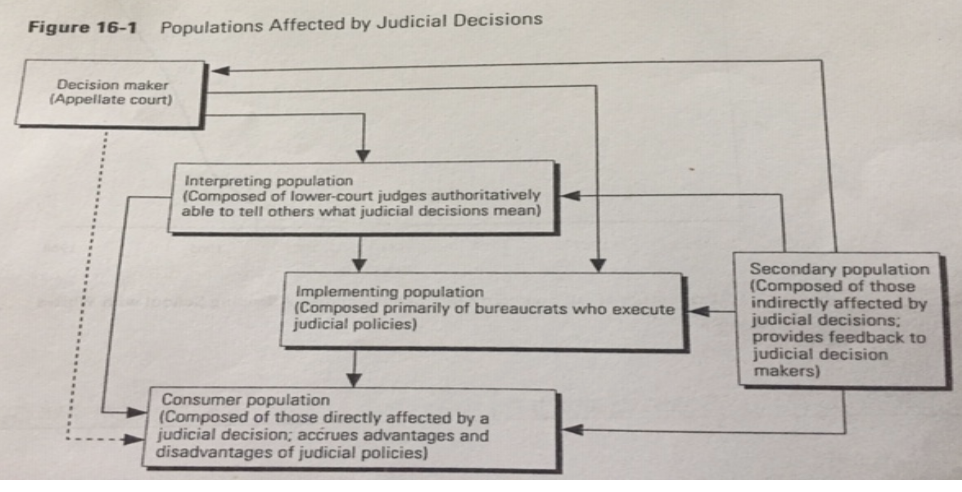
Canon-Johnson Model of Judicial Impact
framework that explores how court rulings influence legislative and executive actions, as well as public perceptions of law and justice
Canon-Johnson Model helps understand _____ court decisions affect different “populations”
how
Interpreting population
composed of lower-court judges authoritatively able to tell others what judicial decisions mean
Implementing population
composed primarily of bureaucrats who execute judicial policies
Consumer population
composed of those directly affected by a judicial decision
accrues advantages and disadvantages of judicial policies
Secondary population
composed of those indirectly affected by judicial decisions
provides feedback to judicial decision makers
Decision maker
appellate court
Canon-Johnson flow chart
Did Roe v. Wade (1973) ease access to abortions?
SCOTUS decision may have slowed rate of change occurring in American society toward widespread access to safe and legal abortions
unintended effect of actually increasing number of restrictions on abortion access
What are the two competing views of the role of courts in social change?
Dynamic and Constrained
Dynamic view
US Supreme Court is indeed capable of affecting widespread change (standard view)
Constrained view
US Supreme Court is unable to accomplish significant change alone due to existing constraints imposed upon the Court by the Constitution and other key actors (Rosenberg’s view)
Courts are political actors whose decision matter more (greater compliance and greater impact) when their support and legitimacy is ______.
highest
Effect of dual system of federal and state courts on law and policy
double source of rights protection
litigants may use to expand on scope and level of protection for federal rights (e.g. right against unreasonable search & seizure)
progressive realization of many rights not protected by US Constitution and Bill of Rights (e.g. right to education)
Define New Judicial Federalism
state high courts look to their state’s constitution…
to protect new rights and liberties that federal courts have not recognized
to supplement the scope and level of rights recognized by federal courts
Causes of New Judicial Federalism
State Court Reforms
Federal retrenchment on Rights
Federal avoidance of some issues
Arrival of new cadre of state court judges (trained during Warren Court years)
Justice Brennan called the new judicial federalism…
the most important development in our constitutional jurisprudence
Doctrine foundations of the New Judicial Federalism
Doctrine of “independent and adequate state grounds”
Federal Floor, State Ceilings
Independent and adequate state grounds
SCOTUS would leave state court decisions alone so long as state high courts rest their decisions on “independent” and “adequate” state law grounds
Federal floor, state ceilings
federal minimums set by SCOTUS are the floor below which the states may not fall when interpreting analogous rights based on their state constitutions
ceilings are how far or expensive the analogous state-based rights may be, determined by state high courts
Analogous rights
legal rights extended by analogy to over situations similar to, but not explicitly listed in, existing laws
Conceptual models of state high court decision making
Lockstep
Supplementary
Primacy
Lockstep model
state courts turn first to federal law, then follow it without regard to the analogous right in the state constitution
Supplementary model
state courts turn first to federal law, and then look to the state constitution or bill of rights to see if there is an independent and adequate state grounds to provide supplementary protection for the right
Primacy model
state courts turn first to their own state constitutions and try to find the basis for rights protection over the federal minimum
Which models were adopted as a result of the New Judicial Federalism movement?
Primacy and Supplemental
examples of New Judicial Federalism
right to education
right to same-sex marriage
Abbott v. Burke (1985 NJ)
Claremont School District v. Gov. of NH (1997 NH)
Second-generation rights recognized by state courts
right to shelter/housing
right to counsel in civil cases (Civil Gideon)
Alexis de Tocqueville’s observations on Democracy in America
Courts are “political institutions” that function in a larger political environment
Judges are “political actors” motivated by extra-legal policy preferences
Both popular and elite groups attempt to advance their interests in courts
Empirical vs. Normative Question
What is the role of courts in America’s constitutional democracy? vs. What should the role of courts be?
Which institution is at the “eye of the storm”?
Supreme Court
What constitutional boundaries are maintained by courts?
core principle of ‘separation of powers’ by ruling unconstitutional the actions of one branch that encroach upon the powers/functions of other branches
core principle of ‘federalism’ by ruling unconstitutional the actions of national level government that violate state prerogatives and the actions of states that encroach upon national priorities
How do courts protect individual rights and liberty?
strike the balance between ‘liberty and order’ and give meaning to the fundamental rights in the US Bill of Rights
protect members of ‘insular and discreet’ minorities against majoritarian overreach
How do courts control the administrative state?
review for legality the actions and decisions of the agencies that comprise the vast administrative state
protect citizens’ ‘new property rights’ to the benefits they are entitled to as a result of the nation’s social welfare policies
Concrete meaning to the idea of rule of law
courts interpret laws and regulations for legality (whether they are lawful)
courts assure that rulers and ruled, powerful and weak, are treated the same
When do courts overcome the counter-majoritarian difficulty?
when they fulfill the maintaining/protection functions in a constitutional democracy
Counter-majoritarian difficulty
tension in democratic systems where unelected judges possess the power to invalidate laws enacted by elected representatives
Tipping function of courts
the idea that courts, at critical times in American history, cast their support in favor of the new political regime and help institute changes in American political, social, and economic life
What theory is the ‘tipping function’ based on?
Dahl’s regime-maintenance theory
Regime-maintenance theory
SCOTUS cannot hold out for very long against the dominant governing coalitions of the day
may exercise the power of judicial review and nullify an act or policy instituted by the dominant governing coalition, but eventually decides to uphold the new regime’s policy ideas
T/F: The Court’s weakness has always been its sensitivity to the changing political scene and its reluctance to stray too far from the main currents of public opinion.
F
Historical Supreme Court ‘Tips’
Reconstruction & Industrialization
New Deal and Great Society
Present Judicial Minimalism
Pendulum Theory
various eras of the modern, post-WWII Supreme Court move gradually from left (Liberal) to center (moderate) to right (Conservative) gradually over time
Warren Court (1953-1969)
Liberal
Burger Court (1969-1986)
Moderate
Rehnquist Court (1986-2005)
Conservative
Roberts Court (2005-present)
Ultra Conservative
Obergefell v. Hodges (2015)
landmark civil rights case
SCOTUS ruled (504) that right of same-sex couples to marry is guaranteed by US Constitution
substantive due process in the personal sphere —- private autonomous choice
Dobbs v. Jackson Women’s Health Organization (2022)
SCOTUS overturns constitutional basis for a woman’s right to abortion
substantive due process
Substantive due process
protects certain fundamental rights from government interference
ensures that laws and governmental actions do not infringe on individual liberties without sufficient justification
Weak abusive judicial review
occurs when courts uphold legislation or executive action that significantly undermines the democratic minimum core
Strong abusive judicial review
occurs when courts themselves act to remove or undermine democratic protections
Paradox of Judicial Power
democratic and undemocratic at the same time
Dynamic view of the role of courts is often linked with ____ judicial activism
liberal
Common law
US, UK, Australia, and others
Civil law
Germany, France, Denmark, and others
Mixed legal system
Scotland, South Africa, Israel
What aspects of the US legal system technically make it a "mixed system”?
Maritime law and Louisiana are under civil law
Objectives of examining courts from a comparative perspective
Better understanding of the phenomenon
Advancing the field of comparative politics
Quest for Universal Theories
Pioneers of Comparative Judicial Studies
Alexis de Tocqueville
Sybille Bedford
Martin Shapiro
Strong Form Judicial Review
US: courts have power to declare acts null and void
Weak Form Judicial Review
UK: courts can merely issue “declarations of incompatibility” and ask Parliament to change the law
Concrete Judicial Review
US: judicial power can only be exercised in real, live cases and controversies
Abstract Judicial Review
Germany: the Constitutional Court may review the constitutionality of acts before they go into effect
Diffuse Judicial Review
US: decentralized, all courts of record may exercise judicial review
Concentrated Judicial Review
South Africa: only the Constitutional Court may exercise judicial review
How did the idea of Judicial Review spread globally?
First wave (pre 1945)
Second wave (post 1945/WWII)
Third wave (1960s/70s)
Fourth wave (post 1989)
Political insurance theory
in times of political uncertainty, when no party can expect to hold onto power, all parties will prefer to limit the majority and therefore value minoritarian institutions such as judicial review
judicial review is everyone’s ‘hedge’ against the prospect of future electoral loss
Hegemonic preservation theory
political elites, fearing the loss of power, will seek to preserve their hegemony by placing like-minded judges on the bench and empowering them to rule in their interest when they are out of power
Judicial Empowerment
explains how courts struggle to establish their legitimacy in newly established democracies
T/F: The use of judicial elections in almost every American state is a unique feature of American courts.
T
Unlike the US system, most judicial systems around the world use ____ _____ _____ to generate a list of nominees from which a President, Prime Minister, or some other politically accountable official chooses.
Judicial Appointments Commissions
In the US, judges are ____ who are recruited after distinguishing themselves in the practice of law.
generalists
The advantage of career judiciary systems is that the judges are the ______ of their generation.
the best and brightest
Problem with Career Judiciaries
judges are always auditioning for their next job or for a promotion to a higher court
these judges may be reluctant to disappoint those who will decide their future with an adverse ruling
Judicialization of Politics
the observed trend of the growth and expansion of judicial power in most democratic countries
when controversial political issues are brought into the courts, all eyes focus on them
more and more disputes in society which would normally have been redressed in Parliaments with ordinary legislation are now being brought to courts
Causes of the judicialization of politics
Explicit provisions for judicial review in the constitutions written after 1945
the provisions are treated as “green lights” and encouraged courts to perform more prominent roles
Prevalence of “rights discourse” in the post-WWII era
the drafting of new international treaties dealing with fundamental human rights elevated the concern for rights protection in nation states
Appointment of less deferential judges who were willing to perform these new more prominent and assertive roles
Desire to depoliticize some sensitive issues that legislators/elected officials are reluctant to take positions on
Instrumental or strategic use of courts by interest groups
Transnational borrowing and influence of international and supranational courts on national courts
T/F: Judicialization of politics is the result of judges playing more prominent roles in national politics
T

