Behaviourist approach : Approaches
 Call Kai
 Learn
Learn Practice Test
 Spaced Repetition
 Match
Match Flashcards
 Knowt Play
1/29

There's no tags or description
Looks like no tags are added yet.
Name | Mastery | Learn | Test | Matching | Spaced | Call with Kai |
|---|
No analytics yet
Send a link to your students to track their progress
30 Terms
When did the behaviourist movement begin and who by?
John Watson (1913)
What was Watsons main study
Little albert
What is the behaviourist approach?
A theory of learning which states all behaviours are learned through interaction with environment through conditioning.
What are the 4 basic assumptions of the behaviourist approach?
All behaviour is learned from the environment through experience
Behaviourism is primarily concerned with observable behaviour, as opposed to internal events; thinking and emotion.
It is valid to study on animals and generalize it to humans
humans are born ‘tabula rasa’ - blank slate
What are the 2 types of behaviourism?
1. Methodological Behaviourism
2. Radical Behaviourism
Who is Pavlov?
A behaviourist who studies classical conditioning
What is classical conditioning?
When we learn through association, eg phobia of dogs due to being bitten by a dog
What was pavlovs procedure
Paired food(UCS) with a sound of a bell (NS) to condition the dogs to salvate(UCR). Did this multiple times
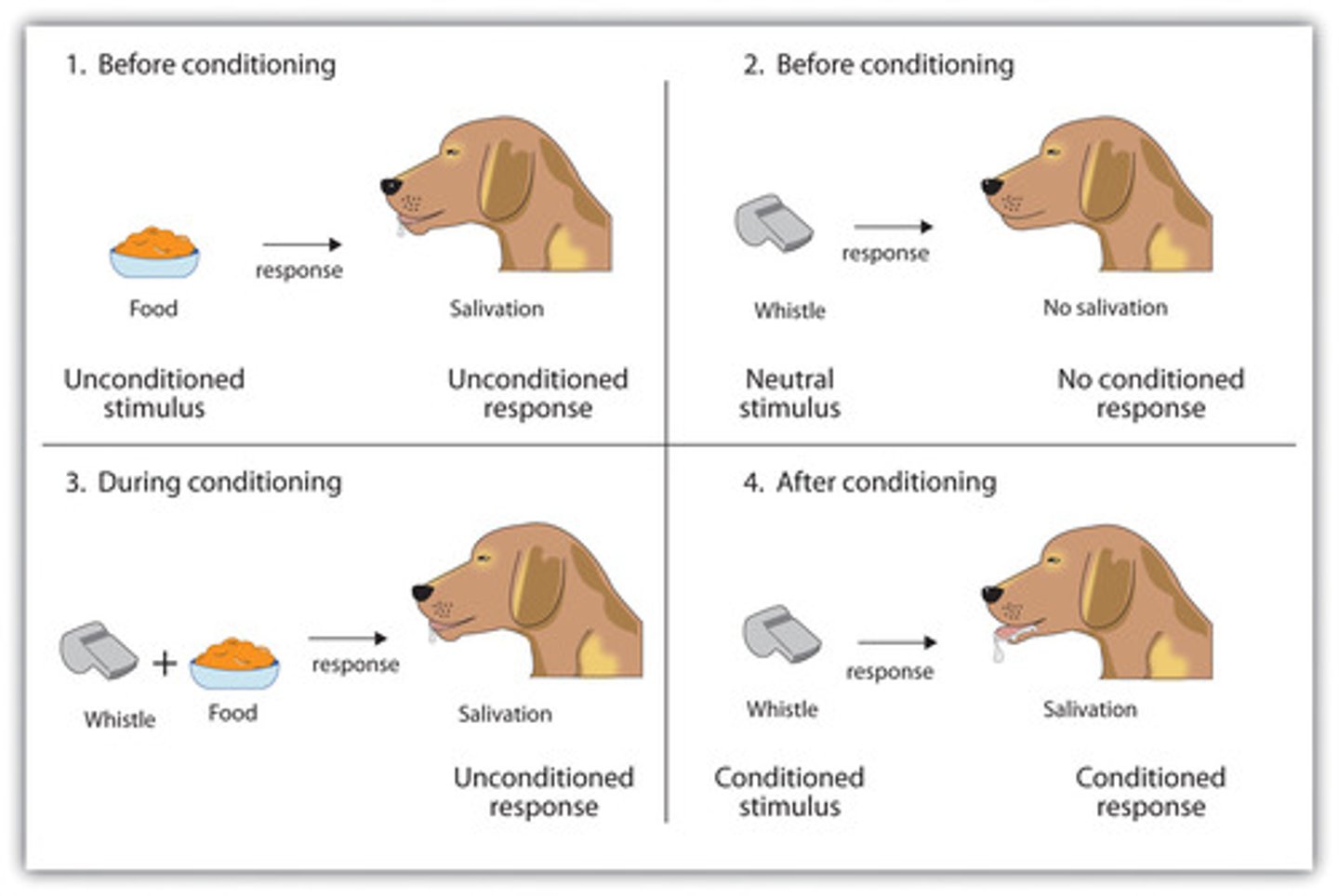
What did pavlov find
that the dogs would salvate at the sound of a bell , due to the association with food,
Who is Skinner?
He discovered operant conditioning
What is operant conditioning?
Learning through consequence, can be positive or negative
What is positive reinforcement
Recieving a reward for behaviour, eg sweet if you do well in a test
What is negative reinforcement
When something unpleasant is removed when a behaviour occurs , meaning we avoid something unpleasant, eg fear of water = avoiding water so not anxious
What was skinners research , AIM
He used rats to see the effect of positive and negative reinforcement
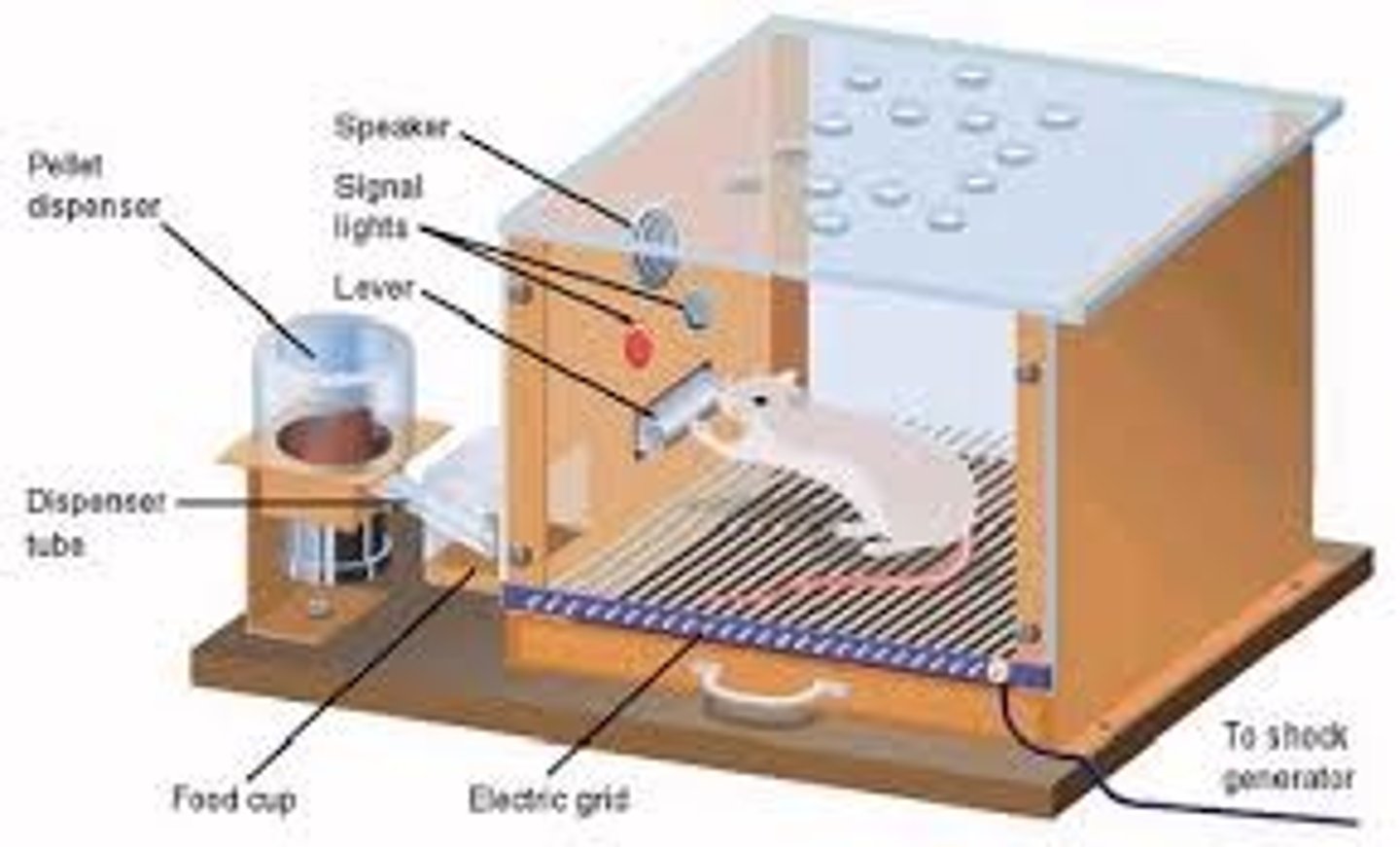
What was the positve condition in skinners research
skinners box, where there was a lever that would release food when the rat would accidentally push it
What was the negative condition in skinners research
Skinners box, where there was a constant electrical shock on the floor, that would turn off when the rat accidentally pushed the lever.
What did skinner find happened in the positive condition
that the rats in the positive condition would consistantly press the lever, and would stop when food would stop being released
What did skinner find happened in the negative condition
Rats would quickly run to lever to turn off the shock as they learnt that the unpleasant feeling would be avoided when pressing lever
What are the 3 types of responses in operant conditioning?
1. Neutral operants
2. Reinforcers
3. Punishers
What are neutral operants?
responses from the environment that neither increase nor decrease the probability of a behavior being repeated.
What are reinforcers?
Responses from the environment that increase the probability of a behavior being repeated. Reinforcers can be either positive or negative.
What are punishers?
Responses from the environment that decrease the likelihood of a behavior being repeated. Punishment weakens behavior.
What is positive punishment?
adding a reward to stop a behaviour from happening.
What is negative punishment?
removing a reward to stop a behavior from happening.
What is a strength of the behaviourist approach
Research is scientific and is in lab settings, meaning it has high internal validity and reliability. We can also establish cause and effect
What is a weakness of the behaviourist approach
Hard to generalise, samples are small and the control groups are animals making it difficult to generalize to humans and our behaviours.
What is a study done linked to humans
Little albert, white rats, conditioned to be scared of them as they were repeatedly paired with a loud bang.
What is an issue with the behaviourist approach
Hard enviromental determinism approach, suggests humans have no free will of their behaviour and that all behaviour is determined from our upbringing.
What does the behavioural approach ignore
The role of biology and genes
where has the behavioural approach been usefully applied
Treatments like systematic desensitization for phobias and token economies to minimize criminality and avolition in schizophrenia

