Microbio 4000 Exam 1 Key Concepts
 Studied by 0 people
 Call with Kai
 Learn
Learn Practice Test
 Spaced Repetition
 Match
Match Flashcards
 Knowt Play
1/43

Earn XP
Description and Tags
Gotta Cram!
Name | Mastery | Learn | Test | Matching | Spaced | Call with Kai |
|---|
No analytics yet
Send a link to your students to track their progress
44 Terms
What does the field of Microbiology study?
The study of microscopic organisms like bacteria, (viruses), archaea, fungi and protozoa.
What are the prokaryotic groups of microbes?
Bacteria
Single celled, cell walls made of peptidoglycan, some can be pathogens and some can be extremophiles
Archaea
Single-celled, no known pathogens but some can be extremophiles
What are the eukaryotic groups of microbes?
Protozoa
“Animal-like, single celled eukaryotes, NO CELL WALL, some can be parasitic or pathogenic
Algae
Photosynthetic eukaryotes with cell walls, can be both single and multi cellular, can release toxins but are not a pathogen
Fungi
cell walls, yeasts are singled celled while olds and mushrooms are multi- some are pathogens
Helminths
Multicellular, macroscopic parasites, flat- or round- worms, microscopic during first stages
What were the important observations made by Hooke and Van Leeuwenhoek? (mid 1600s)
Hooke built the first compound microscope and coined the term cells
Van Leeuwenhoek observed smaller organisms and bacteria with a stronger single-lens microscope (father of microbio)
What is the germ theory of disease and what is the importance of Koch’s postulates? (Late 1700s -1850s)
The idea that specific diseases are caused by specific microscopic “germs”.
Koch’s postulates were a scientific method used to determine of a specific microorganism causes a specific disease in which he used pure cultures (single colonies of bacteria)
What is the significance of Jenner’s discovery? (1796)
He deliberately infected patients with a less lethal version of a disease to build immunity against the human smallpox.
What did Pasteur realize is important for successful vaccination? (1870s - 80s)Hu
He realized the the dosage of the exposure to the disease is important so that the patient can be protected from the disease without having severe symptoms
Why is human microbiota important?
It helps with digestion, helps develop immune system, makes growth factors, etc.
What are the three domains of life and who is responsible for this organization?
Bacteria, Archaea, Eukarya
Carl Woese (1977)
What are some key differences between prokaryotes and eukaryotes?
Prokaryotes
No nucleus or membrane bound organelles, have a nucleoid region to store their DNA
Eukaryotes
complex, often multicellular with a nucleus and specialized membrane-bound organelles
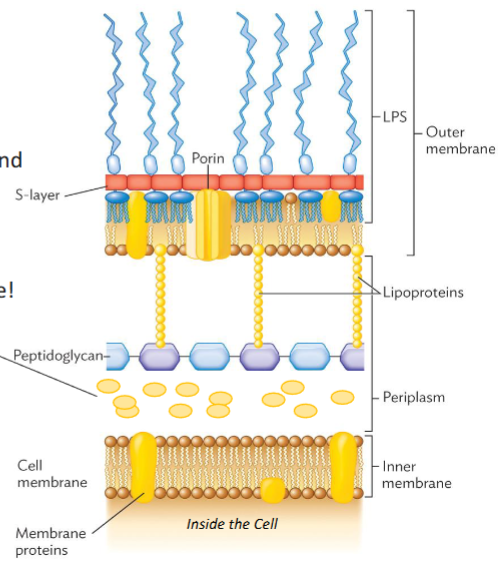
What does a Gram-negative bacteria contain?
Stain reddish pink
Thin Cell Wall
Few Peptidoglycan layers with lipoproteins attached
Periplasm
between membranes
Outer-membrane
lipopolysaccharides (LPS) - O polysaccharide (O Antigen) layer is useful for identification and pathogen interaction, Core Polysaccharide, Lipid A (endotoxin)
S-layer
Extra protein layer in some species
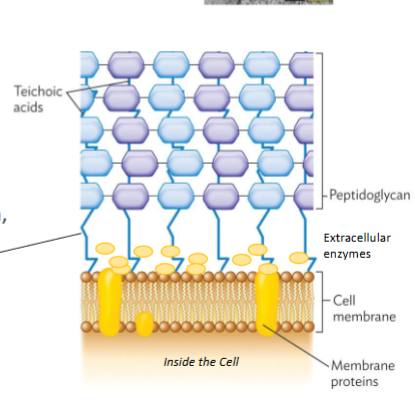
What does a Gram-positive bacteria cell contain?
Stain purple
Thick Cell Wall
Many peptidoglycan layers
Teichoic Acids
Carbohydrate chains (-)
Lipoteichoic Acids
also attach to cell membrane
Gram Staining
Step 4: Decolorization step
Alcohol dehydrates the thick peptidoglycan layer (Gram +) into a dense mesh like barrier; Crystal violet is retained
Gram Positive: remain purple
Gram Negative: CV stain is removed and then counterstain Pink (because of the 2 membranes present, the color doesn’t stick)
What are some bacteria classes that don’t Gram Stain well and why?
Mycobacteria
have a complex cell wall that makes them resistant to gram staining (phylogenetically related to gram positives)
Mycoplasma
LACK a cell wall so no peptidoglycan or outer membrane, cell membrane only
What is the composition of other microbial cell walls (not bacteria)?
Archaea
Pseudomurein (not peptidoglycan), S-layers, can’t gram stain
Algae
polysaccharides, and unique diatoms
Fungi
Polysaccharides (chitin) and glycoproteins
What are the different kinds of passive transport?
Moves nutrients with the concentration gradient (high → low)
Simple diffusion - direct transport through the phospholipid membrane (+ Osmosis)
Facilitated Diffusion - a protein channel or carrier is used
What are different kinds of active transport?
Moving against the concentration gradient (low → High)
Primary transport & ABC transporters
use ATP hydrolysis
ATP-Binding Cassette - use siderophores which are helper molecules for scavenging scarce mineral like iron from outside the cell
Coupled Transport
Symport - both moving in or both moving out (same)
Antiport - one moving in and moving out (opposite)
Group Translocation
Uses energy from high energy organic compound in the cell to power transport; PEP here (not ATP)
Transported molecule is modified (phosphorylated) Transporter transfers a phosphate to the molecule that is being imported.
What is bacterial secretion and what is it used for?
The secretion of proteins, DNA, and other large molecules is crucial. These systems allow bacteria to interact with their environment, compete with other bacteria, adhere to surfaces, and modulate host immune responses
Eukaryotes typically move extracellular proteins through exocytosis
Where are ribosomes found and how they differ in prok. and euk. cells?
Ribosomes are used to synthesize proteins
located in the cytoplasm and nucleoid edge
In Eukaryotes they are larger while in prokaryotes they are smaller and could be found in the mitochondria
What is the nucleoid?
Where bacterial DNA is organized
double-stranded helix, supercoiled, and organized by DNA binding proteins into chromosomes (circular) and plasmids (non-essential genes transferred in horizontal gene transfer)
What is the endosymbiotic theory?
Larger cell engulfed smaller bacterial cells and provided protection. the smaller cell provided a benefit too. Symbiotic relationship (organelles)
Evidence for Endosymbiosis
mitochondria and chloroplasts resemble bacteria in shape and size, have bacterial-like genomes have a double membrane
What is the difference between Eukaryotic and bacterial flagella?
Bacterial flagella
Made from flagellin protein, motility, spin like a propeller, powered by the proton motive force
Eukaryotic cells
Made up of microtubules underneath the cell membrane, whip-like motion, ATP hydrolysis
What structures do all bacterial cells need?
Plasma membrane, cytoplasm, ribosomes, membrane transporters, chromosomes
What is an axial filament and which microbe group has this?
Bundles of Endoflagella located under the outer membrane/ sheath, in the periplasm. Provides motility through connective tissue
Spirochetes (group of bacteria)
What types of environmental energy sources do microbes use?
Light (photo-), Organic sources (organo-), and Inorganic sources (litho-)
What is the difference between catabolism and anabolism?
Catabolism - breaks things down and releases energy in the end
Anabolism - build things up and energy is consumed overall.
These chemical reactions provide energy and create substances that sustain life.
What are 3 ways in which cells transfer energy to ATP?
Substrate-level - an intermediate in catabolism directly provides energy (and H3PO4) to ADP
Oxidative - Energy from the oxidation (breakdown) of nutrients is used to create a Proton Motive Force (PMF) which drives the ATP synthase (respiration)
Photophosphorylation - light energy used to create a PMF which drives ATP synthase (photosynthesis)
What are electron carriers and how are they used in metabolism?
They help the cell harvest or transfer energy in a controlled and stepwise manner.
They transfer electron energy from catabolism to other pathways.
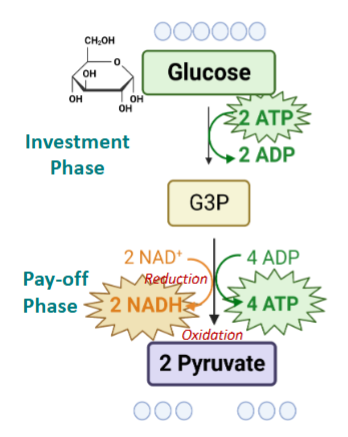
What are the inputs and outputs of the glycolysis pathway?
Input: 1 glucose and 2 ATP
Output: 4 ATP (Net 2 ATP by SLP), 2 NADH, 2 Pyruvate, and intermediates
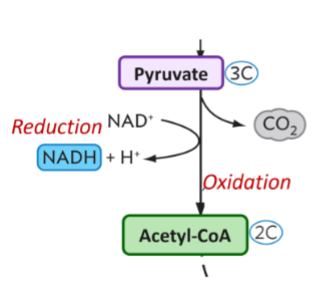
What is the input and output of the Preparatory step?
Input: per 1 glucose… 2 Pyruvate
Output: 2 NADH, 2 CO2, 2 Acetyl-CoA,, and intermediates
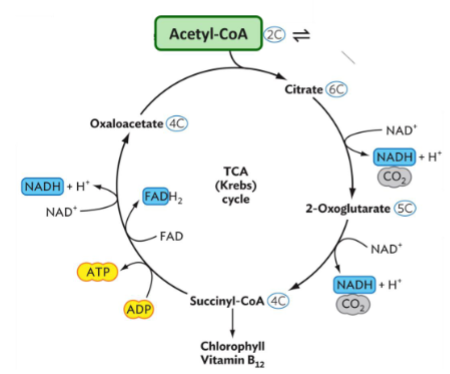
What are in the inputs and outputs of the TCA (Krebs) Cycle?
Oxidation of Acetyl-CoA → CO2
Input: 2 Acetyl CoA (2 turns)
Output: 4 CO2, 6 NADH, 2 FADH2, 2 ATP (SLP)
In respiration (starting with glucose and ending with ATP); How is the energy transferred? How do electrons flow or where are they transferred?
The electron transport chain (system) is a series of redox reactions that occur within the oxidoreductase enzyme. They pass electrons from the stronger e- donor to the stronger e- acceptor.
What is the Proton Motive Force?
The energy from the ETC allows for complexes to move or pump protons (H+) across a membrane, generating a chemiosmotic gradient
Why are microbial ETCs so diverse?
Since they have no mitochondria, it occurs across the cell membrane
the number and arrangement of complexes vary
Cytochrome C placement
Terminal Complex - many organisms use Cytochrome C oxidase which gives final electrons to O2 but this can vary because not all microbes have O2 as their final electron acceptor
What is the theoretical yield of ATP during Respiration?
38 ATP
Anaerobic Respiration
Same process as respiration but different final e- acceptor.
Less energy but enables substantial growth even without O2. and requires a specific final enzyme complex in the ETC to transfer the final electron.
Fermentation
The partial catabolism of glucose (or other carbon source) where electron energy is transferred to pyruvate. ATP is produced without oxygen or other ETC final electron acceptors.
Goal: regenerate NAD+
Pyruvate is the final electron acceptor
Net: 2 ATP per glucose
What is the difference between Lactic Acid and Ethanol fermentation?
Lactic acid fermentation - pyruvate is reduced to lactic acid.
Gram-positives in cheese, yogurt, pickles, and muscle cells when O2 is low
Alcohol Fermentation - 1.) Pyruvate is converted to Acetaldehyde and CO2 is released. 2.) Acetaldehyde is then reduced to ethanol.
Brewing, winemaking, and baking (Saccharomyces - yeast)
What must have microbe have to use a particular Carbon source?
Enzymes - to break down something used in central catabolism
Transporter - to get the carbon source into the cell
How do (chemo)lithotrophs (rock eaters) harvest energy from their environment?
They harvest electron energy from inorganic sources using an electron transport chain/system.
lithotrophs are also autotrophs, they use CO2 and carbon fixation to fulfill the cell’s carbon needs.
The amount of energy harvest is relatively inefficient per food molecule
The final electron acceptor may or may not be O2
Usually found in very specific environments.
Oxidizers
What microbes groups utilize oxygenic phototrophy?
Algae and Cyanobacteria
Oxygenic (use H2O; release O2)
What microbe groups utilize anoxygenic?
Purple Bacteria and Green Bacteria
Anoxygenic (Use H2, H2S, etc.; NO O2 release)
What are Chemosynthesis and photosynthesis and compare and contrast their processes
Chemosynthesis - use energy and CO2 to synthesize organic carbon compounds (sugar) (Chemo-lithotrophs that use mineral oxidation)
Photosynthesis - use carbon fixation (phototrophs use light absorption)
What are autotrophs and what is carbon fixation?
Autotrophs make their own sugar (carbon)
Carbon fixation converts carbon dioxide into organic compounds (carbon) through the Calvin cycle and rubisco enzyme.
requires a lot of energy and is the reverse of central catabolism.
 Note
Note  Flashcards (21)