Clinical Genetics Exam 1
 Studied by 0 people
 Call Kai
 Learn
Learn Practice Test
 Spaced Repetition
 Match
Match Flashcards
 Knowt Play
1/78

There's no tags or description
Looks like no tags are added yet.
Name | Mastery | Learn | Test | Matching | Spaced | Call with Kai |
|---|
No analytics yet
Send a link to your students to track their progress
79 Terms
Allele
An alternative form of a gene.
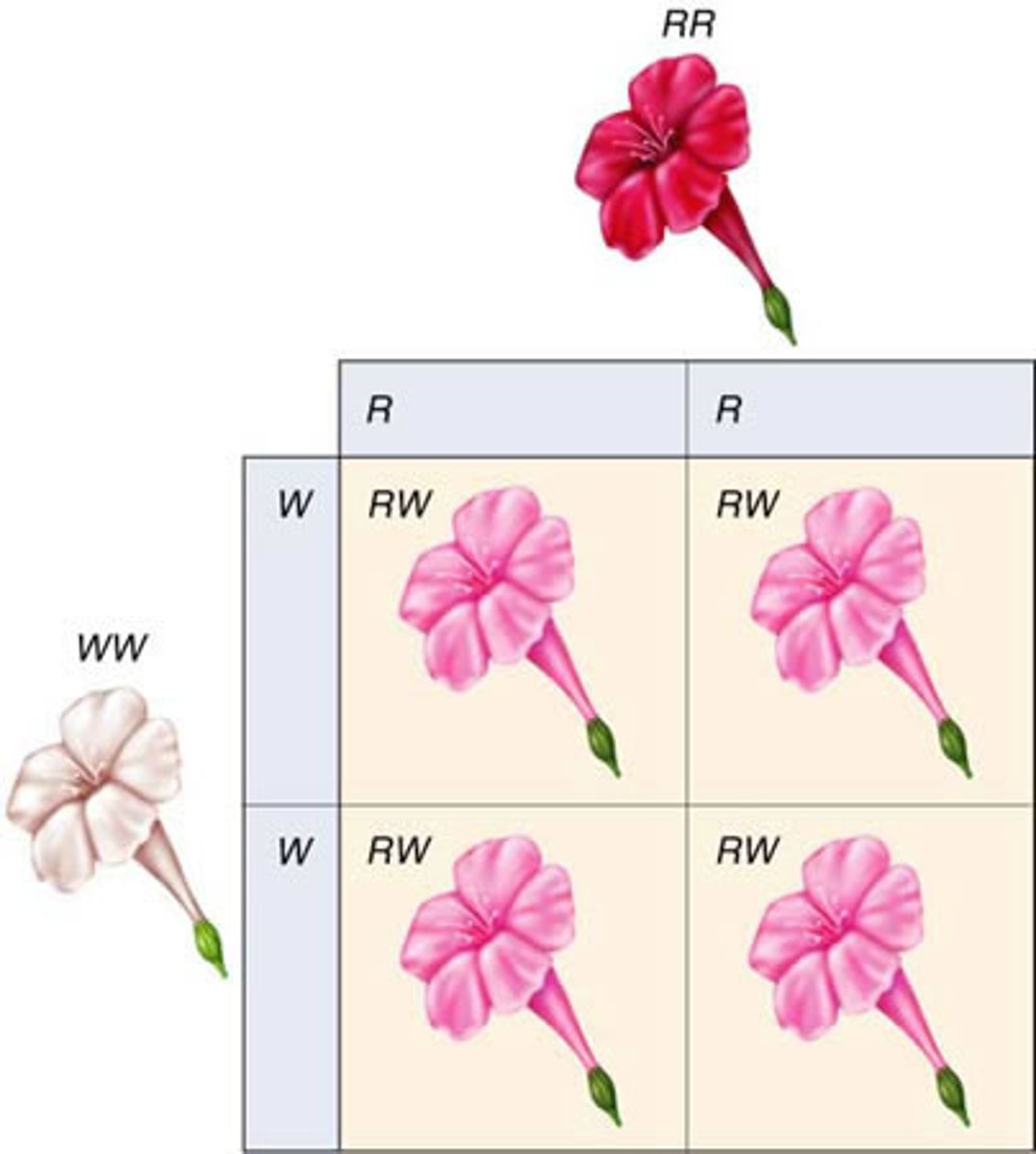
Partial dominance
A form of dominance in which the expression of the heterozygote is intermediate to the expressions of the homozygous genotypes and more closely resembles the expression of the homozygous dominant genotype
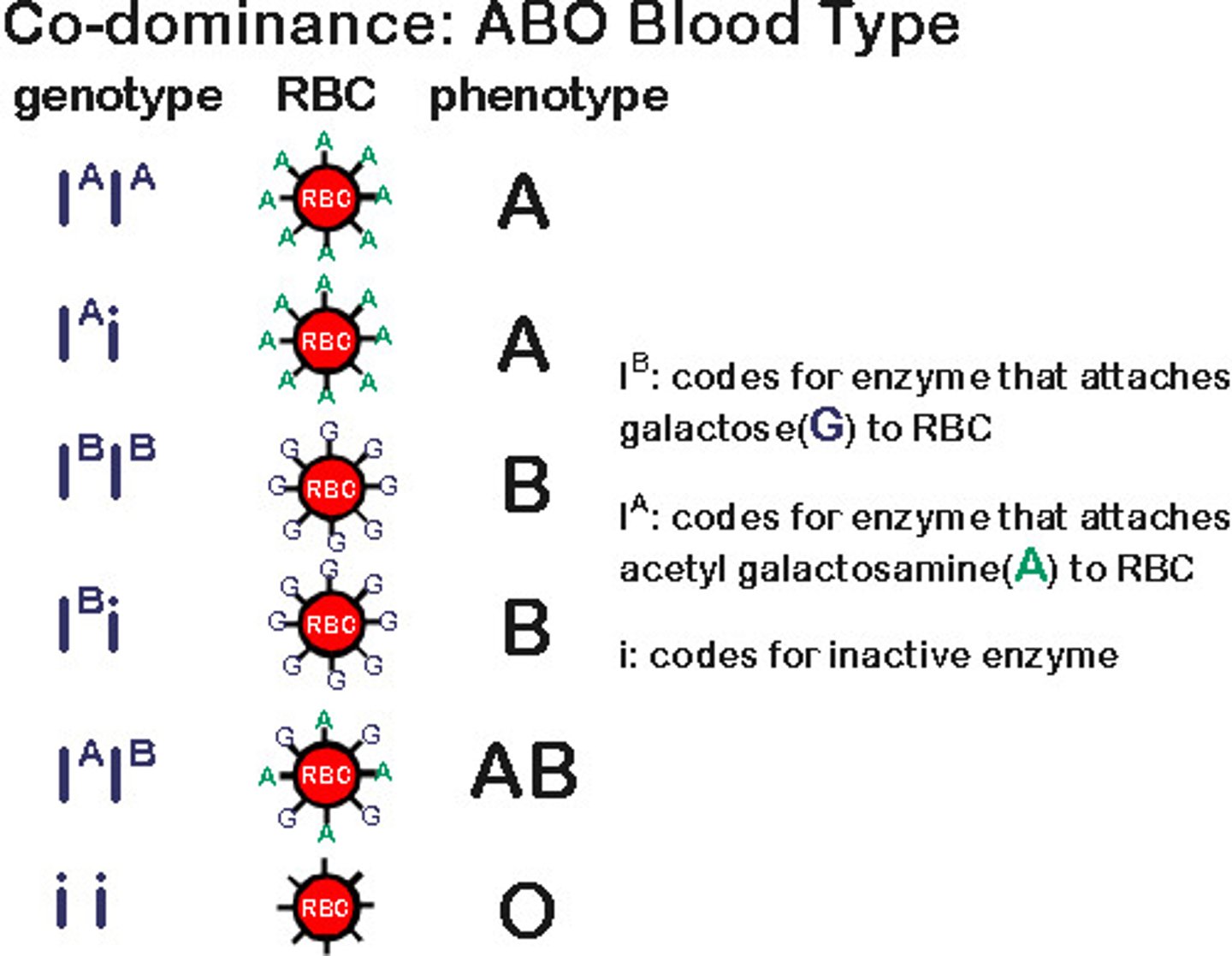
Co-dominant alleles
Pairs of alleles that both affect the phenotype when present in a heterozygote. Ex. AB blood type.
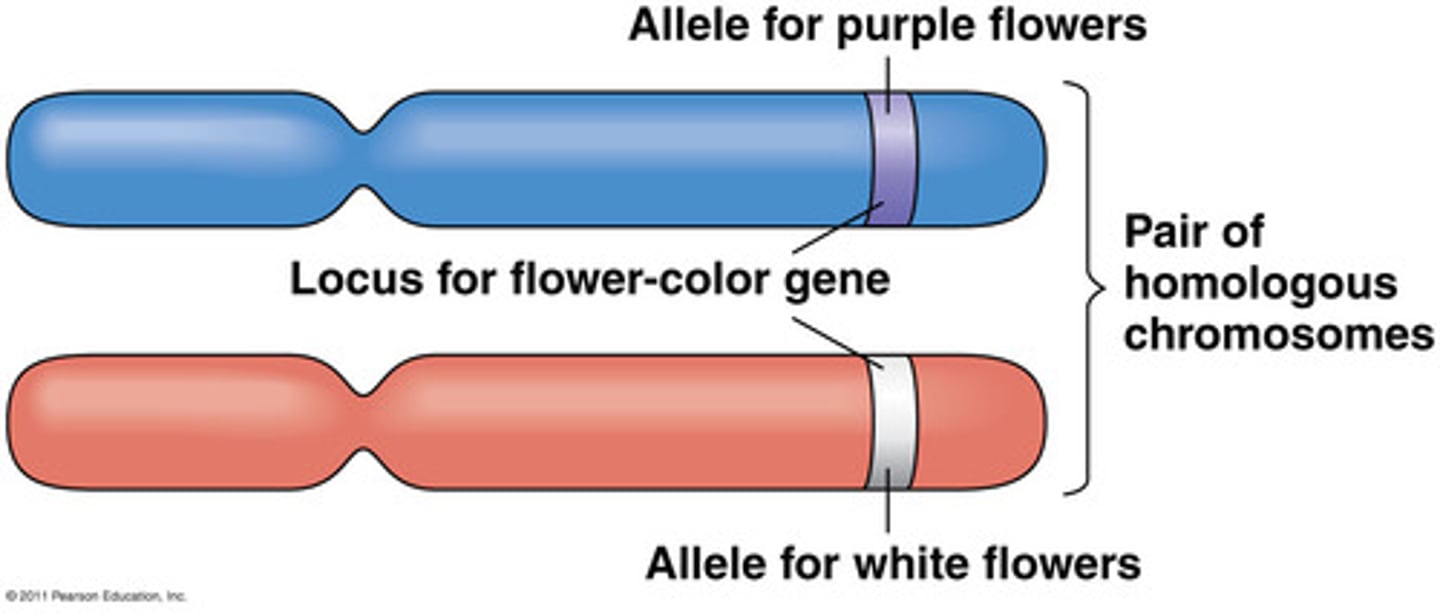
Wild type
The phenotype for a character most commonly observed in natural populations
Mutant
An organism or a new genetic character arising or resulting from an instance of mutation, which is generally an alteration of the DNA sequence of the genome or chromosome of an organism. It is a characteristic that would not be observed naturally in a specimen.
Mutation
A random error in gene replication that leads to a change
Null gene
Nonfunctional gene caused by a mutation, may not produce proteins
Amorphic
Complete loss of gene function
Hypomorphic
Refers to a mutation that reduces but does not eliminate the activity of a particular gene product (partial loss of function)
Sterile mutation
Mutation that causes sterility. Ex. kl-3 gene: sperm tails do not form.
Lethal mutation
A gene or chromosomal mutation that influences the development of an organism in such a way that the organism cannot survive
Loss of function mutation
Causes a complete or partial loss of function
Dominant negative mutation
Exerts a dominant effect. A heterozygote produces a nonfunctional altered protein that also prevents the normal gene product from functioning.
Gain of function mutation
Causes the appearance of a new trait or function or causes the appearance of a trait in inappropriate tissue or at an inappropriate time
Complementation test
A test for determining whether two mutations are in different genes (they complement) or the same gene (they do not complement)
Penetrance
The percentage of individuals with a particular genotype that actually displays the phenotype associated with the genotype.
Expressivity
The degree to which a trait is expressed (can cause same gene to look different in different people)
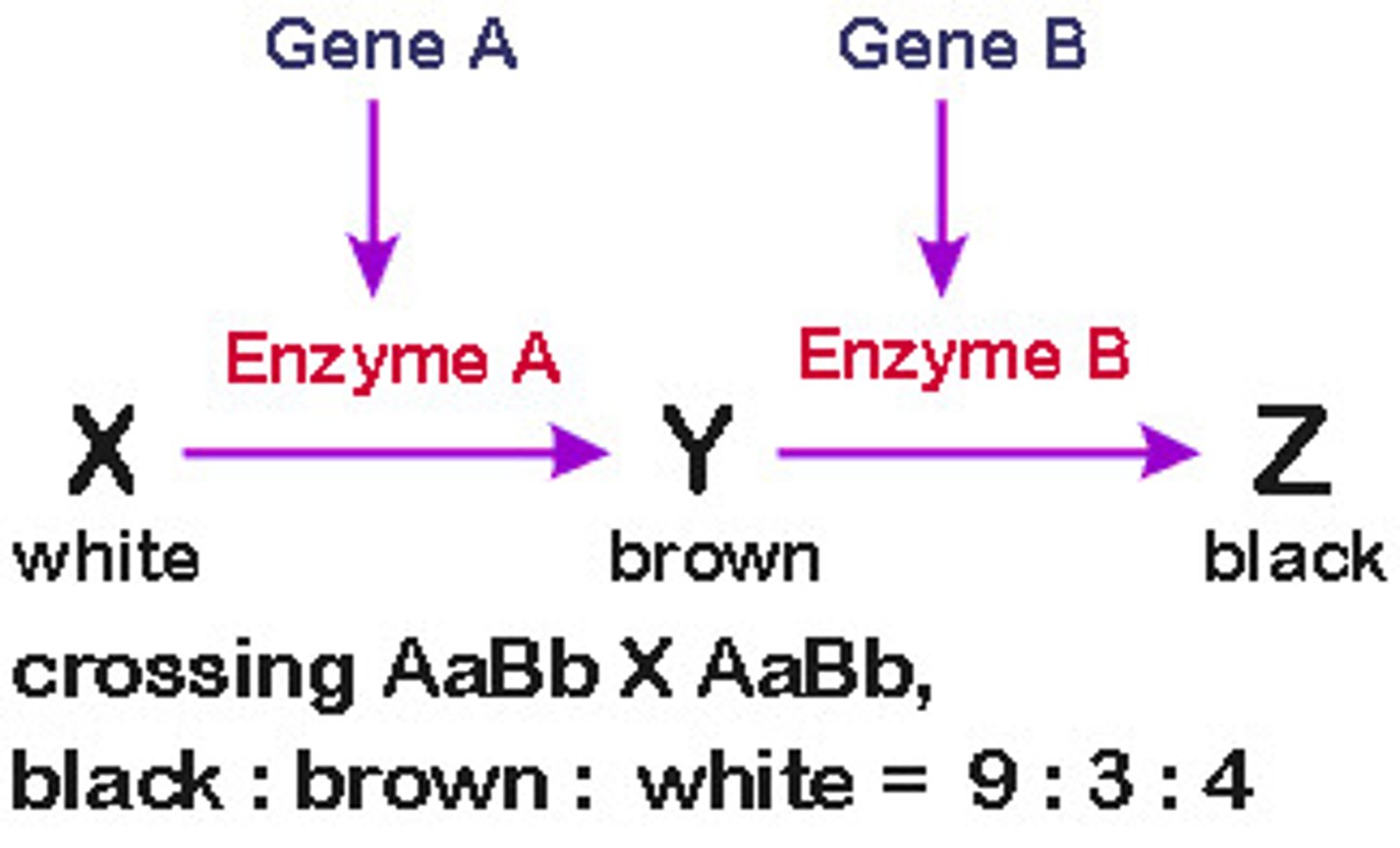
Epistasis
A type of gene interaction in which one gene alters the phenotypic effects of another gene that is independently inherited.
Pleiotropy
The production by a single gene of two or more apparently unrelated effects.
Consanguineous mating
Mating between biological relatives
Inbreeding depression
When individuals with similar genotypes - typically relatives - breed with each other and produce offspring that have an impaired ability to survive and reproduce
Hybrid vigor
A phenomenon in which the hybrid state is selected because it has greater survival and reproductive success; also known as heterosis
Classical genetics
The study of the patterns and mechanisms of the transmission of inherited traits from one generation to another
Molecular genetics
The study and manipulation of DNA on a molecular level
Population genetics
Study of allele frequency distribution and change under the influence of evolutionary processes.
Name the 2 locations of DNA in eukaryotic cells
Mitochondria and nucleus
Name the 2 locations of DNA in prokaryotic cells
Plasmids and nucleolus
Ploidy
Number of sets of chromosomes in a cell
Diploid
(genetics) an organism or cell having two sets of chromosomes or twice the haploid number
Haploid
An organism or cell having only one complete set of chromosomes.
Somatic cells
Any cells in the body other than reproductive cells
Gametes
Sex cells
Germ line
The lineage of reproductive cells that contributes to the formation of a new generation of organisms, as distinct from somatic cells, which form the body and leave no descendants in the next generation.
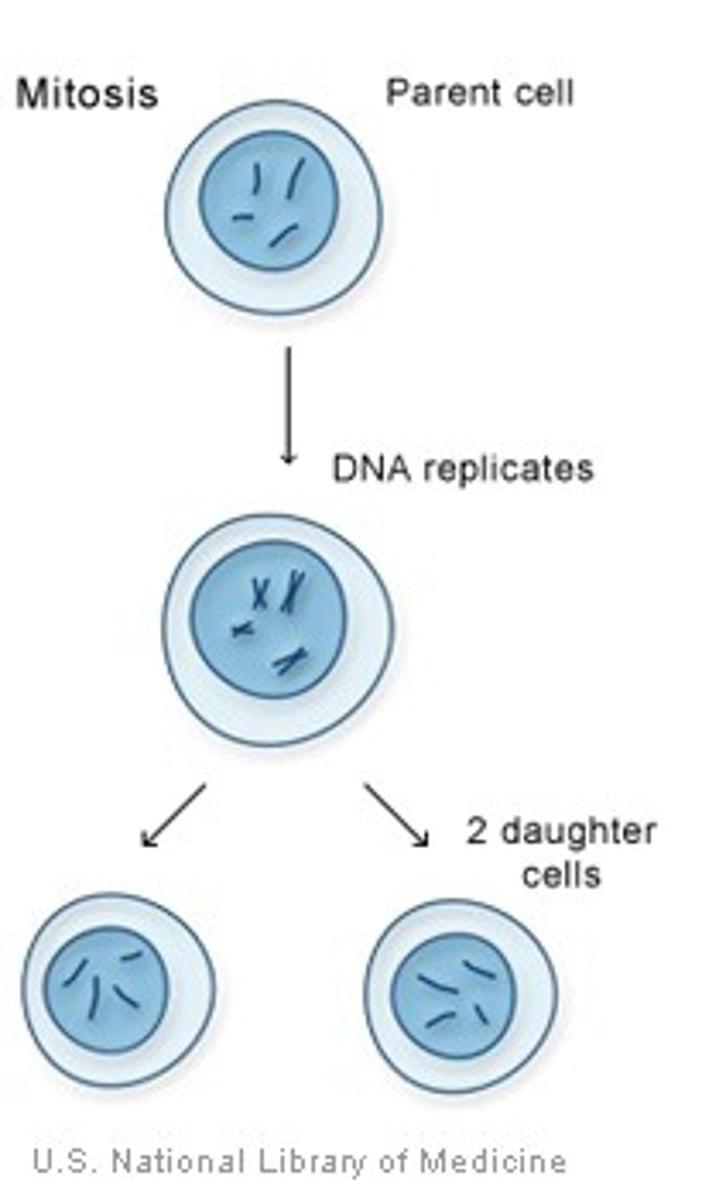
Mitosis
Part of eukaryotic cell division during which the cell nucleus divides and forms two daughter cells. These cells are identical diploid cells.
Meiosis
Cell division that produces reproductive cells in sexually reproducing organisms. There are two steps: meiosis 1 and meiosis 2. At the end of meiosis 1 there are 2 diploid cells. Then these cells further divide into 4 haploid cells. These are not identical to the mother cell.
Clone
An organism that is genetically identical to the organism from which it was produced
Fission (cell)
Division of a parent cell into two or more daughter cells
Centriole
Structure in an animal cell that helps to organize cell division
Spindle
Fanlike microtubule structure that helps separate the chromosomes during mitosis
Quiescent
Inactive; at rest
Kinetochore
A specialized region on the centromere that links each sister chromatid to the mitotic spindle.
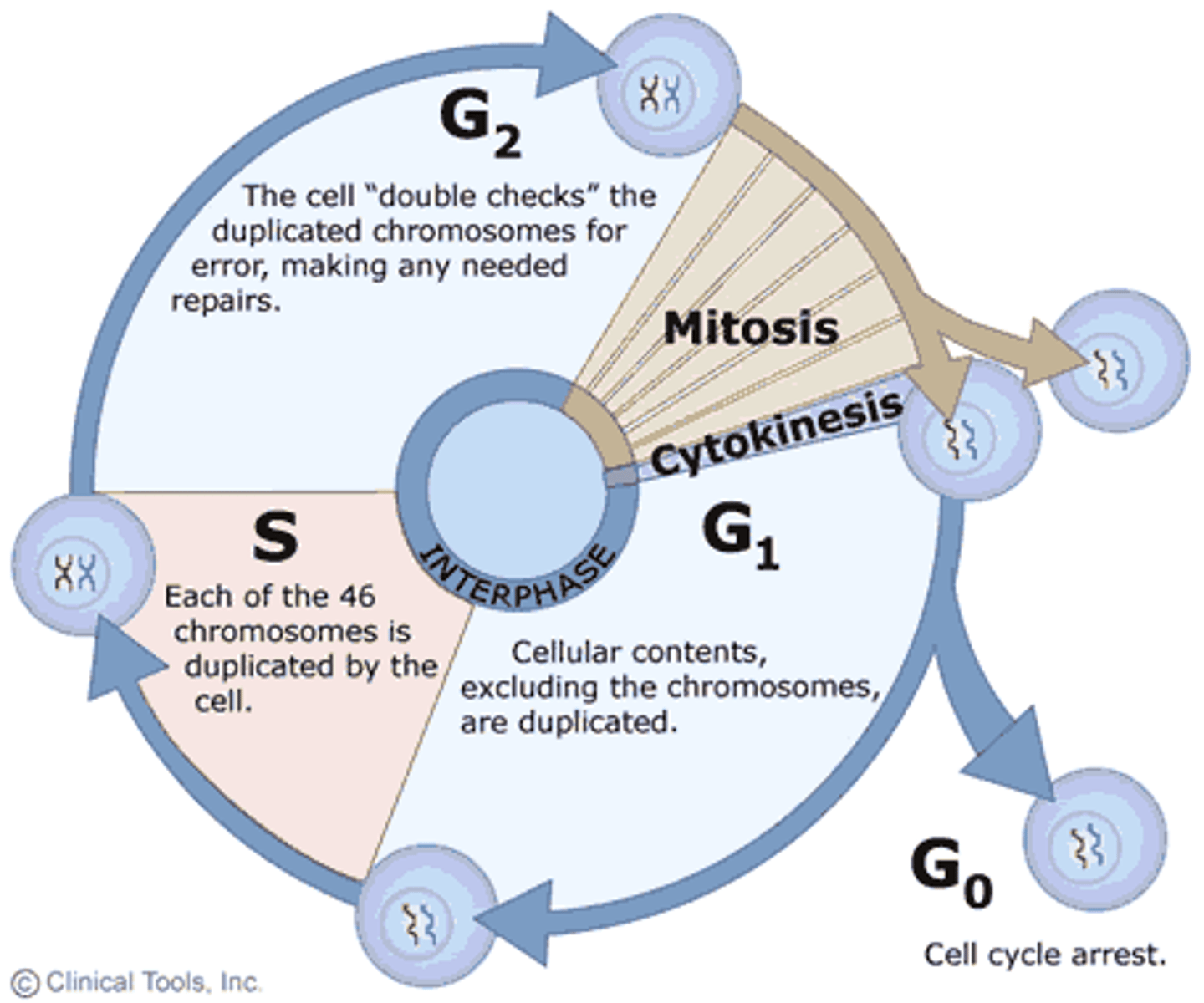
Cell cycle
Interphase (G1, S,G2, M), Mitosis (Prophase, Metaphase, Anaphase, Telephase), and Cytokinesis
Interphase
Cell grows, performs its normal functions, and prepares for division; consists of G1, S, and G2 phases. During G1 phase there is growth and metabolism. During S phase there is DNA synthesis and chromosome duplication. During G2 phase the cell prepares for mitosis.
Prophase
First and longest phase of mitosis, during which the chromosomes become visible and condense. The centrioles separate and take up positions on the opposite sides of the nucleus
Metaphase
Second phase of mitosis, during which the chromosomes line up across the center of the cell. The nuclear membrane breaks apart.
Anaphase
Phase of mitosis in which the chromosomes separate and the sister chromatids move to opposite ends of the cell
Telephase/Cytokinesis
Nuclear membranes form around each of the two sets of chromosomes the chromosomes begin to spread out (decondense) and the spindle starts to break down. Nuclear membrane forms.
The cell splits into two daughter cells, each with the same number of chromosomes as the parent. In humans such cells have two copies of 23 chromosome and are called diploid.
Prophase 1
Chromosomes become visible; nuclear envelope breaks down; crossing-over occurs. There are 5 stages: leptonema, zygonema, pachynema, diplonema, diakinesis.
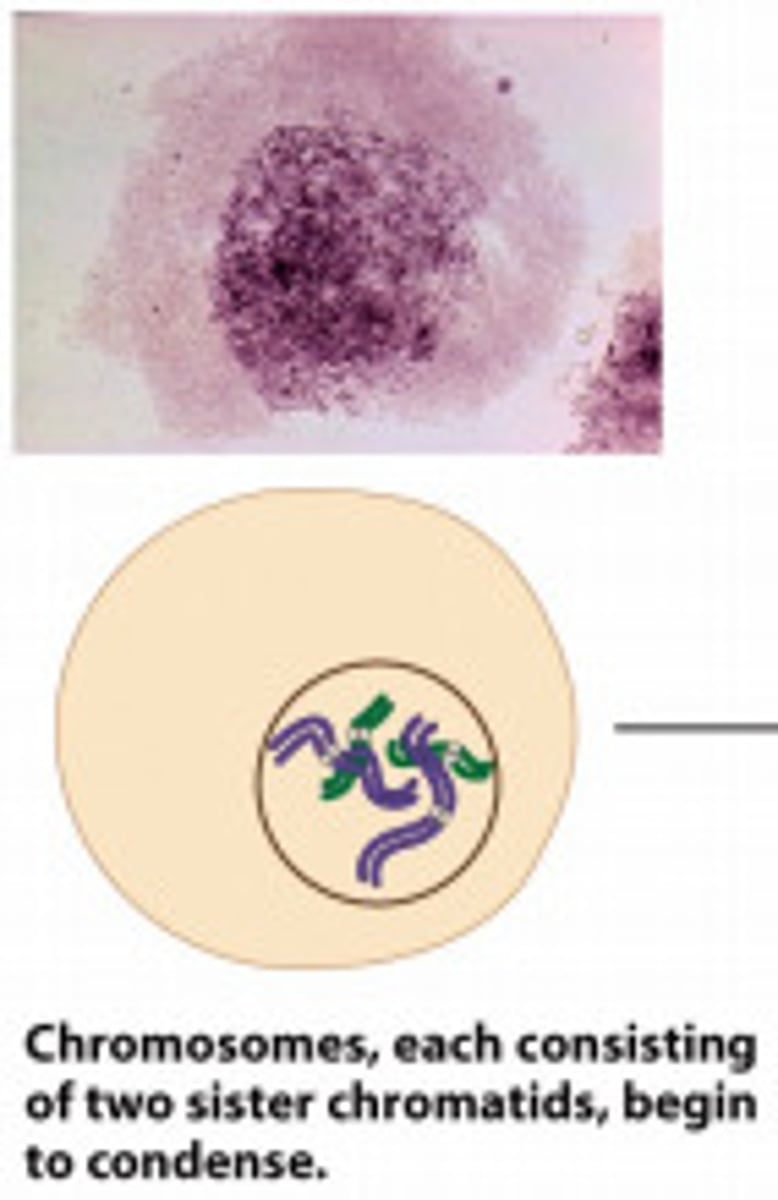
Leptonema
chromosomes condense and become visible. Each chromosome has two sister chromatids.
Zygonema
Homologous chromosomes begin to pair (synapse) with Synaptonemal complex
Pachynema
The chromosomes are fully condensed and paired. Each bivalent becomes shorter, thicker, and splits into two sister chromatids called tetrads. Crossing over occurs at this point.
Diplonema
Within tetrads, sister chromatids separate but are still in contact at the Chiasma.
Diakinesis
Paired chromosomes condense further and become attached to spindle fibers. The spindle fibers attach to kinetochores and the chromosomes move to the central plane in pairs.
Metaphase 1
Paired chromosomes align on the equatorial plane in the cell. The chromosomes are oriented towards the opposite poles and the chisamata move towards the teleomers.
Anaphase 1
Homologous chromosomes disjoin and move to opposite poles of the cell.
Telephase 1
Chromosome movement is complete and new nuclei form. The spindle appartates is dissable. At this point just a membrane separates the daughter cells. The chromosomes still have two sister chromatids.
Prophase II
Chromosomes each condisiting of two chromatids condense and become attached to spindle fibers (a new spindle apparatus).
Metaphase II and anaphase II
The chromosomes align on the equitorial plane in each cell and then the sister chromatids disjoin and move to opposite poles in each cell.
Telophase II and cytokinesis
Chromosomes decondense and new nuclei begin to form. The separated chromatids gather at poles so the daughter nuclei will form. The chromatids are now considered chromosomes. Each daughter cell formed contains a haploid set of chromosomes. The haploid cells are separated by cytoplasmic membranes.
The principle of Dominance
In a heterozygote, one allele may conceal the presence of another.
The Principle of Segregation
In a heterozygote, two different alleles segregate from each other during the formation of gametes.
The principle of Independent Assortment
The alleles of different genes assort independently of each other.
ABO system
A system of four types (A, AB, B, and O) which human blood is classified into, based on the presence or absence of certain antigens. IA and IB are dominant and IO is recessive (chromosome 9).
Rh type
The D gene determines the Rh type. D (Rh positive) is dominant. d (Rh negative) is recessive (chromosome 1).
5 antigens of the Rh system
D, C, c, E, and e. C/c and E/e are codominant
Haplotype
A group of alleles of different genes on a single chromosome that are closely enough linked to be inherited usually as a unit.
Phenotypic ratio with two heterozygotes in a dihybrid cross
9:3:3:!
Formed line method
The first trait gets forked into the 3 dominant and 1 recessive trait. Then each trait gets forked into the 3 dominant and 1 recessive second trait. Follow the fork to determine the number associated with each phenotype. Ex. 3 A and 3 D means 9 A D.
Probability method
Look at the probability of the separate components and then muliple all them together. Ex. Aa Bb Cc self cross, what is the chance of Aa Bb Cc, would be solved by looking at the separate probability of each, 1/2. Mulitplied would be a 1/6 chance.
Chi-square test
A significance test used to determine if a linear relationship exists between two variables measured on interval or ratio scales. x2=E(observed-expected)^2 / expected. When the value is small, the observed and expected values are similar and the hypothesis is true. There is a critical value of X2 where the value is large enough to reject the hypothesis. This critical value depends on the degrees of freedom. The degrees of freedom is the number of different phenotype - 1.
Sex Determination in humans
-Primarily determined by the presence or absence of a Y chromosome. The Y chromosome has a SRY gene. This has a testis-determining factor that will later produce testosterone. On the X chromosome, there is a tmf gene that is necessary for secondary male sex characteristics.
Ratio system of Drosophilia
There is a ratio of autosomal and sex chromosomes (X:A) that determine the sex. If the ratio is more than 1, then the fly is female. If the ratio is under 0.5 then the fly is male. If the ratio is between 0.5 and 1, then the fly is intersex.
The Haplo-Diplo system
females are diploid, males are haploid
The ZW system
A sex determination system in fish, butterflies, birds where males are ZZ and Females are ZW. The egg determines the sex of the offspring.
Nondisjunction
Error in meiosis in which homologous chromosomes fail to separate. Causes XXY similar chromosomes.
Possible mechanisms to control dosage
X linked genes in males might work twice as hard, one copy of the X linked genes may be inactivated in females, and both X genes work half as hard in females.
Dosage compensation in Drosophilia
Hyperactivation of X-linked genes in male drosophilia
Dosage compensation in mammals
Inactivation of X-linked genes in female mammales. Causes a mosaic.
Frequency of recombination
the proportion of recombinant chromosomes among the total number of chromosomes observed
 Note
Note  Flashcards (42)