The Process of Synaptic Transmission
 Studied by 0 people
 Call Kai
 Learn
Learn Practice Test
 Spaced Repetition
 Match
Match Flashcards
 Knowt Play
1/16

Earn XP
Description and Tags
Name | Mastery | Learn | Test | Matching | Spaced | Call with Kai |
|---|
No analytics yet
Send a link to your students to track their progress
17 Terms
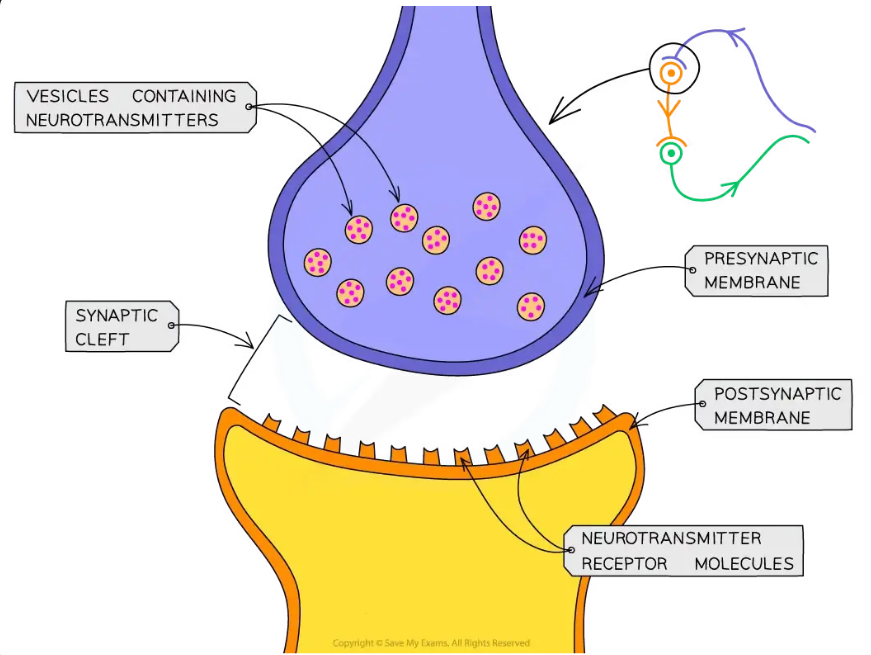
What is a synapse?
The junction where two neurons meet.
It consists of:
The Presynaptic Knob
The Synaptic Cleft
The Postsynaptic Membrane
What is the presynaptic knob?
A swelling at the end of the presynaptic neuron; it contains vesicles which hold neurotransmitters.
What is the synaptic cleft?
The space in between the axon of one neuron and the dendrites of another; where the electrical signal is turned into a chemical messenger that can be detected by the next neuron.
What is the postsynaptic membrane?
The membrane receives a signal (and binds the neurotransmitter) from the presynaptic neuron.
What is the structure of a synapse and associated neurones?
What happens at a synapse (synapse transmission)?
The gap between two neurons is called the synaptic cleft/synapse
When the electrical signal within a neuron reaches the axon terminal of that neuron, neurotransmitters (chemicals) are released from vesicles and cross over the synapse, where they are taken up by receptors in the dendrites of other neurons (converted back to an electrical signal)
Signals within neurons are transmitted electrically
Signals between neurons are transmitted chemically
Neurotransmitters can have either excitatory or inhibitory effects
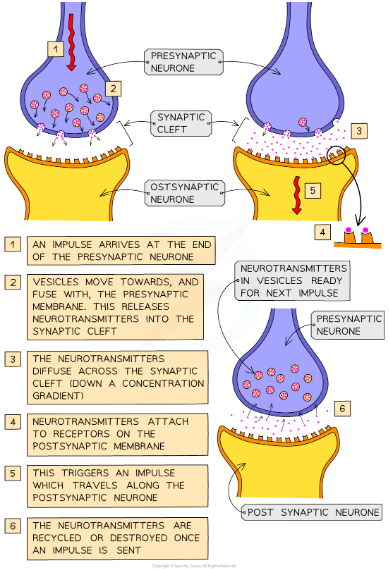
What happens first in synaptic transmission?
A signal begins as an electrical impulse (an action potential) within the presynaptic neuron.
What happens second in synaptic transmission?
When the electrical impulse arrives at the end of the axon on the pre-synaptic knob, chemical messengers called neurotransmitters are released from structures called vesicles at the presynaptic membrane.
What happens third in synaptic transmission?
Neurotransmitters are released into the synaptic cleft as a chemical substance from the presynaptic neuron after the action potential has occurred.
What happens fourth in synaptic transmission?
Neurotransmitters diffuse across the synaptic cleft and temporarily bind with receptor sites on the postsynaptic membrane.
What happens fifth in synaptic transmission?
This action stimulates the postsynaptic neuron to generate another electrical impulse (action potential) that then travels down the axon of the postsynaptic neuron.
What happens sixth in synaptic transmission?
The neurotransmitter molecules are then destroyed by enzymes or recycled to prevent continued stimulation of the second neuron, which could cause repeated impulses to be sent.
What happens seventh in synaptic transmission?
The re-absorbed neurotransmitter may be used again by the presynaptic neuron.
What is the purpose of synaptic transmission?
It allows the nervous system to control body functions, thoughts, and movements.
What are neurotransmitters?
Many and varied, each having a specific function with accompanying receptor sites ready to 'catch it' e.g.
Serotonin receptor 4 (5-HT4R) plays an important role in regulating mood, particularly depression and anxiety
Dopamine receptors play an essential role in movement and the experience and anticipation of reward
Dopamine receptors are located in the hippocampal dentate gyrus (part of the hippocampus which regulates the formation of new episodic memories)
Neurotransmitters are either excitatory or inhibitory.
What are excitatory neurotransmitters?
Those which stimulate an action potential in the postsynaptic neuron.
They increase the neuron’s positive charge
Increasing the neuron's positive charge makes it more likely to ‘fire’
E.g. Adrenaline
What are inhibitory neurotransmitters?
Those which inhibit an action potential in the postsynaptic neuron.
Inhibitory neurotransmitters increase the neuron’s negative charge
Increasing the neuron's negative charge makes it less likely to ‘fire’
E.g. Serotonin
 Note
Note  Flashcards (150)