SOCI 200 Exam 1
 Studied by 0 people
 Call with Kai
 Learn
Learn Practice Test
 Spaced Repetition
 Match
Match Flashcards
 Knowt Play
1/154

Earn XP
Description and Tags
Name | Mastery | Learn | Test | Matching | Spaced | Call with Kai |
|---|
No study sessions yet.
155 Terms
What is “family?”
Family often viewed & defined under certain ideologies
Systematic beliefs that claim to be “truth” that rationalize or justify behaviors and actions
What is subjective is viewed as objective
SNAF (Standard North American Family)
The "normative family” by which other family types are compared and measured
Theses normative defns can support discourse of family decline
Past family life romanticized, current family trends viewed with worry or skepticism
Alternative lenses: family change and family diversity
Families are metamorphosizing, changing
There has never really been a “golden” or “stable” age of family
Determinants of family change also frequently shift
Ex. there are a rise of children in single parent households -> more than in the 1930s and 1950s -> ebbing and flowing
Other defns include religious, legal, official classifications, more informal
Census families
married or common-law couple (w or w/o children) or single parent w/ at least one child living in same dwelling and that child/children
Economic families
2+ persons living in same dwelling who are related (by blood, marriage, etc), encompasses Census families, broader defn
Used when govt wants to know about household income
Fictive kin
people who aren't related by blood, marriage, or adoption but are considered family due to deep emotional bonds and assumed family roles
“The term family is not simply a concept, but a
…minefield of contested values and power relationships”
Family is defined by the Vanier Institute of Family as any combo of 2+ ppl bound tgt over time by ties of mutual consent, birth, adoption or placement who assume responsibilities for various combinations of the following:
Physical maintenance and care of group members
Addition of new members through procreation or adoption
Socialization of children
Social control of members
Production, consumption, distribution of goods and services
Affective nurturance - love
Technological change
innovations drastically reshape our world, for good or bad
Ex. communication with smartphones, tv
Economic changes
shifts in flow of goods/services, work & employment patterns, wealth distribution, etc. impact social life
Ex. child labour, types of jobs available, who is expected to do what type of labour
Legal change
rights/freedoms granted or taken away can impact individuals & populations
Ex. Interracial marriage, slavery
Cultural change
shifts in values, norms, attitudes, beliefs can lead to changing behaviors
Example: religious changes, shifting attitudes about the importance of marriage, many ppl went from being against to for same-sex marriage in a short period of time, shifting to a more individualistic mindset
What are some drivers of Social (& Family) Change
Technological change
Economic change
Legal change
Cultural change
Economic changes
shift from preindustrial economies of household production → emergence of a globalized consumer society
Demographic changes
declines in child mortality & increased longevity; people having fewer children than they used to
Family Life “Back Then” – Canada & US (1600s-1800s)
Slavery in US & Canada
Indigenous living & European conquest
Slavery in US & Canada
Brought as laborers at plantations (mainly US, + Caribbean & South America): to construct buildings & infrastructure; to clear lands; perform household labor, etc.
Family life highly regulated/constrained: family separations, marriages needed permission, some women forced to bear children, etc.
1600s-1800s (abolished 1834 Canada; 1865 US); legacy endures in many ways
Indigenous living & European conquest Pre: Europeans brought:
Pre: hunting & gathering, extensive kinship networks, many matrilineal families
Europeans brought material culture, disease, Chirsitanity, diff family systems like patriarchy
Indian Act of 1876 & Residential Schools w/ goal of
Assimilation
Assimilation
= processes by which group/individual becomes more like the “dominant” group w/ respect to its culture
Family Life “Back Then” – Canada & US (1900s)
Industrialization & transition to a consumer society
Huge changes to women’s lives
Feminist movements, labor force participation increases
But lingering pattern of “separate spheres” - division of labour b/wn men and women
Globalization
World scale of economic & market activity; fueled by expansion of telecommunications & multinational corporations
Transnationalism
people crossing/straddling multiple economic and cultural regions via migration
Corporate family
The family was a productive unit, often living and working on the same premises (e.g., a family farm or business). The family was largely self-employed, with income generated through the collective efforts of the household.
Changing meanings of marriage: In the West, marrying for economic/political reasons → …
marrying for love
Changing meanings of marriage: Serial monogamy w/
more cohabitation, separations, divorce, & remarriage
Changing meanings of marriage: New(ish) legal benefits to marriage
E.g., tax credits, loans to buy homes, property sharing
Recent Population Trends Around the World:
Integral roles of social demography & population science
Rising age at first marriage + increasing non-marriage
Delayed childbearing + increased childlessness
Low birth rates leads to
- Aging populations
- Increased urbanization
- Increased international migration
SDT is one prevalent theoretical framework for
making sense of so many macro-level family changes
Value change - shift away from materialistic values to non-materialistic values
Builds on first demographic transition
first demographic transition
historical declines in mortality and fertility, “as witnessed from the 18th century onward in several European populations and continuing at present in most developing countries”
Second Demographic Transition (SDT): Emphasizes that a cultural shift from materialist → postmaterialist values (e.g., self actualization) leads to…
Disconnection b/w marriage & childbearing
Lower fertility/birth rates
More diverse family forms
Population aging
Patriarchy
System of social organization where men have authority over family and property
Compare w/ matriarchy, egalitarianism
Lineage and inheritance usually passed through men
Also evident in prioritization of men’s employment, naming practices, power in opposite-sex relationships, sex ratios - sex selection abortion (males preferred over females), religious practices, etc.
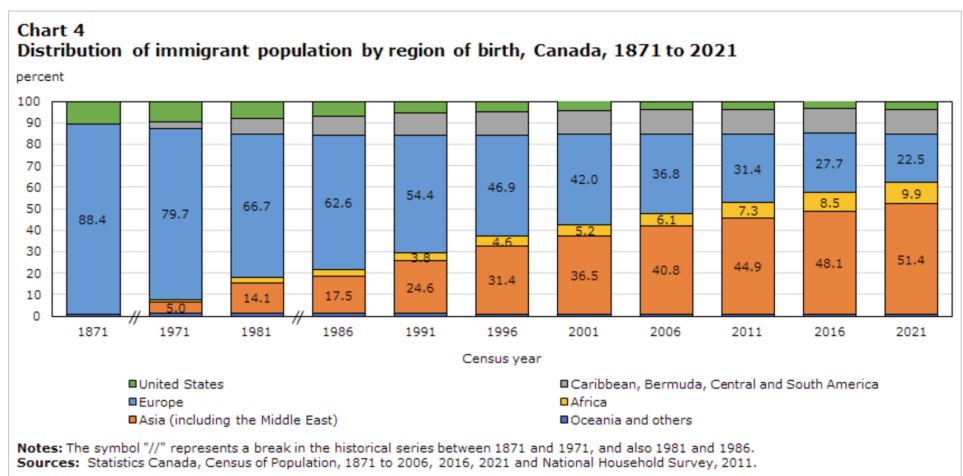
What are the trends of immigration to Canada from 1871 to 2021?
1871 - more European settlers, early 2000s - 2021 more immigrants from Asia
Most immigrants to Canada are
Economic immigrants
Most immigrants to Canada were born in (which countries?)
India 2. Phillipines 3. China
In a matriarchy, are women’s last names passed down?
Extremely hard to find examples of fully matriarchal societies
More examples of matrilineal societies – descent flows thru women but not necessarily power • E.g., Khasi people
What is sociology?
“The study of human relationships, the rules and norms that guide them and the development of institutions and movements that conserve and change society”
A Brief History of Sociology: Early origins…
ancient greek philosophers (500-300 BCE), historians in East Asia (1200s), Islamic scholars in North Africa (1300s)
A Brief History of Sociology: The Enlightenment, development of modern science & the industrial revolution (~1800s)
Industrialization & huge economic changes
Shift toward empiricism
empiricism
discovering the world via methodical, detailed observations
Industrialization & huge economic changes
need to understand changing societies + theorize how to reform them
A Brief History of Sociology: Late 1800s & early 1900s:
solidification of the discipline in Western contexts
Roots in France, Germany and later US
Early Classical Theorists: Comte
French philosopher, popularized the term sociology
Introduced positivism
Works translated by Harriet Martineau, who brought this view to English-speaking world
Positivism
reality is measurable via scientific method; research is value-neutral
Durkheim
French sociologist, influenced by Comte, pioneer of modern social research
Saw sociology as the study of "social facts,” aspects of society that transcend the individual
Famous for work on suicide & how rate varied in different religious contexts
Consensus theory
Society = collective of shared norms & values, order is at the core of social life
We all play important social roles. Otherwise, chaos!
Dominant sociological theory = structural functionalism
rose to fame w/ Talcott Parsons
What is the function of X? What role does X play? Why does X survive?
Stability rather than change
There’s a good reason things are they way they are
Consensus Theory & Structural Functionalism
Nuclear family structure as harmonious; essential to functioning society
Nuclear family
Breadwinner-homemaker family = basis for stability & cooperation
Instrumental role of husband
Expressive role of wife: caregiving, nurturing,
Families 1) socialize children 2) provide economic support 3) provide emotional support
Supposed to provide stability in a quickly changing world
Stephanie Coontz’s Marriage, a History: Until 18th/19th century, marriage mainly for political/economic advancement
→ new ideals of free choice, marrying for love
“The long decade of the 1950s”: truly a unique time for
postwar __&
surge __ in at young ages
by 1959, almost half of all women …
peak of__
Adventures of Ozzie and Harriet, show depicting__
family in the West (late 1940s-mid 1960s)
Postwar prosperity & mass consumerism
Surge in “love marriages” at young ages
By 1959, almost half of all women married by 19
Peak of baby boom
Adventures of Ozzie and Harriet, show depicting nuclear family life
Marriage & male bread-winning ideal was
“like a steamroller that crushed every alternative view” (Coontz)
Became viewed as the "traditional" type of family structure despite being a historical blip
Marriage & male breadwinning ideal: Experts (wrongly) assumed these were pretty stable, universal trends
Parsons never predicted that women might broadly win access to careers ( & that many might want them!)
Goode, another sociologist, saw love-based marriages as inevitable & universal; predicted families will raise daughters to take “only a modest degree of interest in full-time careers”
Neglected contradictory data (e.g. cohabitation patterns in Latin America)
Took a narrow view that neglected history & possibility for even more rapid change
What happened next (post 1960s)?
Rising discontent (among women & men) over male breadwinner/female homemaker marriages
2nd wave feminism & popular books like the Feminine Mystique (1963)
“The problem that has no name”
Expansions in women’s employment & contraceptive revolution
More divorce, more cohabitation, and the trends we discussed last lecture
Why Parsons & SF Fell out of Favour:
drawn on much less in sociological studies today
Parson’s & SF: Work framed as overall simplistic, too abstract,
trying to rationalize, preserve status quo
Parson’s & SF: But still useful to understand for several reasons:
Evolution of sociological theory & how shaped by historical context
Different ways of viewing the world (consensus vs conflict)
Institutions like family can & do play positive roles & help structure society
Conflict Theory & Marx
Roots in Karl Marx & Fredierich Engels
Conflict Theory & Marx
contrast to consensus perspectives
Karl Marx & Fredierich Engels
broadly focuses on power relations & inequality
Not always “bad” to have conflict…viewed as an engine of social change
Macro - work vs. family; men vs women; competing class interests
Micro - parents vs. children; sibling conflict
Engels
nuclear family furthers capitalism & inequality
i.e. families reproduce -> more labour power that benefits capitalists
Karl Marx
Capitalism = ruling class vs working class
Emphasis on alienation, class struggle, exploitation
Political Economy Perspective
Less a unified theory, more of a broad lens/way of approaching research
Intertwinement of economics & politics - how they shape each other
Globalization, inequality, macroeconomic policy, economic development, etc.
How dominant groups manufacture consent
Political Economy Perspective: Manufacture consent
control information via media, shape behavior, shape politics, etc.
Political Economy Perspective: How does it apply to family
Capitalist modes of production shape our lifestyles & choices
Consumption shapes our values, practices, needs
Political & econmic systems shape which families get what resources
Example: Goods that capitalize on parenting stress
Marketed as making life easier
May foster more consumption, more class-based inequality, more parenting stress!
What is Theory & Why Important?
Links the abstract (ideas, concepts, curiosities) to the concrete (observations)
Help us describe, interpret and/or explain a phenomenon
Make sense of chaos!
Not created in a vacuum - subject to time, place, prior theories, etc.
Drives research! But relationship b/wn theory & data bi-directional
In sociology, & studies of family, purpose is to systematically develop a general understanding of
social/family life that we can also empirically test
Inductive
begin w/ observations, create abstract ideas, produce theory
Deductive
begin w/ theory, create hypothesis, collect/test data - more like scientific research
Largescale, unanticipated “package of changes” across wealthy countries - what many macro-level theorists refer to as the
second demographic transition
Link b/wn sex and marriage weakened, rising cohabitation; later childbearing
implications:
increasing family diversity & rising, class-based inequality
“diverging destinies”
inequalities in children’s life outcomes resulting from socioeconomic bifurcation in family behaviors
Eg individuals with lower SES more likely to cohabitate/be solo parents -> potentially less resources for kids
Diversifying of disciplines like sociology (both scholars & their ideas)
More
New methods of research &
Turn toward more
More interdisciplinary work
New methods of research & more complex, context-based theorizing
Turn toward more critical & interpretive philosophies (as opposed to positivism - more objective viewpoint, such as in science) - Max Weber
Feminist Theories: Influenced by conflict perspective & Marxist thought, but more attention to
patriarchy and exploitation
Feminist theories: Not one "unified" theory but
many related ways of viewing & studying the world
E.g., radical feminism, development feminism, socialist feminism
Feminist theories: five basic unifying themes:
Emphasis on the female experience (example of standpoint theory)
Gender organizes social life, seen as a set of relations imbued w/ power & inequality
Gender & family need to be contextualized & experiences vary, but many things … fill in
No single definition of “family”
Often focused on praxis - eliminating inequalities
emergence of studies on masculinity
how masculinities are defined, constructed
E.g. how boys are socialized; how men father
Intersectionality
Challenges narrow views within
Coined by Kimberle Crenshaw
Argued experiences of Black womanhood not simply reducible to 1) being Black or 2) being a woman.. these identities intersect & produce something new
Intersectionality: People’s lives are multidimensional;
shaped by interactions of many identities (race, gender, class, Indigeneity, age, migration status, etc.)
Interactions of identities unfold within unequal contexts (power, historical legacies, lingering injustices)
Strong conceptual approach but also goal of resisting & challenging status quo
Symbolistic interactionism
An interpretivist perspective - focused on how humans attribute meanings to actions; how they interpret & respond to situations
Focus on micro-level processes
Individuals are constantly acting, negotiating, & responding to one another; capable of seeing themselves through the eyes of others
People are active participants in shaping their worlds through everyday interaction
Example - Howard Becker’s study on marijuana users
Argues smoking is as much about social process as biological process
New marijuana users learn (in interaction!) from experienced smokers how to identify the effects, how to enjoy them, and how to label/give them meaning
Social Constructionism
emerged as a theory of knowledge w/ Berger and Luckmann’s The Social Construction of Reality
Social phenomena are created in particular social & cultural contexts
We all participate in the construction of our perceived reality
What exists “out there” are fluid meanings, not objective truths
Influenced by/in many ways similar to symbolic interactionism
Examples
E.g. Money is given meaning
Gender: ideas about “men” or “women” or masculinity or femininity are given meaning by us - how we dress, talk, act, etc. and the labels we attach to these behaviors
Applying SI and SC to Family Life
Interactions of family members or intimate couples involves shared understandings of situations, creation & maintenance of roles; reacting to others’ expectations
In contexts of change or where roles less defined, people create new meanings & roles via interactions (e.g. same-sex parenting, etc.)
E.g. A wedding ring is given the meaning that the person is married, decided by society
Exchange Theory
Another micro level theory; focused on decision-making in terms of costs & benefits & norms about reciprocity
Heavily influenced by economists
Assumes humans act in self-interest & aim to maximize rewards/profits
E.g. (“what I get out of it” - “what I lose by doing it”)= “My decision”
Assumes humans are rational
Becker’s New Home Economics perspective
Household like a small factory trying to maximize utility
E.g. couples divide labour based on efficiency
Becker’s New Home Economics perspective
Household like a small factory trying to maximize utility
E.g. couples divide labour based on efficiency
Social constructionism - example research question
How has academic research itself (Parsons) contributed to dormant constructions of what a "family" should look like?
Life Course Perspective
Popular & very broad framework today (+ our textbook’s dominant paradigm)
Combines sociology, soc. Demography, history, economics, developmental psychology
Key questions like “How does historical time & place shape our lives?”
Key concepts (see also box 2.3 in textbook)
Cohort & Generation - groups of ppl born during same time period
Transition - changes in roles/statuses
Trajectory - long term patterns of stability and change
Linked lives - how are lives are connected to others & broader society
Life event - a significant occurrence that can produce serious effects
Cohort & Generation
groups of ppl born during same time period
Transition
changes in roles/statuses
Trajectory
long term patterns of stability and change
Linked lives
how are lives are connected to others & broader society
Life event
a significant occurrence that can produce serious effects
Turning Point
life event that redirects our life path
Sociologists often focus on categories like gender, race, ethnicity, etc. b/c they aren’t just personal traits but because…
Affect …
they are socially organized categories that produce social inequality
Affect power, status, resources, life chances, lived experiences
Differentiation
sorting of ppl into different groups (often into groups w/ unequal power/resources) i.e., white/black/Asian
Stratification
ongoing, systemic forms of differentiation that determine/reinforce who gets what, when, & why
cause or consequence: Families can be of various forms of … (but also as sites of resilience, meaning & power, safety too)
inequality
Advantages or disadvantages transmitted through families e.g.
money, education, social networks, expectations
Broader inequalities shape family options & daily life e.g.
family formation, caregiving responsibilities
About %(1.8 million) of Canadian population identifies as Indigenous; population is fastest growing in Canada & youngest
5
IndiBut…lower life expectancy; less (quality) education; more teenage pregnancy; higher alcohol/substance use issues; poverty; employment discrimination; rural isolation
Many inequalities are larger for
those living on reserve
 Note
Note  Flashcards (21)