Psychological Dynamics of Empathy Exam #1
 Studied by 0 people
 Call Kai
 Learn
Learn Practice Test
 Spaced Repetition
 Match
Match Flashcards
 Knowt Play
1/76

There's no tags or description
Looks like no tags are added yet.
Name | Mastery | Learn | Test | Matching | Spaced | Call with Kai |
|---|
No analytics yet
Send a link to your students to track their progress
77 Terms
Thomas Hobbes and selfishness
Believes selfishness is bad. Humans are intrinsically selfish and look out for themselves, don't expect someone to be nice to you unless there is something in it for themselves, government needs to step in to keep things civil
Support for the Big Five Model
Shows good validity across cultures and languages. Very remarkable feat. Generalizes across age. Good predictive validity.
Criticisms of the Big Five Model
Openness does not translate as well across cultures as the other elements of the Big Five theory. Need to break down the model into sub parts (different levels of conscientiousness such as discipline at work vs. at home). Oversimplified. Openness does not equal empathy
Measures of empathy developed for adults
More reliant on questionnaires. Early efforts focused on accuracy. Participants claim empathic traits, but are they really?
Dymond (1949): after interaction with another person, subjects asked to guess how the other person rated themselves. Measured how accurate their estimates were. Very popular in its day but has major problems. Problems: agreement does not equal accuracy
Questionnaire measure of emotional empathy (QMEE Mehrabian and Epstein, 1972)
Questionable measures ("I like to watch people open presents" "Other people crying upsets me"). "Close but no cigar"
Mark Davis and IRI (Interpersonal Reactivity Task)
This is not a perfect survey, but filled a huge gap in the individual difference literature for those wishing to use a measure that:
-Captures multi-dimensionality of empathy
-Clear in definitions
-Easy to administer
-High in predictive validity
-Statistically reliable: if there are 7 items proposed to measure empathic concern, they are all correlated.
Four distinct sub components of the IRI
Empathic concern: "I have tender concern feelings for people less fortunate than me," "when I see people being taken advantage of, I feel protective over them"
Perspective taking: "I try to look at everyone's side of a disagreement before I make a decision," "I believe that there are two sides to each disagreement and I try to look at them both," "I find it difficult to see the other guy's POV" (This can vary, esp. in politics)
Personal distress: "in emergency situations I feel apprehensive and ill-at-ease," "I sometimes feel helpless when I am in the middle of an emotional situation"
Fantasy: people who are able to remove themselves from their current situation and imagine themselves as another being
Domain-specific measure of self-reported open-mindedness
I have no patience for (political/religious) arguments I disagree with; I often "tune out" (political/religious) messages I disagree with; I believe it is a waste of time to pay attention to certain (political/religious) ideas; I try to reserve judgement until I have a change to hear arguments from both sides of a (political/religious) issue.
Compassion (Getz et al. 2010)
Similar to empathic concern, but with a stronger emphasis on helping others in need. It's important to take care of others who are vulnerable; I am a very compassionate person; Taking care of others gives me a warm feeling.
Dimensions of the NPI (Narcissism Personality Inventory)
Exploitative dimension, Authority/leadership, Superiority/arrogance, Self absorption.
Traditional model of emotion
Negative emotion --> who is the victim? If the victim is the self --> feelings of sadness, anger, shame. If the victim is another person, does the other person's satisfy the goals of the self? If yes --> feelings of happiness. If no --> is the other person deserving of help? If no --> feelings of disgust, anger, disdain. If yes, do you have the resources to help. If no --> feelings of distress, anxiety, fear. If yes --> compassion. This model excludes the prosocial consequences of anger.
Primary adaptive feelings
Feeling: fear, information: danger, need: safety, goal: avoidance. Feeling: anger, information: justice violation, need: restore justice by punishing the wrongdoers and giving reparations to the victims, approach: see that justice is done. Anger is the only negative emotion that is part of the approach system.
Further theory and research on the evolutionary advantaged of anger
Darwin observed that animals protected their resources through anger. Dynamics of cooperation, freeloading/freeriders must cooperate and contribute to the group as a whole. Anger can signal important things to other members of a group (aka "don't do that!")
Boundary condition
Anger towards "norm violators" is likely when certain boundary conditions are met:
-Intent vs. Impact (Courts are more lenient when the perpetrator did not know that what they were doing was wrong, Clearly forceable consequences)
-Performed by someone by their own free will (Knowing the consequences before the action is performed)
-Performed by someone by an otherwise sound mind (Mental health reasons, Small children)
BAS (behavioral activation system)
Anger is the only negative emotion included in the BAS system, when people are angry they seek justice and action.
Restorative justice
Response is focused on harmful consequences of offender's behavior, emphasis is on the future, crime has both individual and social dimensions of responsibility, victims are central to the process of resolving a crime,**empathy plays a central role in restorative justice, the offender is defined by capacity to make reparation, focus on the problem solving, on liabilities/obligations, and on the future (what should we do moving forward?), restitution as a means of resting both parties, goal of reconciliation/restoration
Waytz et al. 2016
Showed differences in the size and breadth of the ingroup between liberals and conservatives. Heatmaps showed that liberals cared more about people they never met before, people who are different than them culturally, geographically, etc. while conservatives are the opposite
O'Brien and Ellsworth "Lost in the Woods" experiment
Experiment 1: method: asked people to partake in a survey either outside in very cold weather, or in the library. Survey is about "reading comprehension." Read about a person lost in the cold woods, the person lost in the woods was either liberal or conservative, the subjects are also either liberal or conservative (2 x 2 x 2 factorial design). DV: what was most unpleasant for the hiker? (Hunger, thirst, cold), ratings of how the hiker felt.
Experiment 2: experimentally induced thirst. Extremely salty snacks, no water provided, read about the person lost in the woods (similar, dissimilar). Extremely salty snacks, water provided, read about person lost in the words (similar, dissimilar).
Individual differences
Differences in people's ability to be empathic. Consistency: across situations (home, work), they act in similar ways. Cross-situational. Stability: relatively small, or no change, throughout life (35 years old vs. 75 years old). Individual differences: meaningful, not trivial. Construct validity: is your questionnaire measuring what you think it is measuring. Predictive validity: do scores on your measure predict behavior?
Overlapping facets of empathy
Mimicry, Cognitive perspective skills, Behavioral/emotional contagion, Theodor Lipps' "einfühlung", Understanding a person's experiences (Wolfgang Kohler), Sympathy (often when the other has experienced some misfortune). Understanding and sympathy often go hand in hand
Adam Smith and selfishness
Believes selfishness is not ALL that bad: selfishness properly channeled in society can actually help people, a healthy economic system is one in which everyone is doing what they need to do for survival (every man for themselves, true capitalism), unregulated economic systems have been embraced by Republicans in the past.
Ayn Rand's: the Virtue of Selfishness
Born in Russia, immigrated to the U.S. People should be allowed to pursue their own interests and it will work out in the end. Embraced the Adam Smith ideology. It depends on HOW one goes about being selfish, not about just being selfish
Selfishness vs. empathy
maximizing own outcomes vs. other-oriented.
Kin selection theory
People are often "choosy" in terms of who they end up helping. Everything else being equal, we assist others if they are similar to us (belong to the same group, in-group). We rely on cues to see if we are similar (if they look like me); perceived similarity in the genetic composition of the helper and the one in need of help. Kin selection cannot explain everything: people often help others that they aren't related to.
Reciprocal altruism (Trivers, 1971)
Natural selection may create psychological mechanisms designed to deliver benefits even to non-relatives, provided that such actions lead to reciprocal beneficial actions in the future. If you scratch my back, I'll scratch yours. People may help each other because they think that they will help in the future. Symbiotic relationships: cleaner birds, clean the crocodile's teeth without being eaten themselves
Social reward perspective
Humans like to be recognized as good, people want others to think of them as altruistic
Personal distress motive
Relieving your own feelings of stress through helping. Alleviating feelings of guilt
Empathic concern
Expressing concern for another's welfare
Bystander effect
The more people present, the less likely that any given person will help
Conformity effect
No one else is doing anything, so I will do nothing
Kitty Genovese case
Early 1960s. She was attacked by a man and killed. NYT story: 37 Who Saw Murder Didn't Call the Police. More like 16 people saw (and heard) from their windows and did nothing. "People are morally bankrupted"
John Darley and Bibb Lantane Model
During a potential emergency: people 1) notice the event 2) interpret the event as an emergency 3) assume responsibility. The presence of others may play a role at both stages 2 and 3, but for different reasons
The Good Samaritan Study
Students were to give a speech across campus. Results: No hurry condition: 63% helped person in need. Moderate hurry condition: 45% helped person in need. High hurry condition: 10% helped person in need. Power of the situation, don't help because you don't notice.
The Smoke Filled Room Study
Blew white smoke under the door. Timed participants in how long it would take for them to tell someone. Conditions: alone, not alone (group of three, subject and two unresponsive confederates). Results: those in the alone condition were significantly faster at alerting someone. Percentage of people who get up and get help. Alone condition: 75%. Not alone (group of 3): 10%. "You see a bunch of other people doing nothing and this may be telling you that doing nothing is the right thing to do" — Bibb Latane
Seizure Study
Subjects were told they would be discussing acclimating to college life. Real participant talks with their "partner" who, at some point, seems to suffer an epileptic seizure. Perceived number of other observers, aside from the person having the seizure, who are privy to this potential emergency; percentage who helped; average delay in seconds among people who eventually did help. 0 (real person thinks they are alone): 85%; 52 seconds. 1: 62%; 93 seconds. 4: 31%; 166 seconds
Big 5 Model of Personality
Openness, conscientiousness, extroversion, agreeableness, neuroticism.
Openness
Imagination, feelings, actions, ideas. Low score: practical, conventional, prefers routine. High score: curious, wide range of interests, independent
Conscientiousness
Competence, self-disciple, thoughtfulness, goal-driven. Low score: impulsive, careless, disorganized. High score: hardworking, dependable, organized. Higher longevity correlated with high conscientiousness (more likely to go to the doctor and follow up on health problems, more attentive to surroundings, third variable issue: on average they have a higher income —> better access to basic needs such as healthcare
Extroversion
Sociability, assertiveness, emotional expression. Low score: quiet, reserved, withdrawn. High score: outgoing, warm, seeks adventure. Introverted people are in a state of overstimulated, lifelong quest to dampen the stimulation. Extroverted people are in a low state of stimulation, seek out stimuli to increase level of activation.
Agreeableness
Cooperative, trustworthy, good natured. Low score: critical, uncooperative, suspicious. High score: helpful, trusting
Neuroticism
Tendency toward unstable emotions. Low score: calm, even-tempered, secure. High score: anxious, unhappy, prone to negative emotions.
Measures of empathy for young children (5-6 yrs old)
Focus on behaviors, not responses to surveys. Ex: perceptual role taking (Piaget's three mountains task). Ex: referential communication. Telling another person how to build a tower sight-unseen: intercom between two rooms, two young children, must place shoes in that of the other child to complete the assignment.
Hogan's empathy (EM) scale (1969)
Somewhat cognitively-oriented. Step 1: experts (psychologists) asked to imagine what type of qualities a "highly empathic man" would have. Step 2: actual subjects take a global personality test. If their scores match what psychologists say said is the "empathy template" then they are score as empathic. Very problematic approach.
Correlations between empathic concern and perspective taking and other parts of the Big five model
-High correlation between the two
-Highest correlation between empathic concern and agreeableness
-High correlation between empathic concern and extroversion, openness, and conscientiousness
-High empathic concern is NOT correlated with neuroticism
-The same goes for perspective taking
Exploitative dimension of the NPI
I can make anybody believe anything I want them to; I find it easy to manipulate people
Authority/leadership dimension of the NPI
I would prefer to be a leader; I like to have authority over people (these are both negatively correlated with empathic concern and perspective-taking)
Superiority/arrogance dimension of the NPI
I am an extraordinary person; I know that I am good because everyone keeps telling me so
Self absorption dimension of the NPI
I like to be the center of attention; I am apt to show off if I get the chance
Three different methods to use to measure empathy across time
longitudinal, cross-sectional, time-lag studies.
Longitudinal studies
Tracks the same group of people over time. Ex: measuring college sophomores in 1945, measuring them in x year intervals). Advantages: can be useful (when done well). Cautions: very hard to do, attrition (people dropping out of the study for various reasons), "age effects" are difficult to disentangle from cultural effects ** (ex: context changes over time, 1959 vs. 1969).
Cross-sectional study
Collects data from different groups of people at the same time. Ex: a group of 20 yr olds, group of 30 yrs, etc. during Spring of 1959. Advantages: easier to run compared to longitudinal studies, easy to run huge samples. Caution: perfectly confounds age with generational effects (people in each of these groups grew up in different eras)
Time-lag studies
Examines responses of different participants of similar age at different points in time. Ex: find college sophomores who completed a given personality survey at different points in time (1980, 1990, 2000, 2010). Advantages: can be very compelling, controls for age. Challenges: groups need to be matched on different demographic variables. Not always possible, although college sophomores are a convenient approach, the interpretation of why you find changes can be difficult (what about 1980 is different from 1990).
Jean Twenge and her studies with NPI scores from 1980-2008
N = 49,818 college students. Cohen's d = .37 (medium effect size). Linear pattern, narcissism rates have gone up. Critiques of Twenge's conclusions: No "why"
Konrath, O'Brien, Hsing empathy study
Changes in Dispositional Empathy in American College Students Over Time: Meta-Analysis. Over time, empathy decreases. Cohen's d = .65 (medium to large effect size). Measuring empathic concern. Perspective taking also decreases
Emotions
A specific reaction to something (an experience).
Categorical approach to emotions
Paul Eckman: Fear, contempt, sadness, happiness, surprise, anger, disgust. Works cross-culturally (very few theories do). Universally expressed and recognized
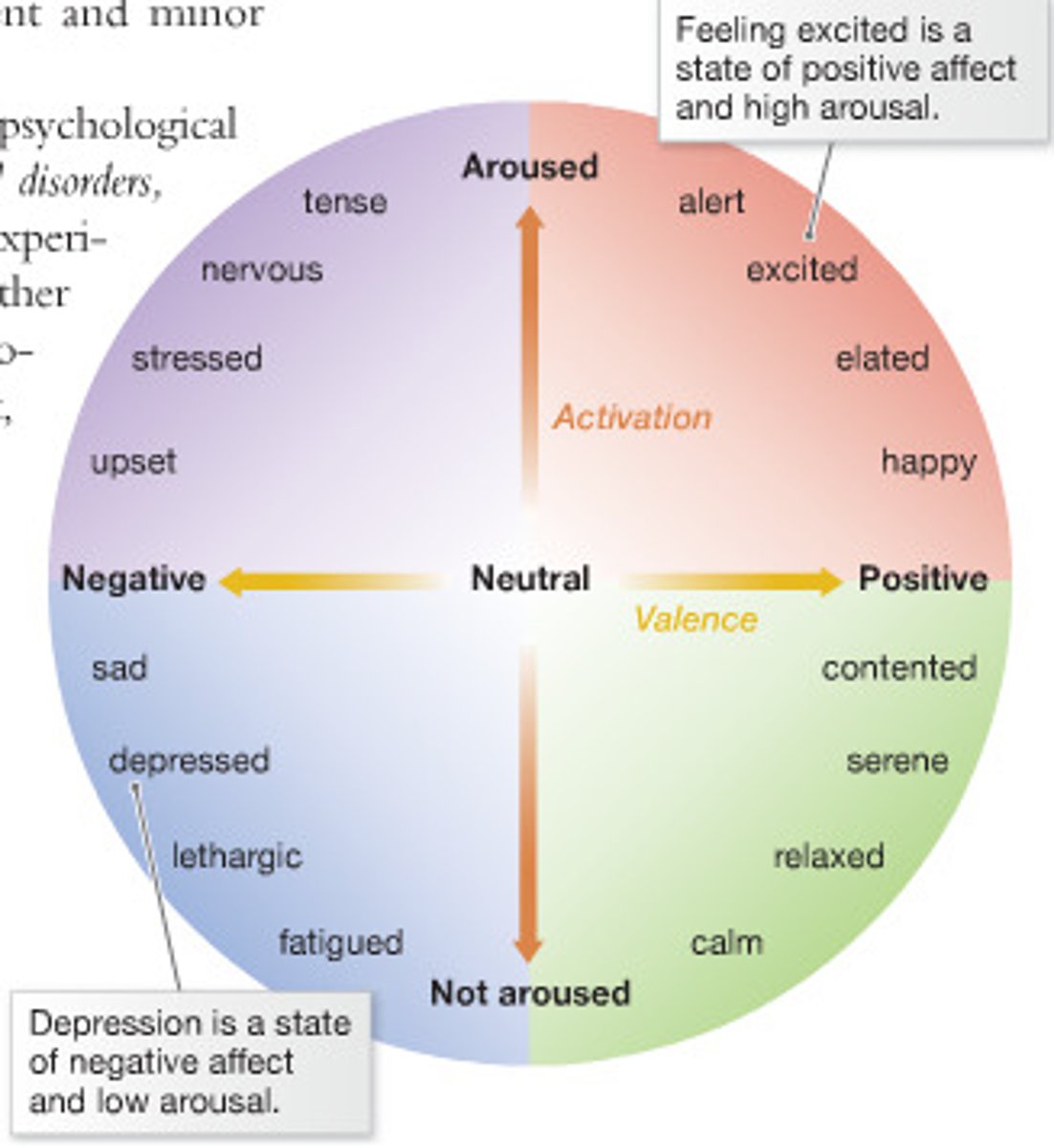
The "dimensional" approach to emotions
Russel's circumplex model of emotions. x axis: pleasant, unpleasant. y axis: high arousal, low arousal. Understood in terms of quadrants
-Top right: surprised
-Top left: contempt
-Bottom right: relaxed
-Bottom left: gloomy
Low arousal emotions DO impact behavior, such as sadness
Three notable theoretical perspectives on emotion
The "nature" perspective, the "nurture" perspective, cognitive perspectives.
The "nature" perspective of emotion
Emphasizes genetic basis for emotional experiences/expression. Emotions framed as "universal" properties of a given species
The "nurture" perspective of emotion
Emphasizes the "social construction" of emotion; assumes that different cultures have different emotional experiences
Cognitive perspectives of emotion
Emphasizes the role of goals/cognition in triggering different emotions
Traditional role of anger
Seen as exclusively leading to negative consequences. At least 30 diagnosable illnesses related to anger. High levels of anger (chronic levels) are correlated with high levels of physical ailments. Also associated with higher risks of cardiovascular disease
Anger as a motivator
No social protests without anger. A trigger of anger can be social injustice. Wanting to do something about it
BIS (behavioral inhibition system)
Dampens down activation, trying to reduce activation, fear and anxiety tries to push down things we are worried about
Two types of justice
Restorative, retributive
Retributive justice
Response focused on the offender's past behavior, crime is an individual act with individual responsibility, victims are (somewhat) peripheral to the process (eye for an eye), the offender is defined by deficits, focus on establishing blame or guilt on the past (did she do it?), imposition of pain to punish and deter/prevent**
Helper's high
Empathetic acts make the helper feel good. Trigger the release of endorphins. Being empathic towards others can be selfish act.
Self-serving
Doing something for others and feeling good about yourself.
Common view by liberals of conservatives
Liberals feel like conservatives lack empathy. "The Cold Hearts of Conservatives."
Common view by conservatives of liberals
Conservatives feel like liberals have "bleeding hearts." Perceived excess of empathy.
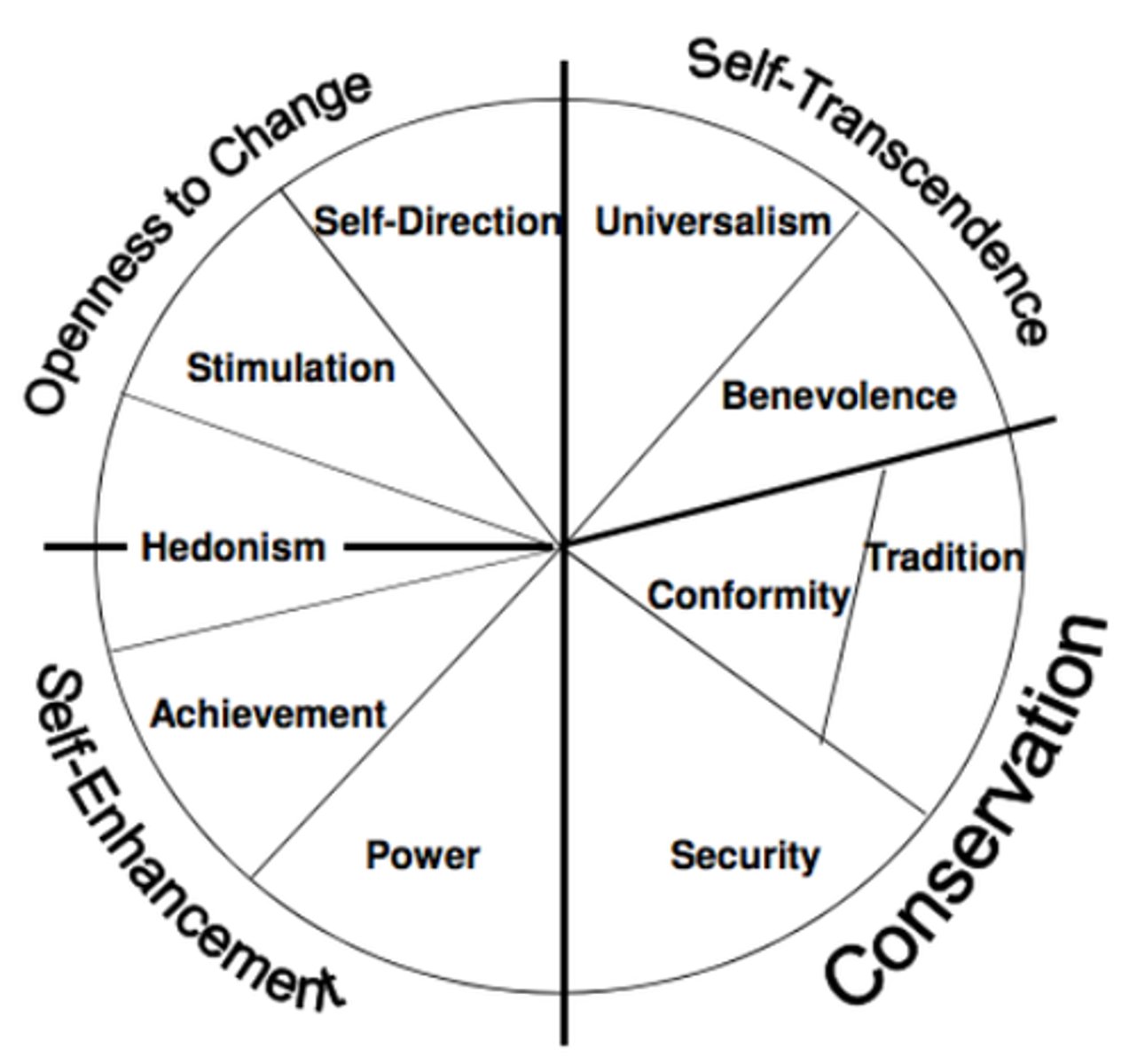
Shalom Schwartz Value Circumplex
Liberals: openness to change, self-transcendence (broadly related to how public views empathy). Conservatives: self-enhancement, self-transcendence (broadly opposite to how the public views empathy).
Right Wing Authoritarianism (RWA)
Correlated somewhat with religiosity. Not related to empathy
Social Dominance Theory (SDO)
SDO is more related to empathy. "Some groups of people are just inferior to others." "An ideal society requires some groups to be on top and others on the bottom." "We should not push for group equality." People who score high in social dominance tend to score low in empathy. They believe in a hierarchical society, Quasi darwinians. They tend to believe strongly in a belief of a just world: people who are on top are deserving of their status
Other relevant differences between liberals and conservatives
Liberals are concerned about poverty in general. Not just in their countries but in the world. Conservative ingroups are much smaller, they are much more tribal (concerned with people they know personally).
Parochial empathy
Empathy is directed in different directions, allocated in different ways. Empathy is a limited resource: we can't be empathic towards everyone, even if we wanted to be. Empathy does not exist in a vacuum, it is guided by pre-existing world views (such as politics). People thus (metaphorically) can dole out empathy in (somewhat) different directions, depending on, for example, whether they are liberal or conservative. This can lead to social division and further polarization
Do You Feel My Pain? Racial Group Membership Modulates Empathetic Neural Responses (Xu et al. 2009)
Anterior Cingulate Cortex active when asked to feel another's pain. Design: Caucasian and Chinese participants were exposed to a random assortment of of 48 short videos, each depicting faces receive in either a painful (needle stimulation) or non-painful (q-tip) stimulation. Faces were either Caucasian or Chinese. Main findings: Ps show greater neurological reactions to perceived pain of ingroup vs. outgroup members. Analyses are complex. This experiment displayed an in group favoritism effect.
Rodney Kind and OJ Revisited experiment
The study manipulated two variables: target race (white, black), motivation for participants to be empathic (high, low). Control condition was not given any instructions at all. All participants were white. White participants —> white defendant—> high empathy condition: try to imagine how Mr. Williams felt and try to out yourself in his position; low empathy condition: try to be as objective as you can while reading and try to remain as detached as possible. White participants —> Black defendant —> high empathy and low empathy were the same as above. Results: empathy set instructions worked, but did not erase ingroup-outgroup effect. In every condition, empathy for the white defendant was higher.
 Note
Note  Flashcards (39)