Attachment
 Call Kai
 Learn
Learn Practice Test
 Spaced Repetition
 Match
Match Flashcards
 Knowt Play
1/34

There's no tags or description
Looks like no tags are added yet.
Name | Mastery | Learn | Test | Matching | Spaced | Call with Kai |
|---|
No analytics yet
Send a link to your students to track their progress
35 Terms
attachment
a close two way emotional bond.
Reciprocity
turn taking - the infant and mother respond to each others signals and each ellicit a response from other.
interactional synchrony
Mother and infant reflect both actions and emotions of the other in a coordinated synchronised way.
Evaluation of caregiver-infant interactions
+ controlled in a lab and filmed so observations are recorded and analysed later
- hard to interpret a baby's behaviour , lack coordination and subtle changes in expression
- simply observing behaviour does not indicate developmental importance
Stages of attachment (Schaffer and Emerson)
Asocial, indiscriminate, discriminate, multiple
Glasgow study 1964 60 babies male and female working class
Stages of attachment evaluation
+ high ecological validity, in natural environmetn
- generalisability on glasweigen working class babies
+practical application for day care
- mothers are observers could be biased
Role of the father
-Schaffer and Emerson found that 75% of the infants in their study formed a secondary attachment to their father by the age of 18 months, with 29% doing so within a month of forming a primary attachment, as demonstrated by separation anxiety.
Field filmed 4 month old babies and found that fathers can be primary caregivers and they were seen to adapt behaviours of mothers.
Grossman et al - attachment with father is less important for later life
evaluation role of the father
- lack of clarity over quesions being asked, some studies investigate father as secondary attachment figure others investigate them as a primary
+ can be used as advice for parents
Lorenz 1935
imprinting after being with lorenz goslings became attached to him rather than mother. if no attachment formed in 32 hours them perment damage - critical period
evaluation for lorenz
-generalisability - to humans
+ reliability further research by Regoin and vallortigara shows same results
+ ecological validity - field experiment
- ethical issues with goslings
Harlow studies
1958 16 monkeys with wire and cloth mother, 8 had wire mother for food, 8 had cloth mother for food. Both spend majority of time with cloth mother. and went to cloth mother when scared by object.
1965 Baby monkeys seperated from mother at birth and rejoined with other monkeys after 3,6,9 or 12 months. they were bullied and self harmed were bad mothers etc, but if rejoined after 3 months it was reversable
evaluation of harlow
-generalisability to humans
+ reliabiltiy his later experiements shows similar results, show monkey damaged from lack of attachemetn
+ real world application , importance of parenting
_ ecological validity in lab
- ethical issues to monkeys
Learning theory of attachment
acquired through classical conditioning reinforced through operant
Dollard and Miller - cupboard love theory
evaluation of learning theory of attachment
- lack of support from harlows study
- Schaffer and emerson found babies would attach to whoever was most responsive to them
Biological explanation: bowlbys monotropic theory
evolutionary
monotropy; attached to one specific caregiver
critical period around 6 months butextends to 2 years
social releasers; behaviours baby gives to attract adult social interaction
internal working model concept of a relationship child learns from their caregiver to model future relationships
Evaluation of Bowlby's monotropic theory
+Practical application in social care and orphanages
- alternative theory dollard and miller
- opposing research to monotropy by dollard and miller who found babies can form attachments to multiple caregivers.
Behaviours judged in strange situation
Proximity seeking, Exploration, Secure-base, Stranger-anxiety, Separation anxiety, Reunion behaviour
Stages of Strange Situation
1) Both introduced to the room
2) Left alone and the child can investigate the toys in the room
3) Stranger enters the room, speaks to the mother and slowly approaches the infant with a toy
4) Mother leaves and the stranger interacts with the child
5) Mother returns to greet and comfort the child
6) Child if left alone
7) Stranger returns and tries to engage with the child
8) Mother returns, greets and picks up the child while the stranger leaves inconspicuously
types of attachments (Ainsworth)
secure (type B) 60-75%
insecure avoidant (type A) 20-25%
insecure resistant (type C) 3%
properties of attachment types
Secure - high secure base, high reunion behaviour, with moderate exploration, stranger, separation and prox seeking
Insec-avoid - low proxseeking, secure base and seperation anx, moderate stranger and reunion. High exploration
Insec-Resistant - low exploration and reunion, high proxseeking, secure base, seperation, stranger
Evaluation of Strange Situation
- relevancy in different cultural contexts, Japan it is seen as normal for Child to be more close to mother during early years
+ Can be used in practical applications to assess childs relationship with parent
+ Can be used to predict later development - secure more successful in education
- ethical issues with seperating child from mother if it causes distress
Van Ijzendoorn and Kroonenberg Study
Meta-analysis of 32 studies across 8 countries.
UK most secure, Germany most insecure avoident, israel and japan more insecure resistant
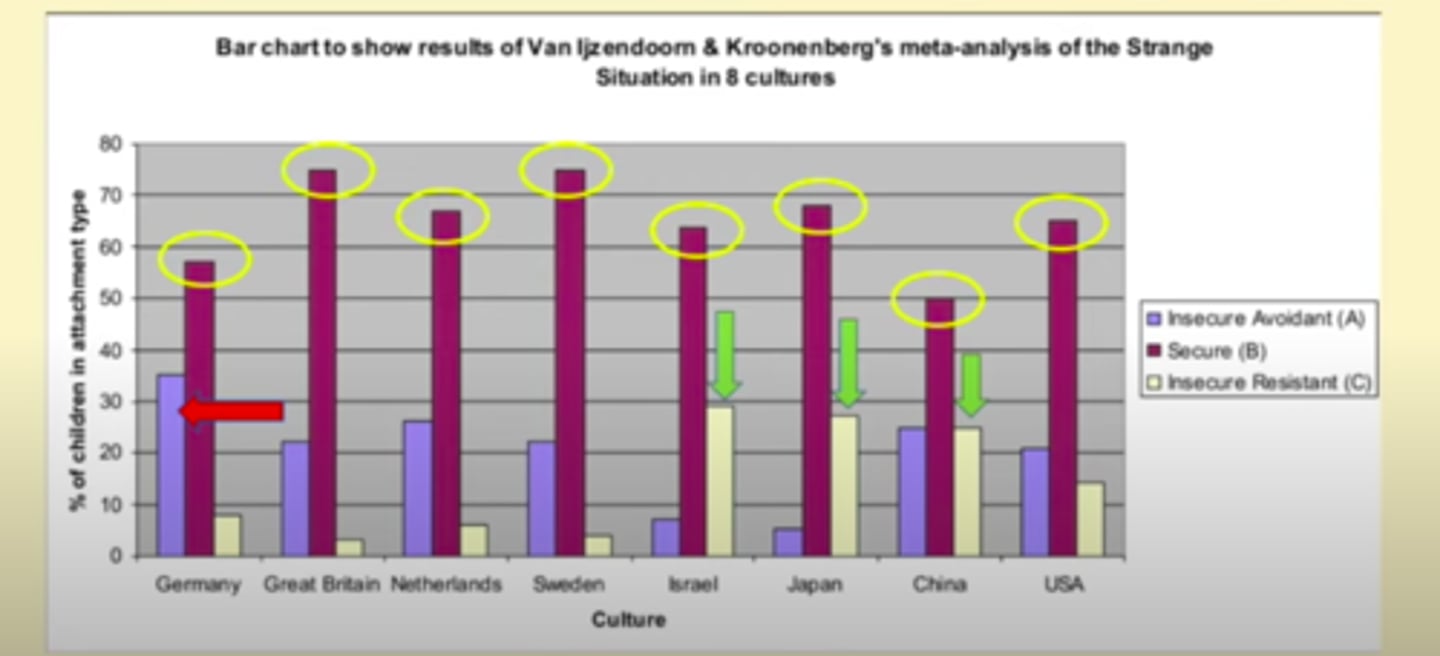
Van Ijzendoorn and Kroonenberg evaluation
+ Carried out using indigenous psychologists
- Test designed for western culture
+Comparison is aided by the standardised methodology. The use of the strange situation as a procedure means that a comparison can be made across cultures, and the reliability is therefore high
Bowlby's theory of maternal deprivation
Maternal deprivation = continued separation or loss of mother
Privation - not having an opportunity to form a bond in the first instant.
Bowlby's 44 thieves study
44 teenage 'thieves' were interviewed for signs of affectionless psychopathology. Their families were interviewed in order to establish whether the 'thieves' had prologues early separation from mothers. A control group of non-criminals but emotionally disturbed young people was set up to see how often maternal separation/ deprivation occurred in children who were not thieves.
Bowlby found that 14/44 thieves could be described as affectionless psychopaths. Of this 14, 12 had experienced prolonged separation form their mothers in their critical period.
This shows failing to form an attachment can lead to affectionless psychopathology.
In the control group 2/44 had maternal separation but 0 were affectionless psychopaths.
Bowlby's 44 thieves study evaluation
- correlation doesnt imply causation
- all boys so hard to generalise
- control group had 0 affectionless psychopaths so possible other variables are linked
Aileen Wuornos
Had a traumatic childhood, abandoned by mother at 4 years old etc.
Killed 7 men (with gun) while working as a prostitute in Florida. Men were strangers. Executed, received 6 death sentences.
Maternal deprivation evaluation
-methodological flaws
+case study aileen wuornos
-supporting evidence may be poor
Romanian orphan studies
1966 dictator banned abortions and encouraged women to have large families
When overthrown in 1989 media became aware of more than 100,000 children in 600 orphanages
minimally staffed and overpopulated
Rutter et al romanian orphans
longitudinal 1990s Studied Romanian institutionalized children.
2 Groups. 1 - before 6 months 2- between 6 months to 2 years.
Control group of those adopted in the UK
If adopted before 6 months they would catch up to uk children
If adopted after 6 months they would show more significant deficits and disinhibited attachments
Properties of Romanian orphans according to Rutter et al
Quasi-autism - difficulty with social and language
Disinhibited attachment - attention seeking and clingy, problems with adult rels
Emotional problems
Physical growth delay
Lower IQ if adopted after 6 months
Other studies of Romanian Orphans
Hodges and Tizard - 65 children who were in childrens home till 4. almost all formed close attachments with parents but had difficulty with friendships and were more attention seeking than control group
Evaluation of romanian orphan studies
-Generalisability - in Romania - Orphanages were unusually bad conditions- unlike modern day orphanages
+ethics simply an observation
Hazan and Shaver (1987)⭐️- influence of attachment
developed a love quiz which looked at attachment type and childs relationship with parents
Internal working model could influence this
securely attached - love experiences as happy, friendly and trusting. more accepting of partner regardless of fault.
Insecure- avoidant - feared intimacy, experienced emotional highs lows and jealousy
Insecure- resistant - obsessive lovers, desire for reciprocation, emotionally high and low, extreme sexual attraction, jealousy and worry that their partners didnt love them
Evaluation of early attachment on later relationships
- research is correlational, a third variable could be at work
- relies on retrospective recall. adults are assessed and asked about childhood attachment which they likely dont have a good memory of nor are honest about
-alternative theory, Temperament hypothesis- Kagan, argues some infants are more innate- friendly and easier for mother to care for, however other infants who have more difficult personalities make it more difficult to mother to care for them

