The Adaptive Immune System
 Studied by 0 people
 Call Kai
 Learn
Learn Practice Test
 Spaced Repetition
 Match
Match Flashcards
 Knowt Play
1/15

There's no tags or description
Looks like no tags are added yet.
Name | Mastery | Learn | Test | Matching | Spaced | Call with Kai |
|---|
No analytics yet
Send a link to your students to track their progress
16 Terms
Why is it referred to as the ‘adaptive’ immune system?
The adaptive immune response is specific to the pathogen and involves recognising antigens being “foreign” to the body.
What are the 2 strands of action to the adaptive immune system?
Humoral response
Cell-mediated response
What does the humoral response involve?
The humoral response results in the production of antibodies.
B lymphocytes originate from stem cells in the bone marrow and mature in the spleen and lymph nodes.
There are many different B lymphocytes and each B lymphocyte has receptors for the detection of its specific antigen. When a B lymphocyte with a specific receptor binds to the specific antigen it is activated. This is called clonal selection.
Activation stimulates the B lymphocyte to undergo mitosis, rapidly forming clones of plasma cells and B memory cells. This is clonal expansion and differentiation.
Where do B lymphocytes originate from?
From stem cells in the bone marrow.
Where do B lymphocytes mature?
In the spleen and lymph nodes.
What is the role of plasma cells?
Release antibodies, which bind to antigens on the pathogen surface.
What is the role of B memory cells?
Memory cells remain in the circulation, ready to divide quickly if the same antigen is encountered again.
What is an antibody?
Antibodies are proteins (globulins) which are specific to the antigen with which they bind to form an antigen-antibody complex.
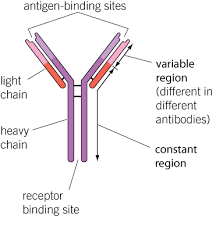
Describe the structure of an antibody.
Antibodies are Y shaped glycoprotein molecules, called immunoglobulins.
They have a quaternary structure as each molecule is made of 4 polypeptide chains, held together by disulphide bonds / bridges.
The binding sites are variable regions that have specific complementary shapes to the antigen. As there are two binding sites, two different antigens can be joined by one antibody molecule. This is called agglutination.
The hinge region is flexible, allowing the antibody to flex and bind to two antigens on the same organism when they are different distances apart.
How many different antigens can be joined by one antibody molecule?
2.
What is agglutination?
The clumping together of cells or particles caused by antibodies which assists phagocytosis.
How may an antigen-antibody complex render an antigen inactive?
An antigen-antibody complex renders the antigen inactive in some way, such as through agglutination, which increases the rate of engulfment by phagocytes. If viruses or toxins are joined together by agglutination, it can mean that they are too large to enter a cell.
What is the cell-mediated response?
The cell-mediated response refers to the activation of phagocytic cells, B and T lymphocytes.
What does the cell-mediated response involve?
T lymphocytes, which also originate from stem cells in the bone marrow, are activated in the thymus gland.
Macrophages, which have engulfed the microbes in the innate response, display the antigens of the microbe on their cell surface; they are antigen presenting cells.
Specific T lymphocytes with complementary receptors, detect the corresponding specific antigen (clonal selection), which causes the proliferation of the specific T lymphocytes (clonal expansion).
The T lymphocytes differentiate into effector (killer) cells, helper T cells and memory cells.
What is the role of effector (killer) cells?
Effector cells (T killer or cytotoxic T lymphocytes) cause lysis of pathogenic cells.
What is the role of T helper cells?
Helper T cells release cytokines, which stimulate B lymphocytes to initiate an antibody response. Cytokines also stimulate phagocytosis by macrophages. Cytokines stimulate clonal expansion of B and T lymphocytes – mitosis results in a large population of cells specific to that particular antigen.
 Note
Note  Flashcards (154)