Lecture 6: Learning & Memory IV
 Studied by 0 people
 Call Kai
 Learn
Learn Practice Test
 Spaced Repetition
 Match
Match Flashcards
 Knowt Play
1/16

There's no tags or description
Looks like no tags are added yet.
Name | Mastery | Learn | Test | Matching | Spaced | Call with Kai |
|---|
No analytics yet
Send a link to your students to track their progress
17 Terms
What does damage to the hippocampus do to humans and rodents?
Devastates spatial memory (Morris Water Maze)
What are place cells, and what does their firing pattern represent?
Place cells are neurons in the hippocampus that fire selectively when an animal is in a specific location in an environment.
Each place cell has a place field: a region of space where its firing rate is high.
Outside that location, the neuron is mostly silent.
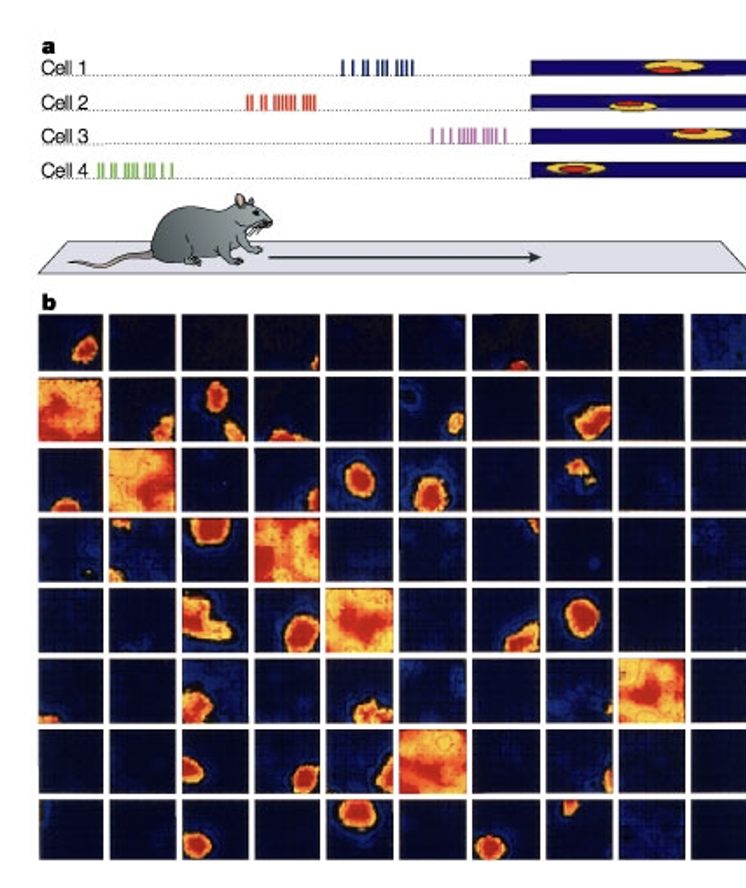
How common are place cells, and what does their population activity represent?
Roughly ⅓ to ½ of hippocampal neurons are place-specific in a given environment.
Each neuron has:
One or a few place fields
Varying precision (some broad, some highly specific)
How does the hippocampus decode location from place cells?
The hippocampus uses a population code, not single neurons.
Each place cell has a broad place field, and many fields overlap.
A specific location is represented by the unique pattern of activity across many place cells, not by one “location neuron.”
What does the CaMKII T286D (asparate) mutation reveal about the role of LTP in place cell stability?
CaMKII T286 (normally autophosphorylated) is critical for LTP maintenance.
In normal mice, CA1 place cells show stable place fields across sessions (same location day to day).
In CaMKII T286D mutant mice, place fields are:
Diffuse
Unstable
Shift dramatically between sessions
Even if a place field forms once, it does not persist (LTP needed to maintain synaptic strength)
How do hippocampal place cells differ from grid cells in spatial representation?
Place cells (hippocampus) fire in one specific location → encode “where am I right now” in a particular environment.
Grid cells (medial entorhinal cortex, MEC) fire at multiple locations arranged in a regular hexagonal lattice → provide a metric map of space (distance + direction).
Why do place fields change size along the dorsal–ventral axis of the hippocampus?
Dorsal MEC grid cells have small grid spacing → project to dorsal hippocampus → small, precise place fields.
Ventral MEC grid cells have large grid spacing → project to ventral hippocampus → large, coarse place fields.
Enlargement permits unique population response to any location
What happens when an investigator makes a null mutation in NMDA-R for CA3 pyramidal neurons?
Mice with unresponsive CA3 develop place fields in CA1 very slowly.
Direct EC → CA1 = slow, coarse spatial representation
Trisynaptic circuit (via CA3) = fast, refined place fields
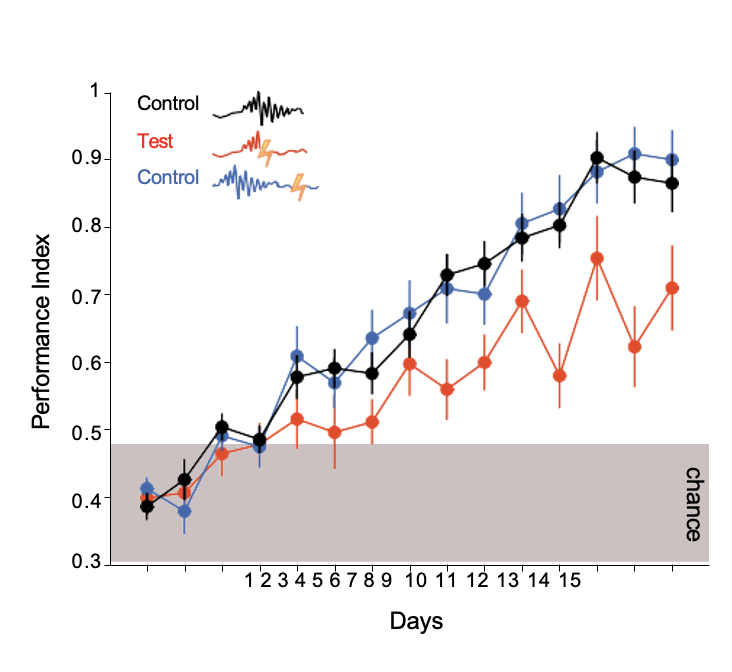
What happens in the hippocampus (HPC) during sleep, and why does it matter for memory?
HPC shows brief, high-frequency events called sharp-wave ripples (~200 Hz).
Place cells replay sequences of activity that occurred during waking exploration—often in the same order (or compressed/reversed).
Stabilizes + transfer memory → LTM
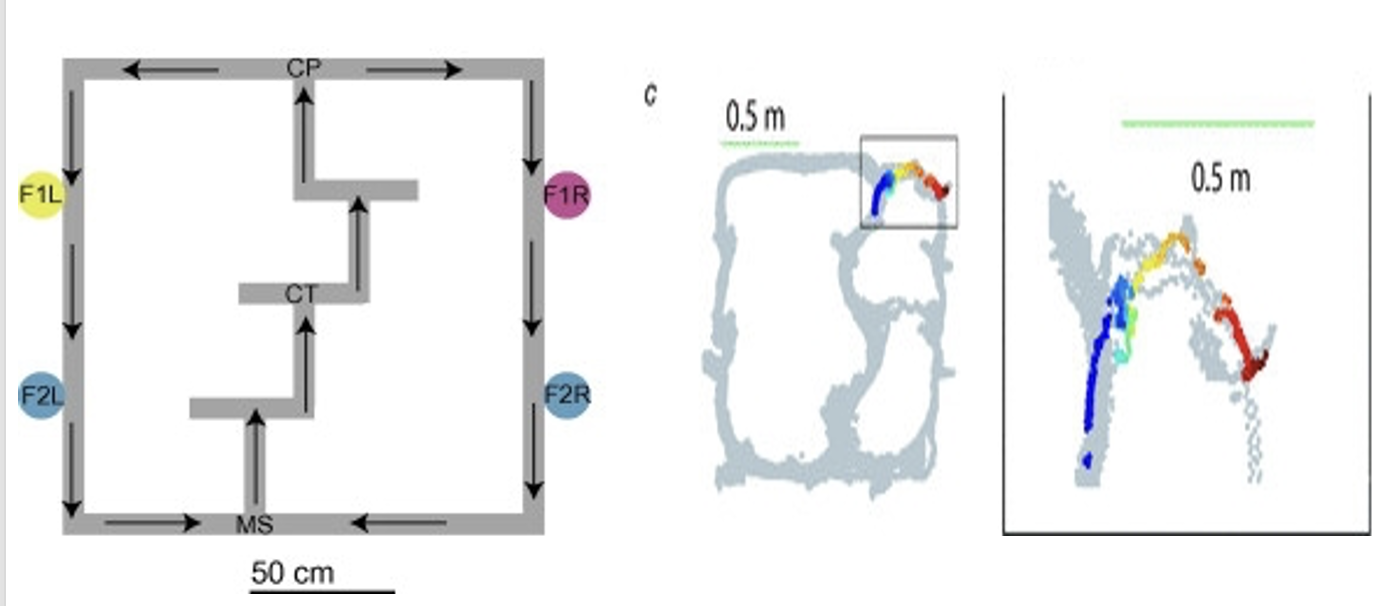
What is vicarious trial and error (VTE) in the hippocampus
VTE = a phenomenon in which, at a decision point (e.g., a T-junction), hippocampal place cells fire in sequential patterns representing alternative future paths, even though the animal is not moving down them.
These sequences match the firing order during actual movement and reflect internal simulation of possible choices to guide decision-making.
What happens when amygdala is damaged bilaterally?
Disrupts emotional processing/memory
Kluver–Bucy syndrome = bilateral amygdala damage; visual agnosia, hypersexuality, hyperorality, inappropriate responses to social cues (esp. emotional)
How does the amygdala inform rest of CNS about emotional processes?
Amygdala receives input from all sensory systems:
Sends separate outputs to thalamus, ventral striatum, hypothalamus
How does the amygdala help with associative learning?
By integrating information across all sensory systems, amygdala contains circuits that pair co-occurence of repeated events to produce appropriate response.
Conditioning e.g. siphon-tail
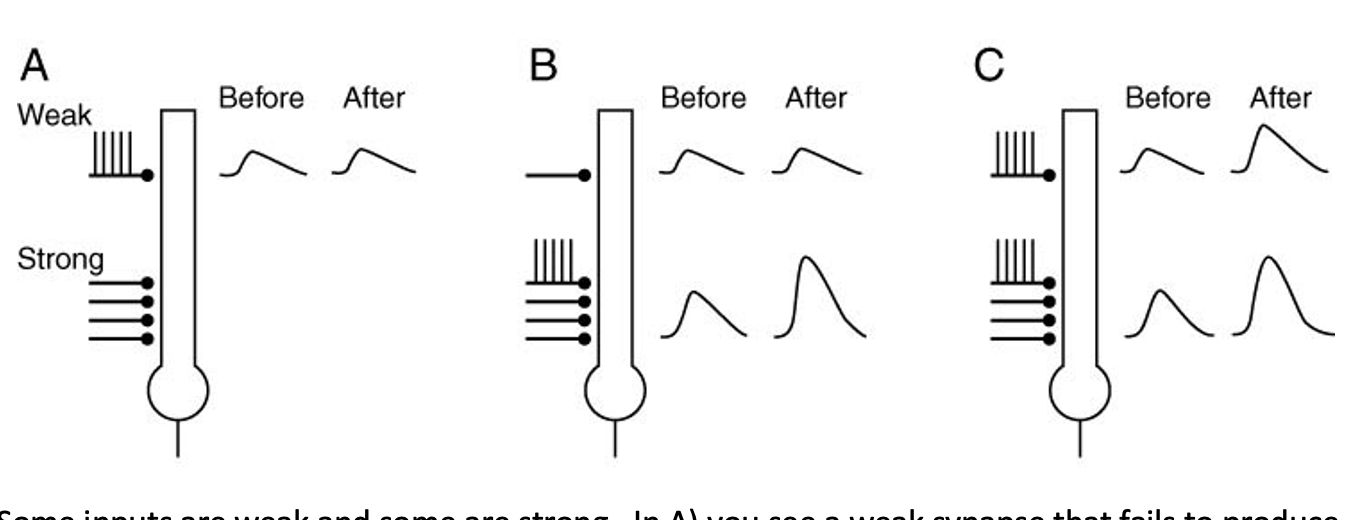
What’s a homosynaptic vs. heterosynaptic LTP?
Homosynaptic = when the same synapse that receives HFS undergoes long-term potentiation.
Heterosynaptic = weak synapse potentiates only because it is active at the same time as a nearby strong synapse.
Aplysia tail-siphon
What’s an example of heterosynaptic in fear conditioning?
Pair tone w/ footshock to rat → freezes when presented with tone alone.
This circuit has nociceptive + auditory inputs reach amygdala from thalamus + cortex → neurons in amygdala become strongly driven when tone paired w/ shock.
Fear conditioning uses same molecular logic as hippocampal LTP (Ca²⁺ → kinases → CREB → LTP/fear) but implements it in amygdala circuits to store emotional memories.
When does fear extinction appear?
Extinction occurs when tone presented repeatedly w/o additional shock pairing.
But present the tone in a different box again, rat will freeze → extinction is context-dependent
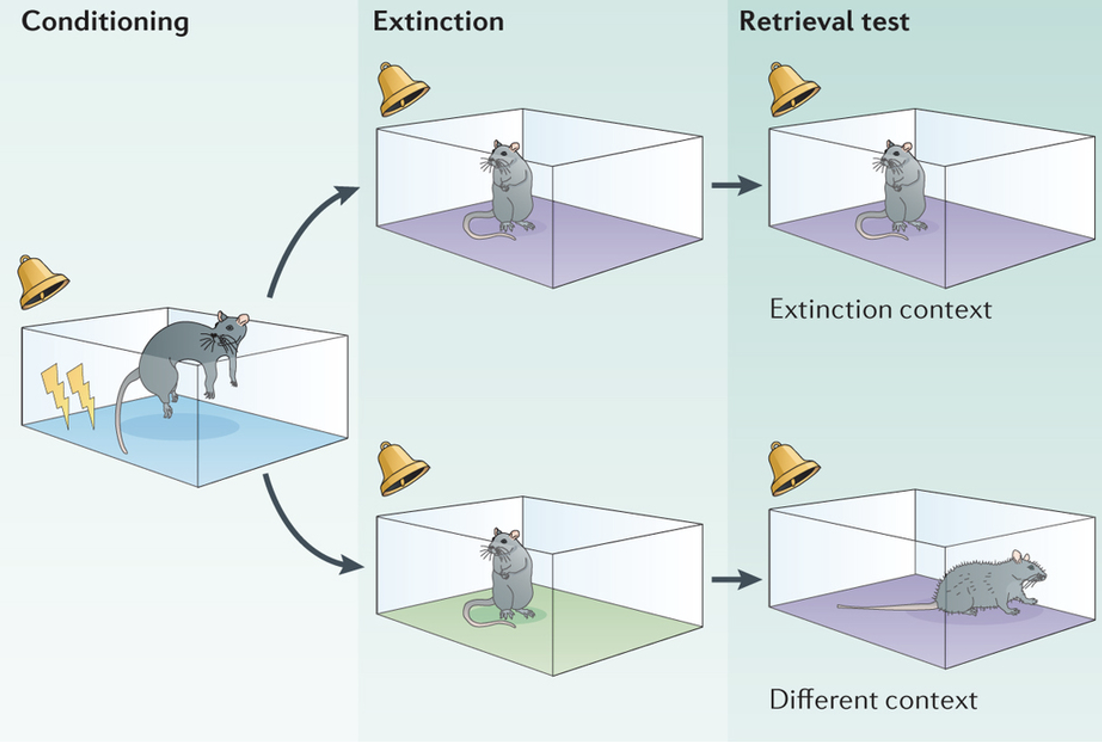
What are the 2 lessons about fear extinction + renewal?
Repeated presentation of conditioned stimulus w/o shock → extinction (PFC activates inhibitory neurons in amygdala)
Single re-pairing of shock + tone brings back fear response even stronger (due to HPC involvement).
 Note
Note  Flashcards (42)