EMF301c - MOOC 1
 Call Kai
 Learn
Learn Practice Test
 Spaced Repetition
 Match
Match Flashcards
1/49

There's no tags or description
Looks like no tags are added yet.
Name | Mastery | Learn | Test | Matching | Spaced | Call with Kai |
|---|

50 Terms
What is the force between two people at arm's length (0.3 m) if they have 1% more protons than electrons in their body (Newton)? The number of protons in human body is 2.38E28 and the charge each proton has is 1.6E-19 C.
A. 1.5E24
B. 9E9
C. 1.45E-26
D. 1.45E26
D. 1.45E26
Q=0.01\times N_{p}\times e=0.01\times(2.38\times10^{28})\times(1.6\times10^{-19}\,\text{C}) =3.808\times10^7\,\text{C}
F = k \frac{Q^2}{r^2}
F = (9 \times 10^9) \frac{(3.808 \times 10^7)^2}{(0.3)^2}
F \approx 1.45 \times 10^{26} \text{ N}
What is the major force that holds atoms and molecules together?
A. Electric force
B. Gravitational force
C. Nuclear force
D. Centrifugal force
A. Electric force
What holds negatively charged electrons together?
A. Electric Forces
B. Magnetic Forces
C. Unknown Forces
D. Gravitational forces
C. Unknown Forces
If an electric field of 3 V/m overlaps another field of 6 V/m, what is the value of the electric field where the two fields overlap (in V/m)? (Here, two electric fields have the same direction)
9
(3 + 6)
If an electric field of 3 V/m overlaps another field of 6 V/m (the direction of the two fields is the same), and a charge of 0.5 C is placed in the overlapping field, what is the force it will feel (in Newton)? (Please put your number in X.X format)
4.5
(3 + 6) * 0.5
A field is any _________ which takes on different values at different points.
A. physical quantity
B. vector superposition
C. gravitational force
D. scalar multiplication
A. physical quantity
(True/False) Magnetism is a relativistic effect of electricity.
True
What is the difference between the scalar and vector fields?
A. Scalar fields have magnitude, while vector fields have both magnitude and direction.
B. You can experimentally measure scalar fields but not vector fields.
C. The scalar field can only be represented by field lines and contour maps.
A. Scalar fields have magnitude, while vector fields have both magnitude and direction.
Which of the following is true:
A. Wires with currents flowing in the same direction attract.
B. Wires with currents flowing in the same direction repel.
C. Wires always attract if there is some current flowing through them.
D. Wires always repel if there is some current flowing through them.
A. Wires with currents flowing in the same direction attract.
What is your preferred way to visualize a field? (2 answers)
A. Mathematical equations
B. Vector fields
C. Field lines
B. Vector fields
C. Field lines
What is the dot product of (1,3) and (4,5)?
19
(1 × 4) + (3 × 5)
Check all that are true about the ∇ operator (>1 answer):
A. The operator means nothing by itself.
B. Like all vectors T∇= ∇T.
C. ∇T has the direction of the steepest uphill slope.
D. The result of applying the ∇ operator on a scalar field can be both a vector or a scalar field.
A. The operator means nothing by itself.
C. ∇T has the direction of the steepest uphill slope.
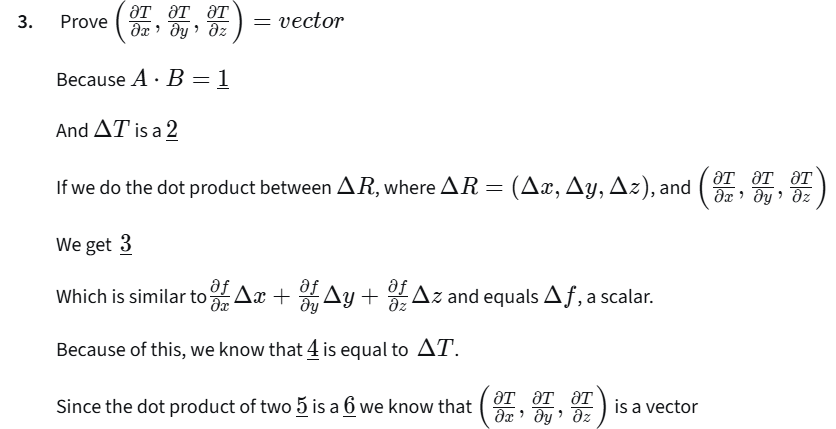
Prove(\frac{\partial T}{\partial x}, \frac{\partial T}{\partial y}, \frac{\partial T}{\partial z}) = \text{vector}
BecauseA \cdot B = 1
And\Delta T is a 2
If we do the dot product between\Delta R, where\Delta R = (\Delta x, \Delta y, \Delta z)
and(\frac{\partial T}{\partial x}, \frac{\partial T}{\partial y}, \frac{\partial T}{\partial z})
We get 3
Which is similar to\frac{\partial f}{\partial x}\Delta x + \frac{\partial f}{\partial y}\Delta y + \frac{\partial f}{\partial z}\Delta zand equals\Delta f, a scalar.
Because of this, we know that 4 is equal to\Delta T.
Since the dot product of two 5 is a 6 we know that(\frac{\partial T}{\partial x}, \frac{\partial T}{\partial y}, \frac{\partial T}{\partial z})is a vector.
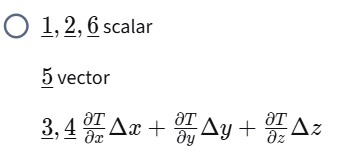
A.\underline{1}, \underline{2}, \underline{5}, \underline{6} vector;
\underline{3}, \underline{4}(\frac{\partial T}{\partial x}\Delta x, \frac{\partial T}{\partial y}\Delta y, \frac{\partial T}{\partial z}\Delta z)
B.\underline{1}, \underline{2}vector;
\underline{5}, \underline{6}scalar;
\underline{3}, \underline{4}(\frac{\partial T}{\partial x}\Delta x, \frac{\partial T}{\partial y}\Delta y, \frac{\partial T}{\partial z}\Delta z)
C.\underline{1}, \underline{2}, \underline{5}, \underline{6}scalar;
\underline{3}, \underline{4}\frac{\partial T}{\partial x}\Delta x + \frac{\partial T}{\partial y}\Delta y + \frac{\partial T}{\partial z}\Delta z
D.\underline{1}, \underline{2}, \underline{6}scalar;
\underline{5}vector;
\underline{3}, \underline{4} \frac{\partial T}{\partial x}\Delta x + \frac{\partial T}{\partial y}\Delta y + \frac{\partial T}{\partial z}\Delta z
D.\underline{1}, \underline{2}, \underline{6}scalar;
\underline{5} vector;
\underline{3}, \underline{4} \frac{\partial T}{\partial x}\Delta x + \frac{\partial T}{\partial y}\Delta y + \frac{\partial T}{\partial z}\Delta z
Write Maxwell's Equations in vector form
1\mathbf{E}=\frac{\rho}{\epsilon_0}
2\mathbf{E}=-\frac{\partial\mathbf{B}}{\partial t}
3\mathbf{B}=0
4 \mathbf{B}=\frac{\partial\mathbf{E}}{\partial t}+\frac{\mathbf{j}}{\epsilon_0}
A. 1, 3\nabla \times ;
2, 4\nabla \cdot
B. 1, 2\nabla \cdot ;
3, 4\nabla \times
C. 1, 2\nabla \times;
3, 4\nabla \cdot
D. 1, 3\nabla \cdot;
2, 4\nabla \times
D. 1, 3\nabla \cdot;
2, 4\nabla \times
We can take Laplacian on a vector field
True
Apply the del operator to 3xy+z^2 .
A. (2z, 3x, 3y)
B. (2z, 3y, 3x)
C. (3y, 3x, 2z)
D. (3x, 3y, 2z)
C. (3y, 3x, 2z)
Đặt
f(x, y, z) = 3xy + z^2 . Ta tính các đạo hàm riêng:
Đạo hàm theox:
\frac{\partial}{\partial x}(3xy + z^2) = 3y
Đạo hàm theoy:
\frac{\partial}{\partial y}(3xy + z^2) = 3x
Đạo hàm theoz:
\frac{\partial}{\partial z}(3xy + z^2) = 2z
Ghép các thành phần lại, ta được vector:
\nabla f = (3y, 3x, 2z)
If the curl A is ___ then A is always the gradient of a scalar.
0
If the divergence of D is zero than D is the _____ of a vector.
curl
The curl of a curl is always zero
False

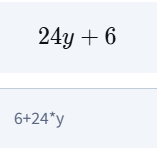
Take the laplacian of 3x2 + 4y3 (use * for multiplication).
24 * y + 6
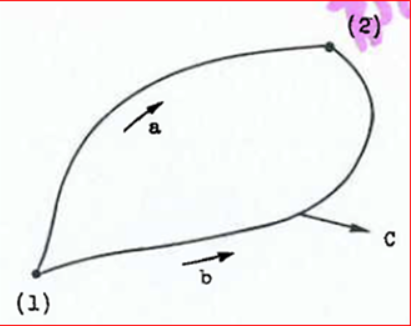
Which path has higher linear integral of ∇Ψ associated with it?
A. a
B. b
C. They are equivalent.
C. They are equivalent.
What is a key difference between heat flux and electric flux?
A. Heat flux doesn't have to be continuous.
B. Heat flux always flows out of a surface.
C. Electric flux is a function of distance traveled.
D. Electric flux does not have flow of matter.
D. Electric flux does not have flow of matter.
What is the divergence of an electric field from a very small cube where the flux is 12V \cdot m
and the volume of a small cube is 1nm^3
in unit ofV/m^2? [Here10^9nm = 1 m, and use Gauss' theorem for a cube]
A. 1.2E28
B. 1.2E19
C. 1.2E-28
D. 12
A. 1.2E28
\Phi \approx (\nabla \cdot \mathbf{E}) \cdot V \implies \nabla \cdot \mathbf{E} = \frac{\Phi}{V}
\nabla \cdot \mathbf{E} = \frac{12}{10^{-27}} = 12 \times 10^{27} = 1.2 \times 10^{28} \text{ V/m}^2
The ______ of a vector field is equal to the circulation of the vector field per unit area
curl
The _____ of a vector field is equal to the flux of the vector field per unit volume
divergence
Why is it often more convenient to use the derivative form of equations instead of integral? (>1 answer)
A. Taking derivatives is usually easier than taking the integral.
B. Derivatives are point functions.
C. The derivative does not need an input to provide an answer
D. All of the above
A. Taking derivatives is usually easier than taking the integral.
B. Derivatives are point functions.
What is the characteristic of a curl-free field?
A. A curl free field can be expressed in terms of a curl of a vector field.
B. A curl free field can be expressed in terms of a curl of a scalar field.
C. A curl free field can be expressed in terms of a gradient of a vector field.
D. A curl free field can be expressed in terms of a gradient of a scalar field.
D. A curl free field can be expressed in terms of a gradient of a scalar field.
What is the characteristic of a divergence free field?
A. A divergence free field can be expressed in terms of a gradient of a scalar field.
B. A divergence free field can be expressed in terms of a curl of a scalar field.
C. A divergence free field can be expressed in terms of a curl of a vector field.
D. A divergence free field can be expressed in terms of a gradient of a vector field.
C. A divergence free field can be expressed in terms of a curl of a vector field.
Which of the following is Gauss' Theorem?
A.\int_S \mathbf{C} \cdot \mathbf{n} da = \int_V (\nabla \cdot \mathbf{C}) dV
B.\int_S \mathbf{C} \cdot \mathbf{n} da = \int_S (\nabla \times \mathbf{C}) \cdot \mathbf{n} da
C.\oint_\Gamma \mathbf{C} \cdot d\mathbf{s} = \int_S (\nabla \times \mathbf{C}) \cdot \mathbf{n} da
D.\int_S \mathbf{H} \cdot \mathbf{n} da = -dQ/dt
A.\int_S \mathbf{C} \cdot \mathbf{n} da = \int_V (\nabla \cdot \mathbf{C}) dV
Which of the following is Stokes' Theorem?
A.\oint_{\Gamma} \mathbf{C} \cdot d\mathbf{s} = \int_{S} (\nabla \times \mathbf{C}) \cdot \mathbf{n} da
B.\psi(2) - \psi(1) = \int_{(1)}^{(2)} (\nabla \psi) \cdot d\mathbf{s}
C.\int_{S} \mathbf{C} \cdot \mathbf{n} da = \int_{V} (\nabla \cdot \mathbf{C}) dV
D.\oint_{\Gamma} \mathbf{C} \cdot d\mathbf{s} = \int_{V} (\nabla \cdot \mathbf{C}) dV
A.\oint_{\Gamma} \mathbf{C} \cdot d\mathbf{s} = \int_{S} (\nabla \times \mathbf{C}) \cdot \mathbf{n} da
A magnetostatic system is always electrostatic.
False
What is the force exerted by a 1 C charge on a 2 C charge 4 m apart (in Newton)?
A. 4.5
B. 125,000,000
C. 1,125,000,000
D. 4,500,000,000
C. 1,125,000,000
F = k \frac{q_1 q_2}{r^2}
F = (9 \times 10^9) \frac{1 \times 2}{4^2}
F = 1,125,000,000 \text{ N}
You can get work out of an electrostatic field by carrying a charge along one path, then back to its origin along a different path.
False
What are the advantages of using electrostatic potential instead of electric field? (>1 answer)
A. You don't have to use integrals to get electrostatic potential.
B. Finding the potential involves using a less complicated integral.
C. Superposition of the potential is easier than superposition of the electric field.
D. Electrostatic potential is only a change not a value.
B. Finding the potential involves using a less complicated integral.
C. Superposition of the potential is easier than superposition of the electric field.
The flux of E out of a volume where the point charge is outside the volume is _____. (Insert a number)
0
The flux of an electric field is proportional to the amount of the charge inside.
True
What is the electric field 4 m away from a charge of 4 C (in terms of V/m)?
A. 2,250,000,000
B. 225
C. 2,250,000
D. 20,000
A. 2,250,000,000
E = k \frac{|q|}{r^2}
E = (9 \times 10^9) \frac{4}{4^2}
E = 2,250,000,000 \text{ V/m}
What is the electric flux out of an arbitrarily shaped volume if it contains a net charge of Q?
A.Q/4\pi R^2\epsilon_0
B.0
C.\int_S Q \mathbf{n} da
D.Q/\epsilon_0
D.Q/\epsilon_0
\Phi_E = \oint_S \mathbf{E} \cdot d\mathbf{a} = \frac{Q_{\text{enclosed}}}{\epsilon_0}
Electric field lines should start at (1) _____ charges, stop at (2) _____, and be (3)_____ to equipotential surfaces.
A. (1) negative (2) positive (3) perpendicular
B. (1) positive (2) negative (3) parallel
C. (1) negative (2) positive (3) parallel
D. (1) positive (2) negative (3) perpendicular
D. (1) positive (2) negative (3) perpendicular
What is the flux from a sphere encompassing a charge of 8 C?
A. 8 C
B. 0 V/m
C. 0 C
D. 8.89E11 Vm
D. 8.89E11 Vm
\Phi_E = \frac{Q}{\epsilon_0}
\Phi_E = \frac{8}{8.85418782 \times 10^{-12}}
\Phi_E \approx 9.035 \times 10^{11} \text{ V}\cdot\text{m}
Which of the following are necessary for a stable equilibrium? (>1 answer)
A.\frac{dU}{dr} = 0
B.\frac{d^2U}{dr^2} = 0
C.\frac{dU}{dr} = \text{maximum}
D.\frac{d^2U}{dr^2} < 0
E.\frac{d^2U}{dr^2} > 0
A.\frac{dU}{dr}=0
E.\frac{d^2U}{dr^2}>0
It is impossible for an electrostatic charge to be at stable equilibrium.
True
The electric field of a uniformly charged infinite plane sheet will theoretically be constant, even at infinite lengths.
True
The electric field inside a cavity of a conductor is _____. Assume there is no net charge inside the conductor as well as in the cavity.
0
All of the charges are located on the ______ of a conductor.
surface
Imagine you have a sphere with a radius of 3\text{ m}, with a volume charge density of 3\text{ C/m}^3. What is the electric field at a radius of 2\text{ m}(in terms of \text{V/m})?
A.2.26 \times 10^{11}
B.2.26 \times 10^{13}
C.2
D.7.63 \times 10^{11}
A.2.26 \times 10^{11}
R = 3\text{ m}, r = 2\text{ m} => r < R
E = \frac{\rho \cdot r}{3\epsilon_0}
E=\frac{3 \cdot2}{3 \cdot(8.854 \times10^{-12})}
E=2.258\times10^{11}\text{ V/m}
Imagine you have a sphere with a radius of 3\text{ m}, with a volume charge density of 3\text{ C/m}^3. What is the electric field at a radius of 6\text{ m}(in terms of \text{V/m})?
8.48\times10^{10}\text{ V/m}
R = 3\text{ m}, r = 6\text{ m} => r > R
Q=\rho\cdot\frac{4}{3}\pi R^3=3\cdot\frac{4}{3}\pi\cdot(3)^3=108\pi\text{ C}
E=\frac{k \cdot Q}{r^2}=\frac{9 \times10^9 \cdot(108\pi)}{36}\approx8.48\times10^{10}\text{ V/m}
Given two sheets with equal and opposite charge densities, the electric field is A between the sheets and B outside of the sheets.
A. A: \frac{\sigma}{2\epsilon_0}
B: \frac{\sigma}{2\epsilon_0}
B. A: \frac{\sigma}{\epsilon_0}
B: 0
C. A: \frac{\sigma}{2\epsilon_0}
B: 0
D. A: 0
B: \frac{\sigma}{\epsilon_0}
E. A: 0
B: 0
B. A: \frac{\sigma}{\epsilon_0}
B: 0
The electric field out of a surface on a conductor has the same electric field as a sheet of charge with the same surface charge density.
False
During a thunderstorm the safest thing to do would be:
A. Stay in your car
B. Stand under a tree
C. Ground yourself
A. Stay in your car
Explore top notes

