Reproduction in Animals
Reproduction
- the process by which living organisms produce young ones of their own kind.
Important of Reproduction
- ensures continuity of species
- prevents extinction of species
- plays important role in evolution → creates variations in organisms through genetic fusions.
Types of Reproduction
- asexual
- sexual
Asexual Reproduction
- no fusion of gametes
- no change in no. of chromosomes
- only 1 parent
- occurs in both unicellular or multicellular organisms
- offspring inherits full set of parent’s genes (it is exact copy) → because only 1 parent’s genes are being inherited
Advantages:
- fast process
- only single parent involved
- daughter cells are exact copies
Disadvantages:
- If parent cell has a disease, it gets transferred to daughter cells. This could disrupt whole species.
Types of Asexual Reproduction
- binary fission
- budding
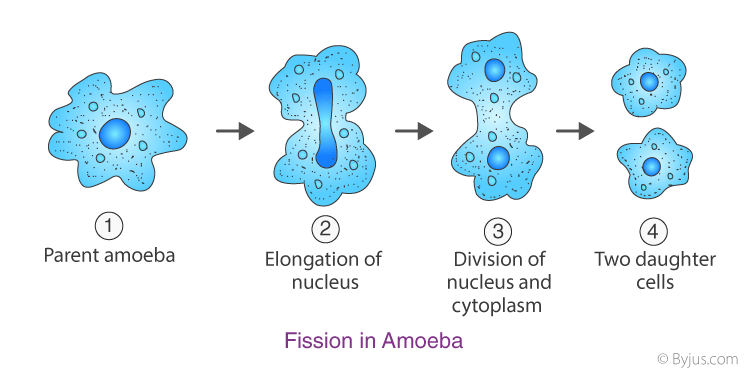
Binary Fission
- asexual reproduction
- in prokaryotes and few unicellular eukaryotes - amoeba, paramecium, euglena
- parent cell divides into 2 new daughter cells
- each daughter cell receives one copy of parent DNA
- “fission” means division
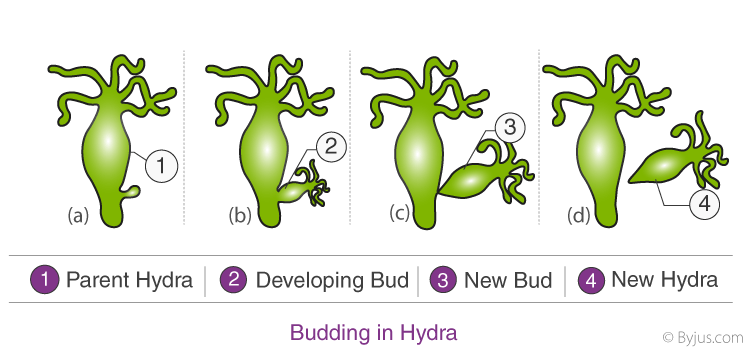
Budding
- asexual
- new organism is developed from a small part of parent body
- baby remains attached as it grows further
- it is separated when it gets matured & leaves scar tissues behind
- hydra, yeast, jellyfish
Sexual Reproduction
- two parents
- fusion of male-female gametes forms zygote
- genes from both parents inherited & baby is not a total copy
Advantages:
- genetic variation
- disease is less likely to affect every single person in the species
- diversity
Disadvantages:
- slow process
male and female reproductive systems are present in different individuals
: invertebrates (leeches, earthworms) have both male and female reproductive.
: process of fusion of male and female gametes + nuclei of sperm fuse with nuclei of the egg to form a single nucleus
Types of Fertilisation
1. Internal fertilisation
→ fertilisation occurs inside female +mostly in land (cows, dogs, cats, humans)
Advantages:
- more probability of successful fertilization
- low chances of dehydration of gametes
- young one is protected against predators SO chances of survival are increased.
Disadvantages:
- less number of offspring produced at a given time
2. External fertilisation
→ fertilisation occurs outside female body + mostly in water (fish, frogs)
Advantages:
- produces a larger number of offsprings
Disadvantages:
- A large quantity of gametes is wasted and left unfertilized.
- young isn’t protected against environmental hazards and predators.
- Eggs and sperms may not come in contact.
: special reproductive cells in males and females (male = sperm, female = ovum/egg)
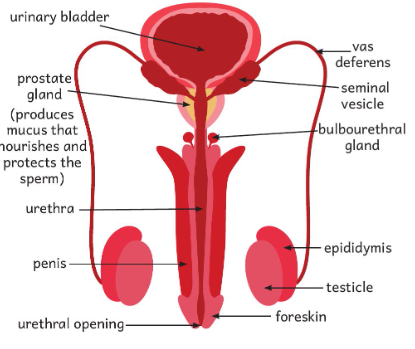
Male Reproductive System:
- located in the pelvic region
- include a pair of testes, two sperm ducts and a penis
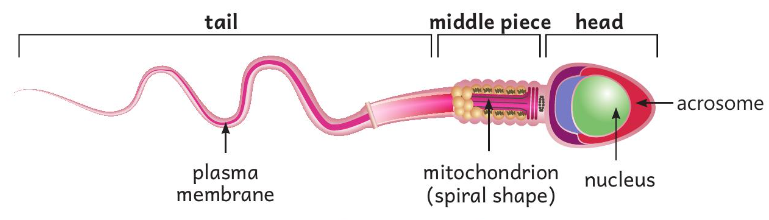
Sperm
- single cell, consisting of the usual cell components + very small
- has a head, a middle piece and a tail which is the longest part + propels it for swimming and aids in penetrating the egg.
- The testes are present outside the abdominal cavity in a pouch called scrotum
PARTS
- Testes:
- produces sperms
- present outside abdominal cavity in a pouch called scrotum
- made up of coiled tubes called seminiferous tubules
- endocrine glands
male reaches puberty → pituitary gland stimulates testes to produce male sex hormone testosterone
- Sperm duct/Vas deferens:
- narrow tube
- transport sperms from testes to penis
- fluids are secreted by different glands [the seminal vesicles, the prostate gland, and the bulbourethral glands (Cowper's glands)]. + mix with sperms to form semen
- Penis:
- transfers semen to vagina
- Urethra:
- tube within the penis through which semen and urine go out
- Scrotum:
- thick-skinned sac that surrounds and protects the testes.
- maintains optimum temperature required for sperms
- Epididymis:
- a long coiled tube
- transports and stores sperms
Female Reproductive System:
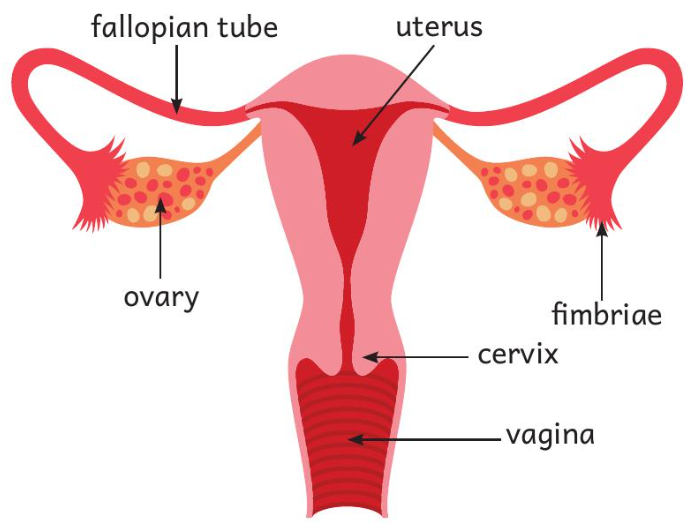
- Ovaries:
- located in the abdominal cavity
- produces female ova
- Either of the two ovaries releases 1 mature ovum in a cycle ranging from every 21 to 35 days
- Oviduct or fallopian tubes:
- oviduct has finger-like projections called fimbriae that capture mature egg & transport it to uterus
- oviduct is tube leading to the uterus
- oviduct transports the fertilised ovum (zygote) to the uterus.
- Uterus:
ovum is fertilised by the sperm → the zygote travels to uterus → embeds itself in uterine wall, which thickens (cuz of increased blood supply) → zygote develops.
development of zygote takes place here + it expands to adjust the baby.
- Cervix: narrow, neck-like passage + connects to the vagina.
- Vagina:
- muscular tube
- “birth canal” bc it allows passage of the baby from the uterus.
Fertilisation
- The fertilised egg is called a zygote.
ovum is released every month by an ovary during the process of ovulation → ovum moves into the oviduct → male transfers semen in vagina → The sperms travel through cervix into uterus and reach the oviduct → one of the sperms fuses with egg to form a zygote
- fertilisation occurs in the oviduct
fertilised egg moves down the oviduct and reaches the uterus → The zygote divides further and gets implanted into the wall of uterus → The zygote develops to form an embryo → embryo develops different body parts and is called a foetus → growth of foetus is complete? mother gives birth
Development of Embryo
- Repeated division in the zygote forms a ball of cells
- cells form groups to create different organs of the body ==== EMBRYO
- embryo to 16 cells == ==MORULA== ===
- morula becomes hollow == ==BLASTULA== === implants in uterus
- GASTRULATION ==== development of organs
- PLACENTA ==== embryo receives nourishment from its mother's blood through placenta + it is a special tissue attached to uterus & connected to embryo through umbilical cord
- growing embryo floats in an amniotic fluid, a clear yellow fluid enclosed in an amniotic sac + serves as a cushion, provides nourishment and protects the growing embryo from injury
- The stage of the embryo in which all body parts can be recognised is known as the FOETUS
→ PARTURATION : baby delivering
→ GESTATION PERIOD : when baby is inside mom +++ longest is elephant (95 weeks)
In vitro fertilisation [IVF]
- egg and the sperm are made to fuse in lab
- when embryo in the multicellular stage its implanted into uterus
- babies born through this are called test tube babies.
Sex determination
- sex is determined by father's sperm.
- male has X and Y sex chromosomes & female has X and X.
- egg will have only X
- if sperm has X and ova fuses with it, then baby will be a girl (XX)
- if sperm has Y baby will be a boy (XY).
Oviparous and viviparous animals
- The animals that lay eggs === oviparous animals (snakes, frogs and fish)
- The animals that give birth === viviparous animals (cows, horses, dogs)
Reproduction in hens
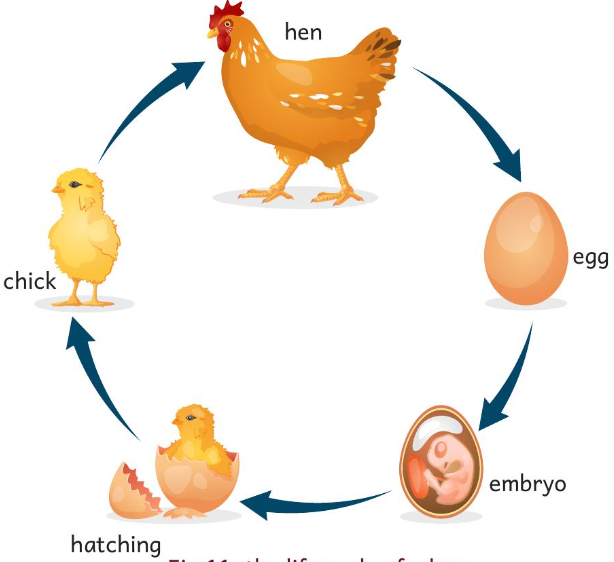
- internal fertilisation occurs in a hen BUT it don’t give birth
- internal fertilisation → fertilised ovum undergoes divisions → moves down oviduct → protective layers are formed including a white hard shell → hen lays the egg → embryo inside hard shell takes 3 weeks to develop into a chick
- hen sits on the eggs to provide sufficient warmth (incubation).
- When chick is developed, it bursts open hard shell.
 Metamorphosis
- in some animals, newly-hatched organisms do not resemble their parents + they undergo a series of changes called metamorphosis after birth.
- featuresin these young ones are different from adults of their species.
- eg frog butterfly
Frogs
- frogspawn → fertilised egg → embryo → larva/tadpole → tadpole w/ 2 legs → tadpole w/ 4 legs → froglet w/ short tail → adult frog
- process of metamorphosis controlled by the hormone thyroxine.
- tadpole/larva can survive only in water BUT adult frogs can survive both in water and on land.
Butterfly
- fertilised egg → larva (caterpillar) → pupa → adult butterfly
- metamorphosis controlled by two hormones: ecdysone hormone and juvenile hormone.