BIO100 Nutrition Reading #2
 Studied by 0 people
 Call Kai
 Learn
Learn Practice Test
 Spaced Repetition
 Match
Match Flashcards
 Knowt Play
1/35

There's no tags or description
Looks like no tags are added yet.
Name | Mastery | Learn | Test | Matching | Spaced |
|---|
No study sessions yet.
36 Terms
Lipids
A diverse group of organic compounds.
- hydrophobic, do not mix with water
- ex: phospholipids, cholesterol, triglycerides, and steroid hormones.
Phospholipid Bilayers
Makes up the membranes that regulate the passage of materials into and out of the cell.
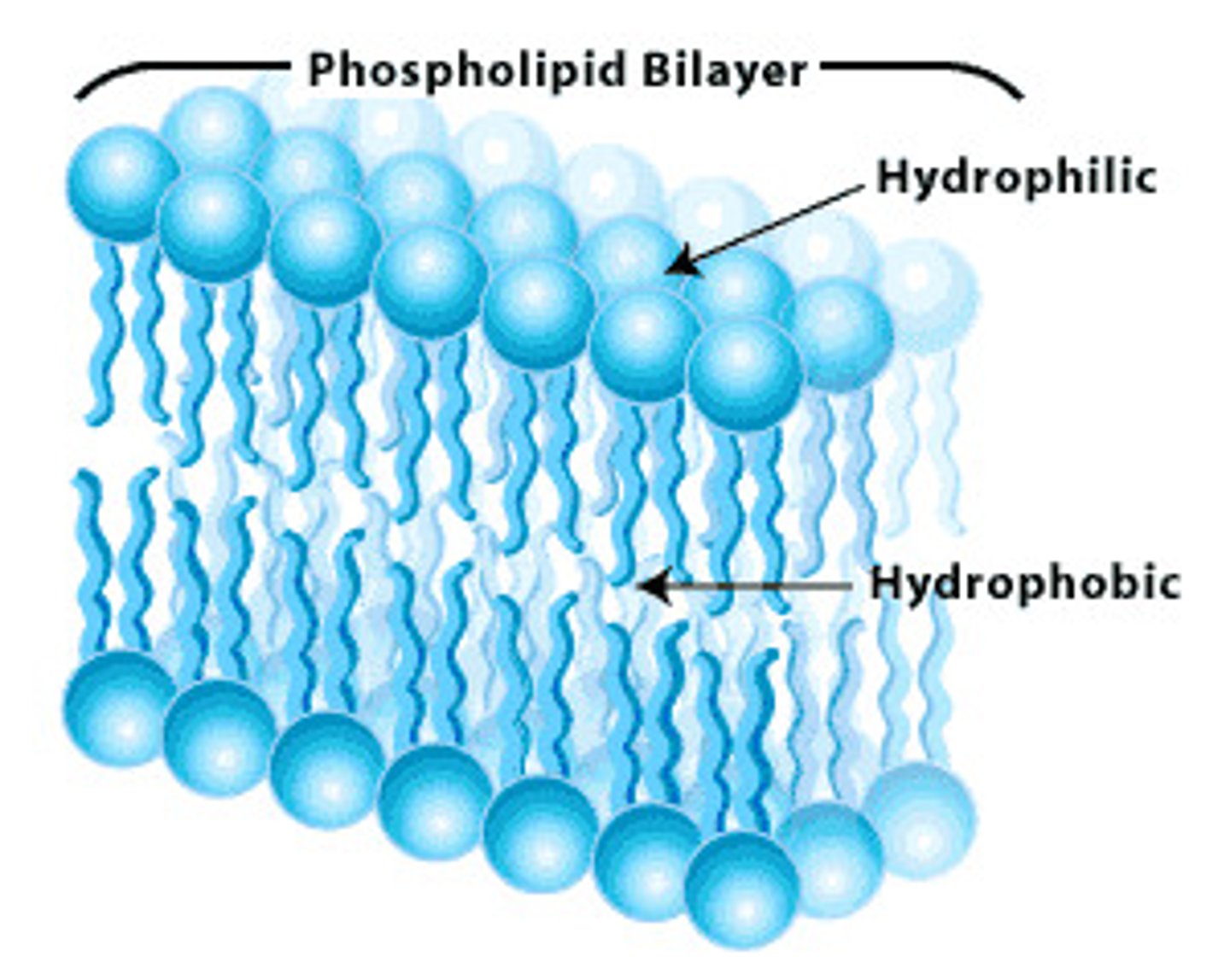
- two phospholipid stacked into layers of a molecule
Phospholipid
Contains a phosphate group in its hydrophilic head, and two long hydrophobic tails. Many proteins float within the layers.
Cholesterol
A type of lipids that plays several important roles.
- maintains fluidity in animal cell membranes
- synthesizes several important lipid hormones
- found in animal-derived foods (eggs, red meat).
Types of Cholesterol
LDL (Low-density lipoprotein) "Bad Cholesterol" = levels can be increased through poor diet, high levels increase heart diease
HDL (High-density lipoprotein) "Good Cholesterol" = levels can be increased through exercise, high levels reduce risk of heart disease.
Triglycerides
One molecule of glycerol joined to three fatty molecules. Makes of typical dietary fat.
Fatty Acids
Stores a lot of energy within a triglyceride within the carbon/hydrogen chains. This causes fatty foods to have high calories.
Adipose Tissue
Body fat made from excess calories in the body.
Steroids
Lipids that contain four fused chemical rings made primarily of carbon.
- cholesterol
Anabolic steroids
Synthetic variants of testosterone that mimics its effects, increasing body effects, but could have dangerous side effects.
Core Question:
What physical property is shared by dietary fats, cholesterol, and anabolic steroids?
They are all hydrophobic.
Saturated Fats
One of two dietary fats that has the maximum number of hydrogens along the fatty acid tail, which corresponds to all single chemical bonds in the chain. This causes them to be straight allowing them to easily stack together and form solids.
- solid at RT
- found in higher amounts in animal products
- less healthy
- all single bonds
- straight shape
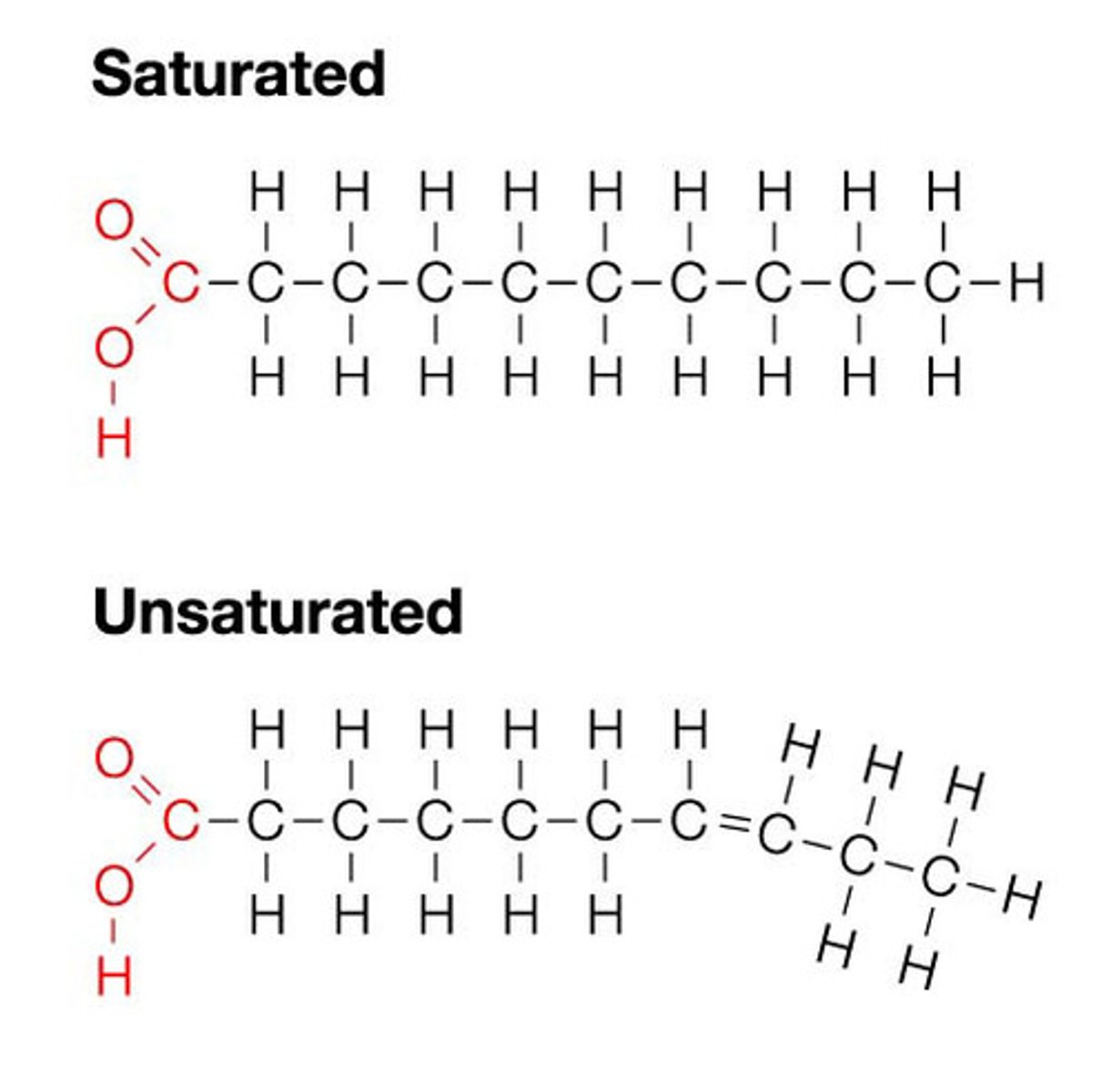
Unsaturated Fats
One of two dietary fats that has one or more doubles in the fatty acid tail, causing them to have fewer than the max number of hydrogens. This causes to have a bend and twisted shape which prevents it from stacking, so its liquid.
- one or more double bonds
- stays liquid at RT
- found in higher amounts in plant products
- healthier
Hydrogenation
The process of rendering unsaturated fat into a solid form in manufacturing creating trans fat.
Trans Fat
A type of unsaturated fat produced from hydrogenation that contains an unusual bond that does not occur naturally.
- super unhealthy
- increased risk for heart disease, diabetes, high blood pressure.
Omega-3 Fatty Acids
An example of a healthy unsaturated fat that is known to reduce the risk of heart disease.
Core Question:
What is wrong with this statement: Animal fats are saturated, whereas plant fats are unsaturated.
Animal and plant fats each contain both saturated and unsaturated fats, but in different proportions.
Plasma Membrane
A thin, flexible, oily sheet that forms the boundary between each living cell and its surrounding.
- found in every cell
- maintains a relative constant internal environment
- regulates the passage of materials into and out of the cell.
- composed of phospholipids and proteins
Phospholipid Bilayer
The organization of the phospholipids into two layers in the plasma membrane. Drift about in the membrane, allowing it to flex.
Fluid Mosaic
A description of the plasma membrane in animal cells because cholesterol within the bilayer provides additional flexibility. Molecules can move freely past one another (fluid) which results in a highly diverse set of proteins that float around (mosaic)
Phospholipid in Membranes
Spontaneously organize themselves into a two-layered membrane because the heads are hydrophilic and the tails are hydrophobic. The heads point toward the watery environment on the inside and outside. The tails point toward the interior of the membrane to form an oily barrier.
Extracellular Fluid
The liquid environment outside the cell. The plasma membrane regulates the passage of materials between here and the inside of the cell.
Cytoplasm
The interior of the cell. Mainly consists of a watery liquid cytosol, the organelles, and dissolved molecules.
Membrane Proteins
Most membranes have proteins embedded within them.
- help regulation of materials
- aid in communication
- facilitate chemical reactions
- anchor the cell
- some are fixed, others float within
Core Question:
Why is the structure of a membrane called a phospholipid bilayer?
Because it consists of two stacked layers of phospholipid molecules.
Steps of Material Passage into a Cell
1. Plasma Membrane
2. Phospholipids
3. Extracellular Fluid
4. Cytoplasm
5. Membrane Proteins.
Cytosol
The fluid part of the cytoplasm, in which organelles are suspended.
Passive Transport
Occurs when a substance moves across a membrane from an area where its concentration is higher to an area where its concentration is lower. This is called a concentration gradient.
- flow freely
- no energy expenditure by the cell
- ex: oxygen gas diffuses from the air into our blood
Diffusion
The movement of molecules from an area of higher concentration to an area of lower concentration.
- ex: glucose diffusing from the bloodstream into body cells
- ex: perfume molecules moving out of a bottle into the room.
Osmosis
The diffusion of water. Water always flows from an area of higher water concentration to a lower one.
- ex: placing meat in salt draws out the water
- water can flow through the membrane itself or a protein channel through it
Facilitated Diffusion
Transport proteins embedded in the membrane that allows substances that cannot cross on their own.
- selective channels for specific molecules
- always move down the concentration gradient
Active Transport
The moving a substance against its concentration gradient, from where it is less concentrated to where it it more so.
- requires energy expenditure from the cell
- driven by a protein within the membrane
- ex: sodium-potassium pump
Endocytosis
The transport of large substances into the cell. Substances to be ingested are packaged into vesicles that bud inward from the plasma membrane and through the cytoplasm.
Exocytosis
The export of large quantities of material from the cell. Vesicles containing the exports fuse with the plasma membrane and dump the contents outside of the cell.
- ex: tear glands exporting salty tears
Core Question:
What form of passive transport always requires membrane-bound proteins?
Facilitated diffusion. (Osmosis sometimes, but not always, requires protein channels.)
 Note
Note  Flashcards (314)