Economics IGCSE CIE CHAPTER 3
 Call Kai
 Learn
Learn Practice Test
 Spaced Repetition
 Match
Match Flashcards
 Knowt Play
1/86

Earn XP
Description and Tags
CIE IGCSE MICROECONOMIC DECISION MAKERS CHAPTER 3
Name | Mastery | Learn | Test | Matching | Spaced | Call with Kai | Chat |
|---|
No analytics yet
Send a link to your students to track their progress
87 Terms
What is money?
A commodity that can be used for exchange which is widely accepted
What are the 3 forms of money?
Cash-physical form of money
Bank deposits-money in commercial banks mostly electronic
Central Bank reserves-held by central bank, used by commercial banks
What are the 4 functions of money?
-Medium of Exchange
-Measure of value
-Store of value
-Deferred payment
What are the 6 characteristics of money?
Durability
Acceptability
Divisibility
Uniformity
Scarcity
Portability
What is bartering?
trading items for other items; swapping through negotiations
What are the 3 problems with bartering?
-Double coincidence of wants
-Divisibility
-Portability
What is a Central Bank?
-A country’s monetary authority. Issues banknotes, manages the nation’s money supply, responsible for monetary policies, and banking system
What is a Central Bank’s 4 key functions?
Sole issuer of Banknotes
Government’s bank
The Banker’s Bank
Lender of last resort
What is the function of commercial banks?
A commercial bank provides financial services to its customers. They are managed by the Central Bank.
What is the commercial bank’s 3 main functions?
Credit creation (creating usable money through loans)
Making advances (loans)
Accepting deposits
What are the commercial banks’ secondary functions?
collection and transference of money for clients
foreign exchange dealings and wealth management
Safety deposits
Money transfer facilities
Credt transfer facilities'
Online banking facilities
6 influences on household spending?
Income
Rates of Interest
Confidence levels
Inflation
Age
Size
EXPLAIN INCOME AND THEIR RELATIONSHIP WITH HOUSEHOLD SPENDING
-Disposable income is what a family is able to spend after taxes and necessary bills
Taxes lower disposable income
Lower incomes spend more money on necessities
-SOURCES: WAGES, PROFIT, INTEREST, DIVIDENDS, RENT, LOANS AGAINST ASSESTS
EXPLAIN THE RELATIONSHIP BETWEEN RATES OF INTEREST AND HOUSEHOLD SPENDING
-Interest rates determine the cost of borrowing money. When it rises consumption falls.
Demand for loans falls
Savings may be more attractive
Existing repayments rise lowering disposable income
EXPLAIN THE RELATIONSHIP BETWEEN CONFIDENCE LEVELS AND HOUSEHOLD SPENDING
When people feel less confident in the future of their economy (during a period of recession or low growth) people may prefer to save. More people are willing spend money when the economy is in a good state.
Explain inflation’s relationship with household spending
-Spending power determines how much a household consumes
Explain age’s relationship with household spending
People spend varying amounts of money on a varying goods/ service at different stages in life
What is the relationship between the size of households and household spending?
-amount of dependents
-amount of streams of income
What are the influences on Household Saving?
-Saving for the future
-Earning interest
-Precaution in case of emergency
What are the influences on household saving levels?
Age of a person
Attitude
Confidence
Interest rates
Income
What are the reasons on household borrowing?
Funding expensive purchases
Pursuing tertiary education
Purchasing property
Start a new business
Fund large business projects or expansions
What are the factors that influence household borrowing?
Interest rates
Confidence levels
availability of funds
Wealth (collateral)
What are the monetary factors affecting an individual’s choice of occupation?
Wages, Salary, Piece Rate, Commission, Bonus, Profit Related Pay, Share Options, Other benefits
What are the none-wage factors to a worker’s choice of occupation?
Level of Challenge, Danger, Level of Education, Recognition, Personal Satisfaction, Experience needed, Career Prospects, and Length of Training
What type of demand is demand for labor?
Derived Demand
What are the factors of demand for labor?
Cost of labor
Productivity of labor
Level of total demand
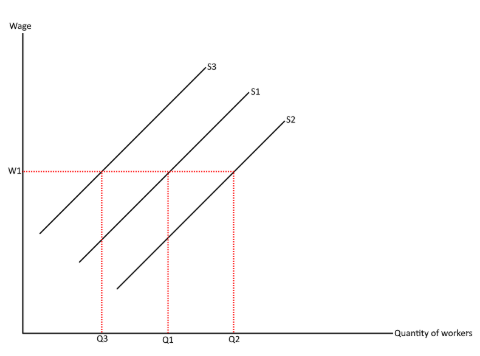
What is the supply of labor?
people who are of working age who are both willing and able to work at different wage rates
DRAW SUPPLY OF LABOR GRAPH
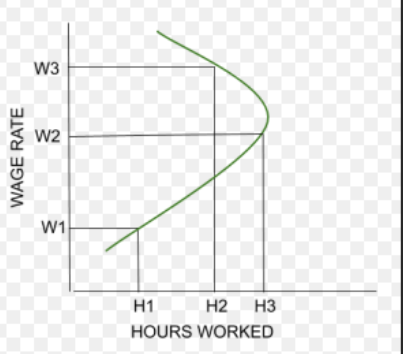
Hours worked to wages graph.
What are the factors influencing the labor participation rate?
-Number of Women in the workforce
-age distribution
-retirement age
-Number of full/ part time workers
-Availability of welfare
higher the less likely
Opportunity cost of losing welfare
-Social attitude
What are the factors influencing wage determination?
-The wage equilibrium rate based on market forces
-National Minimum Wage
DRAW WAGE EQUILIBRIUM RATE GRAPH
What are the advantages of National Minimum Wage?
-livable wage improves lives and prevents exploitation
-More incentives to work
-Stimulates economy by promoting consumption through rise in income
What are the disadvantages of National Minimum wage?
-Unemployment may increase since firms may be unwilling to pay the wage
-Workers who are already well paid may want a proportional increase
What are the different reasons wages are differentiated?
Levels of Skill
Higher skilled professions are in higher demand
Workers in primary sectors earn less than secondary and tertiary workers due to the low value they produce
On average less abundant
Bargaining Strength
Trade unions-unified interests
Age and experience-higher demand
Level of education- higher demand
Male-Female divide
Women tend to work part-time more
May face discrimination
May take flexible hours over pay due to childcare responsibilities
Private-Public divide
Public sector jobs pay less but are on average more secure
What are the two types of mobility of labour?
Geographical
Family ties
Costs of living
Occupational
How long it takes to change professions
What id division and specialization?
-Specialization=becoming skilled in a specific area
-Dividing=separating the work require to produce something
What are the advantages and disadvantages of specialization and division of labor?
Advantages
Productivity increases
Earning potential increases
Disadvantages
Boring and repetitive
Alienated from the final product
Lack of occupational mobility
What are the 3 firm sectors and examples of them?
Primary (Resource extraction)-Fishing and Mining
Secondary (Changing Raw materials)-Construction and manufacturing of goods
Tertiary (services to firms and government)- Lawyers and advisors
What is the goal of the private sector?
TO MAKE PROFIT
What are the 4 types of private firms?
Sole Trader-One owner
Partnership— 2-20 owners
Private limited company-Shareholders unable to sell
Public Limited Company- Shareholders able to sell
What are characteristics of the public sector?
-owned by government
-Funded through taxes
What are the 4 ways to determine relative size of a firm?
Number of employees, market share, Stock value, and Sales revenue
What are the advantages of small firms?
-Less legal issues
-Easier to manage
-More income for the owner
-Flexibility for the Owner
-Personal relationship with consumers
-May be one of the few sellers there
What are the disadvantages of running a small firm?
-Limited capital
-Larger individual risks
-rely on one owner
-Less competitive prices
What are the two ways firms can grow?
Internal and External (mergers or takeover)
What are the two types of mergers?
Horizontal (within the same sector)
Vertical (from a different sector)
What are the benefits of horizontal merger?
-Higher market share
-gaining skilled employees
-Cut down of number of employees
-Economies of scale
What are the disadvantages of horizontal mergers?
-Loss of jobs
-Increased costs from diseconomies of scale
-Culture clashes
What are the two types of vertical mergers?
Forward (lower tier to higher tier) and Backward (higher tier to lower tier)
What are the advantages of a vertical merger?
-More raw materials
-Raw materials are now cheaper
What are the disadvantages of vertical mergers?
-Diseconomies of scale
-Transport costs
What is a conglomerate?
-Unrelated companies merge to become one
What is an economy of scale?
Cost saving benefits of large-scale firms and operations that reduce average costs.
What are examples of economies of scale?
External, Internal, and Risk Bearing economies of scale
Explain Internal economies of scale
Bulk Purchasing, Technical Equipment, borrow more money, more specialized planners and managers improving productivity
What are risk bearing economies of scale?
Research and development
Marketing
What are external economies of scale
Proximity to other businesses
Availability of skilled labor
Reputation of area
Access to transportation
What are examples of diseconomies of scale?
Clash of cultures
Communication issues
more employees
reduced coordination
What are the factors that influence demand on factors of production
-Derived demand
Cost
Quantity
Productivity
What are the two types of productions?
-Labor intensive
Labor disproportionately high part of costs
-Capital intensive
Capital disproportionately high part of costs
What do firms use to decide whether labor or capital intensive productions
-Size of market
-Costs in comparison
-The firm’s goals
What are the reasons to choose capital intensive production?
-Mass production
-Low Unit costs
-Reduces chances of human error
Reasons for labor intensive production
Highly customized products
Better service
Higher quality
more flexible (changing number of employees)
What is production?
Overall output of goods from a production process
What is productivity?
Measurable efficiency of the factors of production
Why is productivity important?
Creating economies of scale
Higher profit margins
Able to afford higher wages
improved competitiveness
Economic growth
What are the influences on Productivity?
Investment
Innovation
Skills
Entrepreneurship skills
Competition
What are costs of production?
Payments that firms make in the production process
What are the 4 main costs of production?
Wages
Rent
Advertising
Utilities
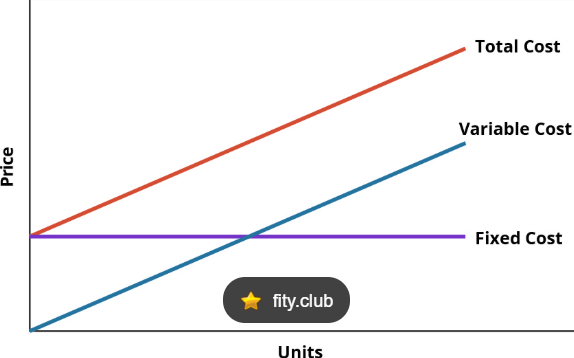
What are fixed costs?
Costs paid no matter what
What are variable costs?
Costs that change when output change
Draw variable and fixed costs total graph
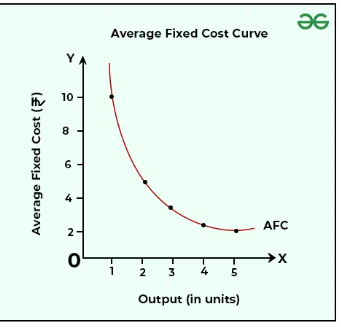
What is average fixed costs; draw a graph
Average fixed costs is the fixed cost divided by units of output; the AFC lowers as more units are produced
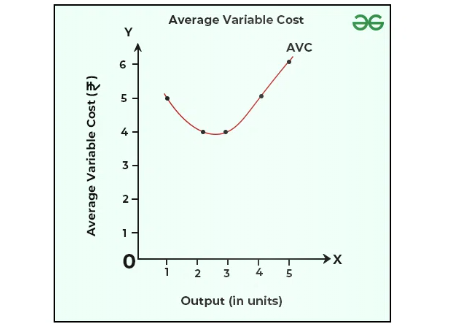
What is average variable cost
TVC/UNITS
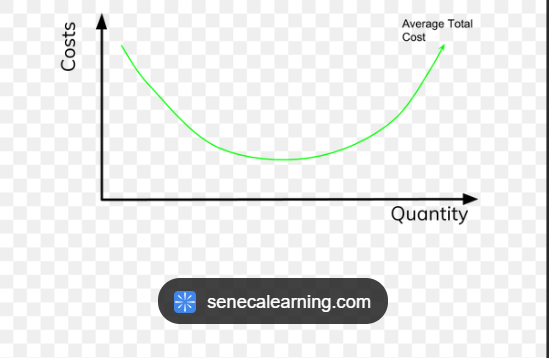
What is average total cost; draw a graph
Total costs/ Output levels
How to calculate revenue
Price x Quantity sold
What are the aims of firms?
Survival, social welfare, growth, profit and profit maximization
What is profit?
total revenue-total cost=profit
What is market structure?
The key characteristics of a market
the number and size of firms
the degree and intensity of price and non-price competition
The nature of barriers to entry
What are the two extreme market structures?
Monopoly and competitive markets
What are characteristics of a competitive market
Price Takers (determined by market forces)
Quality-Homogeneous at times
Low levels of profit due to competition
Wide variety of choices-more advertising
What are the benefits of competitive markets?
-Higher quality and customer service
-More choice
-Lower costs and higher output due to incentives
-Innovation to stay ahead of competition
What are drawbacks of a competitive market?
Firms may not survive
Some firms may not innovate
-Waste through advertising
-Too many choices
-Profts may be shared
What are characteristics of a monopoly market?
-single supplier
Price maker
imperfect knowledge
high barriers to entry
What are the benefits of a monopoly market?
-huge economies of scale
-more chances to innovate
eliminate wasteful competition
What are the drawbacks of monopoly markets?
-less incentive to innovate
-inefficient and can hurt customers
-price gouging