RAD 1227 MIDTERM
 Call Kai
 Learn
Learn Practice Test
 Spaced Repetition
 Match
Match Flashcards
 Knowt Play
1/507

There's no tags or description
Looks like no tags are added yet.
Name | Mastery | Learn | Test | Matching | Spaced | Call with Kai |
|---|
No analytics yet
Send a link to your students to track their progress
508 Terms
Define Disease:
The pattern of the body’s response to some form of injury that causes a deviation from or variation of normal conditions.
Causes of disease:
Hereditary (genes), trauma, infectious agents, vascular processes, metabolic processes.
Etiology:
Study of the cause of the disease process.
Endogenous:
Acting from inside.
Exogenous:
Acting from outside.
Idiopathic:
Cause is unknown.
Symptom:
Change in body function felt by patient, subjective manifestations.
Signs:
Measurable or objective manifestations.
Asymptomatic:
Without subjective or objective manifestations.
Diagnosis:
Identification of disease process.
Prognosis:
Predicted course and outcome.
Syndrome:
Linked combination of sign and symptoms.
Acute:
Sudden onset, short duration.
Chronic:
Gradual development, long term.
Asymptomatic:
Without subjective or objective manifestations.
Remission:
Period in which symptom subsides.
Exacerbation:
Period in which symptoms become more severe.
Relapse:
Return of a disease.
Complications:
A new disease where one previously existed.
Sequela:
One disease condition resulting from another.
Iatrogenic:
Disease cased by physician or treatment.
Nosocomial Infections:
Contracted from acute care facility.
Community-Acquired Infections:
Contracted in a public setting outside of the acute care facility.
Cellular Injury:
Compromise of cellular function as well as change in structure.
Pathogenesis:
Sequence of events that renders the disease apparent.
Manifestations:
The observed changes.
Structural Disease:
A lesion, structural change, tumor, fracture, or inflammation.
Functional Disease:
No lesion, mental illness/dementia, neurosis/psychosis, headache.
Inflammation:
The initial response of body tissues to local injuries.
Five Clinical Signs of Inflammtion:
Rubor, calor, tumor, dolor, loss of function.
Rubor:
Redness.
Calor:
Heat.
Tumor:
Swelling.
Dolor:
Pain.
Transudative:
Occurs due to increased hydrostatic pressure or low plasma oncotic pressure.
Pleural Effusion:
Accumulation of fluid within the pleural space.
Exudative:
Occurs due to inflammation and increased capillary permeability.
Leukocytosis:
Accumulation of leukocytes.
Plasma is comprised of:
Fluid part + serum.
Inflammatory exudate is comprised of:
Leukocytes + serum.
Lymphocytes:
Neutralization of toxin and bacteria.
Serum:
Antitoxins.
Suppuration:
Pus formation.
Abscess:
Cavity filled with pus in tissue.
Ulcers:
Excavation on skin.
Fistula:
Tract from skin to mucous surface.
Granulation Tissue:
Fibrous scar replaces destroyed tissue.
Pyogenic Bacteria:
Thick, yellow fluid called pus (dead white cells).
Bacteremia:
Potential involvement of other organs and tissues in the body by organisms invading the blood.
Pathogen:
Disease causing organism.
Edema:
Accumulation of abnormal amounts of fluid in the intercellular tissue spaces or body cavities.
Anasarca:
Generalized edema occurs with pronounced swelling of subcutaneous tissues throughout the body.
Elephantiasis/Elephantitis:
Localized lymphatic obstruction resulting in localized edema.
Ischemia:
aka stroke; An interference with the blood supply to an organ or part of an organ - deprives cells and tissues of oxygen and nutrients.
Ischemic Stroke:
Obstruction blocks blood flow to part of the brain.
Hemorrhagic Stroke:
Weakened vessel wall ruptures, causing bleeding in the brain.
Infarction:
A localized area of ischemic necrosis within a tissue or organ.
Hemorrhage:
The rupture of a blood vessel that allows blood to escape externally or internally, within surrounding tissues or a cavity.
Bleeding into tissues results in?
A hematoma.
Capillary Hemorrhage:
Slow, even flow, bright red color.
Venous Hemorrhage:
Steady, slow flow, dark red color.
Arterial Hemorrhage:
Spurting blood, pulsating flow, bright red color.
Hematoma:
Accumulation of blood trapped within body tissues.
Neoplasia:
“new growth”; An abnormal proliferation of cells that are no longer controlled by the factors that govern the growth of normal cells.
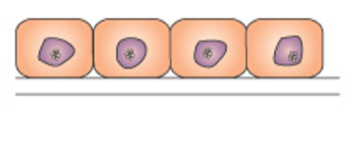
This is an image of?
Normal cells.
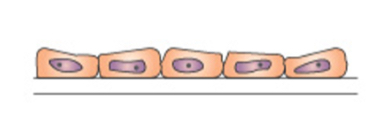
This is an image of?
Atrophy.
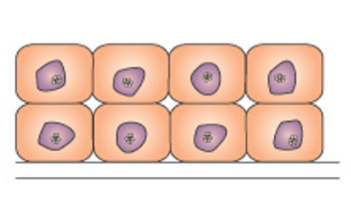
This is an image of?
Hyperplasia.
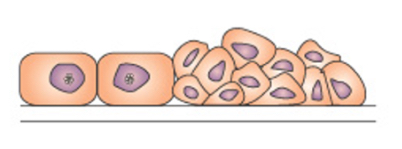
This is an image of?
Dysplasia.
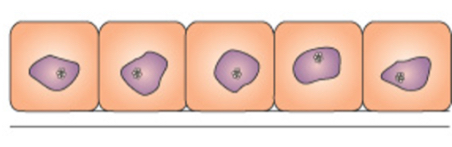
This is an image of?
Hypertrophy.
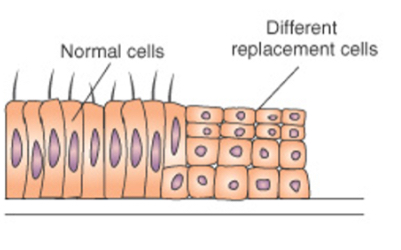
This is an image of?
Metaplasia.
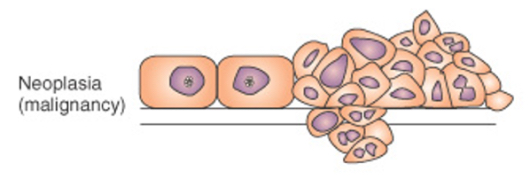
This is an image of?
Neoplasia (malignancy).
Atrophy:
A decrease in cell size or a decrease in total number of cells.
Aplasia:
Congenital absence of an organ.
Hypoplasia:
Failure of an organ to reach full adult size.
Hypertrophy:
An increase in volume f tissue to organ due to an enlargement of existing cells.
Hyperplasia:
An increase in the size of tissue or organ due to additional cells.
Neoplasia:
Abnormal lesion that has excessive growth.
Carcinoma:
Malignant neoplasm which arise from epithelial tissue.
Cancer:
Disorder of cell growth.
Carcinoma Basal Cell:
Skin, face, mouth, canthus.
Adenocarcinoma affects the:
Lungs, breast, uterus, GI tract.
Sarcoma affects the?
Blood, bone, cartilage, muscle
Osteosarcoma affects:
Long bones.
Lipo Sarcoma affects:
Neck and shoulder.
Angiosarcoma:
Malignant neoplasm in the vessel walls.
Osteosarcoma:
Tumor in a bone.
Chondrosarcoma:
Cartilage.
Ewing Sarcoma:
Bone.
Gastrointestinal Stromal Tumor:
Mesenchymal neoplasms of the gastrointestinal tract.
Liposarcoma:
Fat cells.
Fibrosarcoma:
Fibrous connective tissue.
Hemangioendothelioma:
Vascular neoplasms.
Types of Tumors:
Carcinomas, sarcoma, lymphoma, leukemia.
T in the TNM Staging System stands for:
Size of primary.
N in the TNM Staging System stands for:
Regional lymph involvement.
M in the TNM Staging System stands for:
Presence of absence of distant metastasis.
CIS in the TNM Staging System stands for:
Cancer in SITU.
Types of immune reactions:
Anaphylactic, cytotoxic reaction, delayed.
Types of Immunity:
Naturally acquired and artificially acquired.
Anaphylaxis:
An immediate life-threatening systemic hypersensitivity reaction; severe allergic reaction.

