Transport, Erosion and Deposition
 Studied by 0 people
 Call Kai
 Learn
Learn Practice Test
 Spaced Repetition
 Match
Match Flashcards
 Knowt Play
1/29

There's no tags or description
Looks like no tags are added yet.
Name | Mastery | Learn | Test | Matching | Spaced | Call with Kai |
|---|
No analytics yet
Send a link to your students to track their progress
30 Terms
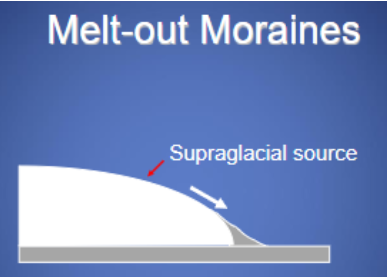
Supraglacial
Above ground glacier. The main supraglacial sediment sources/transport are from weathering of mountain tops and makes up high % of debris supply (for valley glaciers), with a lower % from weathering of nunataks (for ice sheets).
Englacial
In the glacier. Englacial sediment sources and transport is where debris bands are exposed on the surface and can produce debris cones
Subglacial
At glacial base
Percussion
where rocks are forced down into the bedrock, causing it to fracture and break apart
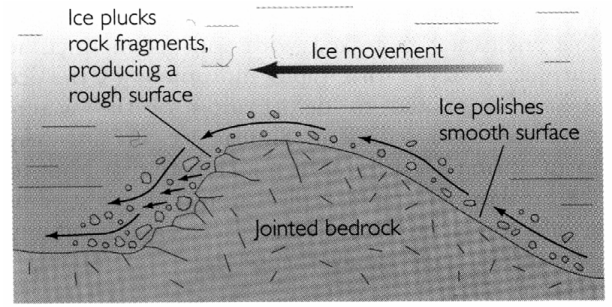
Roche Moutonnee
A rocky feature with a smooth rock face on its stoss side and rocky face on its lee side. This happens when a glacier meets an object, abrading it as it moves over
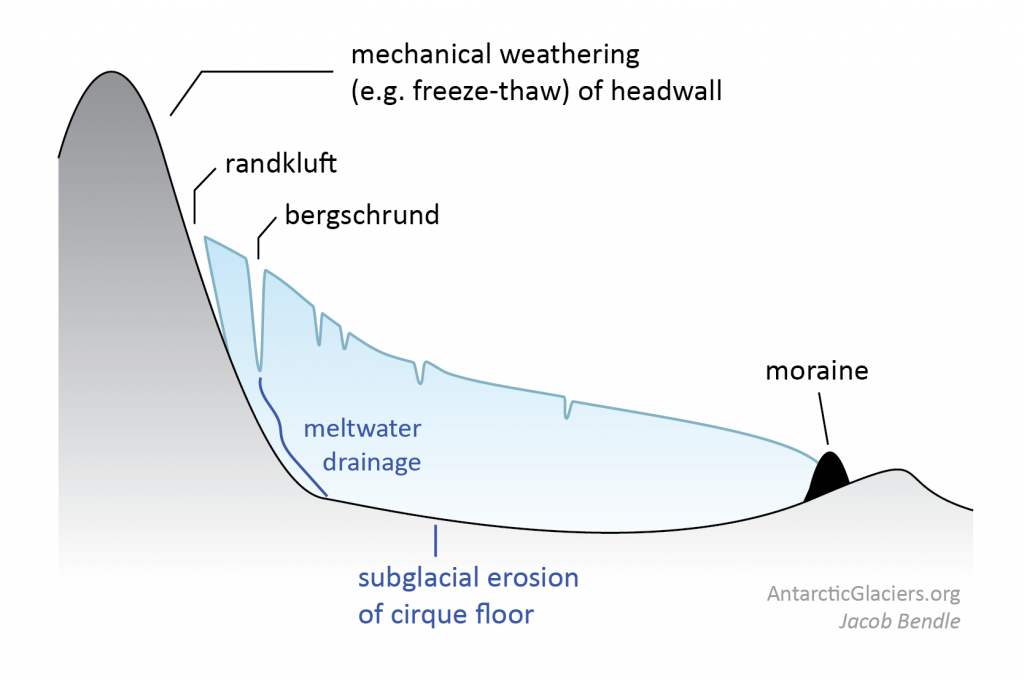
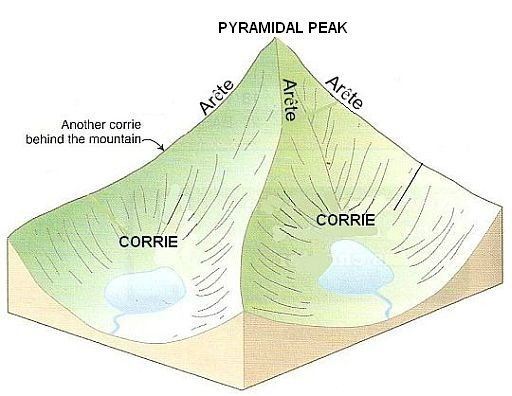
Cirques (Corries)
Columns in rock, where glaciers erode rock hollows at the start of their course (on mountain tops).These hollows are caused when a small glacier develops in a depression. Through rotational slip and erosion of the back wall, the hollow is deepened into a corrie. Water can fill corries to make tarns (lakes).
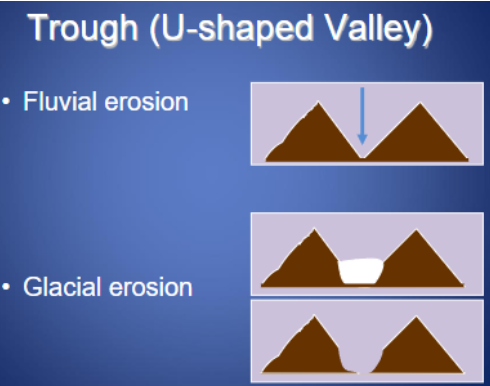
Trough (U-shaped valley)
Where abrasion and fluvial/glacial erosion occurs to widen, steepen, deepen and smooth 'V'-shaped river valleys into a 'U' shape. This leaves smooth but steep truncated spurs on the valley sides and a wide, flat valley floor.
Hanging Valleys
A smaller u-shaped valley caused by a tributary glacier. The smaller glacier does not have enough energy to erode to the valley floor, leaving a hanging valley. Waterfalls often form here
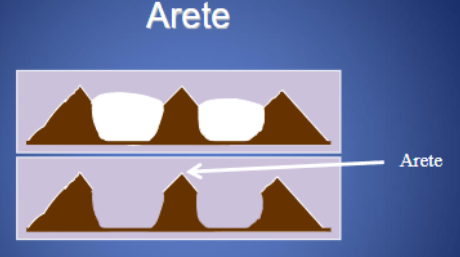
Arete
An arête is a knife-edge ridge. It is formed when two neighbouring corries run back to back. As each glacier erodes either side of the ridge, the edge becomes steeper and the ridge becomes narrower
Pyramidal Peaks
A pyramidal peak is formed where three or more corries and arêtes meet. Glaciers erode backwards towards each other, carving out the rocks by plucking and abrasion. Freeze thaw weathers the top of the mountain, creating a sharply pointed summit
Till
Material deposited by the glacier. Unsorted glacial material formed through erosion and weathering. Till plains form when an ice sheet detaches from the main glacier and melts, causing all of the till on top of deposit and within on the valley floor
Glacial Till
Consists of clasts resting in a finer matrix, the mixture of clasts and minerals including erratics which may be striated (often has oriented clasts (fabric)). Have 2 types: Supraglacial, and Subglacial (that can be split into melt-out, lodgement and deformation till)
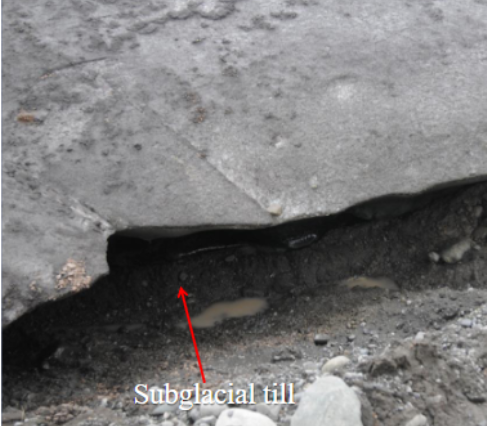
Melt-out Till
Formed from the melting out of the debris-rich basal ice layer, best preserved in cavities, in hard rock environments
Lodgement Till
Friction retardation against a hard rock bed. Well oriented fabric in the direction of ice flow
Deformation Till
Associated with a weak substrate, where frictional retardation can’t occur
What does glacial abrasion depend on
-amount of rock fragments
-hardness of rock fragments
-pressure exerted by rock fragments on the bed
-velocity of basal ice, as velocity increases, abrasion increases until too much rock flour
-meltwater will flush rock flour away, but if too much, it causes bed separation
What are the scales of glacial erosion
-Small scale= striations, fractures
-Medium Scale= Roche Moutonnee
-Large Scale= Cirque, trough, arete and pyramidal peak
Moraine (proglacial landform)
A ridge that forms in front of a glacier. Moraines form via supraglacial melt as supraglacial sediment is avalanching to the bottom of the glacier creating a ridge. Moraines formed via push are formed as the forward movement from the glacier forces sediment from underneath up and across the ground, creating a ledge.
Lateral Moraine
Material deposited on the sides of a glacier, leaving a ridge when the ice melts
Medial Moraine
Formed from two lateral moraines meeting in the middle of a glacier and depositing material
Ground Moraine
Carried under the glacier and abraded between the glacier and valley floor.
Recessional Moraine
Forms at the end of a glacier when a retreating glacier stays stationary for a sufficient time. Usually shows smaller, seasonal retreats
Terminal (End) Moraines
Material deposited at the snout (front) of a glacier on the valley floor. Can also be defined as a push moraine
Melt-Out Moraines
Glacial landforms made of rock and sediment that have melted out from stagnant or slowly moving ice
Hummocky Moraines
Irregular mounds of glacial debris, formed by glacial debris (till), often indicating former stagnant or decaying ice
Kames
Meltwater transports and deposits eroded material on a retreating glacier. Material collects within a depression on top of the glacier. When the glacier melts completely, the material is left on the valley floor. This leaves a mound of (usually fine) material.
Kettle Holes
May be found if a block of 'dead ice' is partially buried by fluvio-glacial deposits. When the ice melts a hole is left which may fill with water to form a kettle hole lake
Erratics
Are boulders carried by ice, often for many kilometres, and deposited in areas of completely different rock type.
Drumlins
Oval hills which form in groups called swarms. The unsorted till appears moulded by ice to form a blunt end with a more streamlined, gentler lee slope. When a glacier hits an obstacle that cannot be eroded, deposition from underneath the glacier builds up behind the obstacle. The glacier moves over the large mound and then drags excess deposition over the other side.
Eskers
Long, winding ridges of layered sand and gravel similar to railway embankments. They are formed inside the ice, in tunnels in which meltwater streams flowed
 Note
Note  Flashcards (132)