P2.3 - Newton's Laws (Ai generated with instructions by me)
 Call Kai
 Learn
Learn Practice Test
 Spaced Repetition
 Match
Match Flashcards
 Knowt Play
1/19

There's no tags or description
Looks like no tags are added yet.
Name | Mastery | Learn | Test | Matching | Spaced | Call with Kai |
|---|
No analytics yet
Send a link to your students to track their progress
20 Terms
What is Newton's First Law?
An object will remain at rest or move at constant velocity unless acted on by a resultant force. A resultant force is needed to change speed, direction or both
What does Newton's First Law tell us about constant velocity?
Constant velocity (including being stationary) can only be maintained when all forces are balanced — resultant force is zero
What is Newton's Second Law?
The acceleration of an object is proportional to the resultant force and inversely proportional to its mass. F = ma
What is the formula for Newton's Second Law and units?
F = ma. F = force (N), m = mass (kg), a = acceleration (m/s²)
How does mass affect acceleration for a given force?
Greater mass = smaller acceleration. Smaller mass = greater acceleration. They are inversely proportional
What is Newton's Third Law?
When object A exerts a force on object B, object B exerts an equal and opposite force on object A — forces are always in pairs on DIFFERENT objects
What are the three conditions that must be met for a Newton's Third Law pair?
Forces must act on two DIFFERENT objects. Forces must be the same type (e.g. both gravitational or both contact). Forces must be equal in magnitude and opposite in direction
Why is a book on a table NOT a Newton's Third Law pair (weight and reaction force)?
They are different types of force — weight is gravitational, reaction is contact. A true N3 pair: Earth pulls book down gravitationally AND book pulls Earth up gravitationally
[PRACTICAL] Investigating Force and Acceleration — write the full method for Experiment 1 (varying force, constant mass)
Aim: investigate effect of force on acceleration of constant mass trolley. Variables: IV = force (N), DV = acceleration (m/s²), CV = mass of trolley.
1. Set up metre ruler on bench with marks at set intervals (e.g. every 0.1m).
2. Attach string from trolley over pulley at end of bench to weight hanger.
3. Make string horizontal and parallel to bench.
4. Place trolley at start mark.
5. Release trolley — record time taken to travel between each interval using a stopwatch.
6. Repeat each run 3 times and average the time.
7. Increase force by adding masses to the weight hanger (e.g. 0.1N, 0.2N, 0.3N, 0.4N, 0.5N) — repeat for each.
8. Calculate speed = distance ÷ time for each interval.
9. Calculate acceleration = change in velocity ÷ time between intervals.
10. Compare acceleration values for different forces
[PRACTICAL] Investigating Force and Acceleration — write the full method for Experiment 2 (varying mass, constant force)
Aim: investigate effect of mass on acceleration at constant force. Variables: IV = mass (m), DV = acceleration (m/s²), CV = force (F).
2. Keep force (weight hanger) constant throughout.
3. Add masses to the trolley in steps (e.g. 200g, 400g, 600g, 800g, 1000g).
4. Release trolley and record times at each distance interval — repeat 3 times and average.
5. Calculate speed and acceleration for each mass.
6. Compare acceleration values for different masses.
Systematic error: always place masses so the mass hangar is constant.
Random error: take multiple readings at each interval and average
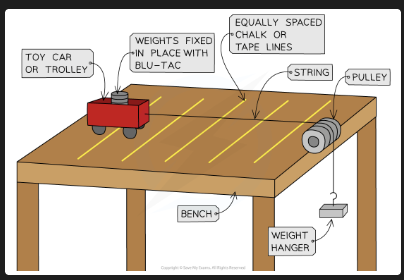
[PRACTICAL] What are the limitations and safety considerations for the force and acceleration experiment?
Limitations: measurement of time is difficult — use multiple readings and average to minimise. Friction on the trolley can cause error — use a slight tilt on the bench to compensate. Safety: do not stand directly beneath the mass hanger. Place a cushion underneath in case masses fall
[HIGHER] What is inertia?
The tendency of an object to remain in its current state of motion (rest or uniform velocity) unless acted on by a resultant force — objects resist changes to their motion
[HIGHER] What is inertial mass?
A measure of how difficult it is to change an object's velocity. Inertial mass = force ÷ acceleration (from F = ma). Larger inertial mass = smaller acceleration for the same force
[HIGHER] What is momentum and its formula?
Momentum = mass × velocity. p = mv. Units: kg m/s. Momentum is a VECTOR quantity — it has magnitude and direction
[HIGHER] What sign convention is used for momentum?
Choose a positive direction. Objects moving in that direction have positive momentum. Objects moving in the opposite direction have negative momentum
[HIGHER] What is the principle of conservation of momentum?
In a closed system, total momentum before an event = total momentum after the event. Total momentum is always conserved in collisions and explosions
[HIGHER] What is the difference between elastic and inelastic collisions?
Elastic: objects bounce apart — kinetic energy IS conserved. Inelastic: objects stick together — kinetic energy is NOT conserved (converted to heat/sound). Momentum is conserved in both
[HIGHER] What is the force-momentum equation?
F = Δp ÷ Δt = (mv - mu) ÷ t. Force equals the rate of change of momentum. Larger force = greater rate of change of momentum
[HIGHER] How does contact time affect force in a collision?
For the same change in momentum, a longer contact time = smaller force. A shorter contact time = larger force. This is why: crumple zones increase contact time → reduce force on passengers
[HIGHER] How does Newton's Third Law link to momentum in collisions?
When two objects collide, they exert equal and opposite forces on each other for the same time → equal and opposite changes in momentum → total momentum of the system is conserved

