Aerobic and Anaerobic Resp. (Week 2, Mod 9)
 Studied by 0 people
 Call with Kai
 Learn
Learn Practice Test
 Spaced Repetition
 Match
Match Flashcards
 Knowt Play
1/16

There's no tags or description
Looks like no tags are added yet.
Name | Mastery | Learn | Test | Matching | Spaced | Call with Kai |
|---|
No analytics yet
Send a link to your students to track their progress
17 Terms
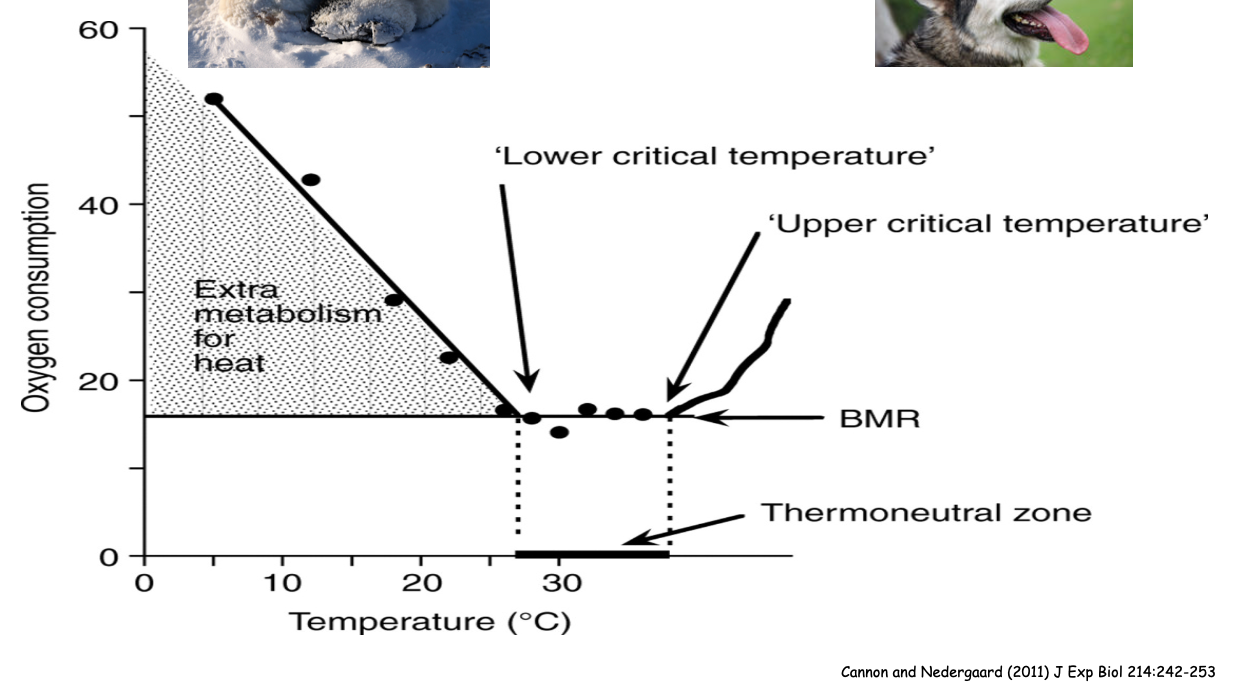
What is the relationship between an animal’s metabolic rate and temperature? How does the metabolism contribute to thermoregulation?
Metabolic rate will increase BOTH when the animal passes its lower critical temperature, and its upper critical temperature
What is shivering thermogenesis?
An involuntary motor muscle response
Muscle contraction of antagonistic muscles
Contraction, but little net movement
Produces heat through hydrolysis of ATP
Is metabolically expensive and relatively inefficient
What is non-shivering thermogenesis?
Brown adipose tissue is metabolically active, has many mitochondria:
Cold is sensed by the brain, activating the sympathetic nervous system and resulting in the release of noradrenaline
This triggers the production of cAMP, which creates Protein Kinase A which will stimulate lipolysis of that brown adipose tissue
Acute effects:
Stimulation of lipolysis
Activation of UCP-1 activity
Chronic effects:
UCP-1 gene transcription
Mitochondrial biogenesis
Hyperplasia of brown adipose tissue
Recruitment of brown adipocytes in white adipose tissue deposits
What is the uncoupling protein 1 (UCP-1) in non-shivering thermogenesis, and what is its significance?
Is found in the inner mitochondrial membrane
Protons BYPASS ATP synthase and leak back across the membrane VIA UCP-1
Energy is dissipated as heat
This is THE CATALYST for non-shivering thermogenesis
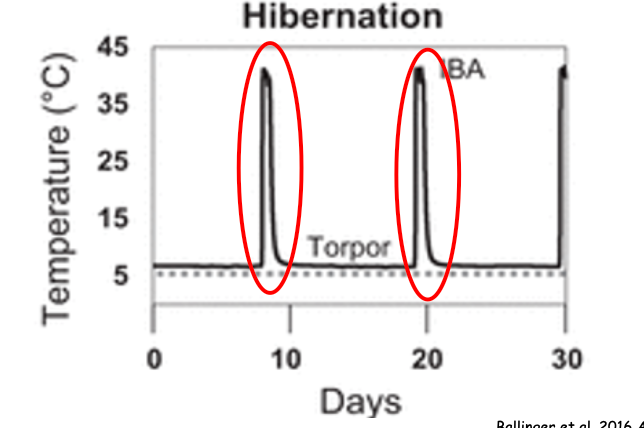
What is non-shivering thermogenesis’ roll in hibernation?
Induces spikes in body temperature in the animal, effectively bringing them out of hibernation
Allows them to:
Drink / eat
Urinate / defecate
Cellular repair and proteostasis
Activates the previously dormant immune system
Counters “sleep debt”
Briefly describe non-shivering thermogenesis in neonates…
The peri/postnatal catecholamine surge (norepinephrine, epinephrine, dopamine) triggers non-shivering thermogenesis in neonates, which is essential for babies to survive going from the mother’s womb to colder temperatures
Only happens in animals that have been NATURALLY BIRTHED
In animals that have been birthed via c-section, NST isn’t triggered
Leads to metabolic stress
How does obesity affect an individual’s ability to perform non-shivering thermogenesis?
Overall, obese individuals possess LESS brown adipose tissue than lean individuals
Also more difficult to trigger NST due to white adipose tissue acting as an insulator
What is one complication of non-shivering thermogenesis in pigs?
Farm pigs lack a functional UCP-1 protein
Are very cold sensitive
Neonates subject to hypothermia
What is the sarcoplasmic reticulum Ca2+ ATPase enzyme, and what is its function?
The SERCA pump contributes to non-shivering thermogenesis (NST) by using ATP to pump calcium (𝐶𝑎2+) into the sarcoplasmic reticulum (SR) of the mitochondria for muscle relaxation
Its activity can be "uncoupled" by proteins like sarcolipin (SLN). This uncoupling causes the pump to hydrolyze ATP and release heat without effectively transporting calcium, creating a futile cycle that generates significant heat, increasing energy demand, and maintaining body temperature without shivering
VERY energetically expensive
What genetic mutation do pigs have that affects the SERCA enzyme, and what does it cause?
Pigs have an inherited mutation of the ryanodine receptor, making the SERCA enzyme much more permeable to calcium
Causes a calcium build up into muscle
Result of stress, exercise, and heat
This causes pigs to be more susceptible to HYPERTHERMIA in general, can die of heat stress very easily
What is the relationship between metabolic function and aging?
Metabolic function rapidly DECLINES as an individual ages, affecting things like body functions, reproductive ability, and disease resistance
How do the aging rates BETWEEN species differ from the aging rates WITHIN species?
BETWEEN species:
Animals that are larger tend to have longer lifespans
Ex: Elephant will live much longer than a mouse
WITHIN species:
Is the opposite
Dogs that are larger tend to have SHORTER lifespans than smaller dogs
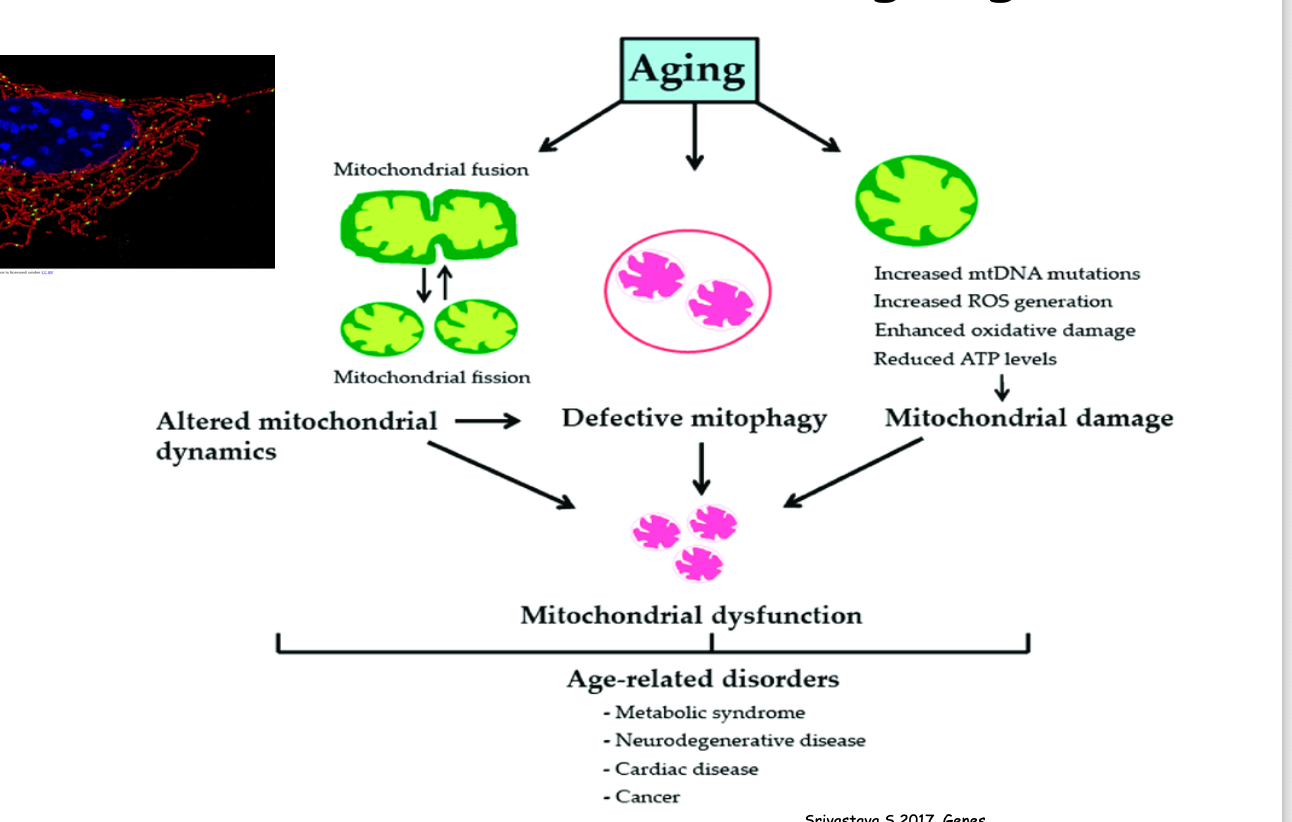
How does mitochondrial aging contribute to increased physical aging?
Mitochondrial aging produces more ROS, which can be damaging as they increase in concentration
Are the primary drivers in aging in individuals
Causes oxidative damage to telomeres, lipids, and proteins
Cause functional decline associated with aging as well
What is Alkaptonuria?
A mutation in homogentisate 1,2 dioxygenase (HMG) gene
Causes an inability to metabolise tyrosine and phenylalanine
Results in a build-up of Homogentisic acid- oxidises to pigment (ochre)
AKA: “Black urine disease”
Urine turns dark when left standing due to oxidation of homogentisic acid
Symptoms:
Ochronotic arthritis
Calcification of invertebral discs
Kidney stones
Valve stenosis
What is Fanconi syndrome?
Proximal kidney tubule dysfunction
Causes urinary loss of ESSENTIAL electrolytes and nutrients
Inherited form of disease is due to a mutation in the gene that encodes enoyl-CoA
Causes impaired fatty acid oxidation, mitochondrial dysfunction, and impaired functionality of the proximal kidney tubule
Results in:
Growth retardation
Diarrhoea
Hypokalaemia
Hyponatraemia
Hypochloraemia
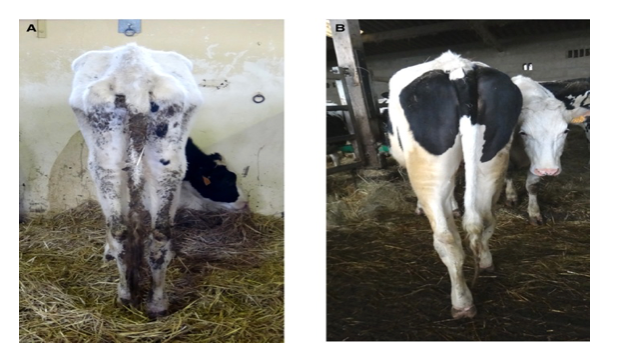
Image shows two heifers of the same age… first one has Fanconi syndrome, second one is healthy
What is MELAS disease?
Mitochondrial Encephalopathy, Lactic Acidosis and Stroke-like episodes
Clinical signs in humans usually between 2-15 years
Caused by a mutation in tRNA gene MT-TL1
tRNALeu involved in assembly of OXPHOS Complex 1
Results in:
Seizures, recurrent headaches, vomiting, hemiparesis, vision and hearing loss, loss of motor skills, cardiomyopathy and intellectual disability
Telltale sign:
Urine has odor of burnt sugar
What is Maple syrup urine disease?
IS DIFFERENT FROM MELAS
Inherited aminoacidopathy
Dysfunction in mitochondrial branch-chain keto acid dehydrogenase (BCKDH)
Build-up of leucine, valine and isoleucine- BCAA
In general, causes damage to mitochondrial DNA, reduced mitochondrial metabolism, apoptosis
Urine smells of maple syrup (in humans)
More common in Hereford cattle
Clinical signs within 2-4 days of age
Dullness, recumbency and opisthotonos
CNS dysfunction if not treated.
 Note
Note  Flashcards (102)