PSY 452 Exam 2
 Call Kai
 Learn
Learn Practice Test
 Spaced Repetition
 Match
Match Flashcards
 Knowt Play
1/88

There's no tags or description
Looks like no tags are added yet.
Name | Mastery | Learn | Test | Matching | Spaced | Call with Kai |
|---|
No analytics yet
Send a link to your students to track their progress
89 Terms
How is memory used in conversations?
Keeping questions in mind
Producing speech
Talking about what you’re planning to do
Making judgments and decisions
Holding words online to derive larger meanings
Keeping responses in mind
Reminiscing about past events
Remembering what we want to say
Accessing words and word meanings
Forming impressions
Emotional expressions
How pervasive is memory?
It is present throughout our daily lives! Both conscious and unconscious
How do we typically study memory?
Learning Phase (learn or encode information)
Retention interval (delay/imediation, etc)
Test Phase (take a memory test in which retrieve the information)
What is a free recall test?
memory assessment method where subjects study a list of items or information and, after a delay, recall them in any order freely
What is a serial recall test?
A type of test in which participants are asked to recall a sequence of items (numbers, letters, or words) in the exact order they were presented.
What is a cued recall test?
Where participants are asked to recall a list of words after given cues
What is a recognition test?
measures a person's ability to identify previously encountered information—such as words, faces, or images—from a new set of stimuli
What are the shortcomings of STM?
Too limited/restrictive; not flexible enough
Too focused on the passive holding of information, not enough focus on the manipulation of information
What are the key components of the Working Memory Model proposed by Baddeley & Hitch?
Phonological loop (Verbal and auditory information)
Central executive (coordinates activity and directs attention)
Visuospatial Skecth pad (Visual and spatial information)
How did the working memory model conceptualize STM?
Conceptualized STM not just as a place for passively holding information, but also as a place for processing/analyzing/manipulating information — operates as our mental workspace
How do we measure capacity of STM/WM?
Simple span tasks
Complex span tasks
What are simple span tasks?
Only measure the passive holding of information (which was appropriate for the old idea of short-term memory)
What are complex span tasks?
Require the holding and processing of information (as needed when examining the more modern idea of working memory)
What are reading span tasks?
requires participants to read sets of sentences aloud, judge their semantic validity, and recall the final word of each sentence
What is the operation span task?
Requires participants to simultaneously solve simple math problems while remembering a sequence of letters, testing the ability to maintain information while managing distractions. - tests working memory
What are some similarities between the working memory model and STM model?
Both pertain to the active contents of mind or online memory - the stuff you’re currently thinking about
Both are dealing with a form of memory that is proposed to be of very limited capacity and duration (very small!!)
What are some differences between the working memory model and STM model?
WM has greater flexibility with regard to the code (the way that information is held and operated on)
STM focuses on the holding of info, WM emphasizes both the holding and analysis of info
Given the latter difference, capacity is measured with complex and simple span tasks
How does the phonological loop work?
Auditory/Speech input (direct access) → Phonological short-term store (subvocal rehearsal - “inner voice”) + Non-auditory input (indirect access) → Auditory/Speech output
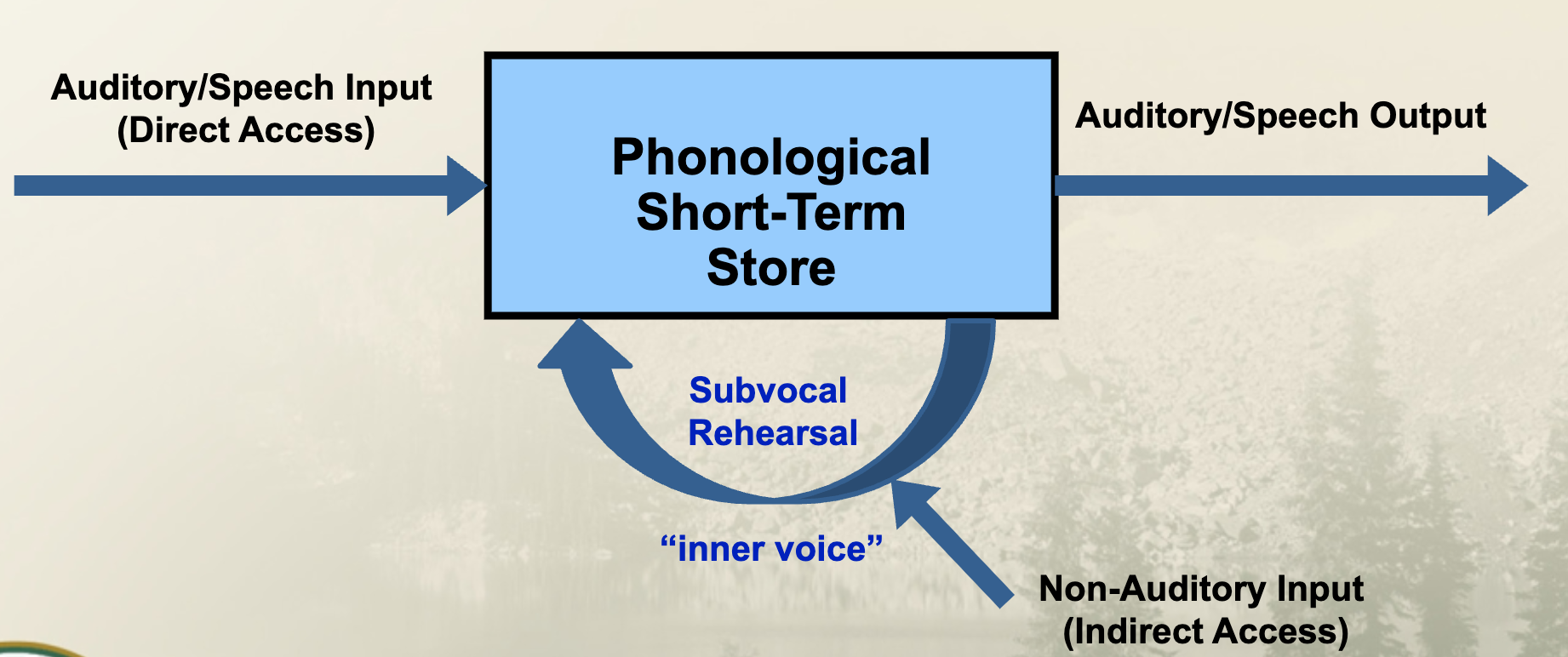
What does the phonological loop predict about how auditory information is stored? (1)
Predicts similar-sounding information will be confused - Phonological similarity effect (similar sounding info more likely to be confused than dissimilar)
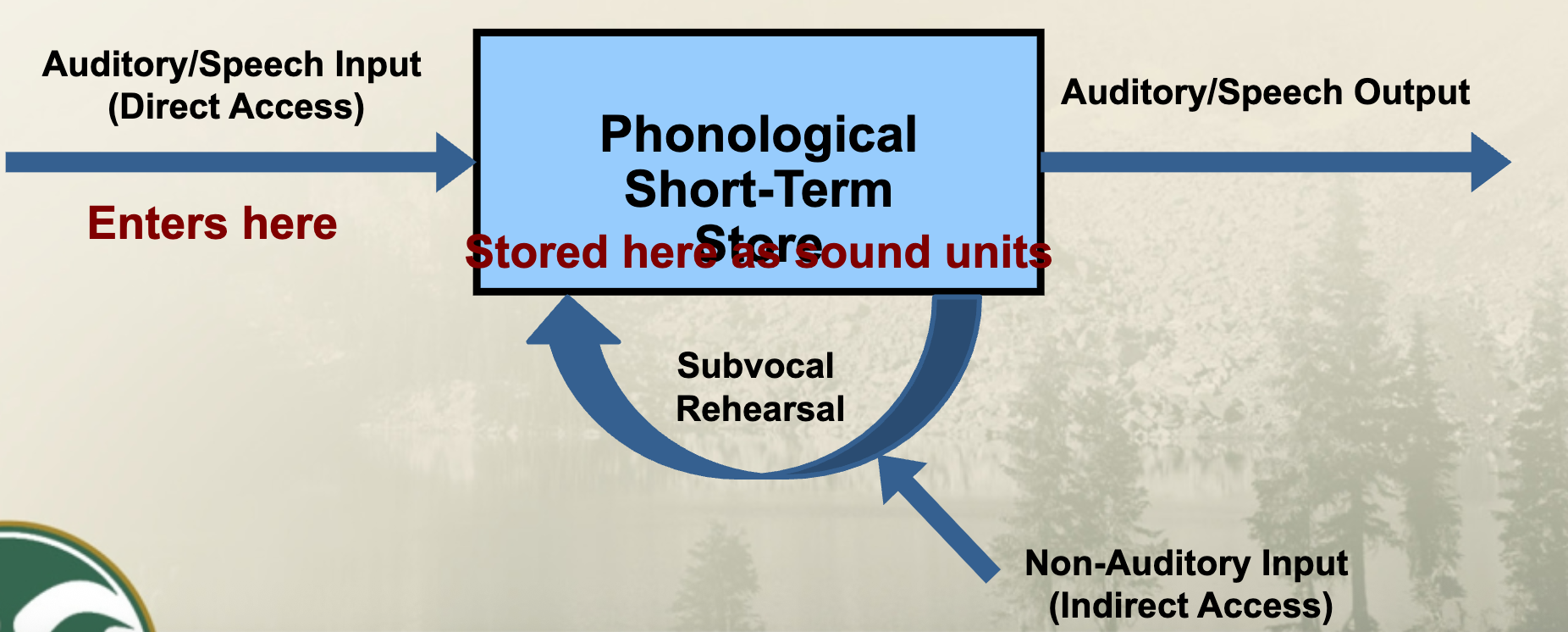
What does the phonological loop predict about auditory information? (2)
Similar-sounding information can be confused even if shown visually
How does the phonological loop predict the prevention of the phonological similarity effect?
Predicts NO confusion of similar-sounding information if shown visually and you knock out subvocal rehearsal (stored in visuospatial sketchbook) — i.e.) making people repeat a word
What is the visuospatial sketchpad?
Strongly suggests that people hold visual information
How did Shepard & Metzler (1971) study the visuospatial sketchpad?
Gave participants two different pictures of blocks and told to extinguish whether the two pieces are the same/different — subjects appear to solve task by engaging in mental rotation
In the study conducted by Della Sala et. al. (1999), what did they find when participants were told to duplicate patterns of squares on blank grid?
On average, successful up to 9 squares
What did Della Sala et. al. (1999) conclude in their study on the visuospatial sketchpad?
People used chunking (made chunks of blocks to help them remember better) as seen with verbal information
How did Brooks (1968) study the visuospatial sketchpad?
Told participants to visualize a letter and mentally trace the outside in a clockwise direction and report whether each corner is an outer corner or an inner corner
Told to respond verbally or by pointing
What did Brooks (1968) find in their study on the visuospatial sketchpad?
Similarity-based interference as seen with verbal information, in this case pertaining to competing visuospatial activities
What are the functions of the central executive in the WM model?
Coordinates the systems/subsystems
Controls retrieval and use of info from LTM
Focusing, switching, dividing attention
Maintains task goals
How did James (1890) define primary memory?
Immediate contents of consciousness
How did James (1890) define secondary memory?
Content that is no longer consciousness and must be brought back in
How did Atkinson and Shiffrin (1968) shift the idea of primary and secondary memory?
Primary memory became short-term memory
Secondary memory became long-term memory
According to Atkinson and Shiffrin’s (1968) Modal Model, how does the concept of short-term memory work?
Information enters sensory memory, and with attention moves to working memory, where rehearsal stores it in long-term memory and retrieval brings it back when needed.
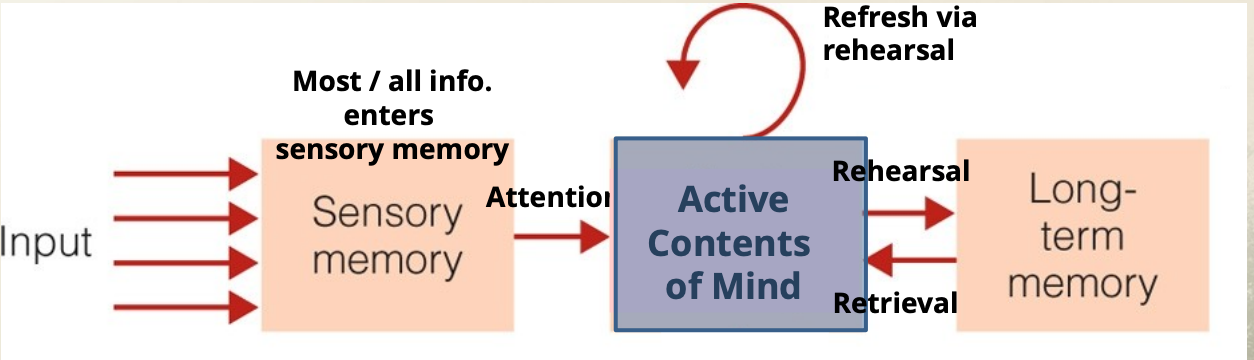
What makes up short-term memory?
Active contents of mind
Stuff that you’re currently thinking about
How is short-term memory defined?
Not by time, but by the status of information, whether it’s currently on your mind or not
What are some misconceptions about short-term memory?
The belief that it acts like a perfect, passive video recorder, holds vast amounts of information, or is solely responsible for all immediate forgetting
What are some characteristics of STM?
Duration is short/limited
Capacity is small/limited
Format is commonly acoustic
How did Peterson & Peterson (1959) study the duration of STM?
Gave participants three letters, then told to count backwards (retention interval) and then asked to recall letters.
Varied the retention interval to see how long the memory would last
What did Peterson & Peterson (1959) find on the duration of STM?
The longer the interval was, the less accurate people were
What did Keppel & Underwood (1962) predict in their study on forgetting from STM?
Decay vs. Interference:
Prediction if decay: consistent across trials
Prediction if interference: decline across trials
What did Keppel & Underwood (1962) find in their study on forgetting from STM?
Observed a decline across trials, consistent with interference
In addition, perfect on Trial 1 when there were no previous trials that could cause interference
What can we conclude about the duration of STM?
Very rapid forgetting that from STM that starts immediately
STM has a short duration (seconds, tens of seconds)
Forgetting largely due to interference; focusing on some info means other info will be pushed out
Describe the results of Miller’s study on capacity of STM
Get a different span for different languages
Get a different span for different word lengths
Capacity = amount can say in 2-3 seconds (which on works out to about 7 average-length words)
What can we conclude about the capacity of STM?
Capacity of STM is greatly limited
This is why information is being pushed out, so that there’s “space” for new, incoming information given the limited capacity
Can, in effect, boost capacity with chunking
What is the format of information in STM?
We have the ability to hold and manipulate visual images in STM
Just have a tendency to hold language-based info in a sound format (reflecting the use of our “inner voice”)
In Atkinson and Shiffrin's model model, retrieval entains the movement of information from ______ to ______.
LTM; STM
In the movie 50 First Dates, the main character (played by Drew Barrymore) can not remember the events that happened to her the day before. This is characterized in the movie as short term memory loss. Is the writer of this script using the term short-term memory accurately?
No
Research shows that subjects can only remember, on average, about seven random letters. But those same subjects can remember seven unrelated words, too, even though they might be comprised of 30+ letters. How?
Chunking
Assume a researcher presents a list of random letters to participants, then immediately asks them to recall all of the letters in the order given. If the third letter is the letter "G", which of the following mistakes would you expect to be most common?
Mistakingly recalling T, given it's similarity in sound to the letter G.
Peterson and Peterson conducted a well-controlled experiment to determine how long information lasts in short-term memory when you prevent refreshing / rehearsal. What did they find?
STM lasts on the order of seconds
The working memory model allows for a sound-based code based by virtue of __________, and a visual code by virtue of ___________,
The phonological loop; the visuospatial sketchpad
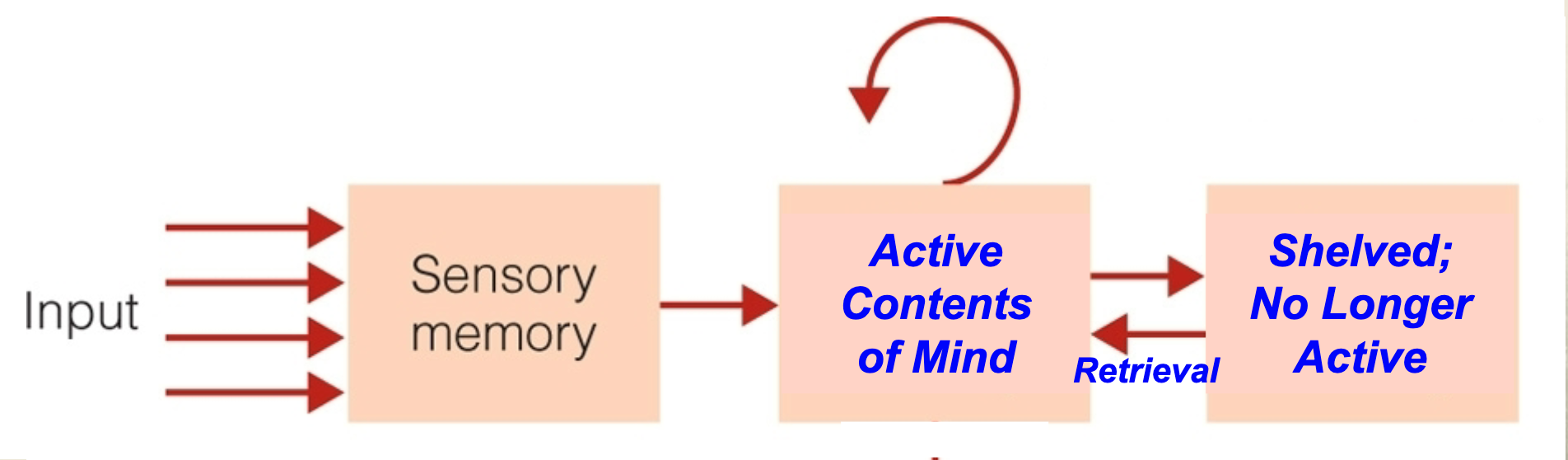
What is the conceptual difference between STM and LTM?
Information enters sensory memory, moves into working memory if attended to, and is then stored in long-term memory (no longer active) but can be brought back into awareness through retrieval.
What is the serial position effect?
memory bias where items at the beginning (primacy effect) and end (recency effect) of a list are recalled better than those in the middle
What is the explanation for primacy?
In a word list, items at the beginning of the list are often rehearsed more and thus remembered more — more likely to enter into LTM
What is the explanation for recency?
If the memory test comes right after the list, the last items may still be active in STM
Can simply be “dumped: out
So recency is due to the activity of STM
What would happen if a memory test is delayed and filled with activity that occupies STM?
Recency should go away
What is experimental dissociation?
the laboratory-based, temporary induction of dissociative states—such as detachment from reality, depersonalization, or memory gaps—in non-clinical or clinical participants to study their underlying mechanisms
Summarize patient H.M.’s condition
Epilepsy, bilateral removal of hippocampus
Intact STM
Intact LTM from before operation
Severe deficits in committing new information to LTM
Summarize patient Clive Wearing’s Condition
Viral encephalitis, severe damage to hippocampus
Intact STM
Intact LTM from long ago
Severe deficits in committing new information to LTM
Summarize patient Jimmie G’s condition
Korsakoff’s syndrome, damage to hippocampus (chronic alcoholism)
Intact STM
Intact LTM from long ago
Severe deficits in committing new information to LTM
Summarize patient K.F.’s condition
Parietal lobe damage (not include hippocampus)
STM capacity of just 2 (with sample span task)
Reduced recency effect
Functioning LTM
What is a population dissociation?
When populations differ on one measure, but don’t differ (or differ in the opposite way) on another measure
How can do we use population dissociations to describe what happened to H.M., Clive, and Jimmie G?
Patients and controls differ on measures of LTM, no difference on measures of STM
How can do we use population dissociations to describe what happened to K.F.?
Difference with STM, no/minimal difference with LTM
What do dissociations reveal about memory systems?
They show that memory is made up of separate systems, since one type can be impaired while another remains intact.
Explain Henry Molaison’s condition
Could still learn new motor skills/LTM for motor skills
Lack of LTM memory for practice sessions
Similar pattern in other hippocampal patients
What is repetition priming?
a form of implicit memory where exposure to a stimulus (like a word or object) improves processing speed or accuracy when encountering the same or similar stimulus again
What did Graf et al.’s study on priming in Korsakoff’s patients find?
Poor memory when consciously, deliberately trying to use memory
Normal memory when not consciously, deliberately trying to use LTM
What phenomenon do the results of Graf et al. (1985) study reflect?
Population dissociatio
What is explicit memory?
Conscious memory - episodic (personal events) and semantic (facts/knowledge)
What is implicit memory?
Unconscious memory - priming, procedural, conditioning
How do we directly test memory?
Directly refer to a past event
Typically instructed to use memory
Aware when using memory
Therefore used to examine explicit memory
Examples of direct tests of memory
Free recall, cued recall, recognition
How do we indirectly test memory?
Do not refer past events
No mention of memory
Simply asked to perform current task
Memory may be without awareness
Therefore used to examine implicit memory
What are three types of indirect memory tests?
Perceptual identification
Fragment completion
Homophone spelling
What is perceptual identification?
The process of recognizing or interpreting a sensory stimulus (visual, auditory, etc.) as a specific object, word, or event, usually occurring after initial sensory encoding
What is fragment completion?
a common implicit memory test where participants fill in missing letters of a word
What is homophone spelling?
words that sound identical when spoken but have different meanings and, usually, different spelling
What did Jacoby & Dallas find in their direct vs. indirect study?
People performed worse on the perceptual identification test, which tested unconscious memory
What do the results of Jacoby & Dallas (1981) demonstrate?
Experimental dissociation
List 4 pieces of converging evidence for explicit vs. implicit memory
Population dissociations
Experimental dissociations
Developmental dissociations
Drug-induced dissociations
Glanzer & Cunitz (1966) ran a serial position effect experiment in which they followed list presentation with 30 seconds of distracter activity. They found that this selectively affected recency (i.e., there was no effect on primacy, but there was elimination of recency). This pattern, in which the same variable (post-list distracter) has one effect on one measure (recency), but a different effect on another measure (primacy), is called what?
Dissociation
Can severely amnesic patients (such as HM or Jimmy G.) learn completely new skills for the first time?
Yes - A spared long-term memory ability of amnesic patients is that they can learn and retain new skills. One example of this is that H.M. was able to learn and signficantly improve in performing a mirror tracing task.
Amnesic patients like H.M. and Clive Wearing show intact STM, but deficient LTM (in some respects). What do we call it when a patient population shows deficits relative to normal healthy adults on some measures, but no deficits on others?
Population dissociation
Which of the following findings have been observed by researchers studying implicit and explicit memory?
All of the answers are correct
What is the process of encoding?
Acquiring info and getting it into LTM
Processes occurring during initial exposure
What is the process of retrieval?
Pulling info out of LTM, into the active contents of mind
Does repeated exposure help to consolidate stuff into LTM?
No - even at very high levels, does not ensure that information will be well retained; not an effective encoding activity for producing good long-term memory
Does rehearsal increase the likelihood of transfer to LTM?
Not really! There’s not a significant difference based on amount of repetition (Glenberg et al. (1977), Craik & Waitkins (1973))
What is maintenance rehearsal?
Simple repetition of information
Focus is on the quantity of processing/rehearsal

