BIS126 Genetics and evolution
 Studied by 0 people
 Call with Kai
 Learn
Learn Practice Test
 Spaced Repetition
 Match
Match Flashcards
 Knowt Play
1/229

There's no tags or description
Looks like no tags are added yet.
Name | Mastery | Learn | Test | Matching | Spaced | Call with Kai |
|---|
No study sessions yet.
230 Terms
what was jean Baptiste de Lemark’s theory of inheritance
Inheritance of acquired characteristics
organs that are used most evolve within the organism and offspring develop these characteristics
e.g. giraffes stretching their necks
what was Darwins theory of inheritance
he didn’t know how inheritance worked
noticed preservation of favourable characteristics and called it natural selection
how was the modern synthesis of evolution (1940) created
darwinian ideas of selection was combined with mendels work on genetics
what are the 3 ingredients of evolution
variation → inheritance→ selection
examples of some ways to study evolution
field- based studies (e.g Darwins finches)
experimental evolution (e.g e.coli populations)
comparative approaches (e.g primate genome project)
examples of adapting to new environments
peppered moths "bison betularia”
tibetans and high altitude
covid-19 strains
examples of evolution of resistance
warren resistance in rats
antibiotic resistance/ MRSA
examples of domestication
dogs - much inbreeding so high frequency of genetic diseases that can be studied
plants - brassicas
what does evolutionary change require
variation that is heritable and affects fitness
What are the two types of nucleotide base structures?
Pyrimidines and purines
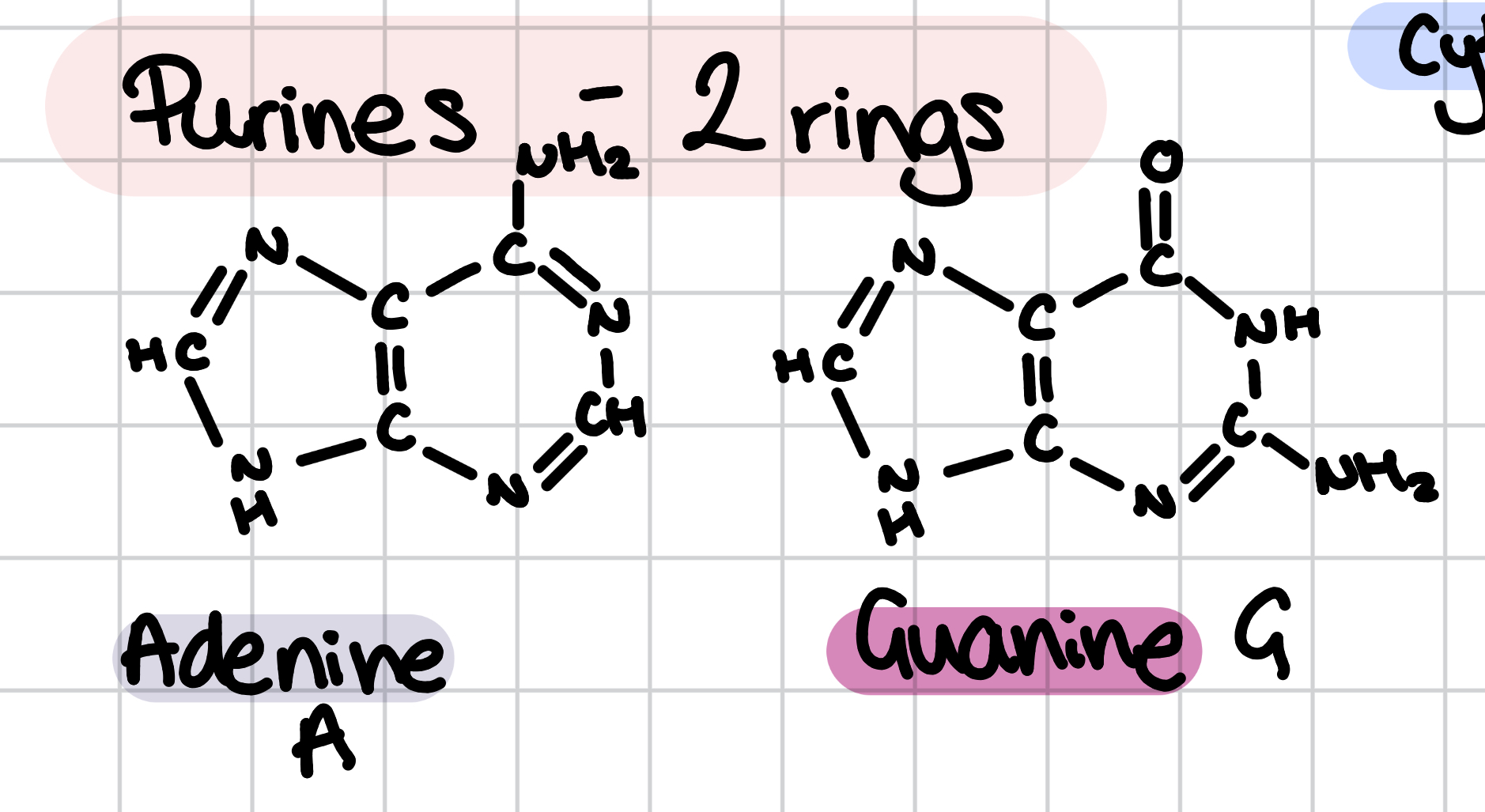
What is a purine?
2 rings (adenine and guanine)
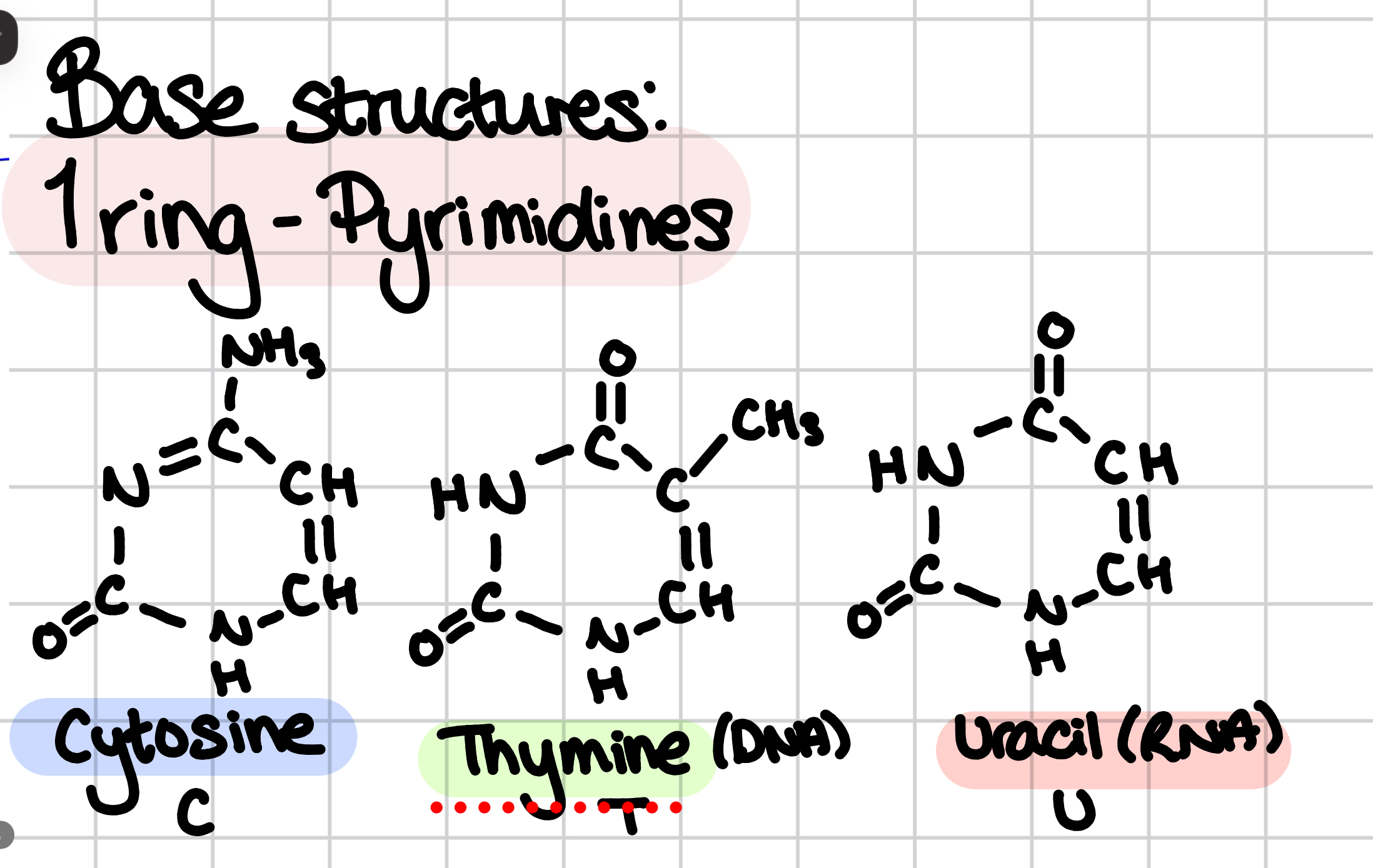
what is a pyrimidine?
one ring (cytosine, thymine, uracil)
Watson and crick’s DNA structure
A-T and C-G H-bonded base pairs
antiparallel strands (opposite 5’ to 3’ directions)
right handed double helix
one turn every 10.5 bp
DNA strands complementary
3 H bonds G-C, 2H bonds A-T
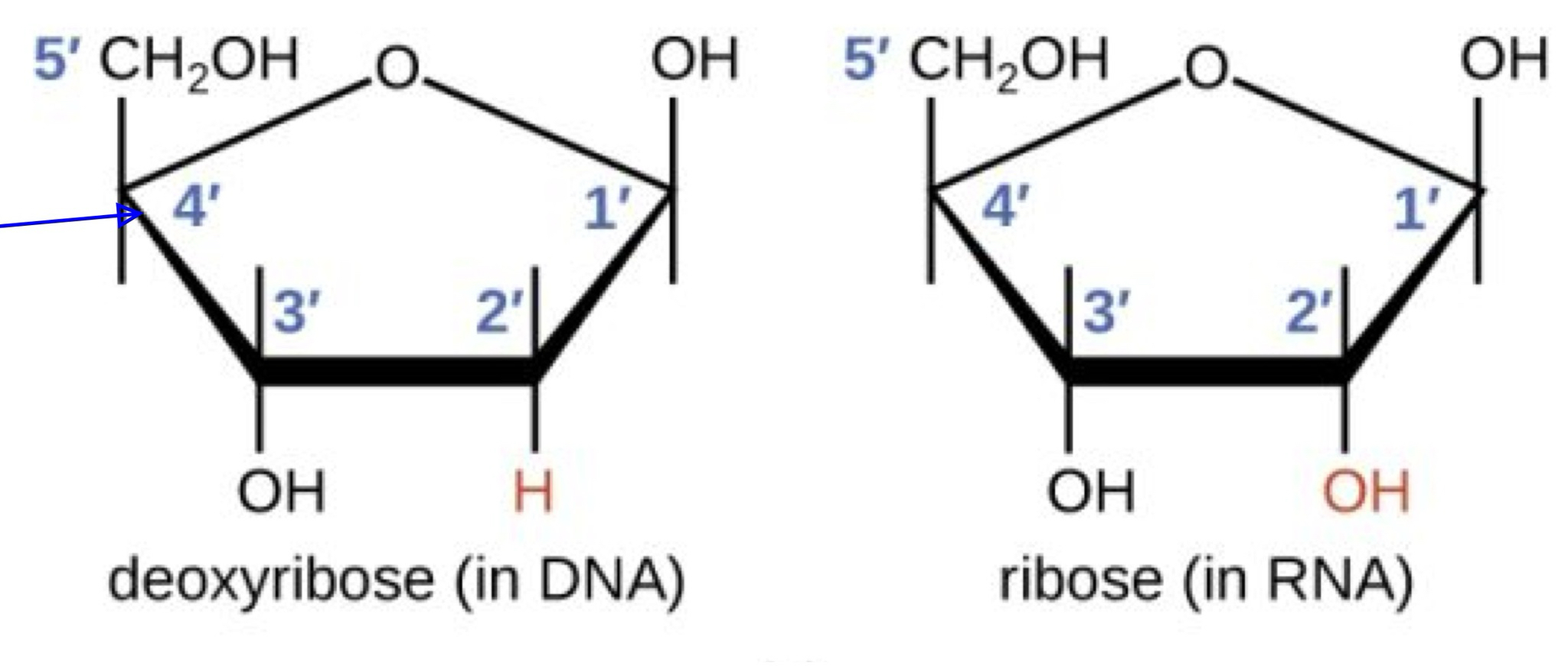
RNA and DNA main differences
Nucleotide contains ribbons instead of deoxyribose in pentose (missing oxygen)
RNA contains uracil instead of thymine
RNA is often one stranded
Where is DNA found in prokaryotes?
No internal structure such as nucleus
DNA is condensed in a structure called the nucleiod
single stranded DNA molecule densely packed with genes
few million bases
also contain smaller plasmids (thousands of nucleotides) passed from cell-cell in certain circumstances
Where is DNA Found a eukaryotes?
Contained the nucleus, eukaryotic chromosomes are linear
Structure of chromosomes in eukaryotes
p arm, q arm, telomeres, centromere
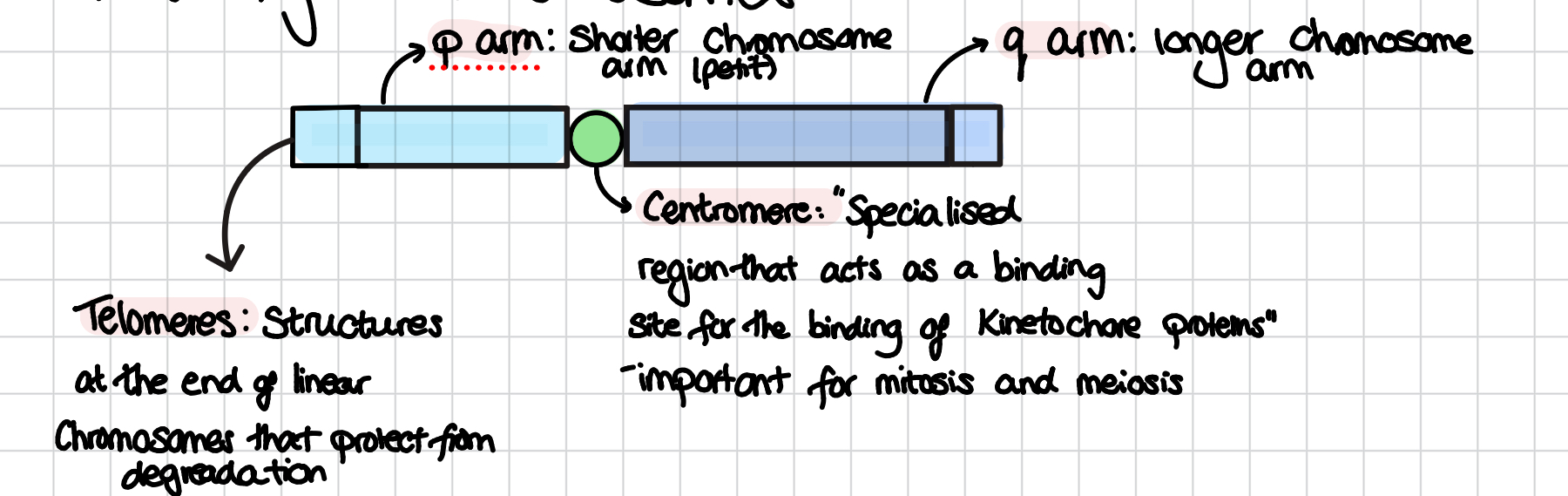
P arm
Shorter chromosome arm
q arm
Longer chromosome arm
Telomere
structures at the end of linear chromosomes that protects from degradation
Centromere
Specialised region, that acts as a binding site for the binding of kinetochore proteins important for mitosis meiosis
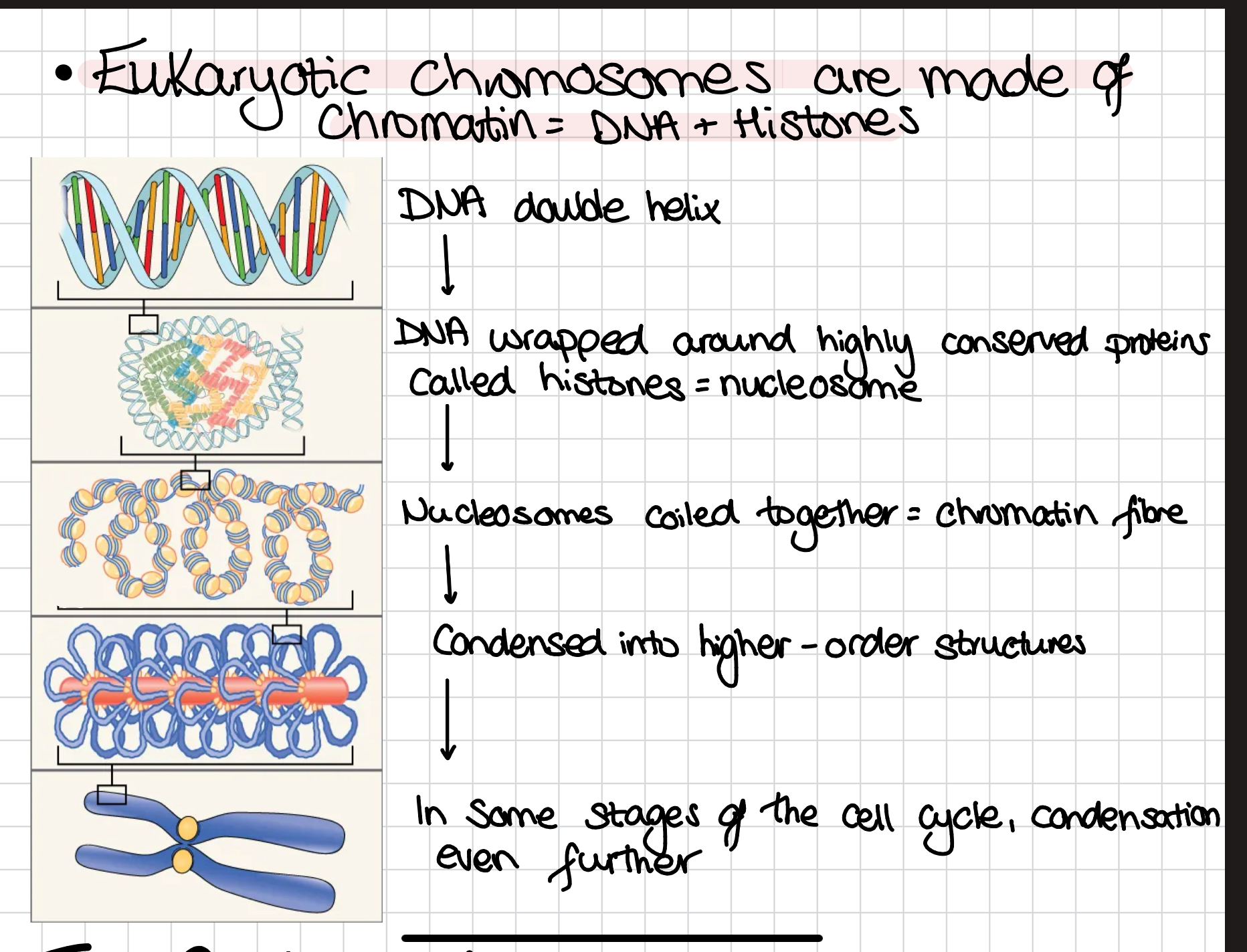
What are eukaryotic chromosomes made of?
Chromatin= DNA + histones
What is the central dogma?
DNA makes RNA makes protein
transcription + translation
amino acid
What's the difference between different R groups?
Shapes and sizes, electric charge ,polarity
Gene definition
Unit of hereditary information occupies a fixed position (locus) on a chromosome
Gene expression definition
The process of transferring the information in a gene to a functional protein needs to be controlled. Gene is not expressed equally.
Initiation sequence at the promoter
Conserved sequences just before the transcription starts, recognised and bounded by RNA polymerase subunits
termination sequence
At the end of the gene, sequence that makes polymers slow down and therefore dissociate from DNA
Operon
A group of genes with a single promoter in bacterial gene
genes are often needed in similar circumstances to expression is controlled together
When do transcription translation occur in prokaryotes?
Simultaneously, several ribosomes can work to translate the RNA molecule at the same time process begins before transcription is finished therefore large amounts of protein can be built up quickly
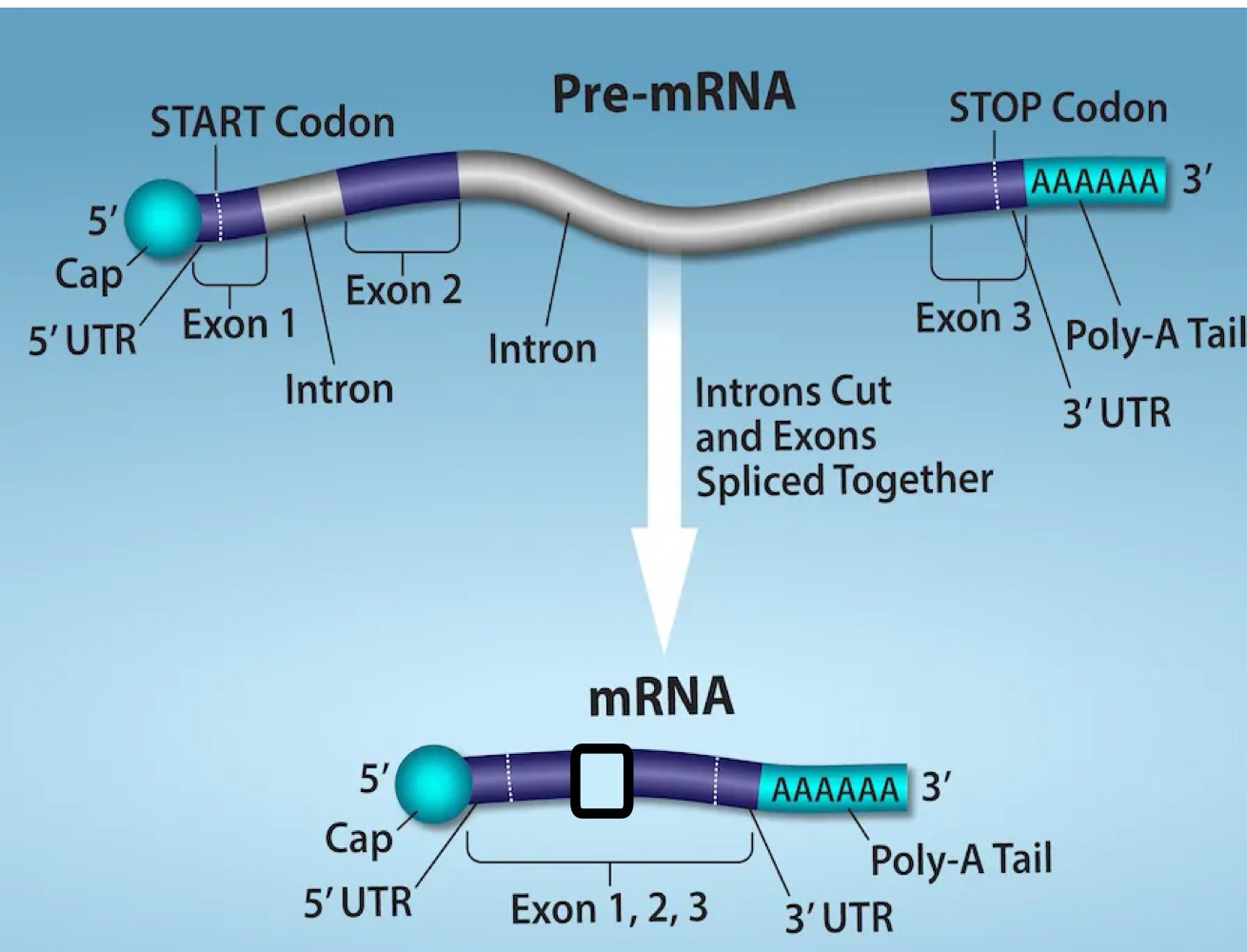
What are the type of sections of mRNA?
Exon's, intron and UTRs
What are Exon?
Protein coding sequences
What are introns?
Regulatory sequences needed to be removed in a process called splicing before mRNA is ready to be translated
What are UTR's?
untranslated regions that direct the ribosomes
What is added to the ends of mRNA?
5’ and 3’ PolyAtail added to mRNA, which is an export from the nucleus to the cytoplasm
What role does complementarity provide?
Provide a mechanism to replicate DNA
What sort of replication of DNA occurs?
Semiconservative, the complementary standards are separated and each is used as a template for new DNA strands which was predicted by Watson and Crick in the original DNA model
What is the origin of replication?
specific DNA sequences where cellular machinery begins duplicating a genome, acting as binding sites for initiator proteins that unwind the DNA, creating replication forks for bidirectional synthesis
Two replication forks proceed from each one
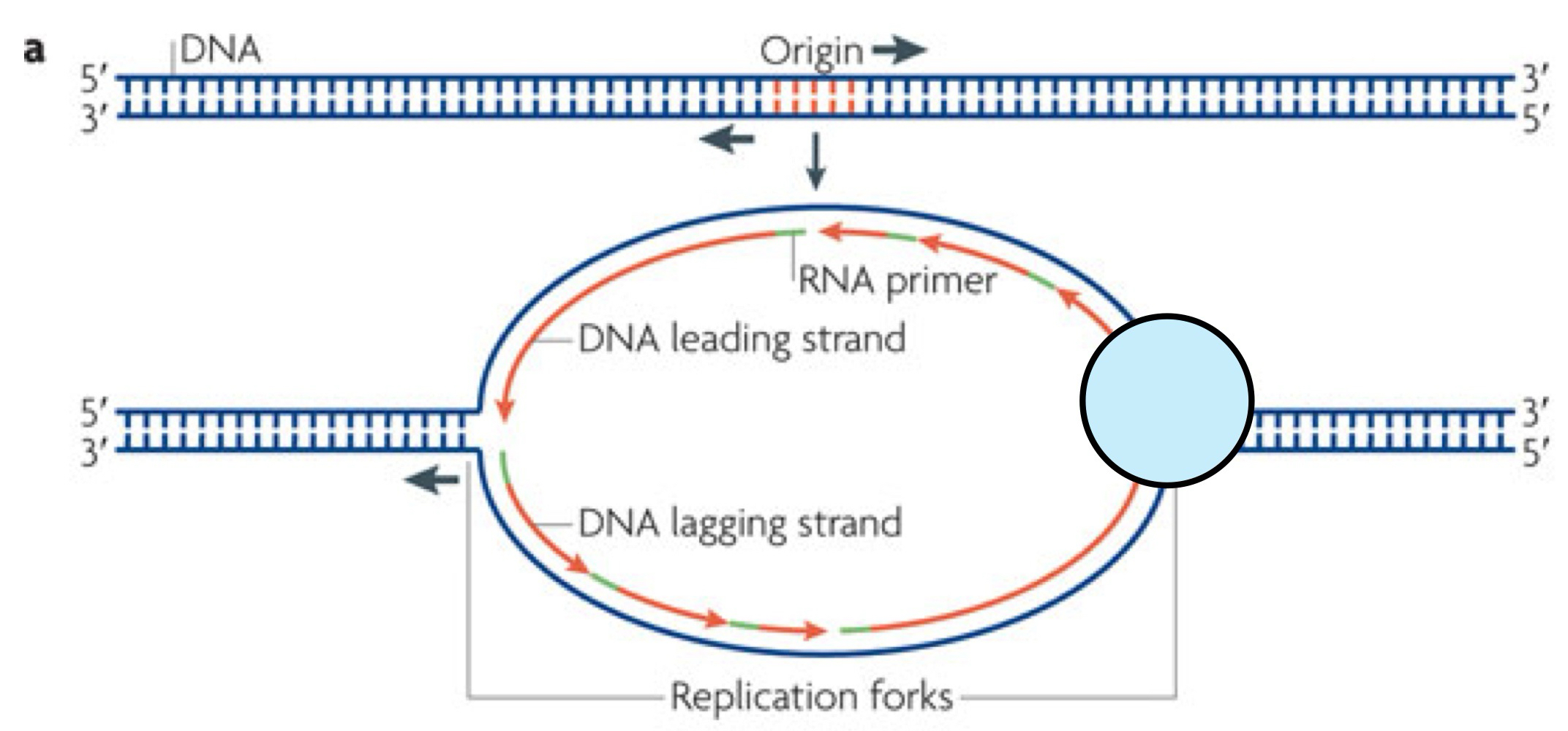
How many origins of replication in prokaryotes versus eukaryotes?
One in prokaryotes and thousands in eukaryotes
What are the two strands in replication?
Leading and lagging strand
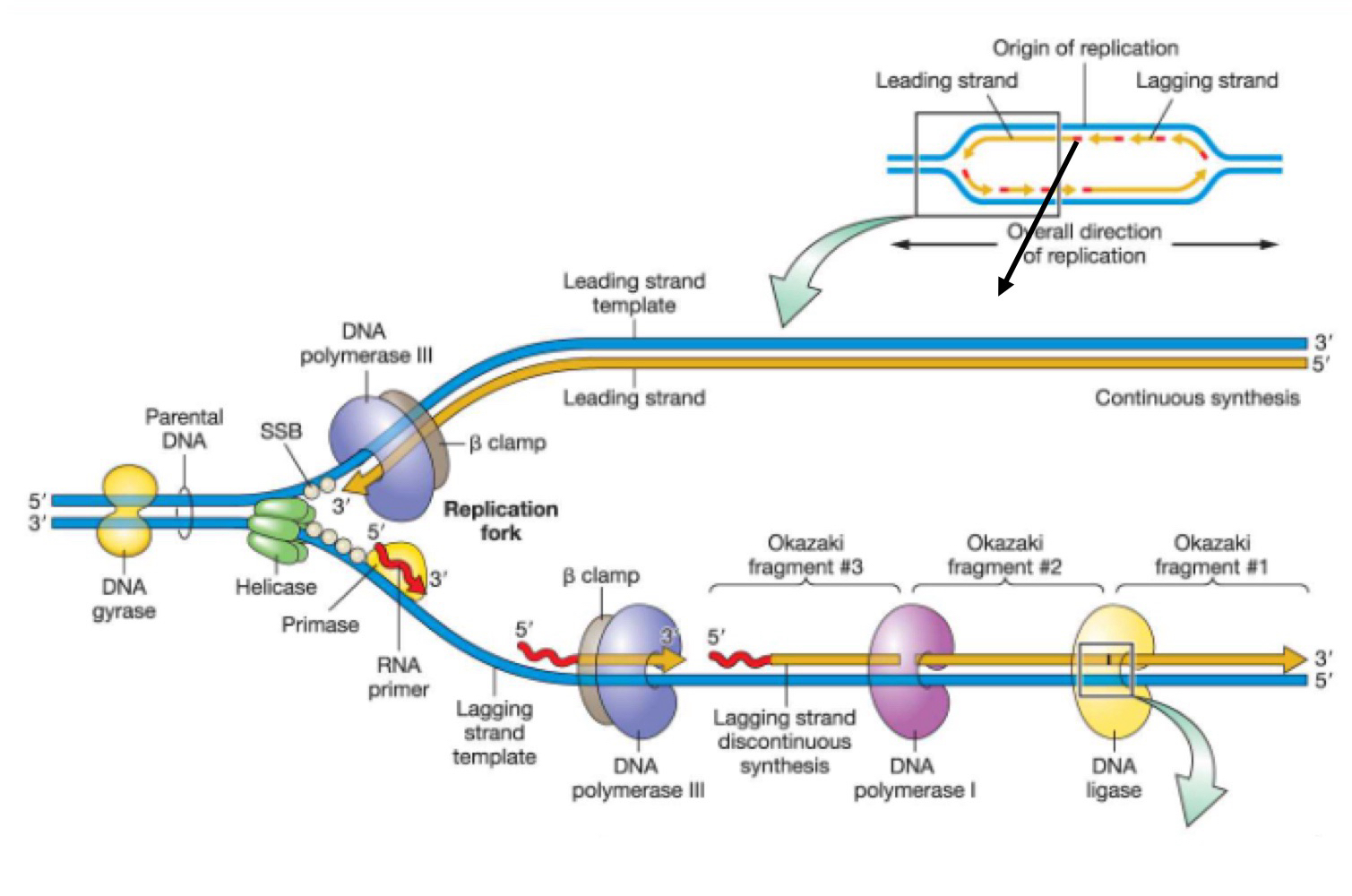
Which is the leading strand?
In direction from five prime to 3 prime
DNA synthesis points towards the replication fork and can proceed continuously
follows Helicase
Which is the lagging strand?
Five prime to 3 prime
Points away from the replication and must therefore be a discontinuous
Primed numerous times
What is the mechanism of DNA polymerase?
Adds nucleotides one at a time in a five prime three prime direction
primer starts it
can only add to three prime end
uses template strand to form hydrogen bonds tells which base to add next
rate of 10/100s of nucleotides per second can only add nucleotides an existing strand
What does primase do?
Generate a primer, ligase joins the stretches of new DNA
What does a short RNA primer indicate?
Start point for replication
What does topoisomerase do
Release pressure from overwinding around the replication by making and resealing breaks the DNA
What does SSB do?
Single strand binding protein binds to the separated transparent them from renaneling
What are Okazaki fragments?
The piece of DNA that are stuck together to make up the lagging strand
is ploidy level conserved in mitosis
yes
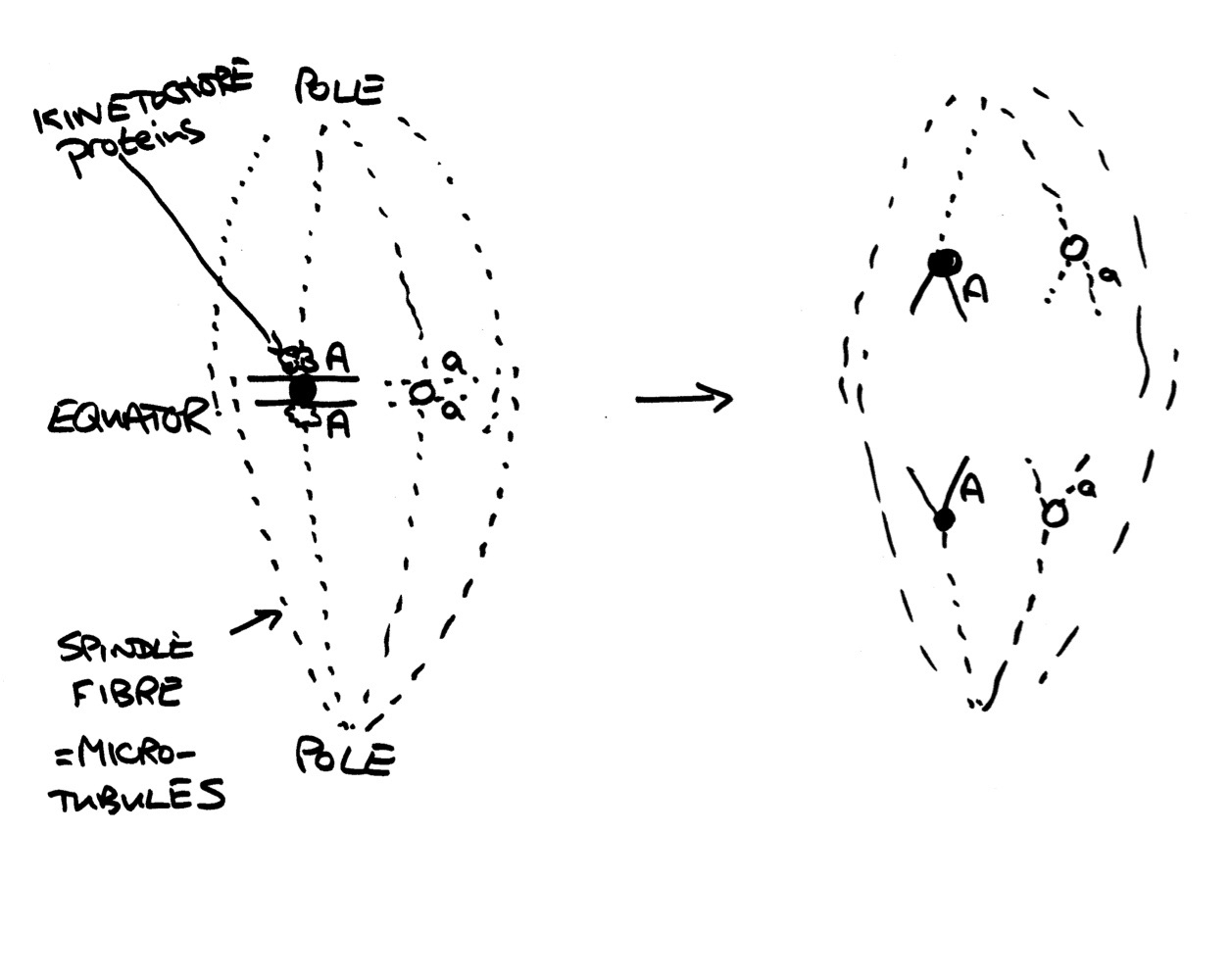
role of spindle
separate sister chromatids to different daughter cells, microtubules get shorter pulling chromosomes to the poles
centromeres
specialised chromosome regions that direct the equal segregation of chromosomes
connected to microtubules via a large protein complex called the kinetochore
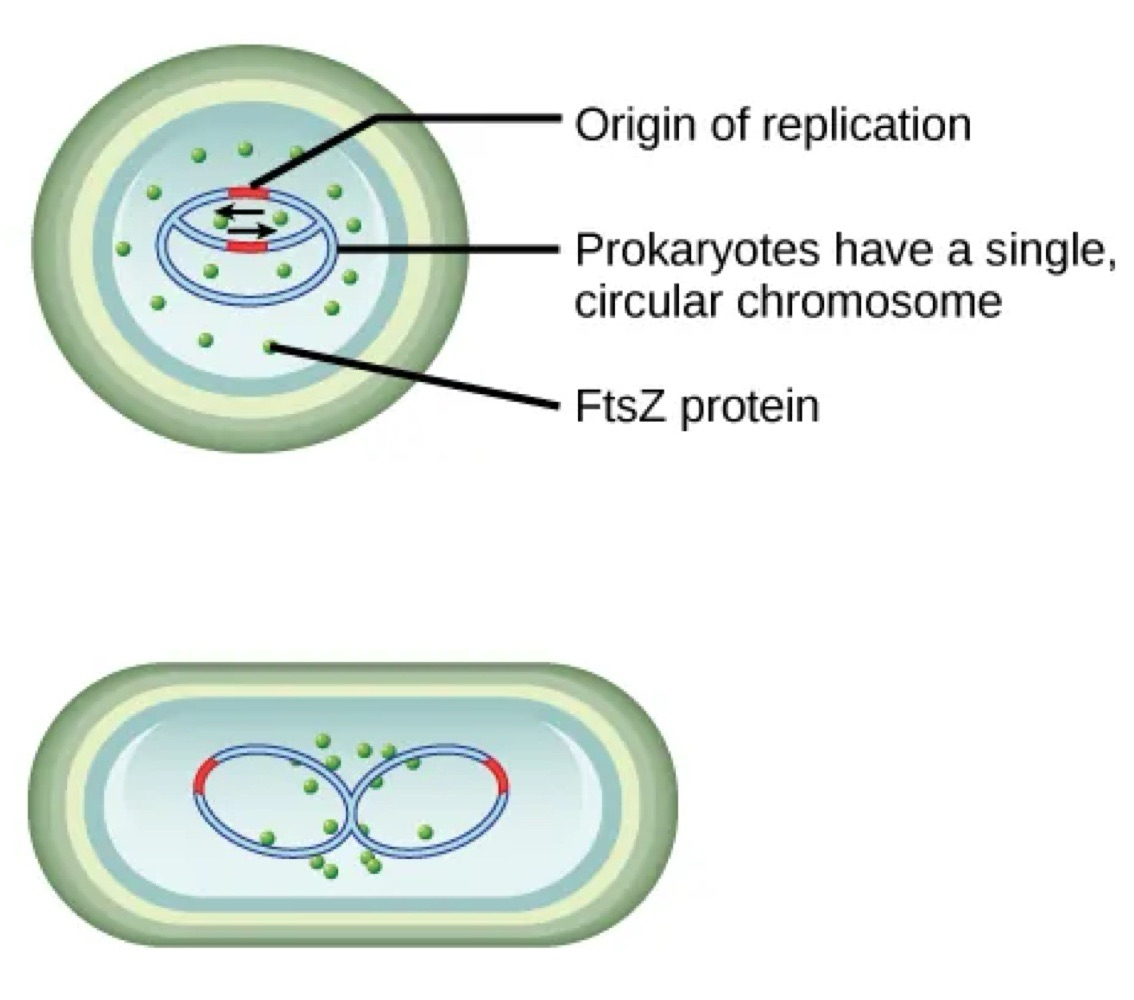
binary fission
binary fission begins with replication of DNA
FtsZ is distributed throughout cell
the cell elongates
FtsZ moves to middle of cell
chromosomes move to opposite ends of cell
FtsZ gathers at midpoint between them
FtsZ directs the formation of the septum made of plasma membrane and cell wall materials
the cell pinches in half and 2 daughter cells formed
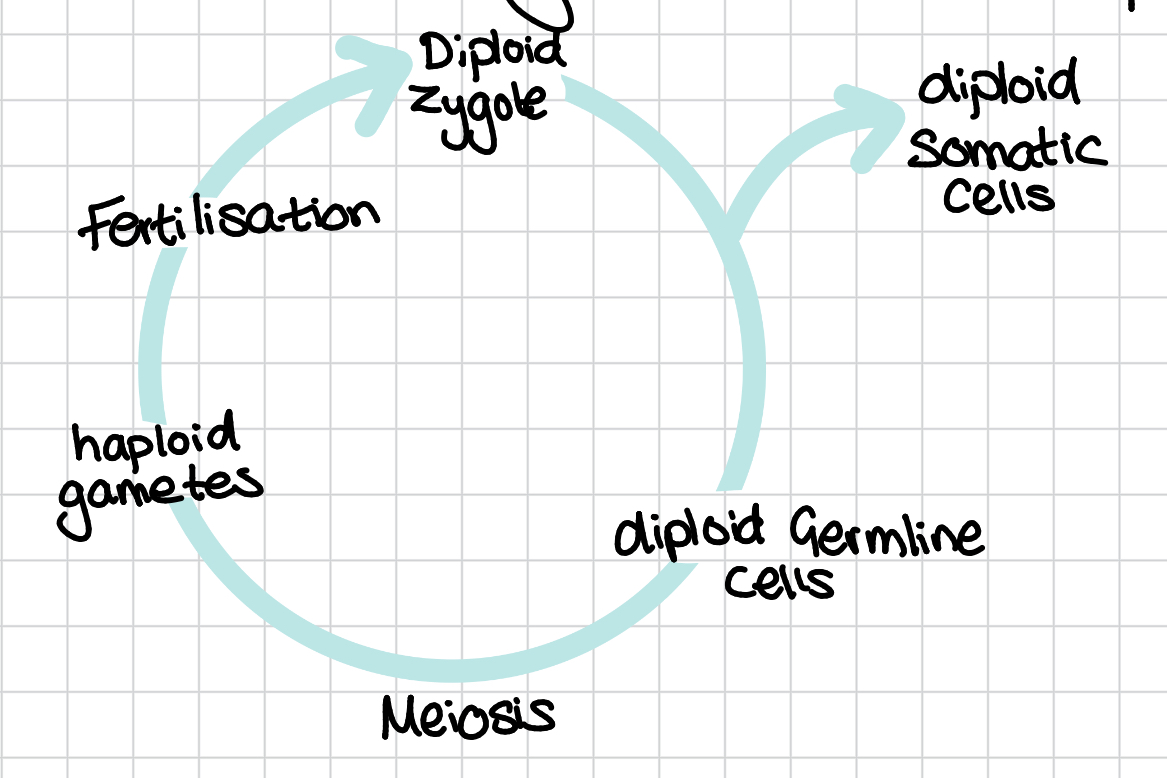
What is the nuclear cycle in typical animal?
Diplo most of life cycle
two mating cycles
germline cells that separate from the rest of the animal
then meiosis occurs giving four haploid gametes these combined to give a zygote with all the genetic info needed
What is the nuclear cycle in budding yeast?
Haploid through most of the life cycle
Two types a and alpha determined by a single locus
One a and one alpha combined to give a transient diploid stage
Then meiosis occurs
Giving four haploid products which then developed into the normal building form
Nomenclature for replicated chromosomes
Diploid organisms have two homologous chromosomes same genes but could have different versions of them
each chromosome is replicated to give two identical Sister chromatids
the Sister chromatids are joined together with a single centromere structured called a dyad
meiosis I: first division stages
interphase- homologous chromosomes
prophase I - each replicated chromosome = dyad, 2 sister chromosomes with a single centromere
metaphase I - bivalent = 2 dyads joined together
anaphase I - dyads moved to different poles, centromeres stay intact
telophase I
By and have two nuclear both containing both Sister) chromatids of one chromosome from each pair of homologous pair different from each parent cell
Stages of crossing over
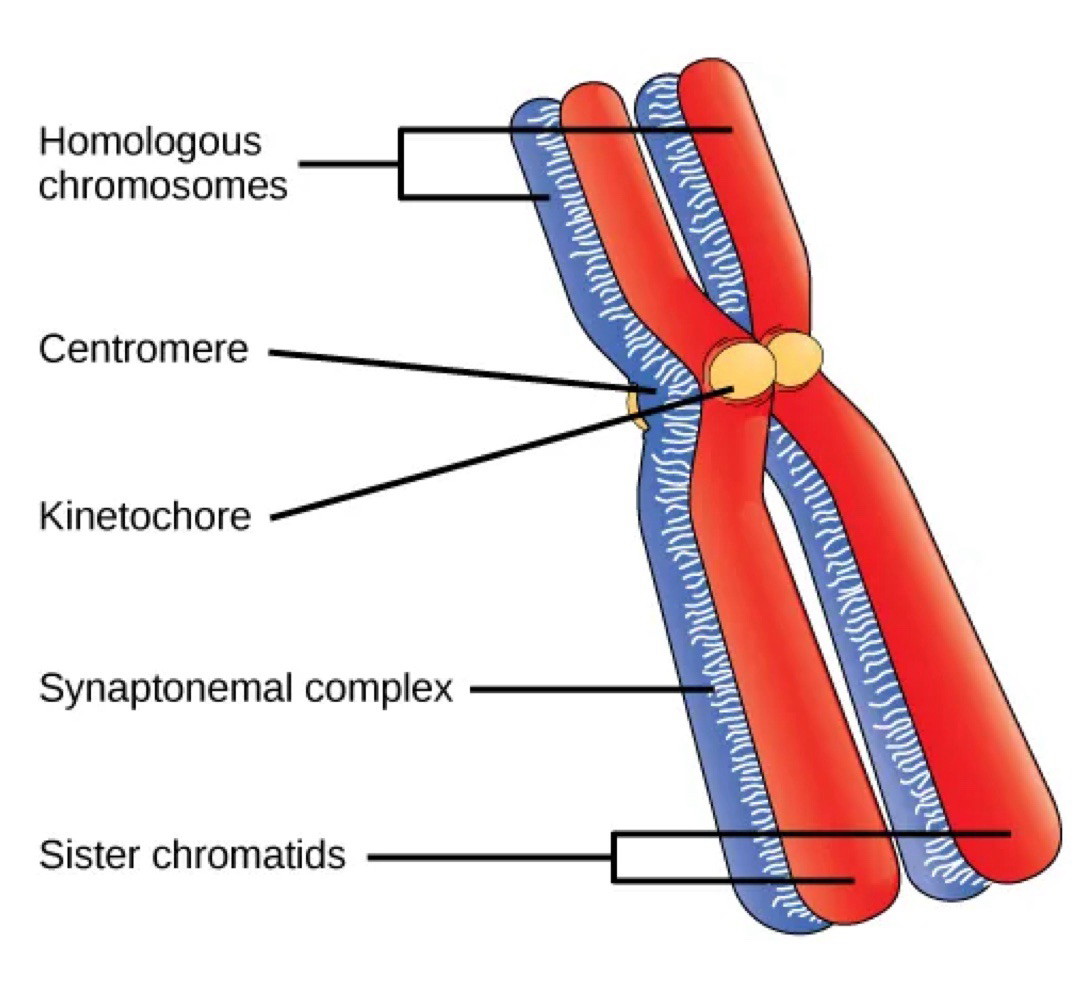
Holds non-Sister chromatids together
Leptotene - replicated chromosomes start to contract
Zygotene- chromosomes line up in homologous pairs = synapsis held together by protein called the synaptonemal complex relies on recognition of similar sequences
Pachytene - crossing over/ genetic exchange between non sister chromatids
diplotene - chromosome separate a bit but sites of crossing over is still visible
diakinesis - chromosomes contract further

meiosis ii stages
Sister chromatids lineup together
centromere splits
chromatids moved to opposite poles
by the end four nuclei 2 contain one copy of first homologous chromosome of the pair other 2 contains one copy of the second
What is recombination?
The process by which new combinations of alleles are generated during meiosis through independent assortment and crossing over
What are crossovers?
Sites of genetic exchange between homologous sequences on nonsense credits
How do crossovers occur?
Double strand breaks are made deliberately by specialist enzymes
homologous recombination occurs; relies on chromatids aligning identical sequences sections of the chromosome are swapped giving new allele combinations
What is linkage?
If genes are closer together, it is less likely there will be crossover between them and more likely they will be inherited together
How many possible combinations of chromosomes for humans?
For 23 human chromosomes 2²² = 4194304 combinations
Benefits of recombination
Can produce new fitter gene types can also break up co adaptive gene combinations and speeds up evolution in sexual organisms
Mutation definition
The process that produces a gene of chromosomes that differ from that of the wild type
The gene or chromosome sets the results from such a process
Wild type definition
The form that predominates in nature or in a standard laboratory stock
What is a point mutation?
Small scale mutations, one or a few nucleotides
What types of mistakes can happen during replication?
Incorrect base added, replication slippage
How is an incorrect base added during replication?
DNA polymers adds the wrong nucleotide despite proofreading activity if undetected passed on to all daughters
How does replication slippage occur during replication?
Dissociation of the DNA polymerase during replication, new DNA strand might re-hybridrise in the wrong place, replication continues yielding adult strand that is longer shorter than the template, very common for micro satellites
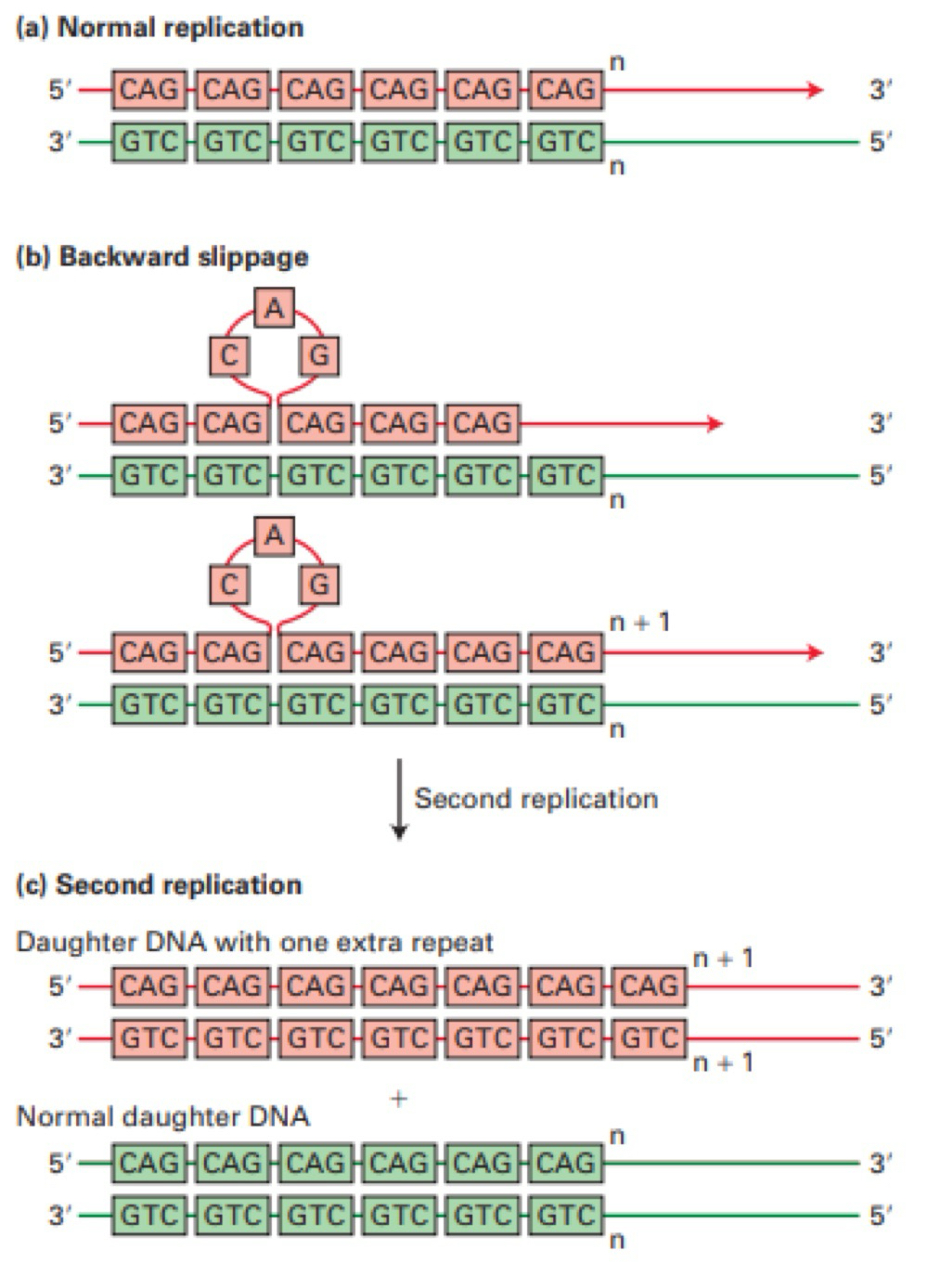
What is a micro satellite?
Short repeated sequences e.g CAG
Are Satellite DNA copy numbers the same between individuals
No different number of repeats between individuals, different alleles on each chromosome, most of the time phenotypically neutral, some exceptions e.g. too many copies of CAG causes Huntington's disease
How can point mutations caused by environmental mutagens?
For example, UV light can link together adjacent bases, bulky structure blocks DNA polymerase during replication and therefore causes breaks DNA which are not always prepared correctly
How are complete mutations caused by the cellular environment
For example, reactive oxygen species are generated by various cellular processes and damage DNA bases,
For example, guanine is oxidised to 8-oxoG which pairs with A instead of C causing a single nucleotide change
How are mutations potentially reversed? e.g mismatch repair.
Recognises removes and resynthesises mismatched DNA due to mistakes in replication
Various methods depending on species to differentiate the template from the new incorrect strand
This is in addition to proofreading activities of DNA polymerase
Types of point mutation
Silent - no change to amino acid sequence
Nonsense-introduction of a stop codon in a gene
Missense - changes to an amino acid sequence varying effect on protein function
Null allele - total loss of function
Where do mutations have the most profound effect?
In the control region of genes, promoters, splice sites, et cetera
Example of phenotypic polymorphisms due to point mutations
Sickle cell anaemia caused by a single amino acid change in beta globin
Why are mutations in non-coding regions useful?
Mutations more like to be neutral and greater conservation of protein coding compared to intergenic regions
Variation in single nucleotide polymorphisms SNP's can be useful to scientist when carrying out mapping
How can transposons disrupt genes?
A.k.a. jumping genes or mobile genetic elements move around the genome using a copy and paste and cut and paste mechanism
They insert themselves at new genomic locations often random, including inside genes which can disrupt their functions
Can also carry genes or part of genes around with them leading to genes being duplicated or shuffled around
How are genes transferred in prokaryotes?
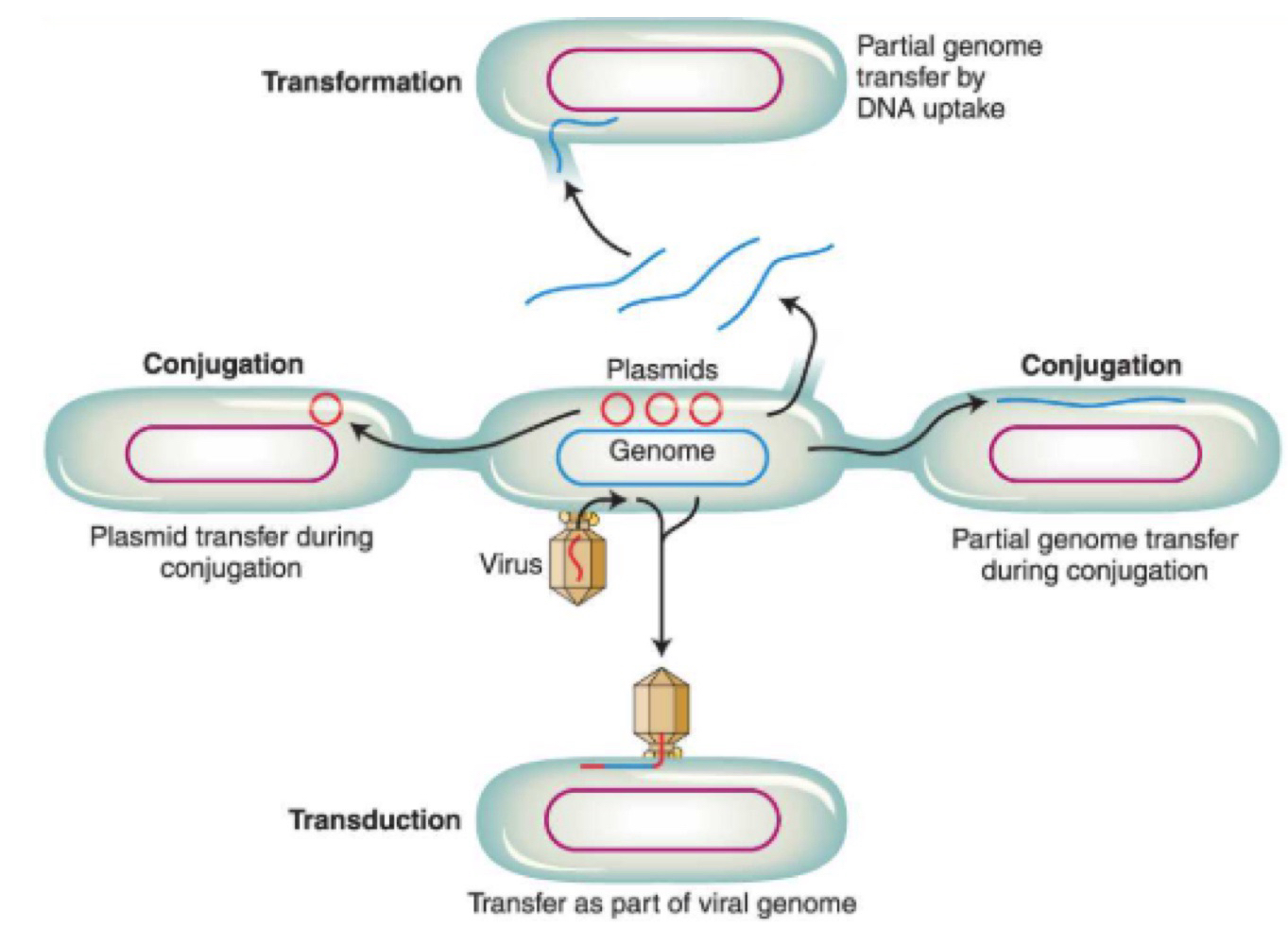
Horizontally
transformation: pieces of genomic DNA taken up an integrated into the bacterial chromosome
Conjunction: close contact between Donor and recipient cell, plasma or genomic DNA transferred via specialised structure
Transduction: DNA injected by viruses along with the viral genome
examples of large scale mutations
aneuploidy, polyploidy, chromosomal rearrangements
what is aneuploidy
one or a few chromosomes missing e.g. 2n+1, n-2
generated by faulty meiotic division: 2 chromosomes/chromatids go to pole, none to the other
embryos with imbalanced chromosome number generally not viable (down syndrome counter example)
what is polyploidy
unusual number of chromosome sets, comes from unusual meiotic events
even number of chromosomes often fine, triploids etc unable to pair chromosomes properly
triploidy
3n
tetraploidy
4n - common in plants and usually bigger
monoploidy
1n (when 2n common)
what causes chromosome rearragment
incorrect repair of double strand breaks
consequences of chromosomal rearrangemts
whole chromosome - embryos generally not viable
inversions/ translocations - might separate genes from important control regions etc, will cause problems during meiosis: homologous sequences line up together
types of chromosomal rearrangements
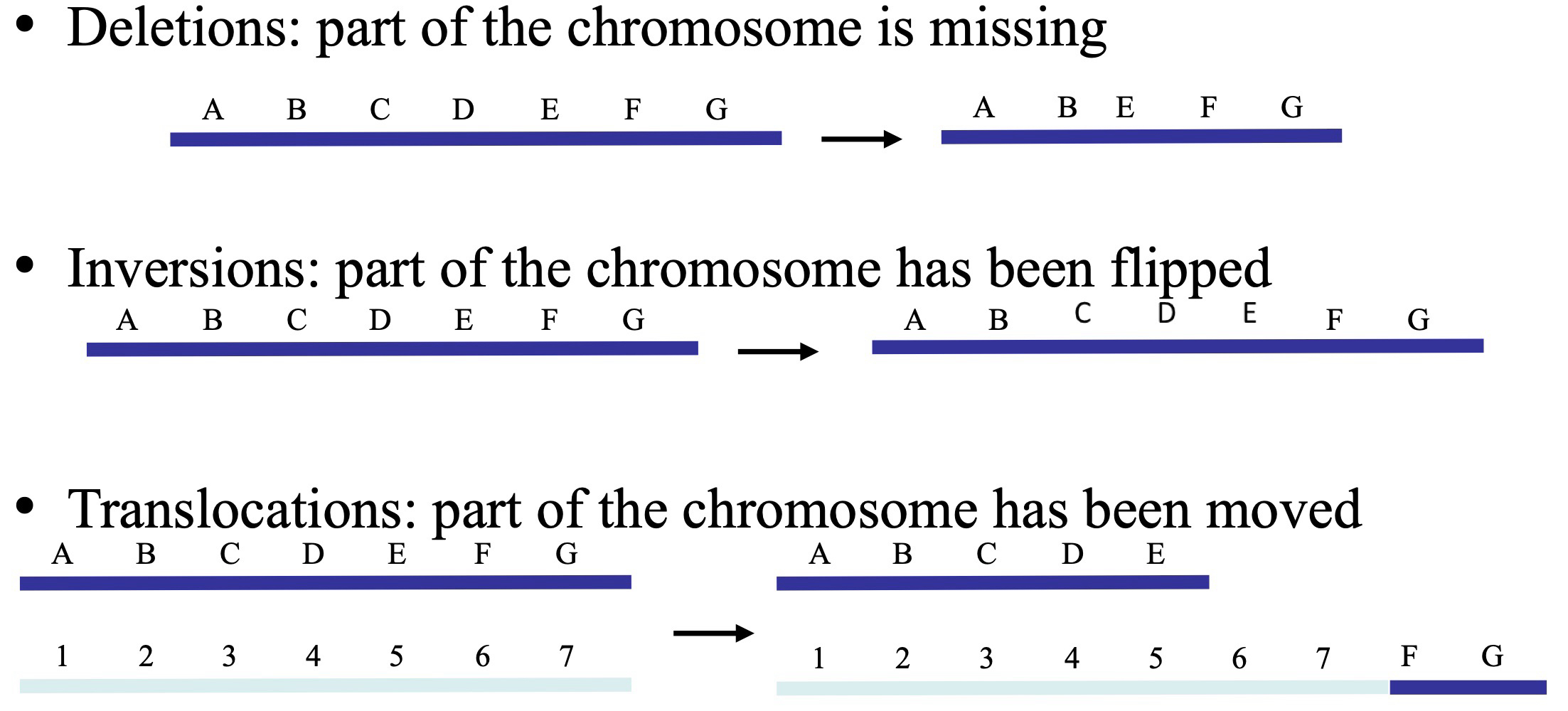
deletions - part of the chromosome is missing
inversions - part of the chromosome has been flipped
translocation- part of chromosome has been moved
effects of spontaneous mutation
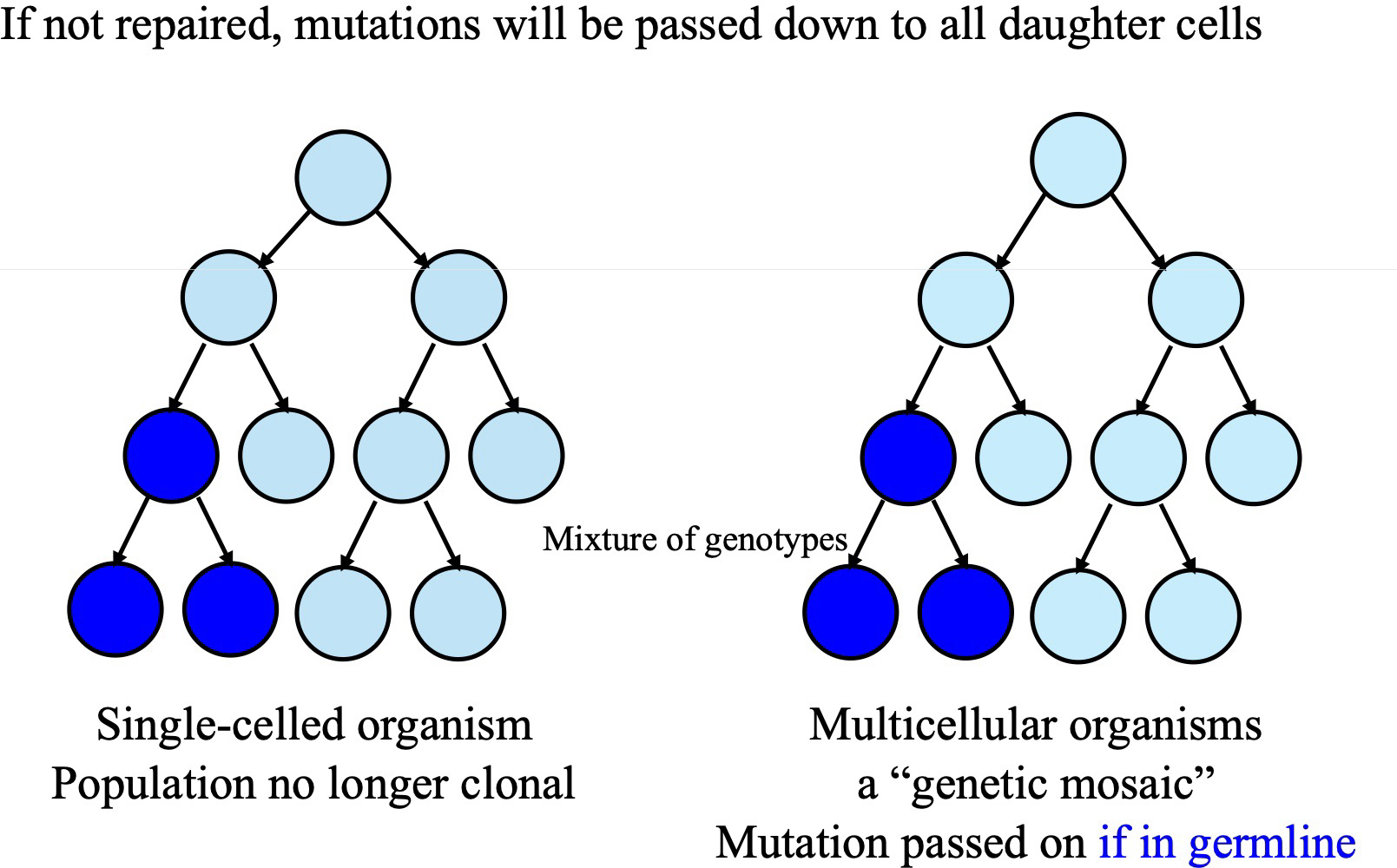
generates new alleles of a gene, can be harmful, beneficial or neutral to the cell
dominant or recessive depending on the nature of the change of the protein
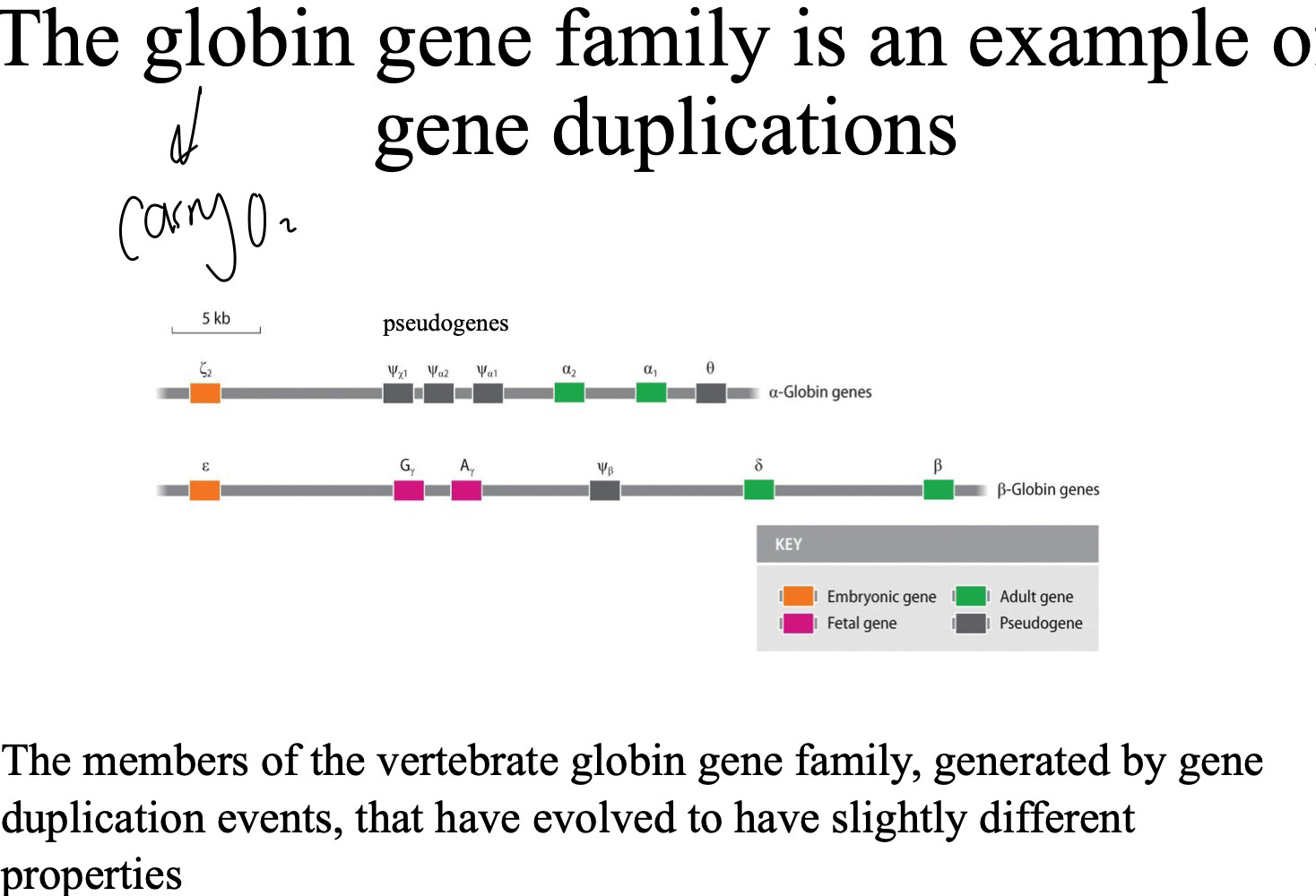
benefits of redundancy and pseudogenes
through various means genes can be duplicated
this allows extra freedom for evolution: one copy free for experimentation
less selective pressure
possible fates of a duplicated gene
accumulation of mutations → pseudogene
one copy gains a new function
each copy specialises (protein has 2 different functions or adapt to different circumstances)
pseudogene
gene that has lost ability to code for a functional protein
example of gene duplications
globin family - carry O2
why is the garden pea studied for genetics (Pisum Sativum)
comes in a wide variety of phenotypes; single gene
readily available, short generation time, large no. of progeny
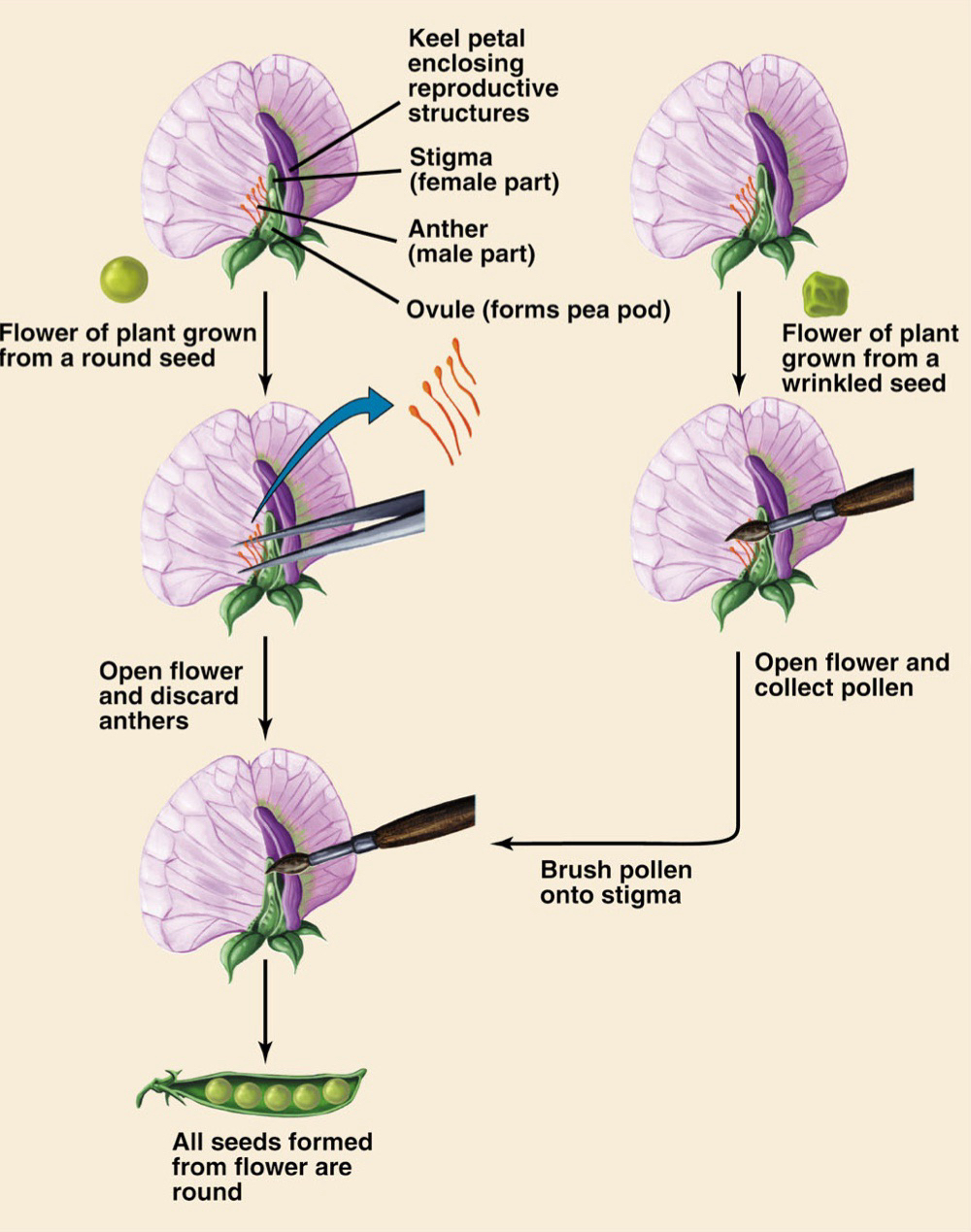
usually breeds by self pollinations (true breeding) easy to manipulate/cross
how does cross pollination in peas occur
anther removed before they shed pollen
transfer pollen between plants
what was mendels first cross
purple x white
all progeny F1 were purple, same with reciprocal cross
what was mendels 2nd cross
purple F1 x purple F1
F2 ratio of 3:1 even with different characterisics
what did Mendel reason after his crosses
alternative versions of one cause variation - alleles
an organism inherits 2 alleles, one from each parent
alleys may be dominant or recessive (explains F1 gen)
alleles segregate during gamete production
 Note
Note  Flashcards (76)