AP Chem 3.1-3.6
 Studied by 0 people
 Call Kai
 Learn
Learn Practice Test
 Spaced Repetition
 Match
Match Flashcards
 Knowt Play
1/76

There's no tags or description
Looks like no tags are added yet.
Name | Mastery | Learn | Test | Matching | Spaced |
|---|
No study sessions yet.
77 Terms
A diagram shows a model of gaseous diatomic element above its boiling point. Intermolecular forces between the gas molecules will cause them to condense into the liquid phase if the temperature is lowered. Which of the following best describes how the model is limited in its depiction of the phenomenon?
It does not show how the temporary fluctuating dipoles of the molecular electron clouds result in a net force of attraction between the molecules.
(In a sample of diatomic element, the only attractive forces present between the molecules are London dispersion forces. The model does not show the temporary fluctuating dipoles of the molecular electron clouds that are responsible for LDFs)
The electron cloud of HF is smaller than that of F2, however HF has a much higher boiling point than F2 has. Which of the following explains how the dispersion-force model of intermolecular attraction does not account for the unusually high boiling point of HF?
Liquid F2 has weak dispersion force attractions between its molecules, whereas liquid HF has both weak dispersion force attractions and hydrogen bonding interactions between its molecules.
( The hydrogen bonding interactions in HF are much stronger than the weak dispersion forces between F2 molecules)
What statement best helps to explain the observation that NH3 (l) boils at -28C, whereas PH3(l) boils at -126C?
NH3 has hydrogen bonding that is stronger than the dipole-dipole forces in PH3
(It is the hydrogen bonding between molecules of NH3 that results in its boiling point being higher than the boiling point of PH3)
Diagram 1 above shows equimolar samples of two gases inside a container fitted with a removable barrier placed so that each gas occupies the same volume. The barrier is carefully removed as the temperature is held constant. Diagram 2 above shows the gases soon after the barrier is removed. Which statement describes the changes to the initial pressure of each gas and the final partial pressure of each gas in the mixture and also indicates the final total pressure?
The partial pressure of each gas in the mixture is half its initial pressure; the final total pressure is half the sum of the initial pressure of the two gases.
(For each gas, the partial pressure in the mixture is half its initial pressure because the volume occupied has doubled under constant n and T
An equimolar mixture of N2(g) and Ar(g) is kept inside a rigid container at a constant temperature of 300 K. The initial partial pressure of Ar in the mixture is 0.75atm. An additional amount of Ar was added to the container, enough to double the number of moles of Ar gas in the mixture. Assuming ideal behavior, what is the final pressure of the gas mixture after the addition of the Ar gas?
2.25 atm, because doubling the number of moles of Ar doubles its partial pressure.
(Under constant V and T, doubling the number of moles of Ar will double its partial pressure to 1.50atm. Because the number of moles of N2 did not change, its initial and final partial pressures are the same (0.75atmbecause the initial mixture had the same number of moles of each gas). The total pressure is (1.50+0.75)atm or 2.25atm.)
The diagram picture shows the distribution of speeds for a sample of N2 at 25C. Which of the following graphs show the distribution of speed for a sample of O2 at 25C.
Both are gases
Two gases at the same temperature have molecules with the same average kinetic energy. Since KE=12mAv2A=12mBv2B for two gases, A and B, the gas with the higher molar mass will have molecules with a lower average speed. This graph shows the O2(g) molecules with a lower average speed than the N2(g) molecules.
Properties of Gases
- gas particles are in constant motion
- There are minimal forces between particles
- The frequencies of collisions and average spacing between them are dependent on: Temperature, pressure and volume
- Gases do not have definite volume or a definite shape, this is due to their constant motion and minimal forces
- Collisions are considered elastic- meaning they do not lose energy when they collide
Intermolecular forces
- weaker than intramolecular force
- ex. takes less energy to vaporize a liquid than to break a covalent bond because intramolecular forces in covalent bonds cause more energy to be used
- Properties of liquids including boiling point reflect the strength of intermolecular forces
- Molecules of liquid must overcome attractive forces to form vapor
melting and boiling points of substances held together by chemical bonds tend to be much higher than
those of substances held together by intermolecular forces
3 types of intermolecular attraction between electrically neutral molecules:
- dispersion forces
- dipole-dipole attractions
- hydrogen bonding
dispersion + dipole-dipole
= van der Waals
All intermolecular interactions are
electrostatic, involving attractions between positive and negative species much like ionic bonds
London dispersion forces
The London dispersion forces are a temporary attractive force that results when the electrons in two adjacent atoms occupy positions that make the atoms form temporary dipoles.
The weakest intermolecular force
London dispersion
Stronger LDF occurs when
there is a larger and heavier atom compared to which there was a smaller and lighter atom, it has weaker dispersion forces.
The strength of LDF tends to increase with
increasing atomic or molecular size
Because molecular size and mass are generally parallel to each other dispersion forces tend to _________ in strength with ________ molecular weight
dispersion forces tend to increase in strength with increasing molecular weight.
As polarizability increases (b/c more electrons), the dispersion forces
also become stronger. Thus, molecules attract one another more strongly, and melting and boiling points of covalent substances increase with larger molecular mass.
Dipole-dipole forces
occur when there is a permanent dipole present (between polar molecules)
A dipole is when there are
two electrical charges of equal magnitude, but opposite signs, that are separated by a distance
How do dipole-dipole forces from
They form from electrostatic attraction between the partially positive end of one molecule and the partially negative end of another molecule
Dipole-dipole forces are only effective
if the molecules are in close proximity
For molecules of similar size and mass, the strength of the dipole-dipole
forces increase with increasing polarity
Hydrogen bonding
A special type of intermolecular attraction between the hydrogen atom in a polar bond, and a nonbonding electron pair on a small nearby electronegative atom (F, O, N)
To have a hydrogen bonding, a hydrogen atom must be bonded to
a pair of either F, O, or N
The bonds between hydrogen and the electronegative atoms make the molecule
polar due to the dipole arrows going towards the more electronegative atom
Example of hydrogen bonding
H2O; hydrogen is bonded to a pair of an electronegative atom, O, and the strong intermolecular attraction results in Hydrogen bonding
How intermolecular forces affect boiling point and melting point
The stronger the intermolecular forces the more energy is required to break those forces and thus they have a higher boiling and melting point
Effects of intermolecular forces on Vapor pressure
- Strong intermolecular forces produce a lower rate of evaporation, and therefor a lower vapor pressure because there are less molecules pressing down on the surface of the liquid
- Weak intermolecular forces produce a higher rate of evaporation because its easier for the molecules to break away from the liquid and therefore a higher aport pressure because there are more molecules pressing down on the surface of the liquid
Effects of intermolecular forces on Surface Tension
- Occurs due to an imbalance of intermolecular forces at the surface of a liquid
- Molecules in interior are attracted equally in each direction
- Molecules in exterior feel net pull down, reducing surface area to as little as possible and packing surface molecules close together
- Ex 1: water droplet, spherical because smallest surface area, water has high surface tension because of hydrogen bonding
- Ex2: Mercury, beads up even more than water because of strong metallic bonds between the mercury
Boyles law
states that the volume of a fixed quantity of gas maintained at a constant temp is inversely proportional to the pressure
P1V1=P2V2
V= constant x 1/p or PV= constant
The value of the constant depend on temperature and on the amount of gas in the sample
Charles law
- states that the volume of a fixed amount of gas maintained at constant pressure is directly proportional to its absolute temp
- Volume increases as temperature increases and decreases as temperature decreases
V= constant x T or V/T= constant
V1/T1=V2/T2
Avagadro's Hypothesis
equal volumes of gases at the same temperature and pressure contain equal numbers of particles
Avagadro's Law
states that the volume of a gas maintained at constant temperature and pressure is directly proportional to the number of moles of the gas
V1/N1=V2/N2
Guy Lusaac's law
states that the pressure of a given mass of gas varies directly with the absolute temperature of the gas, when the volume is kept constant
- P/T = constant
- P1/T1 = P2/T2
Ideal Gas Law
PV=nRT
Situations in which the Ideal Gas Law can be applied:
- using molar mass to find densities of gases
- Finding the volume of gases in chemical reactions
_ Using density to find Molar Mass of gases
Examples in which the Ideal gas equation could be arranged differently
Because PV of the Ideal Gas Equation is constant, it can be used in an equation in relation to Boyle's law resulting in P1V1=P2V2
This is similarly applied with an equation representing Charle's law in that the V and T from the ideal gas equation is used to make the equation V1/T1=V2/T2
Also this is applied in the equation that represents Avogadro's Law where an equation that uses the n and V from the ideal gas equation is V1/n1=V2/N2
Different Ideal Gas rearrangements
Density: n/V=P/RT
and multiply by molar mass
so d= nM/V=PM/RT
or
M=dRT/P
Finding pressure: P=nRT/V
Finding Volume: V=nRT/P
Finding moles: n=PV/RT
Finding Temperature: T=PV/nR
PM=dRT
PV = (m/M) RT
Dalton's law of partial pressure
Ptotal = P1 + P2 + P3...
implies that each gas behaves independently of the others
If each gas obey the ideal-gas equation, we can obtain:
Pt = (n1 + n2 + n3 + ...)(RT/V) = nt(RT/V)
rms speed
urms = (3RT/M)½
Grahams law of effusion
In 1846 Thomas Graham discovered that the effusion rate of a gas is inversely proportional to the square root of its molar mass.
r1/r2 = urms1/urms2 = (M2/M1)½
properties of ionic solids
Strong interactions between cations and anions
The strength of the ionic bonds increases with greater charges and smaller ionic radii
Low vapor pressures, high melting points, and high boiling points
Brittle (due to the repulsion of like charges)
Great insulators since the valence electrons are confined to the anions (no sea of valence electrons)
Can only conduct electricity when the ions are mobile
e.g., when the solid is melted or dissolved in water or another solvent
Symmetric, close-packed arrangements of atoms
Properties of Covalent Network Solids
Atoms held together in 3-D networks or layers of 2-D networks by covalent bonds
Covalent bonds = stronger than the weaker intermolecular forces
High melting points, hard
Only formed from nonmetals: elemental (e.g., diamond and graphite) or binary compounds of two nonmetals (e.g., SiO2 and SiC)
Most 3-D network solids are rigid and hard
2-D networks, like graphite, tend to be soft
Semiconductors crystallize similar to covalent network solids
e.g., silicon, germanium, and gray tin
Properties of Molecular Solids
Covalently-bonded molecules attracted to each other through weak intermolecular forces
Low melting point and are soft (result of weak intermolecular forces present between the molecules)
Gases + liquids at room temp. tend to form molecular solids at lower temperatures
The properties depend on the strengths of the intermolecular forces
Molecular shape determines how efficiently the molecules can pack together in three dimensions
The less symmetrical the solid, the less efficiently the molecules pack together, the weaker the intermolecular forces, and the lower the melting point
Does not conduct electricity
Sometimes composed of very large molecules or polymers
Properties of Metallic Solids
Close-packed structure w/ an array of metal cations sharing delocalized valence electrons (electron-sea model)
The electrons are bonded to the cations through electrostatic forces of attraction + uniformly distributed throughout the metal
Good conductors of electricity and heat due to the presence of mobile valence electrons
Malleable and ductile (b/c the metal cores can rearrange their structure at ease
Can easily redistribute the electrons
Crystalline Solids
Atoms are organized in an orderly repeating pattern usually have flat surfaces
ex) Salt (NaCl specifically) quartz, diamond
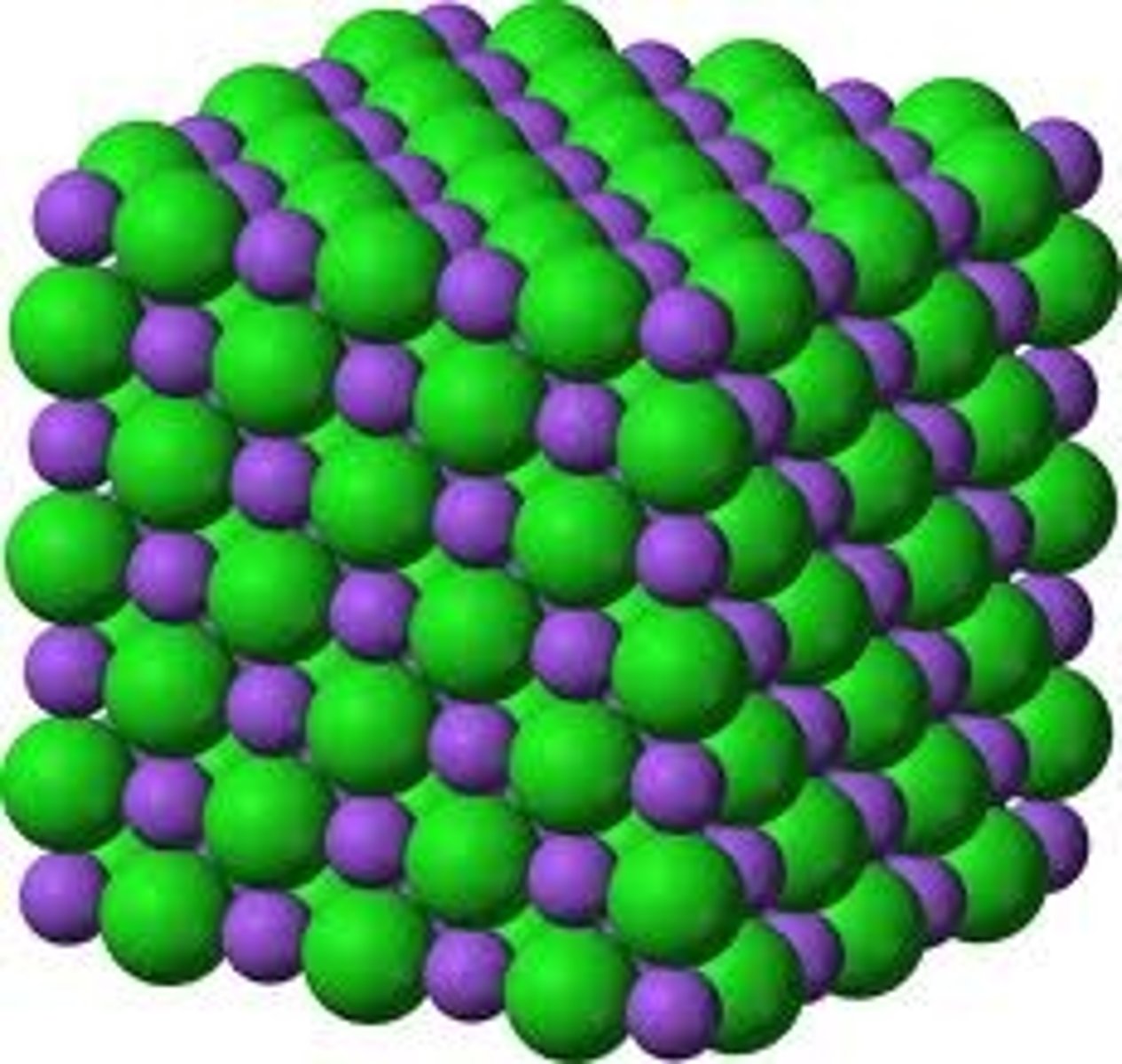
Amorphouse solids
At the atomic level look similar to liquids but lack free motion
Do not have well defined shapes
Ex) rubber, glass, obsidian
Kinetic Molecular Theory
relates the macroscopic properties (visible properties) of a gas to the motion of particles in a gas
a. Helps us picture what happens to the gas particles when conditions such as temperature and pressure change
Summary:
a. Gases consist of large numbers of molecules in continuous, random motion
b. The combines volume of a gas is negligible in comparison to the total volume of the container
c. The attractive and repulsive forces between gas molecules are negligible
d. energy can be transferred between molecules when collisions occur, but the average kinetic energy of the molecules doesn't change with time as long as the temperature remains constant
e. the average kinetic energy of molecules is proportional to the absolute temperature and at any given temperature the molecules of all gases are going to have the same average kinetic energy
Average kinetic energy equation
KE=1/2(mv)^2
The Maxwell-boltzmann
describes the distribution of kinetic energies of particles at given temperature. This provides a graphical representation of the energies/velocities of particles at a given temperature
Hot gases are going to have a more constant and flat curve than cold gases because fewer particles will be slow
The curve for lighter gases is also going to flatten out because there are less particles moving slowly
The most probable speed (MB)
the speed that is most likely found for a molecule in gas
The average speed (MB)
located slightly to the right of the most probable speed This is because of the "tail" off to the right that pulls the average speed to the right of the peak
The root-mean-square speed (MB)
the square root of the mean of the squares of the velocities. This speed of a molecule possessing a kinetic energy identical to the average kinetic energy
The range of molecular speed increases (MB)
as the temp increases
Gas Laws:
An increase in volume results in a what in pressure
a decrease in pressure at a constant temp.
(At constant temp the rms speed and kinetic energy remain constant. Therefore, with an increase in volume the molecules have to travel farther to collide and the number of collisions decreases, as well as the pressure. This explains Boyle's law)
gas laws:
A temperature increases at a constant volume is going to result in a what in pressure
increase in pressure
(An increase in temperature results in an increase in kinetic energy and in the rms speed. Therefore, at constant volume the particles are going to collide more often and with more momentum, resulting in an increase in pressure)
Ideal gases
- Follows the gas laws at all temperatures and pressures
- Behaves according to the kinetic molecular theory
- The particles would have to occupy 0 volume and exhibit 0 attractive forces. Neither of those conditions can be true so ideal gases don't exist, but some gases come very close to behaving ideally
- Gases behave similarly to ideal gases in normal laboratory conditions
- They behave least ideally under high pressure and low temps
Real gases
don't behave ideally bc the particles take up volume and are attracted to each other
Van Der Waals
recognized the ideal equation could be corrected to account for the effects of intermolecular attractive forces and for molecular volumes by introducing 2 constants
a: measure of how strongly the gas molecules attract one another
b: measure of the infinite volume occupied by the molecules
P= (RT/v-b) -( a/V^2)
Alloys
A material that contains more than one element and has the characteristic properties of a metal
- substitutional and Interstitial
- important for modifying properties of pure metallic elements
Manometer
A tool for measuring the pressure of a gas
- The pressure of the gas can be obtained by adding the atmospheric pressure to the difference in height of the mercury in the arms of the U tube
- If the mercury is higher on the open end of the U tube, the high value is positive
- If the mercury is higher on the open end of the U tube, the height value is negative
- The pressure will always be in mmHg or torr
IN A CLOSED ENDED MERCURY MANOMETER THE ARM OF THE U TUBE THAT WAS OPEN IN THE OPEN ENDED MANOMETER IS SEALED. THIS MEANS THAT THE MERCURY IN THE U TUBE IS NOT BEING ACTED UPON THE ATMOSPHERIC PRESSURE THEREFORE THE HEIGHT OF THE MERCURY IS THE PRESSURE OF THE GAS
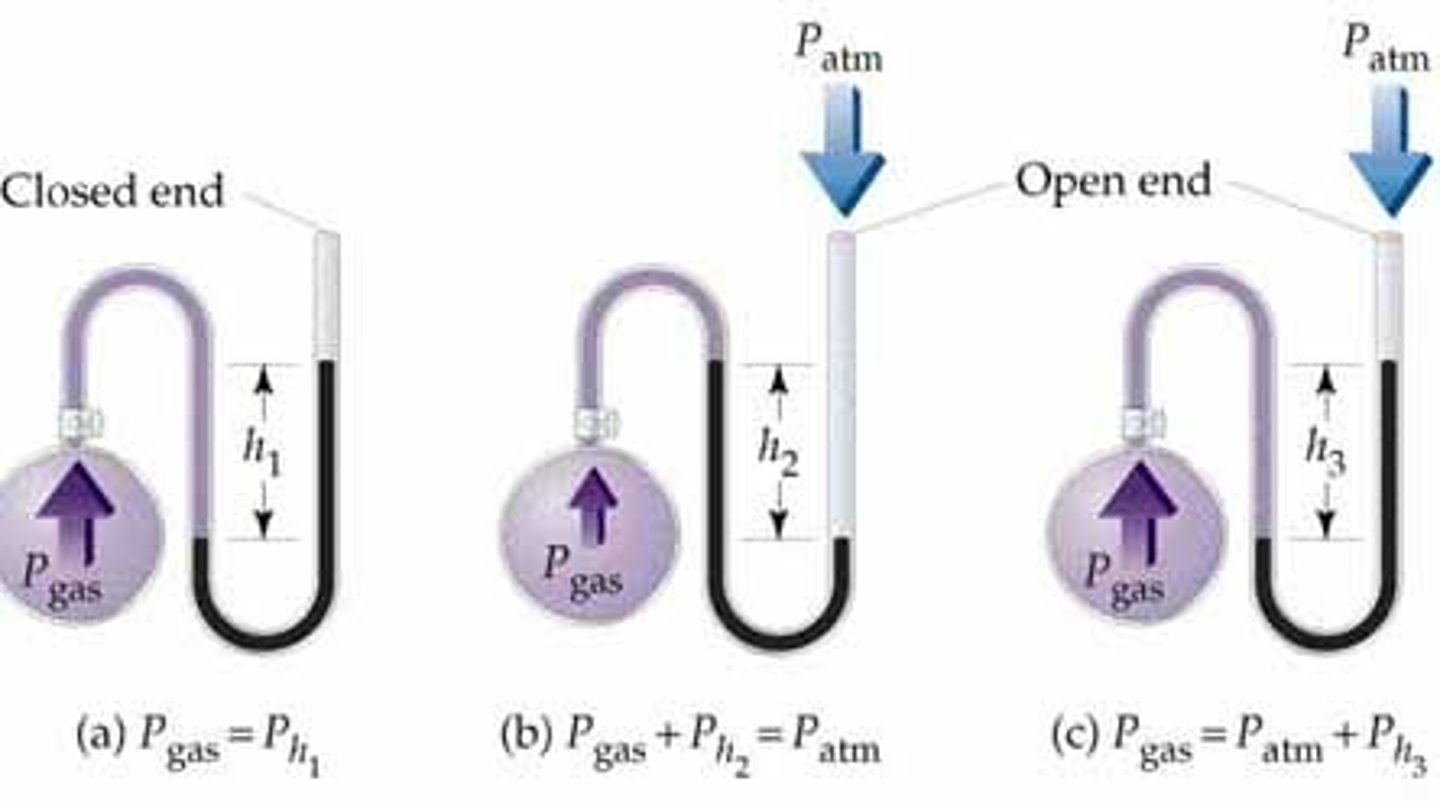
How a manometer problem is worked
subtract or add the height of mercury on the gas side from the height of mercury on the open side
with h solved for we can now add h to the given atmospheric pressure
Then convert torr to atm
Closed tube
h is the same but this time it is equal to pressure so just convert to atm
Deviations from Ideal Behavior
The ideal-gas equation is based on the fact that: the molecules in a gas have no volume and there are no attractive forces between molecules.
As temp decreases gases become less ideal
At low temperature and high pressures, the gas molecules are closer together. They feel their attractive forces more and their volume is more significant
As temp decreases volume
expands bc molecules slow down
How does a gas compare with a liquid for each of the following properties
a) density
b) compressibility
C) ability to mix with other substances of the same phase to form homogeneous mixtures
d) ability to conform to the shape if its container
A) less dense
B)more
C)more
D)more
Each of the following statements concerns a mercury barometer. Identify any incorrect statements and correct them
a) the time must be 1cm2 in cross-sectional area
b) at equilibrium the force of gravity per unit area acting on the mercury column equals the force of gravity per unit area acting on the atmosphere
c) the column of mercury is held up by the vacuum at the top of the column
d) If you took the mercury barometer with you on a trop from the beach to high mountains the height of the mercury column would increase with elevation
A) the tube can have any cross sectional area
b) not equal
c) held up by pressure of atmosphere
d) decrease w/ elevation
Combined Gas Law
P1V1 / T1 = P2V2 / T2
what change or changes in the state of a gas bring about each of the following effects?
a) the number of impacts per unit time on a given container wall increases
b) the average energy of impact of molecules with wall of the container decreases
c) the average distance between gas molecules increases
d) the average speed of molecules in the gas mixture is increased
a) increases temp at constant vol or decrease in vol or increase in pressure
b) decreases in temp (energy dec)
c) increase in vol decreases in pressure
d) increase in temp
What property or properties of gases can you point to that support the assumption that most of the volume in a gas is empty space?
Gases are readily compressible
Explain the difference between average speed and root mean square speed which is larger for a given gas sample at a fixed temperature
Average is the sum divided by total number. The root mean square speed is the speed of a molecule possessing a kinetic energy identical to the average kinetic energy of a sample root-mean-square speed
Increasing average molecular speed has what affect on mass
= decreasing mass (only if at same temp)
Diffusion
The process of spread of a feature or trend from one place to another over time
Effusion
A process by which gas particles pass through a tiny opening
r1/r2 = Square root of M2/M1
As the volume gets larger the correction factor
gets small and it approaches ideal
The kelvin temperature of a sample of matter is proportional to
the average kinetic energy of the particles in a sample
 Note
Note  Flashcards (314)