Lab Exam 2
 Call Kai
 Learn
Learn Practice Test
 Spaced Repetition
 Match
Match Flashcards
 Knowt Play
1/47

There's no tags or description
Looks like no tags are added yet.
Name | Mastery | Learn | Test | Matching | Spaced | Call with Kai |
|---|
No analytics yet
Send a link to your students to track their progress
48 Terms
15-
TNTC is a plate w/ >_____
TFTC is a plate w/ <_____
300
30
What is the DF after two 1:10 (10-1) dilutions and then a 1:100 (10-2) dilution? Draw out the dilution steps
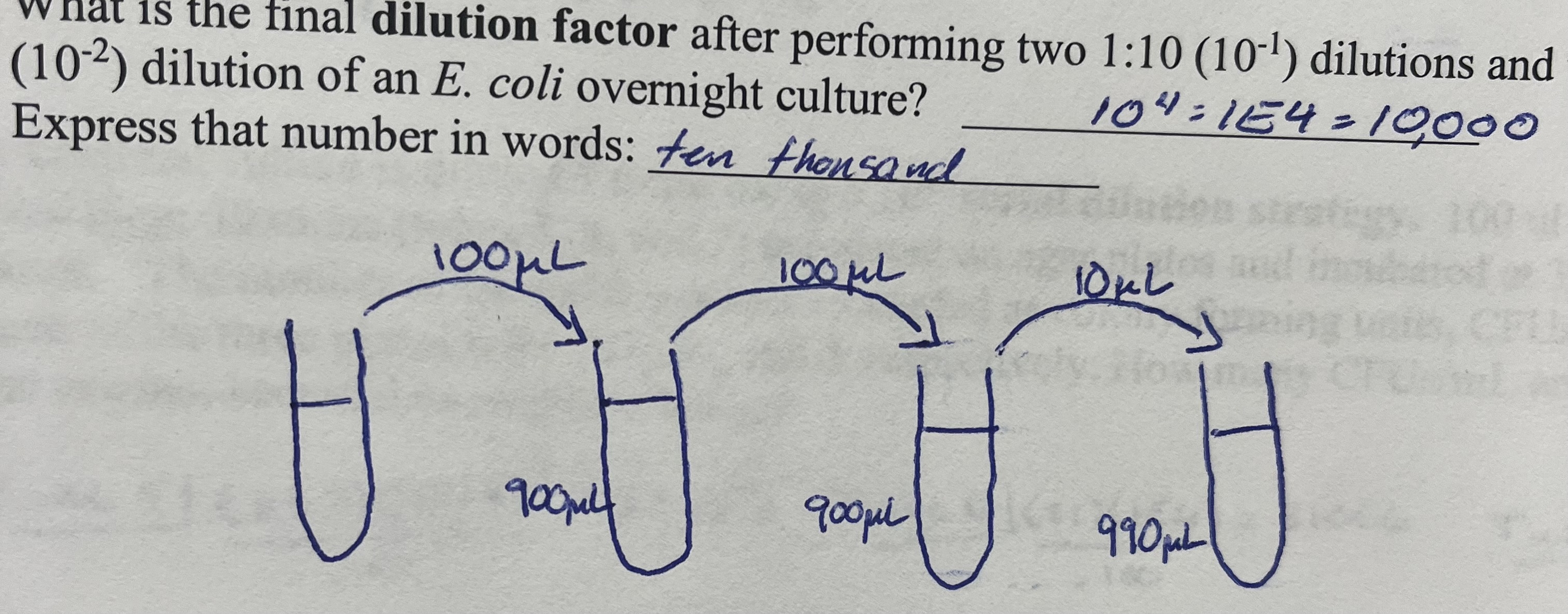
15- serial dilution equation
(#CFU/mL) = (#Colonies) x (DF) / (mL)
15- Verbally:
1E6 = “_____”
1E7 = ____E6 = “ _____”
1E9 = “_____”
9.9E11 = ____E9 = “_____”
one million
10 ; ten million
one billion
990 ; nine hundred ninety billion
16- LBS Agar:
what experiment?
What is it used for?
carbon source?
nitrogen source?
fatty acid/lipid source?
why selective?
kefir
isolation and enumeration of lactobacilli from foods
glucose
ammonium salt
polysorbate 80
ammonium citrate lowers pH 5.5 to select for lactobacilli
17- Starch Plate:
visualize what?
what is it/reaction?
microbe that is + ?
starch hydrolysis
amylase breaks glycosidic bonds in extracellular starch
B. cereus = amylase+
17- amylase:
what is it?
reaction drawn out?
2 steps how test for?
what microbe is +?
exoenzyme that breaks glycosidic bonds in extracellular starch
starch -(amylase)→ glucose
Starch agar + flood w/ iodine
B. cereus
17- Tributyrin Agar:
visualize what?
what enzyme and what bond is it breaking
reaction?
microbe that is +
lipid hydrolysis
lipase breaks ester bond in extracellular lipids
tributyrin -(lipase)→ glycerol + fatty acids
B cereus+
17- lipase:
what is it?
reaction drawn out?
what agar?
what microbe is +?
lipase breaks ester bond in extracellular lipids
triglyceride -(lipase)→ glycerol + fatty acids
Tributyrin agar
B cereus+,
17- Milk Agar:
visualize what?
what is it?
microbe that is +
casein hydrolysis
Caseinase + proteinase breaks a peptide bond in extracellular casein + protein
B cereus+
17- caseinease:
what is it?
reaction drawn out?
what agar?
what microbe is +?
breaks peptide bonds in extracellular casein
casein peptide bond -(caseinase)→ amino acids
Milk agar
B cereus+
17- Gelatin Agar:
visualize what?
what is it?
microbe that is +
3 enzymes in total
gelatin hydrolysis
gelatinase breaks peptide bonds in extracellular gelatin
B cereus+
gelatinase, lipase, bromelain
17: gelatinase:
what is it?
reaction drawn out?
what agar?
what microbe is +?
gelatinase breaks peptide bonds in extracellular gelatin
gelatin peptide bond -(gelatinase)→ amino acids
Gelatin Agar
B cereus+
17: DNA Agar:
visualize what?
what is it?
indicator?
microbe that is +
DNA hydrolysis
DNase breaks phosphodiester bonds in DNA
methyl green
S. marcescens
17: DNase:
what is it?
what agar?
what microbe is +?
DNase breaks phosphodiester bonds in DNA
DNA agar
S. marcescens
17- Optimal Growth Temps:
psychrophiles =
optimal =
mesophiles =
optimal =
facultative thermophiles=
optimal =
obligate thermophiles =
optimal =
Serratia pigmentation =
fungi/yeast =
psychrophiles = -10-25
optimal = 0-5
mesophiles = 20-45
35-40 optimal
facultative thermophiles = 35-60
45-60 optimal
obligate thermophiles =50+
60+ optimal
Serratia pigmentation = 23 (room temp)
fungi/yeast = 30C
Serratia pigmentation =
fungi/yeast =
Serratia pigmentation = 23 (room temp)
fungi/yeast = 30C
obligate thermophiles =
optimal =
obligate thermophiles =50+
60+ optimal
facultative thermophiles=
optimal =
facultative thermophiles = 35-60
45-60 optimal
psychrophiles =
optimal =
psychrophiles = -10-25
optimal = 0-5
17- General optimal growth pHs:
acidophile = 3
neutrophile = 7
alkaliphile = 9
fungi = 5
19-Carbohydrate Fermentation:
what 2 broths?
extra equipment?
results?
Phenol Red Broth: Yellow = fermentation,, red = none
Dextrose (glucose) Broth: Yellow = fermentation,, red = none
Air bubble in Durham tube = CO2 product
19- Phenol Red Broth:
test for what?
based on what?
results?
Lactose/dextrose Fermentation based on pH from acid production: Yellow = (+), Red = (-)
19- IMViC Tests:
what is the purpose of these tests?
what are the four tests?
what question does each test answer?
How to distinguish Enterics (Human GI bacteria in Enterobacteriaceae)
Tests:
Indole Test
degrade tryptophan into indole?
Methyl Red (MR) Test
ferment glucose into organic acids?
Voges-Proskauer (VP) Test
ferment glucose into nonacidic or neutral products?
Citrate Test
import citrate?
19- Indole Test:
what does it test for?
2 steps?
Results?
Drawn out reaction?
microbe that is +?
degrades tryptophan into indole?
culture in SIM medum (deep) for 2 days. Add Kovac’s reagent
Red at top = +
tryptophan -(tryptophanase)→ indole
e. coli
“e. col = indol”
19- Kovac’s reagent:
what test uses it
what does it do?
indole test
indicator that turns red if indole is present
19- tryptophanase:
what test uses it
what reaction
indole test
tryptophan -(trypophanase)→ indole + pyruvate + ammonia
19- Methyl Red (MR) Test
what does it test for?
how is the test done?
Results?
Indicator?
what other test is it paired w/ and why?
ferment glucose into organic acids (Lactic)?
culture in MR-VP broth
red color = (+), yellow = (-)
MR pH indicator
paired w/ VP test bc both start w/ incubating in MR-VP broth
19- Voges-Proskauer (VP) Test:
what does it test for?
2 products?
3 steps
what does each step indicate?
what other test is it paired w/ and why?
ferment glucose into neutral products (acetylmethylcarbinol “ABC” (buttery odor) + 2-3 butanediol)?
Steps
culture in MR-VP broth
Add Barritt’s Solution (a-napthol + 40% potassium hydroxide)
Add Guanidine group
19- products being tested for:
MR Test
VP Test
MR = organic acids
VP test = neutral
2,3-butanediol
acetylmethylcarbinol “AMC” (buttery odor)
19- Citrate Test:
what’s it test for?
what agar?
carbon source
nitrogen source?
indicator, what does it detect?
results?
citrate permease (transporter protein)
citrate agar
C = sodium citrate
N = ammonium salts
indicator = bromothymol blue (detects basic)
blue = (+), green = (-)
“bro, mo citrus please”
19- Hydrogen Sulfide Test:
what agar?
3 things it is testing for?
draw reactions for both?
indicator
reaction for indicator
results?
SIM Agar
Tests
reduces cysteine?
cysteine -(cysteine desulfurase)→ pyruvate + H2S
reduces inorganic sulfur?
thiosulfate -(thiosulfate reductase)→ sulfite + H2S
agar also shows motility
Ferrous sulfate indicates H2S
Ferrous sulfate + H2S = FeS (black precipitate)
Black precipitate = (+), colorless = (-)
19- SIM Agar:
used in what 2 tests
indole and
hydrogen sulfide tests
19- In chemistry, what is LEO GER?
Loss of e- = Oxidation
Gain e- = Reduction
20- Urease Test:
identifies what microbe?
reaction?
indicator?
results
Proteus Vulgaris
urea -(urease)→ Ammonia NH3
phenol red pH indicator
ammonia = alkaline = deep pink color
“peenol red”
20- Catalase Test:
what testing for?
reaction?
catalase
H2O2 -(catalase)→ H20 + O2
20-
what are SOD and catalase needed for?
2 coupled reactions?
life in the presence of O2
ROS -(SOD)→ H2O2 + O2
H2O2 -(catalase)→ water + O2
20- Decarboxylation Test:
what’s it testing for/under what condition?
how condition met?
what agar?
reaction?
indicator/what type?
results?
removal of carboxyl group (COO-) under anaerobic conditions
layer of glycerol added to block O2
Moeller’s decarboxylase broth
lysine -(lysine decarboxylase)→ cadaverine + CO2
brom cresol blue (acid pH turns yellow, neutral/basic = purple)
yellow at 24h → purple at 48h = (+)
20- decarboxylase:
what type of enzyme?
what does that mean for this enzyme?
2 steps + timing + results?)
decarboxylases are inducible enzymes
enzyme won’t activate until acidic 5pH reached
microbe must use glucose to make media acidic
first 24H, (starts purple → yellow)
once acidic, decarboxylase is induced and can convert lysine into cadaverine + CO2
second 24 hours (yellow → back to purple)
alternative decarboxylation enzyme/reaction (not lysine →cadaverine)
what type of enzyme?
omithine -(omithine decarboxylase)→ putrescine
decarboxylases are inducible enzymes
20- Phenylalanine deaminase Test:
what testing for?
reaction?
indicator?
results?
deamination of phenylalanine
phenylalanine -(phenylalanine deaminase)→ keto acid (phenylpyruvic acid) + ammonia
Ferric chloride FeCl3 detects keto acid
green = (+)
“dee-am and kee-ac” “phenyl = ferric”
20- ONPG Test
enzyme ?
natural reaction?
reaction w/ ONPG?
results
b-galactosidase
Lactose →glucose + galactose
ONPG → b-D-galactose + a-nitrophenol
nitriophenol is yellow = (+)
e. coli, shigella, proteus, and Citrobacter are + for what 3 tests?
indole, MR, VP
What 4 tests distinguish b/t e. coli, shigella, proteus, and Citrobacter?
Citrate, H2S, Urease, swarming
citrate test for e. coli, shigella, proteus, and Citrobacter:
who is +?
what result?
Proteus = +
+ = blue
H2S test for e. coli, shigella, proteus, and Citrobacter:
who is +?
what result?
Citrobacter and Proteus are +
+ = black
Urease test for e. coli, shigella, proteus, and Citrobacter:
who is +?
what result?
Citrobacter and Proteus are +
+ = deep pink
how to distinguish b/t citrobacter and proteus?
proteus has swarming motility

