Ecology Exam 2
 Call Kai
 Learn
Learn Practice Test
 Spaced Repetition
 Match
Match Flashcards
 Knowt Play
1/97

There's no tags or description
Looks like no tags are added yet.
Name | Mastery | Learn | Test | Matching | Spaced | Call with Kai |
|---|
No analytics yet
Send a link to your students to track their progress
98 Terms
What are other revolutionary forces that cause change in allele frequency?
-Mutation
-Genetic drift
-Gene flow
-Natural Selection
Define mutation
Any change in genomic sequence of an organism, could be a gene mutation or chromosome mutation
Beneficial mutations
increase the fitness of the individual that possesses it
Neutral mutations
neither increase nor decrease fitness of an individual
Detrimental mutations
reduce the fitness of the individual
What is genetic drift?
-Random change in allele frequencies over time
-Happens by chance, NOT because traits are better
-Strongest in small populations: leads to loss of variation, fixation (only 1 allele left)
Give one example of genetic drift
-Mexican tetra (cavefish)
-live in dark caves, lack pigmentation (genetic drift) and lost eyes
What is the difference between natural selection and genetic drift
-Genetic drift is random, not due to chance, more noticeable in small populations
-Natural selection is not random, based on fitness, works in larger populations
Bottleneck effect
-A sudden reduction in population size (due to disaster, disease, etc.)
-Survivors are a random subset → not genetically representative of original population
Ex: cheetahs had multiple bottlenecks and now have very low genetic diversity, 90% genetic similarity (leads to poor sperm quality, more disease, higher extinction risk)
What is the founder effect
-A small group leaves and starts a new population
-Founders of the new population are a random sample (diff. allele frequencies, less genetic diversity)
What is the relationship between the founder effect and bottleneck?
Founder effect and bottleneck are both examples of genetic drift
-Ex: Pitcairn island, 27 founded the island, diff. genetic makeup than original British population
-New population not equal to full genetic diversity of original population
Define nonrandom mating
-Individuals don’t mate randomly
-allele frequencies=do not change
-Genotype frequencies=do change
-Types: inbreeding, positive assortative mating, negative assortative mating
What is inbreeding
Mating with relatives
Brings out recessive harmful alleles
-Effect: increases homozygous, decreases heterozygous
Inbreeding depression
-Reduced fitness due to inbreeding
-Harmful recessive allele become expressed
Ex: Spanish royal family (high inbreeding→ low survivorship)
Inbreeding coefficient (F)
probability two alleles are identical by descent
-0= no inbreeding
-1= complete inbreeding
-What affects F: number of generations of inbreeding
-Increased F→ increased homozygous
What is positive assortative mating
-Similar individuals mate
-Effect: increases homozygous, decreases heterozygous
Ex: tall people marrying tall people, inbreeding
What is negative assortative mating
Opposites mate
-Effect: increases heterozygous
Gene flow
Movement of alleles from one population to another
-Prevent populations from becoming genetically diff. from one another
-Increases genetic variation within a population
Define asexual reproduction
-One parent
-Offspring= genetically identical (clones)
-Ex: bacteria, whiptail lizards
Define sexual reproduction
-Two parents
-Combines genes→ genetic variation
What are the costs of sexual reproduction
-finding a mate
-Energy/time for mating
-”two-fold cost of sex” (only female produce offspring)
What are the benefits of sexual reproduction
-Genetic variation
-Better ability to: adapt, survive disease, survive environmental changes
What is the red queen hypothesis
-Species must constantly evolve just to survive
-Why sexual reproduction helps: creates genetic variation, helps organisms keep up with parasites, diseases, predators
-without variation→ species gets wiped out
What is anisogamy?
form of sexual reproduction involving the fusion of two gametes that differ in size and form
-Eggs= big + energy expensive
-Sperm= tiny + cheap
What are the consequences of cheap sperm vs costly eggs?
Females invest a lot: eggs, pregnancy, care
-Solution: be selective
Males: invest little
-Solution: mate as much as possible
Explain the certainty of maternity vs paternity
-Females: always sure offspring is theirs, more parental care
-Males: not always sure, less investment
-Leads to sexual selection behaviors
What is sexual selection
Differences in reproductive success due to mating competition
-Intrasexual selection + intersexual selection
What is intrasexual selection (competition)
-same sex competing (usually males), ex: fighting
-Ex: deer antlers, bigger body size, aggressive behavior
What is intersexual selection (mate choice)
-One sex chooses (usually females), attraction
What is operational sex ratio (OSR)
Ratio of males to females ready to mate
-If more males: strong male competition, more intrasexual selection
-If more females: females compete or become choosy
What are sneaker males?
-Males that don’t fight but sneak mating opportunities
Ex: cuttlefish pretend to be female to avoid detection then mate secretly
Define sperm competition
-Competition between sperm from different males
-How? females mate with multiples mates, sperm compete inside reproductive tract
What is the strategy of sperm competition
-Remove other sperm
-Produce more sperm
-Faster sperm
-Females can even choose sperm
Direct benefits of female choice
-Immediate benefits to female such as food, protection, territory
Indirect benefits of female choice
-Genetic benefits
Good genes→ healthier offspring
Explain “bad” traits that evolve
-Surviving with a disadvantage= that gene must be good
Ex: peacock tail: heavy + visible but signals strong genetics because it survived this far
What is life history?
The schedule of an organism’s life:
-Growth
-Development
-Reproduction
-Survival
-Answers: “when should I reproduce?” “how many offspring should I have?”
Define evolutionary fitness
How successful an organism is at passing on its genes
-Fitness doesn’t equal strongest or hottest
-Fitness= number of surviving offspring
Define a fast life history
r-selected: Insects, dandelions
-Many offspring
-Small body size
-Early reproduction
-Short lifespan
-Little parental care
Define a slow life history
k-selected: elephants, humans
-Few offspring
-Large body size
-Late reproduction
-Long lifespan
-High parental care
What is the principle of allocation
-Energy is limited
-If you spend energy on one thing you have less for another
-Energy used for reproduction=less for growth
What are ecological trade-offs
Improving one trait→ reduces another
-Ex: large eggs, higher survival but fewer eggs
-No perfect strategy, just compromises in nature
What is the relationship between offspring size vs number?
-Inverse relationship (organisms balance survival vs quantity)
Bigger offspring=fewer
Smaller offspring=more
What is Lack’s principle
-Animals produce the maximum number of offspring they can successfully raise
-They do not produce the max number possible!
Why is clutch size smaller? (Why don’t animals have as many babies as they physically could?)
1) Trade-off with survival
2) Too many offspring lowers fitness
3) Parent vary in ability
Ex: birds lay fewer eggs than they physically could because they can’t feed them all
What are the characteristics of early reproduction vs delayed reproduction?
Early: smaller size, shorter lifespan
Delayed: larger size, longer lifespan
-large organisms can produce more/better offspring
What is the guppy experiment?
-Wanted to see if predation changes life history strategies
-Studied guppies with two environments: low elevation=high predation, high elevation (low predation)
Results:
-High predation guppies reproduced earlier, had more offspring, offspring are smaller, mature faster (fast life history)
-Low predation guppies reproduced later, had fewer offspring, offspring are larger, grow more before reproducing (slow life history)
What is the big takeaway from the guppy experiment?
Life history traits are evolutionary responses to the environment
What is semelparity?
-Reproduce once then die
-Ex: salmon, cicadas
-This evolves in low survival, unpredictable environment
What is iteroparity?
Reproduce multiple times
-Ex: birds, humans
-This evolves in stable environments, higher survival
What is the grandmother hypothesis
-Older females stop reproducing to help offspring/grandchildren survive
-Helping relatives=increases fitness→ passing on shared genes
Ex: humans, killer whales
What are the key terms in population growth graph?
-Growth rate: births-deaths
-Intrinsic rate (r ): max growth under ideal conditions
-Carrying capacity (k): max population environment can support
What is logistic growth?
model of population growth where a population grows rapidly at first (exponentially) but slows down and levels off at max carrying capacity
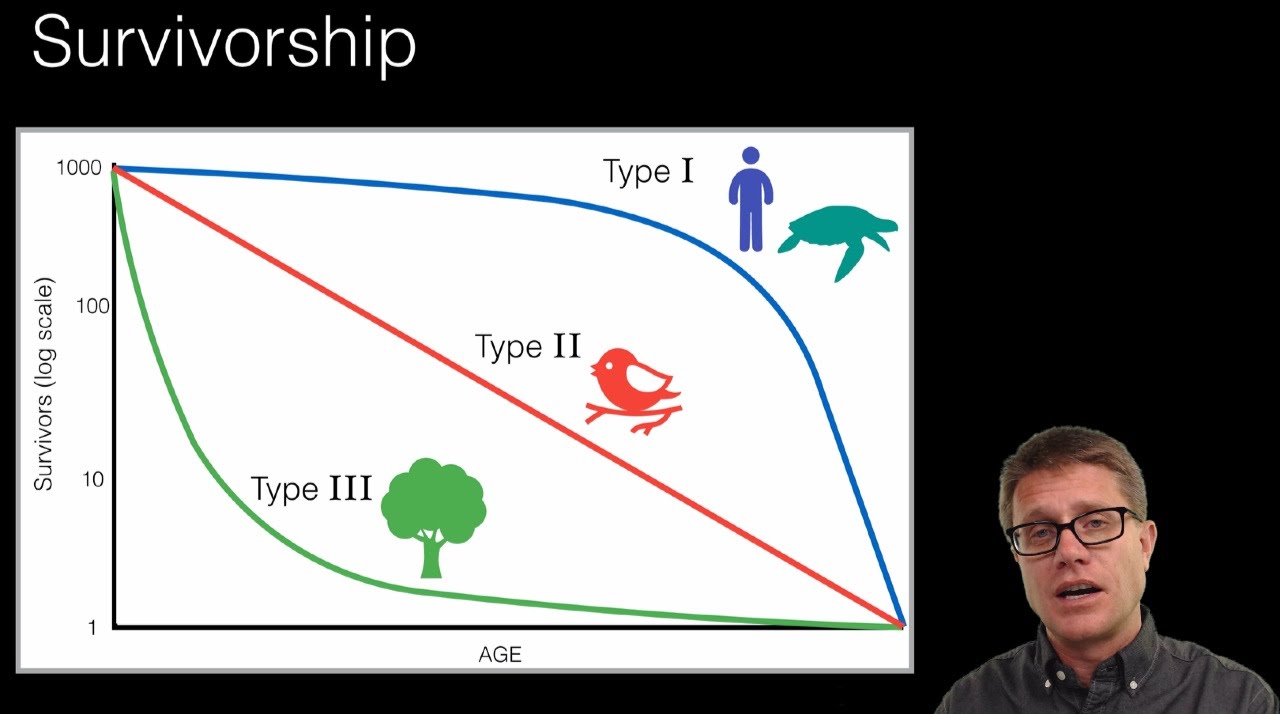
What are the types of survivorship curves and what do they mean?
-Type I: late death (humans)
-Type II: constant death rate
-Type III: high early death (plants, fish)
What is senescence?
-Aging
-Decline in function with age
-Seen in long-lived organisms, iteroparous species (reproduce several times)
What is population growth?
-Change in population size over time
-Population growth when births > deaths
-Population shrinks when deaths > births
Change in pop. = Births + Immigration - deaths- emigration
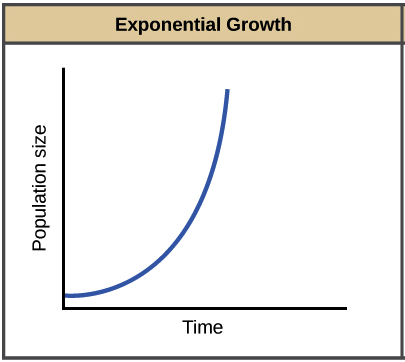
What is the exponential growth model?
-Describes how a population growth when: nothing is limiting it
-Assumes unlimited food, no predators, no disease
-the bigger a population gets, the faster it grows
r=intrinsic rate of growth (max possible growth rate)
J-shaped curve
What is the geometric growth model
-Used in species with discrete reproduction (seasonal breeders)
-λ (lambda) = growth per time step
λ > 1 → population increasing
λ = 1 → stable
λ < 1 → population decreasing
What is the difference between exponential vs geometric?
Exponential: continuous growth, uses r, smooth curve
Geometric: discrete intervals, uses λ , step-like
What are limiting factors?
-Cause populations to not grow forever
-Density dependent vs independent
What are density-independent factors?
-Affect population regardless of size
Ex: weather, natural disasters
What is Density-dependent factors?
-Effect depends on population size
Ex: competition for food, disease, predation
What is negative density dependence?
-As population increases → growth decreases
-Why? more competition, more disease spread
What is positive density dependence (Allee effect)?
-Small populations grow slower
-Why? hard to find mates, less cooperation
What is carrying capacity (k)?
maximum population size environment can support
-At k: births=deaths, population is stable
What is a logistic growth model?
-Shows realistic population growth
S-shaped curve
-Stages:
1) Fast growth
2) slowing down
3) plateau at K (growth rate = 0)
What is age structure?
Distribution of individuals across age groups
-Predicts future growth
-Population shapes:
Triangle=growing population
Rectangle=stable
Inverted=declining
What is demography
-Study of birth rates, death rates, migration W
What are life tables?
Tracks survival & reproduction by age (shows which life stages are most vulnerable)
-Ix: probability of surviving to age x
-px: probability of surviving to next age
-qx: probability of dying
Define Net reproductive rate (Ro)
-Average number of offspring per individual
Ro >1 population is increase
Ro = 1 stable
Ro<1 population is decreasing
What are survivorship curves?
proportion of individuals surviving at each age for a given species or group
-Type I: late death (humans)
-Type II: constant death
-Type III: high early death (plants, fish)
-diff species survive differently
What is an ecological niche?
-An organisms’ role in its environment
It includes: what it eats, what eats it, when it’s active, environmental conditions it can tolerate
-Includes biotic + abiotic factors
What is the diff. between niche, habitat and geographic range?
-Habitat: physical place organism lives
-Niche: role + interactions + conditions (determines habitat!)
-Geographic range: where species is fond on Earth
Define niche as “hypervolume”
-Niche= multi-dimensional space of conditions
-Ex: species depends on temperature, food type, water, predators
Define competition and niche?
-Species often compete for same resources, to lessen competition they develop different niches
What is fundamental vs. realized niche?
-Fundamental: where a species could live (no competition or predators)
-Realized: where it actually lives, includes competition + predation (smaller than fundamental!)
Ex: barnacles→ one species gets pushed into a smaller zone due to competition
What is Gause’s competitive exclusion principle?
Two species cannot occupy the exact same niche long-term
-Ex: paramecium experiment, when grown together one species die
-Why? they compete for the same limited resource
What is niche partitioning?
-Species divide resources to reduce competition
-Overlap of resources exists but usage differs
-Ex: warblers → each species uses different parts of the tree
What some other forms of niche partitioning?
-Temporal: active at diff. times (nocturnal, diurnal)
-Resource: eat diff. food sizes
-Spatial: use diff. areas
What is character displacement?
-Species evolve differences to reduce competition
-Happens with high competition→ natural selection favors differences
-Competition drives evolution of differences!
Ex: birds develop diff. beak sizes to eat diff. foods
What is niche breath?
-Breadth: range of resources used?
Wide=generalist
Narrow=specialist
What is niche separation?
How species differ in resource use
What is the real-world importance of niche?
-Predict species distribution
-Understand invasive species
-Predict climate change effects
What is biodiversity?
The variety of species in a community
-Two parts: species richness, species evenness
What is species richness?
-Number of different species in a community
-Does not tell you how many individuals of each (two communities can have same richness and look very diff.)
Ex: 10 species = richness of 10
what is species evenness?
How evenly individuals are distributed among species
-Ex: high evenness: all species are roughly equal numbers
-Low evenness: one species dominates
What is the diff. between absolute and relative abundance?
Absolute: number of individuals
Relative: proportion of each species
What are rank-abundance curves?
graph used to visualize species richness and evenness
x-axis: species rank
y-axis: abundance
-longer curve: more species (high richness)
-flatter curve: more even (similar abundances)
-steep curve: low evenness (dominant species)
Define Shannon diversity index
-measures both richness and evenness
H value:
0 → only 1 species
High → many species + even (more diversity)
What increases/decreases diveristy?
Habitat size: bigger area→more species
Define island equilibrium model?
Diversity is a balance between immigration and extinction
-at equilibrium: immigration=extinction
What affects diversity?
1) Distance: closer → more immigration
2) Size: larger → lower extinction
Define environmental compexity
More complex habitat=more niches
-Ex: more vegetation layers= more bird species
What is the relationship between nutrients and diversity?
-More nutrients doesn’t always equal more diversity
-Why? too many nutrients → one species dominates (competitive exclusion)
Why are the tropics so biodiverse?
More sunlight and precipitation = more energy, more life
-more time for species to evolve, less extinction (?)
What are biodiversity hotspots?
Areas with: high species richness, many endemic species ( restricted to a specific, unique geographic location)
-Found in: tropics, islands, Mediterranean climates
What is the intermediate disturbance hypothesis?
-disturbance: events like fire, storms
-Moderate disturbance → highest diversity
Why? too little disturbance = dominant species take over, too much disturbance = only a few survive
How can consumers affect diversity?
-Herbivores can: increase or decrease diversity depending on what they eat and which species they remove
Ex: snails eating algae → more species coexist

