BSCI331 Exam 2
 Call Kai
 Learn
Learn Practice Test
 Spaced Repetition
 Match
Match Flashcards
 Knowt Play
1/92

There's no tags or description
Looks like no tags are added yet.
Name | Mastery | Learn | Test | Matching | Spaced | Call with Kai |
|---|
No analytics yet
Send a link to your students to track their progress
93 Terms
what does the central dogma states
DNA → RNA → Protein
How does DNA go to RNA
RNA synthesis also called transcription
How does RNA go to protein
Protein synthesis also called translation
Does the central dogma refer to all biological systems?
No, there are exceptions such as Prions which are misfolded proteins which peer pressure normal proteins to fold weird without DNA transfer
what is the point of RNA transcription
To get the double stranded DNA into a singe stranded RNA
the strand that the RNA is complementary to is called?
The template strand on the DNA
What direction is RNA read in on the template strand
RNA reads the template strand 3 to 5 but synthesizes the new RNA molecule 5 to 3
How does RNA code look like?
ATCGTGCAT
UAGCACGUA
what enzyme reads the DNA in transcription
RNA polymerase
how does RNA polymerase (eukaryotes/prokaryotes) know where to start transcription?
recognizing and binding to promoters
how does RNA polymerase bind to promoters in eukaryotes since it is more difficult?
RNA polymerase is able to bind to general transcription factors (GTF) first and then be loaded onto the adjacent promoter sequence
How is DNA held together in chromating for transcription
As chromatin is looser it allows for transcription and gene expression
what enzyme can we find near the GTF that aids in chromatin opening
histone-modifying enzyme and chromatin remodeling complex
what is the first stage of RNA transcription?
Initiation — where RNA polymerase binds to a DNA’s gene promoter to start RNA synthesis
what is the second step of RNA synthesis/transcription called?
elongation — where the enzyme RNA polymerase moves along the DNA template strand synthesizing RNA
what proteins are required in the elongation of RNA?
elongation factors proteins using ATP hydrolysis
when does elongation end when running along the template strand?
in prokarytes this would be when the RNA polymerase hits the terminator sequence and in eukaryotes transcription ends when it hits a polyadenylation sequence
Most eukaryotic RNA needs what after?
post-transcriptional modifications before it becomes functional
what is the first mRNA post transcription modification after it leaves the RNA polymerase
5’ end capping — the addition of a 7-methylguanosine (m7G) cap
what does the 7 methylguanosine cap do?
it marks the RNA as a messenger RNA
marks the 5’ end as an “intact” end
binding site for the ribosome allowing it to bind to the mRNA
what characterizes the 5’ cap linkage
the 5’ cap is bound to the 7 methylguanosine via 3 phosphates and it is 5’ — 5’ bound
what is pre-mRNA processing?
it is the modification of newly transcribed precursor messenger RNA (pre-mRNA) into mature mRNA
what are introns and exons?
Exons are protein-coding nucleotide sequences in DNA that are transcribed
Introns are non-coding intervening sequences that interrupt coding regions
how are introns cut out so exons can be transcribed?
cut out in RNA splicing by using spliceosomes
what is the spliceosome made of?
snRNPs
snRNAs
some proteins
how does the spliceosome know where to splice?
there are sequences recognizable at the intron and exons boundaries
is the 5’ cap necessary for RNA splicing to occur
Yes it happens before splicing
when does RNA splicing occur?
during or immediately after the transcription of DNA → pre-mRNA
what is alternative splicing
it is a type of RNA splicing in which some genes are includes and excluded (exons) allowing different isoforms of the mRNA to be produced as different proteins
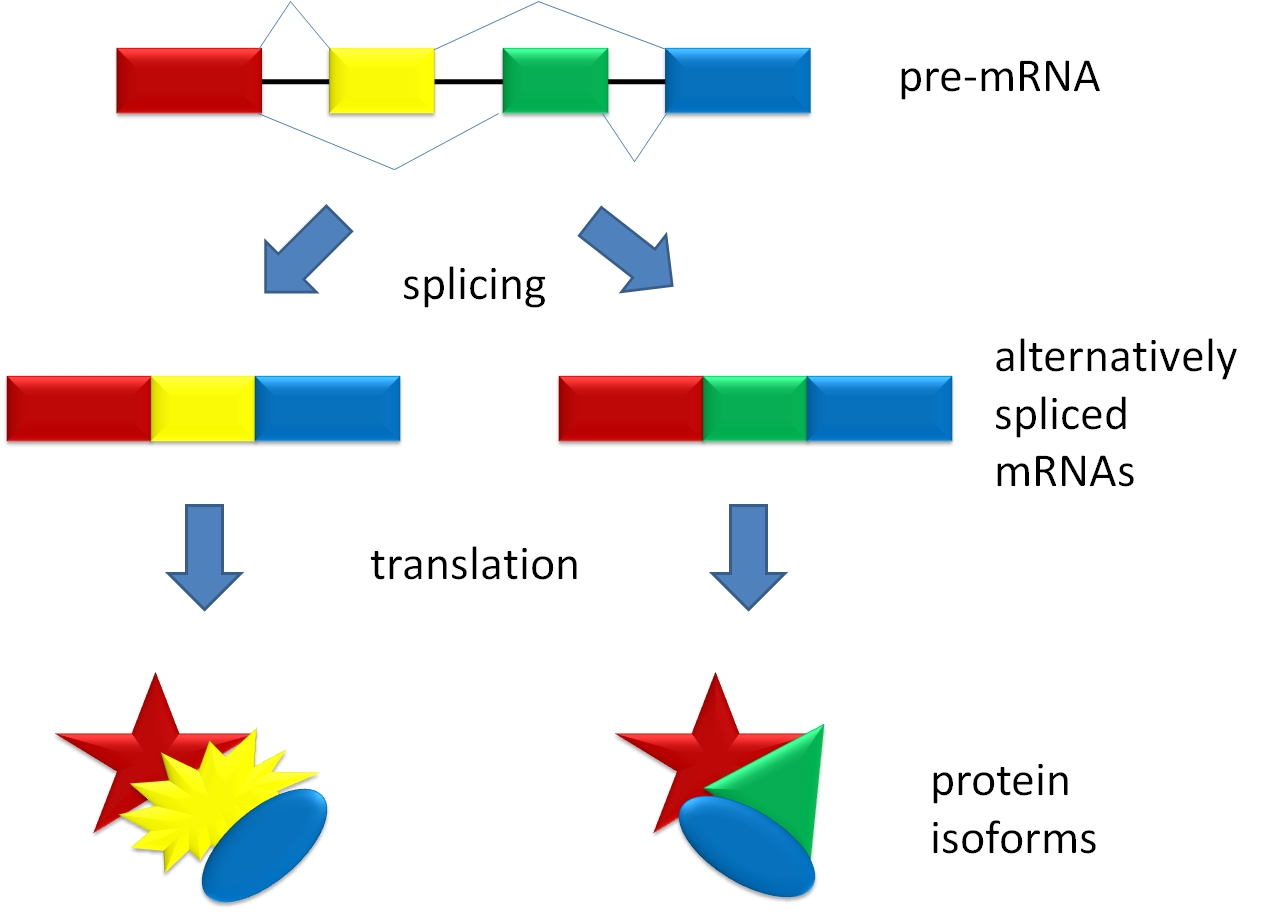
why is it important to carry around so many introns
gives the cell proteins diversity through alternative splicing without needing more DNA
example of a-tropomyosin gene alternative splicing
One DNA sequence but when it is transcribed we can pick and choose to cut out different introns from the gene to get many different forms of muscles
what is added to the pre-mRNA after RNA splicing
the poly-A tail is added to the 3’ end (~200 A’s are added)
What role does the poly-A tail play
allows the cell to recognize that this is a valid mRNA and it can be exported from the nucleus
where does all of the RNA synthesis and processing occur
in the nuclues
where does proteins synthesis occur
in the cytosol
what characteristics are required for pre-mRNA to finally become mRNA
5’ cap (polyadenylation tail)
Splicing is done
3’ cap (poly-A tail)
what is the breakdown of the RNA’s look like
mRNA = 5%
rRNA = 80%
what do mRNA’s even do?
messenger RNAs and used for translation, turning DNA into proteins
what do rRNA’s do?
they are ribosomal RNA’s and are used to form the structure of ribosomes and catalyze proteins structure
what do tRNA’s do?
transfer RNA used as a plug between mRNA and protein synthesis
what do snRNAs do?
they are used in RNA splicing along with snRNPs
once mRNA is transferred to the cytosol what can we do?
translation of mRNA to Proteins
Is translation a 1:1 communication
No, there are only 4 bases and 20 amino acids so there is some overlap
what is a codon
a set of 3 amino acids, there are more codons than amino acids, so amino acids have multiple corresponding codons
what is a degenerate genetic code?
An instance when multiple codon triplets can encode the same amino acid, providing redundant coding
how does the tRNA fit in the central dogma
tRNA recognizes the mRNA on one side and the other recognizes amino acid language
at what end does the amino acid chain begin in the tRNA
3’ end
how is the tRNA structured
contains a loop called with an anticodon that is complimentary to the amino acids codon
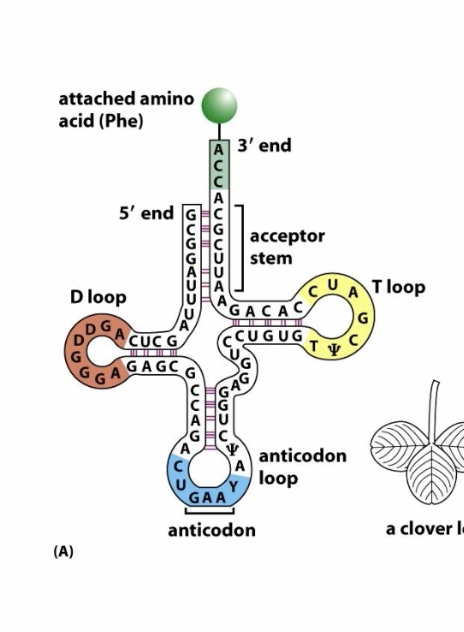
what does the anticodon do?
the 3 nucleotide sequence on the tRNA molecule that base-pairs with a complementary messenger RNA (mRNA) codon during protein synthesis
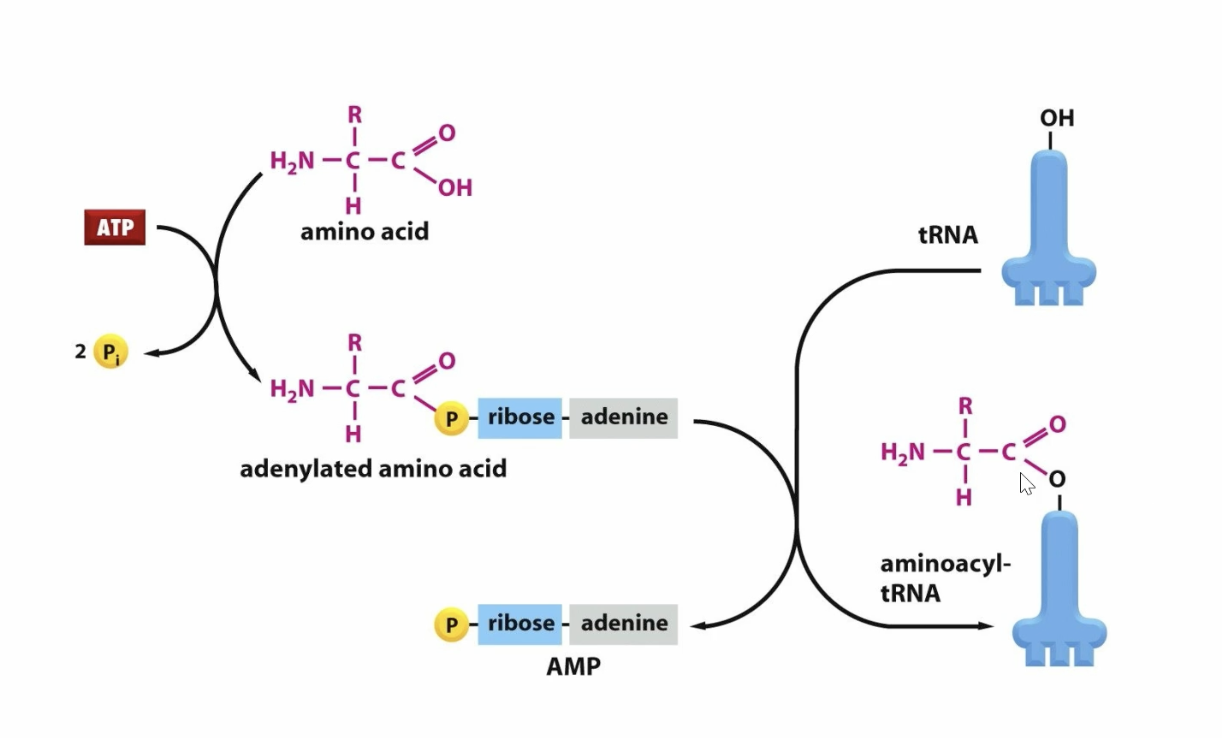
how are amino acids attached to the tRNA?
they are coupled via the aminoacyl-tRNA synthetase (each has it’s own — 20)
what are the steps of amino acids being attached to the tRNA
ATP is hydrolyzed by conjugation to AMP and activated
The amino acid is transferred from AMP to tRNA, resulting in a high-energy bond between the tRNA and the amino acid in the 3’ end
Then the synthetase proofreads for accuracy
photo of amino acid being attached to tRNA
amino acid becomes adenylated using ATP → AMP and then it is transferred to the high energy bond with tRNA making aminoacyl-tRNA on the 3’ end
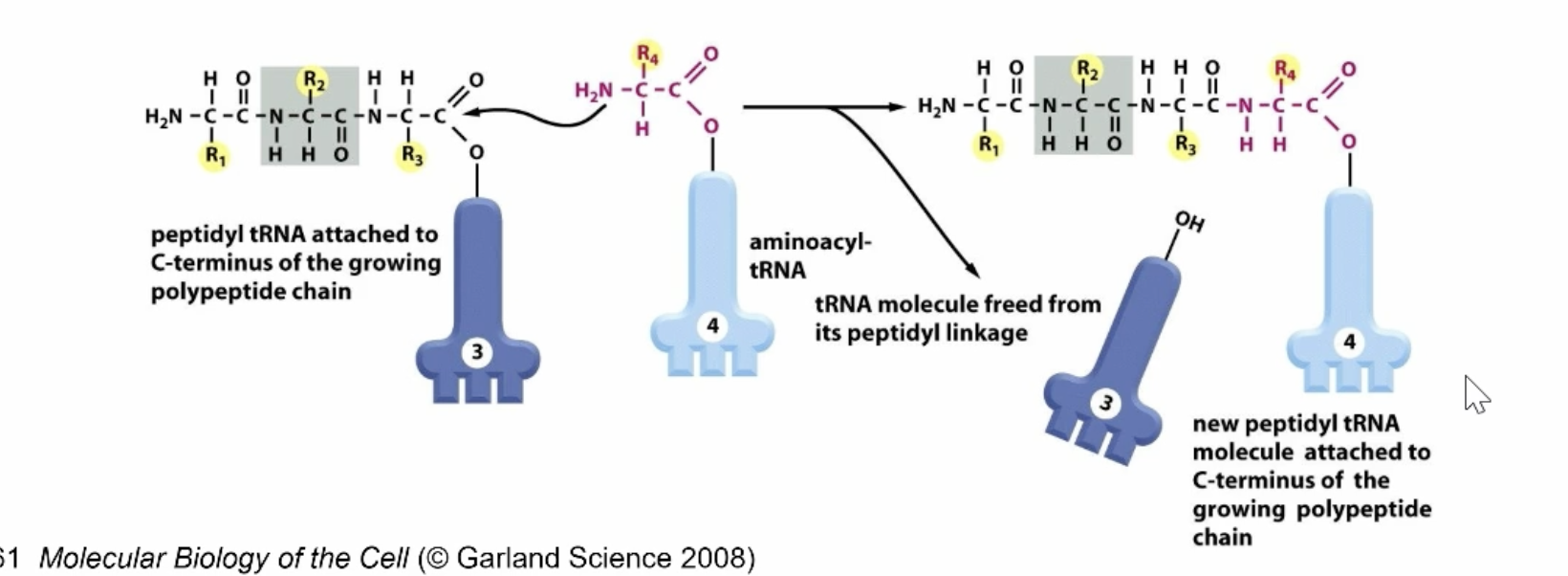
which direction is protein synthesis added?
N→C terminus
amino acid is added to last tRNA that was added
diagram of new aminoacyl-tRNA replacing the last one when the protein residues increase
what does the rRNA do in translation?
they catalyze the peptide bonds and build the amino acids
what direction does the ribosome read mRNA?
5’ to 3’ reading 3 bases (codon) at a time
each mRNA has how many possible reading frames?
3 — so it is important for it to stay consistent and maintain the same reading frame we start with
what is actually reading the mRNA when it comes to the cytosol?
Ribosome
what brings the amino acids?
tRNA
What makes proteins?
Ribosome
where does the ribosome know when to start reading the mRNA?
the first AUG sequence (encodes for Met)
why does AUG (code for Met) use a special tRNA initiator?
to distinguish the start of protein synthesis from internal methionine additions during translation
what is the initiation process of translation consist of?
the assembly of the ribosome, mRNA, and initiator tRNA to begin protein synthesis and start with Met
what are the elongation factors called in prokaryotes and eukaryotes?
Ef-tu anf Ef-G
EF1 and EF2
how does EF-tu/EF1 work?
EF-tu/EF1 binds ATP to the aminoacyl-tRNA and brings it to the A-site and then it checks the codon-anticodon match
Proofreading step after:
If match is correct → GTP is hydrolyzed → EF-Tu/EF1 leaves
If match is wrong → tRNA falls off before GTP hydrolysis
EF-Tu uses GTP as a “checkpoint” to ensure correct tRNA binding
how does Ef-G/EF2 work?
Ef-G/EF2 work by using GTP to physically move the ribosome after the peptide bond begins to form
Translation elongation diagram
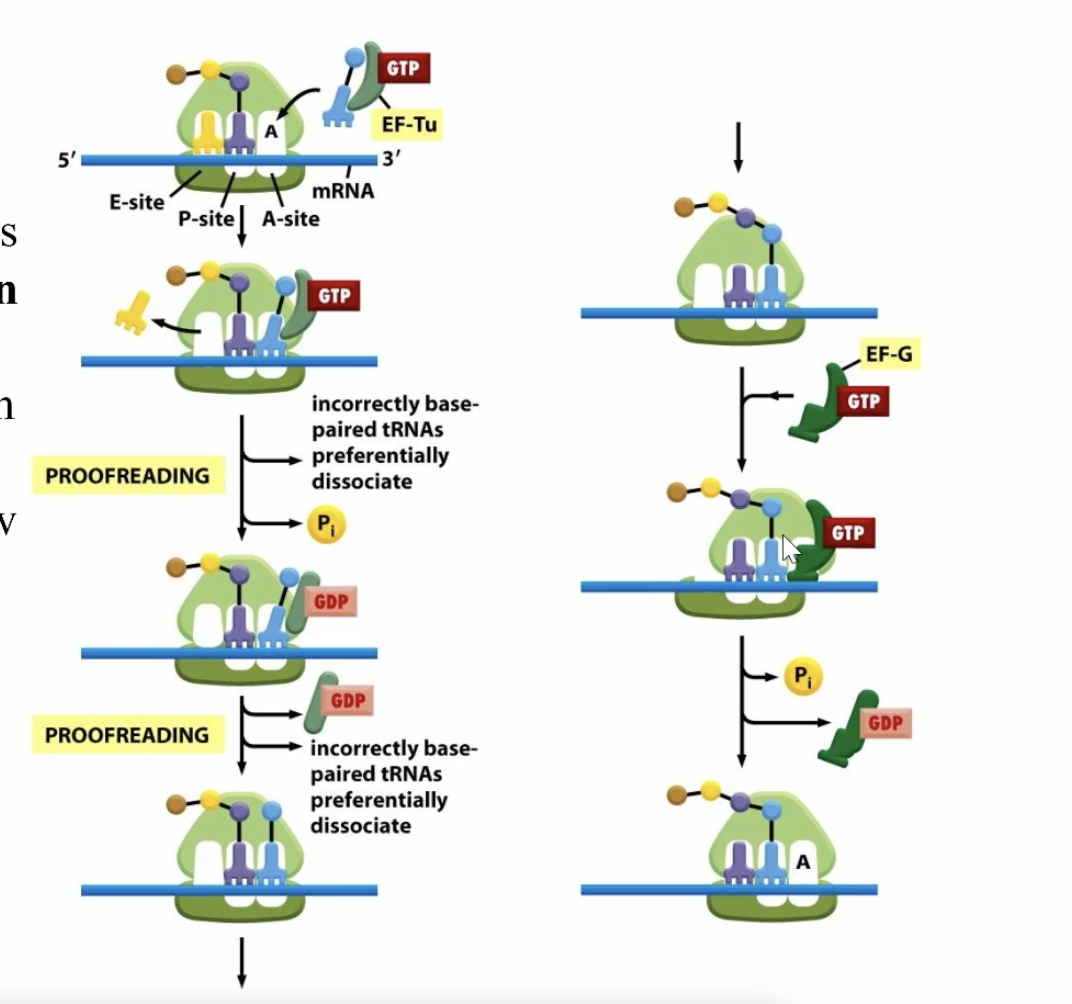
how do we end translation?
termination codon (UAA, UAG, UGA)
are there multiple ribosomes translating a singular mRNA at once?
Yes it is called a polyribosome which is a complex of multiple ribosomes
is the mRNA in a loop when it is being translated?
Yes
How does mRNA stay in a loop during translation?
5’ end is bound by eIF4E and 3’ end has poly-A binding protein (PABP)
between the elF4E and the 3’ polytail end it is bound by eIF4G which connects them
how do antibiotics work?
they work by blocking protein synthesis, if the rRNA of bacteria is blocked it will not be able to grow and the proteins will stop being synthesized
how do antibiotics not target us?
bacterial ribosomes are 70s and we are 80s
however since the mitochondria was phagocytized may still effect mitochondrial ribosomes
examples of antibiotics
Cycloheximide: prevents ribosome translocation by freezing it in place preventing the amino acid to form
Puromycin: larps as a tRNA so when it adds on after hydrolyzing GTP it causes the entire ribosome mRNA contraption to fall apart
when you add one nucleotide or one amino acid how much energy anre you using?
~2 ATP
what does tRNA and EF-Tu / EF-G use?
ATP and GTP
protein synthesis is very expensive
what does having protein tell us?
3D structure
Function
Where it goes in the cell
what does having mRNA tell us?
Protein sequence (codons)
Start/stop signals
Stability info
what does having DNA tell us?
Everything in mRNA
plus
Promoters (start transcription)
Terminators
Introns (regulation, splicing info)
Explore top notes

Explore top flashcards
