enculturation & socialization (SS11)
 Call Kai
 Learn
Learn Practice Test
 Spaced Repetition
 Match
Match Flashcards
 Knowt Play
1/68

Earn XP
Description and Tags
🍂
Name | Mastery | Learn | Test | Matching | Spaced | Call with Kai | Chat |
|---|
No analytics yet
Send a link to your students to track their progress
69 Terms
social group agents
often provide the first experiences of socialization;
people first learn to use the tangible objects of material culture in these settings, as well as being introduced to the beliefs and values of society.
ex. family & peer groups
family
6 AGENTS OF SOCIALIZATION:
first agent of socialization;
parents give a social identity to children;
Nurture in Early Childhood
the responsibility for providing a safe and caring environment typically falls on parents and other family members
True
TRUE OR FALSE:
Social class, like race, plays a large part in shaping a child's personality.
Whether born into families of high or low social position, children gradually come to realize that their family's social standing affects how others see them and, in time, how they come to see themselves
peer groups
6 AGENTS OF SOCIALIZATION:
made up of people who are similar in age and social status and who share interests;
begins in the earliest years;
these lets children escape the direct supervision of adults;
offer the chance to discuss interests that adults may not share with their children
generation gap
6 AGENTS OF SOCIALIZATION (PEER GROUPS):
peer groups have great influence, and the attitudes of young and old may differ because of a _______
importance of peer groups typically peaks during adolescence, when young people begin to break away from their families and think of themselves as adults
school, mass media, government, religion
4 examples of institutional agents
school
6 AGENTS OF SOCIALIZATION:
_______ & classroom rituals, led by teachers serving as role models and leaders, regularly reinforce what society expects from children;
described as the hidden curriculum by sociologists;
join with families in socializing children into gender roles
hidden curriculum
6 AGENTS OF SOCIALIZATION (SCHOOL):
informal teaching done by schools;
isn’t included in the curriculum, but the student still learns it
citizenship & nationalism
6 AGENTS OF SOCIALIZATION (SCHOOL):
Schools also socialize children by teaching them overtly about ______ & ______.
mass media
6 AGENTS OF SOCIALIZATION:
means for delivering impersonal communications to a vast audience;
arise as comms. technology spreads info on a massive scale;
greatly influences social norms;
ppl learn about objects of material culture, non-material culture (beliefs, values, norms)
government
6 AGENTS OF SOCIALIZATION:
many of the rites of passage people go through today are based on age norms established by this;
age of legality & retirement: "adult" means being 18 years old, the age at which a person becomes legally responsible for themselves
65 is the start of "old age" since most people become eligible for senior benefits at that point
religion
6 AGENTS OF SOCIALIZATION:
teach participants how to interact with the ______’s material culture;
important ceremonies related to family structure are connected to these kinds of celebrations;
fosters a shared set of socialized values that are passed on through society;
many of these institutions uphold gender norms (from ceremonial rites of passage to power dynamics)
anticipatory socialization
process that helps a person achieve a desired position;
preparation for future life roles
Zygmunt Bauman’s Liquid Modernity
states that contemporary society reveals an increasing fluidity of roles, as opposed to previous eras;
“It is more difficult to view socialization as a smooth and uninterrupted process. Rather, life is increasingly fragmented, "cut into a succession of ill-connected episodes"
flexible, adaptable
UNDER LIQUID MODERNITY:
As a result of this, social identities have become more ______, more ______ to unpredictable transitions, and more open to taking on new roles or picking and choosing from a globalized palette of cultural values and practices.
enculturation
a.k.a primary socialization
an individual adopts the behavior patterns of the culture in which he or she is immersed;
the connection is deeper with the culture of group of people
acculturation
a.k.a secondary socialization;
nakikisama lang sa culture ng other groups
resocialization
old behaviors that were helpful in a previous role are removed because they are no longer of use;
more stressful than normal socialization because people have to unlearn behaviors that have become customary to them;
radically changing an person's personality by carefully controlling the environment;
occurs in a total institution
ex. military
total institution
setting in which people are isolated from the rest of society and manipulated by an administrative staff;
members are required to live in isolation from the rest of society;
staff members supervise all aspects of daily life
life is controlled & standardized
formal rules dictate when, where, and how they perform their daily routines
staff members supervise all aspects of daily life of “inmates”
life is controlled & standardized
formal rules dictate when, where, and how they perform their daily routines
3 important characteristics of total institutions
two-part process
UNDER TOTAL INSTITUTION:
members entering an institution must leave behind their old identity through a degradation ceremony
after new members of an institution are stripped of their old identity, they build a new one that matches the new society
degradation ceremony
UNDER TOTAL INSTITUTION:
new members lose the aspects of their old identity and are given new identities. The process is sometimes gentle.
mortification of the self
Goffman referred to the process of being stripped of one's external identity as _______
conformity
extent to which an individual complies with group norms or expectations;
lies in pursuing cultural goals through approved means;
groups influence the behavior of their members by promoting this.
True
TRUE OR FALSE:
As experiments by Solomon Asch and Stanley Milgram showed, even strangers can encourage conformity.
social control
attempts by society to regulate people's thoughts and behavior;
regulation and enforcement of norms;
control can be defined broadly as an organized action intended to change people's behavior;
underlying goal: maintain social order
social order
UNDER SOCIAL CONTROL:
underlying goal of social control;
arrangement of practices and behaviors on which society's members base their daily lives
ex. An employee handbook and social control as the incentives and disincentives used to encourage or oblige employees to follow those rules. When a worker violates a workplace guideline, the manager steps in to enforce the rules
sanctions
UNDER SOCIAL CONTROL:
One means of enforcing rules are through these;
can be positive or negative
positive sanctions
UNDER SOCIAL CONTROL (SANCTIONS):
rewards given for conforming to norms
ex. promotion at work for working hard
negative sanctions
UNDER SOCIAL CONTROL (SANCTIONS):
punishments for violating norms
ex. being arrested is a punishment for shoplifting
informal sanctions
UNDER SOCIAL CONTROL:
emerge in face-to-face social interactions;
no laws dictating the proper behavior but it doesn't mean that the person won't be punished
ex. negative - disapproval of the people
positive - positive reactions from the people
formal sanctions
UNDER SOCIAL CONTROL:
ways to officially recognize and enforce norm violation (rewards and punishment)
deviance
recognized violation of cultural norms;
violation of established contextual, cultural, or social norms, whether folkways, mores, or codified law (William Graham Sumner);
what society views as offensive—violations that carry a stigma
can be as minor as picking one's nose in public or as major as committing murder
William Graham Sumner
He stated that deviance is a violation of established contextual, cultural, or social norms, whether folkways, mores, or codified law (1906).
outsider
What deviant actions or attitudes, whether negative or positive, have in common is some element of difference that causes us to think of another person as an
_______ (H.S. Becker, 1966).
reference point
implicit notion of deviance is the _____ _____ (the norms in the society)
True
TRUE OR FALSE:
How a society defines deviance, who is branded as deviant, and what people decide to do about deviance all have to do with the way society is organized
aspects of deviance
examples of these are:
deviation from the norm
negatively valued by a large number of people
can be major or minor
consequences are the sanctions applied depending on the degree of deviation
stigma
UNDER DEVIANCE:
markers or labels that distinguish deviants from the rest of the group and which connote social disgrace;
powerfully negative label that greatly changes self-concept and social identity;
can operate as a master status
crime
UNDER TYPES OF CRIME
violation of a society’s formally enacted criminal law;
consensus crime
UNDER TYPES OF CRIME:
most serious acts of deviance;
there is near-unanimous public agreement
ex. murder, rape
conflict crimes
UNDER TYPES OF CRIME:
may be illegal but about which there is considerable public disagreement concerning their seriousness
ex. prostitution, smoking marijuana
social deviations
not illegal in themselves but are widely regarded as serious or harmful
ex. abusing serving staff or behaviors arising from mental illness & addiction
social diversions
violate norms in a provocative way but are generally regarded as distasteful but harmless
ex. riding skateboards on sidewalks, facial piercings
social context
SOCIAL FOUNDATIONS OF DEVIANCE:
Deviance is defined by its _____ _____.
To understand why some acts are deviant and some are not, it is necessary to understand what the context is, what the existing rules are, and how these rules came to be established.
False; what counts as deviant also changes
TRUE OR FALSE:
If the rules change, what counts as deviant doesn’t change.
True
TRUE OR FALSE:
Deviance varies according to cultural norms
People become deviant as others define them that way
How societies set norms and how they define rule breaking both involve social power.
Emile Durkheim
He made the surprising claim that there is nothing abnormal about deviance;
he said it performs four essential functions
deviance affirms cultural values & norms
4 ESSENTIAL FUNCTIONS OF DEVIANCE:
preferences in attitudes and morals
responding to deviance clarifies moral boundaries
4 ESSENTIAL FUNCTIONS OF DEVIANCE:
members of the society gain a better perspective of what permissible behavior is
responding to deviance brings people together
4 ESSENTIAL FUNCTIONS OF DEVIANCE:
feeling of oneness among conformists, strengthening social integration, strengthen solidarity
deviance encourages social change
4 ESSENTIAL FUNCTIONS OF DEVIANCE:
alarm system for society, what may be deviant today maybe conformist of tomorrow
Robert Merton’s Strain Theory
states that society can be set up in a way that encourages too much deviance;
extent and type of deviance people engage in depend on whether a society provides the means (ex. schooling and job opportunities) to achieve cult goals (ex. financial success)
conformity
UNDER MERTON’S STRAIN THEORY:
accept goals, accept means;
majority of people in society choose to conform and not to deviate;
they pursue their society’s valued goals to the extent that they can through socially accepted means
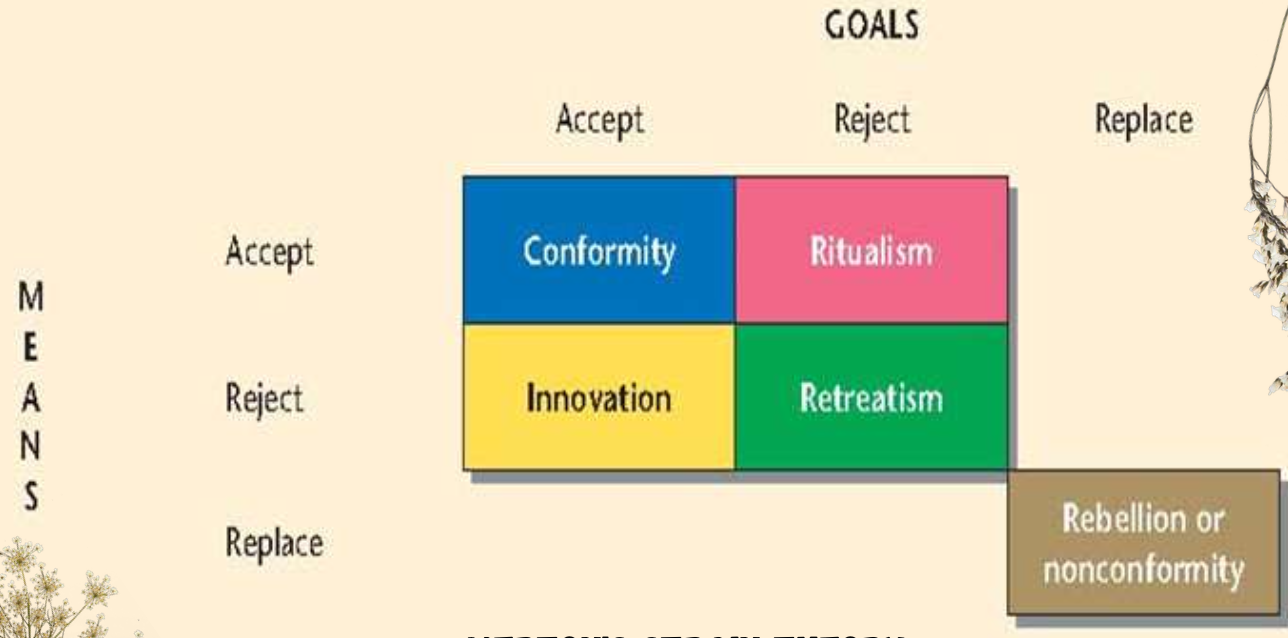
innovation
UNDER MERTON’S STRAIN THEORY:
accept goals, reject means;
those who innovate pursue goals they cannot reach through legitimate means by instead using criminal or deviant means
ritualism
UNDER MERTON’S STRAIN THEORY:
reject goals, accept means;
those who ______ lower their goals until they can reach them through socially acceptable ways;
“social ritualists”
social ritualists
UNDER MERTON’S STRAIN THEORY (RITUALISM):
they focus on conformity to the accepted means of goal attainment while abandoning the distant, unobtainable dream of success
retreatism
UNDER MERTON’S STRAIN THEORY:
others _____ from the role strain and reject both society's goals and accepted means
ex. some beggars and street people have withdrawn from society's goal of financial success → drop outs
rebellion, rebels
UNDER MERTON’S STRAIN THEORY:
new goals, new means;
replacing a society's goals and means with their own;
______ seek to create a greatly modified social structure in which provision would be made for closer correspondence between merit, effort, and reward
looping effect
there is a _____ _____
once a category of deviance has been established and applied to a person, that person begins to define themselves in terms of this category and behave accordingly
labeling theory
idea that deviance and conformity result not so much from what people do as from how others respond to those actions;
this theory stresses the relativity of deviance, meaning that people may define the same behavior in any number of ways
Edwin Lemert
he expanded on the concepts of labelling theory, identifying two types of deviance that affect identity formation
primary deviance
2 TYPES OF DEVIANCE:
violation of norms that does not result in any long-term effects on the individual’s self image or interactions with others;
ex. skipping school or underage drinking
secondary deviance
2 TYPES OF DEVIANCE:
when a person’s self-concept & behavior begin to change after his or her actions are labelled as deviant by members of society;
can be so strong it bestows a master status upon the indiv.;
ex. hs students often cuts class, gets reprimanded often, develops reputation as a “troublemaker”, & starts acting out more, embracing his deviant identity
master status
label that describes the chief characteristic of an individual
deviant career
According to Eric Goffman, secondary deviant marks the start of this;
ppl acquire a stigma as they develop a stronger connection to deviant behavior
Travis Hirschi’s Control Theory
this states that social control depends on people anticipating the consequences of their behavior;
assumes that everyone finds at least some deviance tempting;
links conformity to attachment, opportunity, involvement, & belief
attachment, opportunity, involvement, belief
4 different types of social control that Travis Hirshi links conformity to
unsuccessful socialization
what is deviance viewed as a result of?