4.1.6.3 - Perfectly competitive labour markets
 Call Kai
 Learn
Learn Practice Test
 Spaced Repetition
 Match
Match Flashcards
 Knowt Play
1/3

There's no tags or description
Looks like no tags are added yet.
Name | Mastery | Learn | Test | Matching | Spaced | Call with Kai |
|---|
No analytics yet
Send a link to your students to track their progress
4 Terms
Characteristics/Assumptions of Perfectly Competitive Labour Market
Very large number of workers
Workers are homogeneous
Firms maximise profits, hiring workers up to MRP=MC
No barriers to entry for workers
Price-taking - no firm or worker can influence ruling wage rate
Perfect information about workers’ skills; working conditions, outside wages
Large number of firms/employers
Diagram for Perfectly Competitive Labour Market (Firm & Industry)
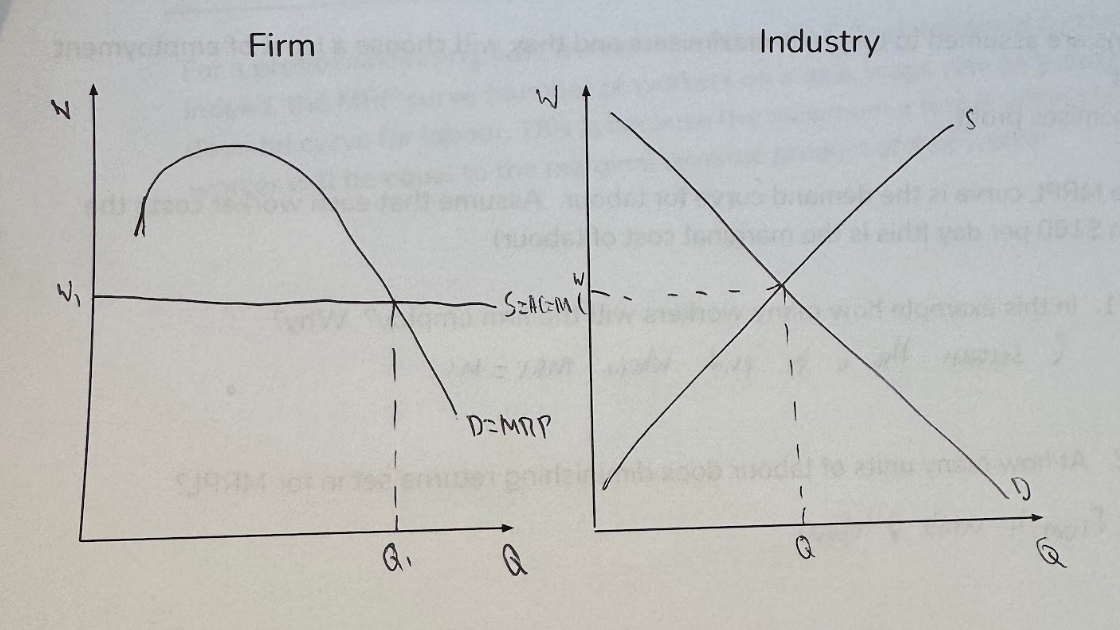
Why is Supply Horizontal for Firms in Perfectly Competitive Labour Markets?
In competitive labour market, each firm can only hire workers if they offer the market-clearing wage rate, because if they offered less, they would work at other rival firms instead. → Supply curve is horizontal
(firms are wage-takers)
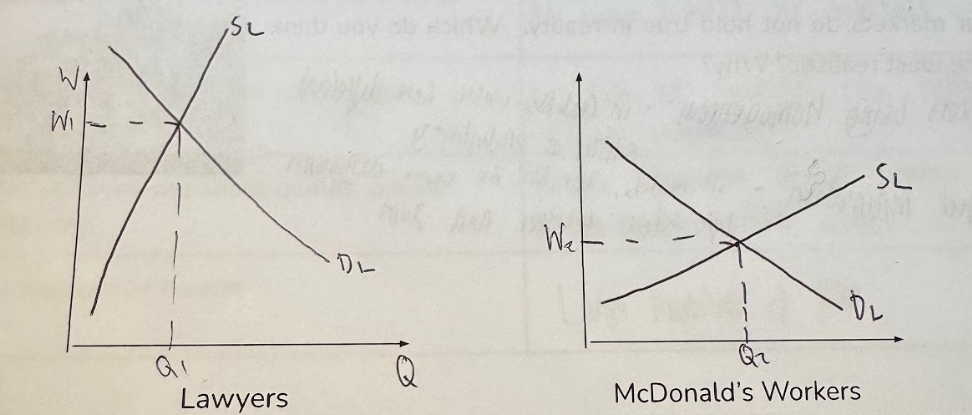
Labour Market for High-Skilled Job vs Market for Low Skilled-Job (Diagrams + Chain of Analysis)
For this example, High-Skilled = Lawyer, Low-Skilled = McDonald’s Worker
Elasticity of Supply:
Supply of Lawyers is more inelastic - More barriers to entry, like rigorous qualification exams, education - need degree, training.
Whereas, supply of McDonald’s workers is elastic - low entry requirements - no education needed, little training
Labour Demand:
Demand for Lawyers exists at much higher wages - Lawyers produce higher MR → higher MRP → firms more willing and able to hire lawyers
→ Equilibrium Wage for Lawyers is higher at W1 compared to W2 for McDonald’s workers