AP Calc Mem Quiz (1-3)
 Call Kai
 Learn
Learn Practice Test
 Spaced Repetition
 Match
Match Flashcards
 Knowt Play
1/121

There's no tags or description
Looks like no tags are added yet.
Name | Mastery | Learn | Test | Matching | Spaced | Call with Kai | Chat |
|---|
No analytics yet
Send a link to your students to track their progress
122 Terms
Logb(A ⋅ C) =
LogbA + LogbC
LogbAB =
BLogbA
(x,y) for cos and sine
(cosθ,sinθ)
lne =
1
ln1 =
0
log10 =
1
log 1 =
0
logn1 =
0
lnex =
x
elnx =
x
tan =
sinθ/cosθ
cotθ =
cosθ/sinθ
xn ⋅ xm =
xn+m
(xm)n =
xmn
x0 =
1
EX: sin π/3 =
√3/2
EX: cos 3π/4
-√2/2
EX: tan 11π/6 =
-1/√3 = -√3/3
EX: cot 5π/4 =
1
Pythagorean Identity #1
sin²θ + cos²θ = 1
Pythagorean Identity #2 (divide by sin²)
1 + cot²θ = csc²θ
Pythagorean Identity #3 (divide by cos²)
tan²θ + 1 = sec²θ
Double Angle Identity #1
sin2θ = 2sinθcosθ
Double Angle Identity #2
cos2θ = cos²θ - sin²θ = 2cos²θ - 1 = 1 - 2sin²θ
Double Angle Identity #3
tan2θ = 2tanθ/1 - tan²θ
logb(E/F)
logbE - logbF
secθ =
1/cosθ
cscθ=
1/sinθ
d/dx xn
nxn-1
d/dx c
0
d/dx lnx
1/x
d/dx x
1
d/dx ex
ex
d/dx ax
ln(a) * ax
d/dx sinx
cosx
d/dx cosx
-sinx
d/dx tanx
sec²x
d/dx cotx
-csc²x
d/dx secx
secxtanx
d/dx csc
-cscxcotx
d/dx arcsinx
1/√1-x²
d/dx arccosx
-1/√1-x²
d/dx arctanx
1/1+x²
d/dx arccot
-1/1+x²
d/dx arcsecx
1/|x|√x²-1
d/dx arccscx
-1/|x|√x²-1
Quotient Rule d/dx t(x)/b(x)
(b(x))(t’(x)) - (t(x))(b’(x)) / (b(x))2
Product Rule d/dx f(x)s(x)
f'(x) s(x) + s'(x) f(x)
How to find the vertical tangent line
1) use the denominator
2) set the equation equal to x
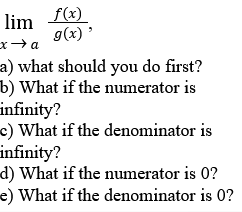
a)Substitute in a
b) The limit is infinity
c) The limit is 0
d) the limit is 0
e) the limit is infinity
Definition of a derivative for f(x)
lim h→ 0 f(x+h)-f(x)/ h
The equation of the normal line to f(x) at (a)
y-f(a) =-1/f'(a)(x-a)
When does a function have jump discontinuity
if the left-hand and right-hand limits exist but are not equal to each other
When does a function have a removable discontinuity at x=c?
if the limit of the function exists as x approaches c, but the function is either not defined at c or is defined at c with a different value
3 requirements to know there is an inverse function
if they tell you f(x) and g(x) are inverse
f(x) and f-1(x)
f(g(x)) = x or g(f(x))
f(x value of f(x)) =
y value of f(x)
g(y value of f(x)) =
x value of g(x)
g(x value of f(x)) =
y value of g(x)
The zeros of f(x)
f(x) = 0
The intersection of f(x) and g(x)
f(x) = g(x) ~ or ~ f(x) - g(x) = 0
Given some f(x) and some value x=a.
What will f(a) generate
What will f’(a) generate
a) y value
b) slope
What is the relationship between continuity, differentiability, and limits?
Differentiability→continuity→limit exists→left limit equals right limit
d/dx sin(u)
cos(u) u ́
d/dx cos(u)
-sin(u) u´
d/dx tan(u)
sec2(u) u´
d/dx sec(u)
sec(u)tan(u) u´
d/dx csc(u)
-csc(u)cot(u) u´
d/dx cot(u)
-csc²(u) u´
d/dx eu
eu u´
d/dx ln(u)
u´ /u
d/dx au
au ln(a) u'
d/dx sin-1(u)
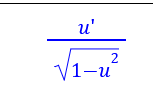
d/dx cos-1(u)
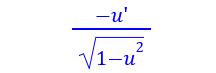
d/dx tan-1(u)
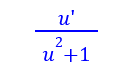
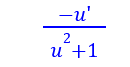
d/dx arccot (u)
What will f’’(a) generate?
Concavity
Derivative of h(g(x))
h’(g(x)) x g’(x)
Steps for implicit
1) derive with respect to x
2) collect y' to one side
3) isolate for y’
What do 1st and 2nd derivative test have in common
Find extrema
Need critical point
What do the 1st derviative test and concavity have in common
Checking tests points
Setting something equal to 0
Two forms that should never be written
0/0 and infinity/infinity both require L hopital rule
Conditions for L hopital
Lim x → a f(x) = 0/infinity
Lim x →a g(x) = 0/infinity
Critical numbers of f(x)
f’(x) = 0 or infinity
Show work for intervals that decreasing or increasing using f’(x)
F’(x) > 0
F’(x) < 0
How to find inflection points of f(x)
F’’(x) = 0 and infinity and where concavity changes
How to find maximum and minimum
1) find critical points
2) use 1st/2nd derivative test
3) plug back into original function
4) check endpoints
In graph of f’(x) where do you find critical points of f(x)
Where f’(x) = 0 or where it is undefined
Intervals where the slope of f(x) is increasing
F’’(x) > 0
How do you find a maximum of the graph f(x) explain with 1st and 2nd derivative test
Find where f’(x) = 0 and where f’(x) changes from positive to negative and f’’(x) < 0
How much time per question on AP exam
Mcq and frq
Non calc mc is 2 minutes, calc is 3 and frq is 15
How to find concavity on f’(x)
Increasing f’(x)
Concave up
Decreasing f’(x)
Concave Down
When is 2nd derivative test inconclusive
F’’(x) = 0
F^-1 (x)
1/ f’(g(x))
Steps of 2nd derviative test
Find critical points
Substitute into 2nd derivative
plus mean min and negative means max
Concavity tests
Inflection points
Test points
Conditions for MVT
a) f(x) is continuous on the interval [a, b]
b) f(x) is differentiable on the interval (a, b)
c) f(a) = f(b)
Reasoning for MVT
(state the conditions) therefore there exists at least 1 value in (a, b) such that
f’(n) = f(b) - f(a) / b - a
Given a graph of f’’(x) and f'(a) = 0 and f’’(x) > 0, what do you know about x = a on f(x) besides it's critical point
f(x) has a minimum at x = a
Given a graph f’’(x), what do zeroes tell you about the graph of f(x)
f(x) has inflection points
Given a graph of f’(x), how do you find critical points of f(x)
f’(x) touches x-axis or is undefined