Physio Section 3 Content
 Studied by 0 people
 Call Kai
 Learn
Learn Practice Test
 Spaced Repetition
 Match
Match Flashcards
 Knowt Play
1/118

There's no tags or description
Looks like no tags are added yet.
Name | Mastery | Learn | Test | Matching | Spaced |
|---|
No study sessions yet.
119 Terms
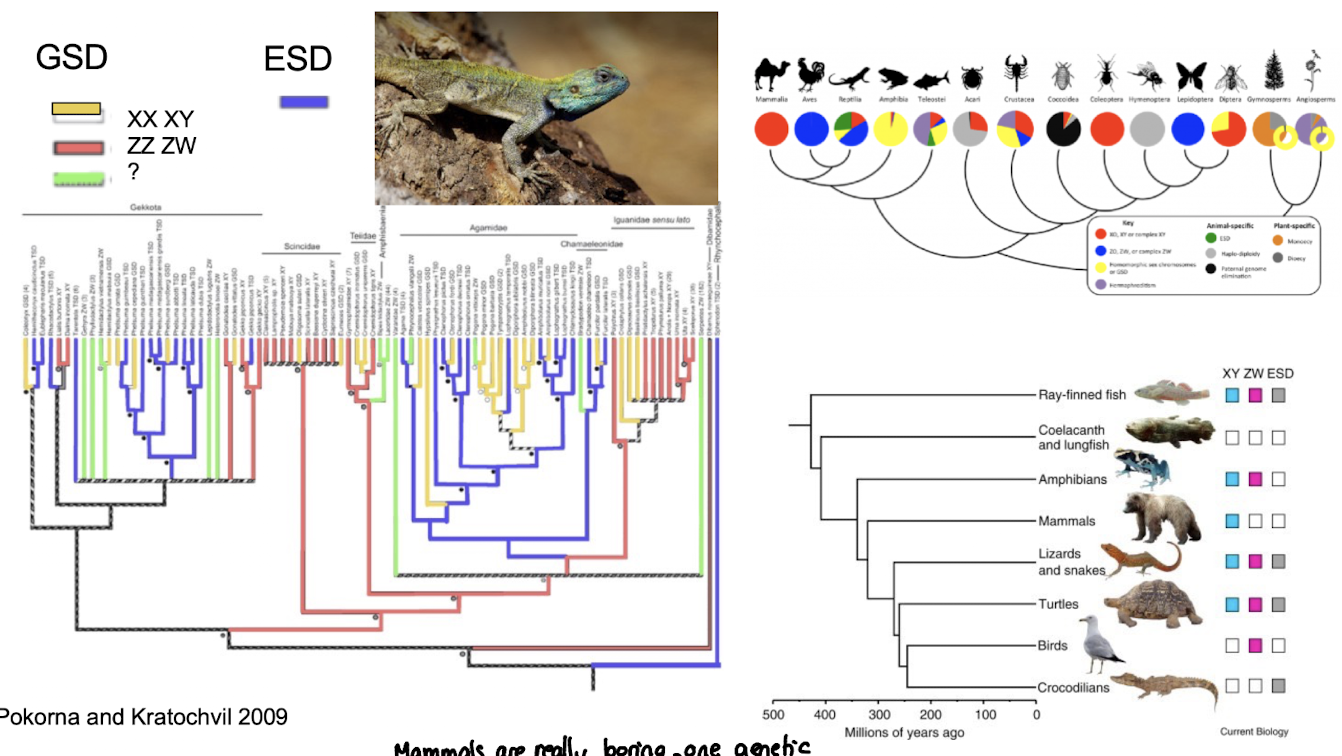
Take Home Message for the Comparison of Sex Determination Mechanisms
Mammals are incredibly boring, only have one version of determination, genetic, which limits our diversification. Other groups, however, have been able to become diverse in part due to their varied sex determination strategies
Names of the Parity and Nutritional Modes
Parity Modes:
Oviparity
Viviparity
Nutritional Modes:
Lecithotrophy
Matrotrophy
Oviparity
Eggs are laid and develop outside of the mother; passive interaction with the environment
ex. frog, turtles, crocs
Viviparity
Eggs develop inside the mother and young are born live; active interaction with the environment
ex. boas, anacondas, viviparous lizard, humans
Lecithotrophy
Nutrition from stored yolk (originally comes from mother)
Matrotrophy
Nutrition from current maternal physiology (often placenta or milk)
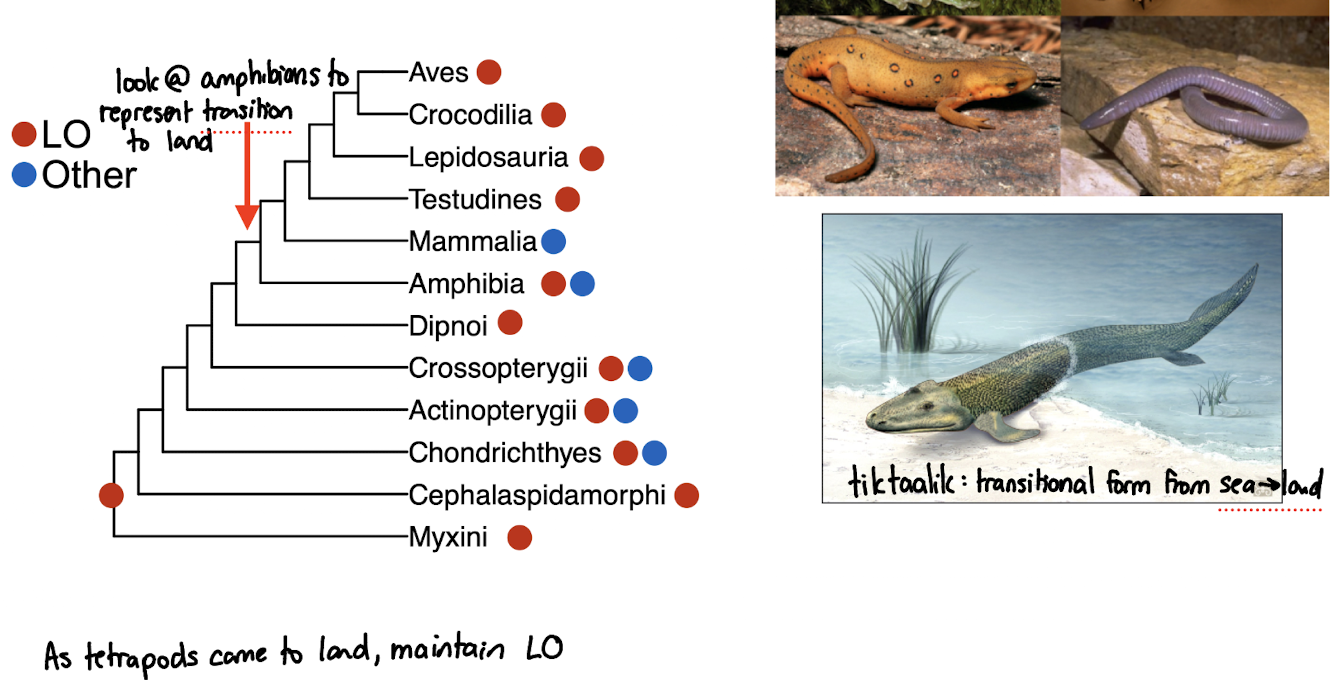
What parity and nutritional modes are likely ancestral in vertebrates?
Lecithotrophic Oviparity

How are the developing vertebrate’s needs met in Lecithotrophic Oviparity?
oxygen: from environment
food: from the yolk
calcium: from the yolk
NOTE: a physiological danger of LO is risk of predation during development
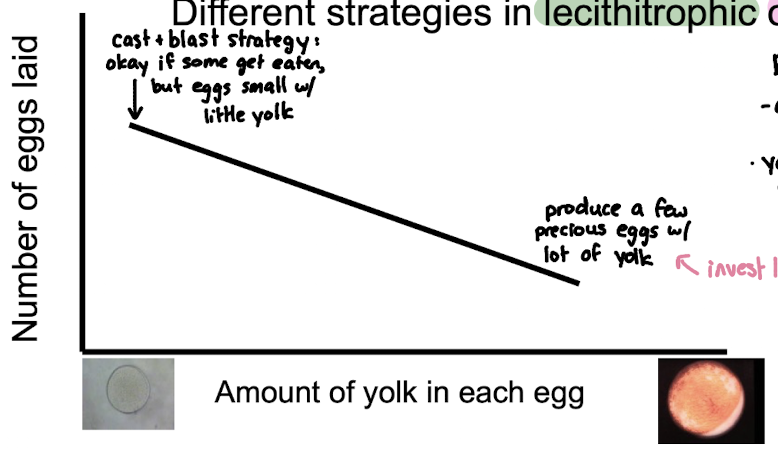
Lecithotrophic Oviparity Evolutionary Trade Off Strategies
balance the amount of yolk v. the number of eggs
cast and blast strategy: produce many eggs with a small amount of yolk in each
okay if some get eaten because you have so many potential offspring
produce a few eggs with lots of yolk, invest more into each egg
Enhancing reproductive success with this strategy
Maiden’s purse: encase embryo in a hard keratin structure
Mouth brooding: hold eggs in mouth when faced with danger
Note: spots on male’s tail often look like eggs, female tries to pick them up and eats his sperm instead
Greatest Threat to the Ancestral Egg on Land (Care Options seen in Lecithotrophic Oviparous Amphibians like Frogs)
Threat: on land, eggs can dry up!
Marsupial frog: male carries embryos on his back in a pouch
Surinam toad: male rolls onto eggs and they are carried around by being embedded in his back skin
Gastric-brooding frog: males ingest embryos and hold hem in their stomach. levels of stomach acid production decrease during this incubation to avoid eggs being digested
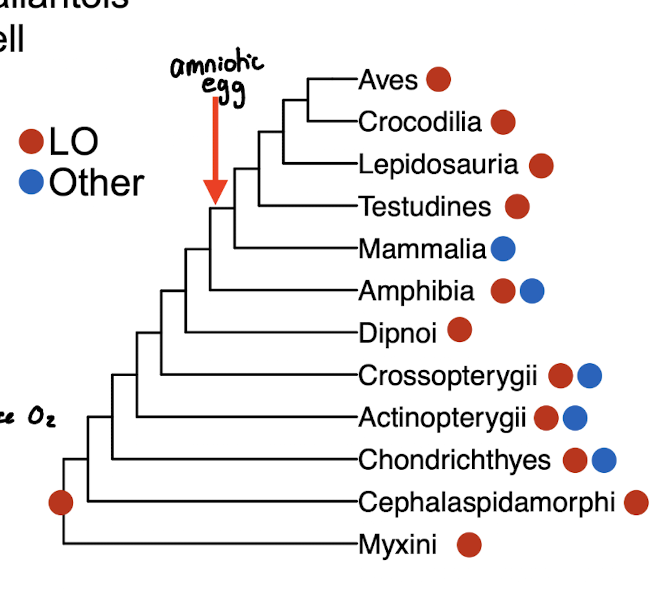
Amniotic Lecithotrophic Oviparity On Phylogenetic Tree and Problem(s) It Solves/Introduces
Solves water problem of eggs drying up on land, but now oxygen is harder to get from the environment due to the shell and amnion
No longer tied to water for reproduction
Develops in amniota group
Components of the Amniotic Egg
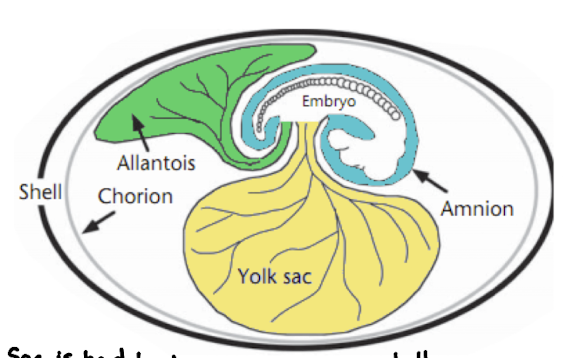
Membranes
Four extraembryonic membranes (yolk sac, amnion, chorion, allantois) that protect, nourish, and support the embryo.
Yolk Sac
Surrounds the yolk.
Provides nutrients to the embryo via blood vessels.
Amnion
Fluid-filled membrane around the embryo.
Cushions, hydrates, and protects from mechanical shock.
Chorion
Outermost membrane.
Main site of gas exchange (oxygen in, CO₂ out).
Allantois
Stores nitrogenous waste (e.g., uric acid).
Assists in gas exchange.
Contributes to umbilical structures in mammals.
Shell
Protective outer covering (hard or leathery).
Prevents desiccation and offers structural support.
Porous, allowing gas exchange.
Amniotic Lecithotrophic Oviparity: Egg Size Trade-Offs
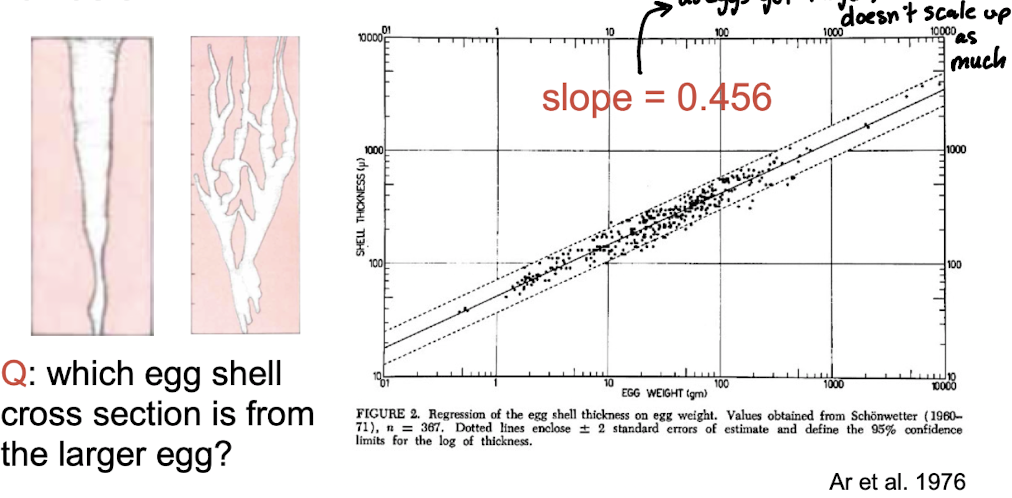
Larger eggs face issues due to the SA/V relationship and the intake of oxygen from the environment
as egg gets larger, the volume needs more oxygen than the SA can allow in
Solutions:
Larger eggs have bigger pores to let oxygen in
As eggs get larger, shell thickness is negatively allometric (does not scale up as much)
Amniotic Lecithotrophic Oviparity: Role and Source of Calcium During Development
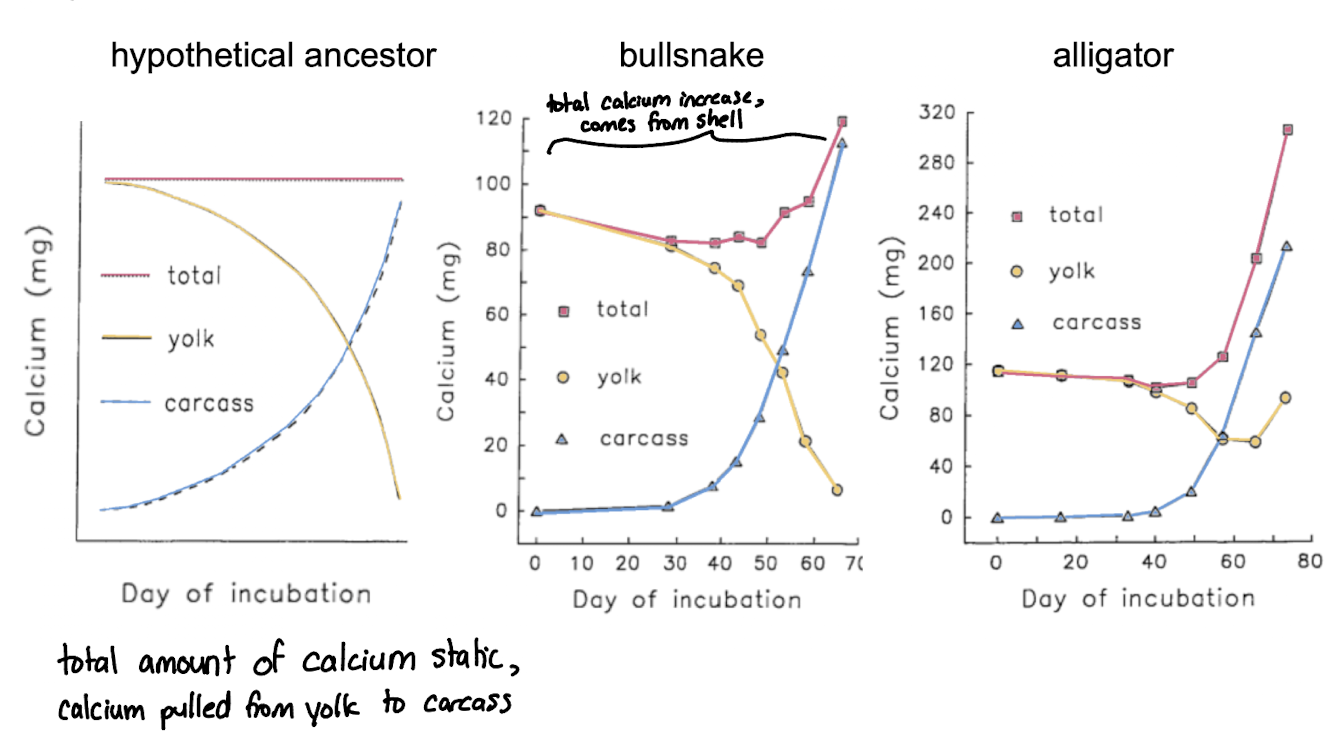
Calcium stores, which are necessary for muscle and bone development, are mobilized for the developing embryo
Eggshel is the storage device for calcium
Across development, the total amount of calcium in the system of yolk and body increase as calcium is pulled from the shell, as opposed to a non amniotic egg ancestor where total calcium is static and gets pulled from yolk to the body only
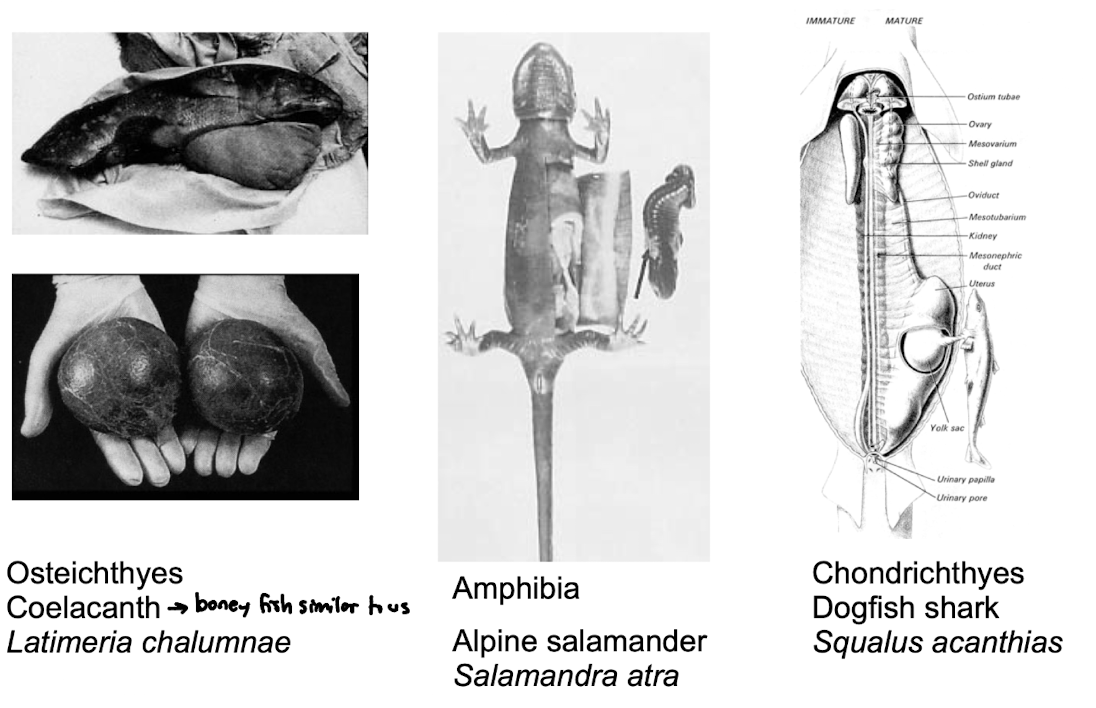
Anatomical Adaptation for the Evolution of Licithotrophic Viviparity
Retention of large, yolk-filled sacs within the maternal reproductive tract
Monotremes: What Reproductive Strategy did Mammals Begin With?
Monotremes represent the ancestors of mammals
Have Matrotrophic Oviparity Strategy, think of platapi
Monotremes are mammals with…
Eggs
Minimal yolk
“incubatorium”: where eggs are laid and the site of…
lactation: milk delivered
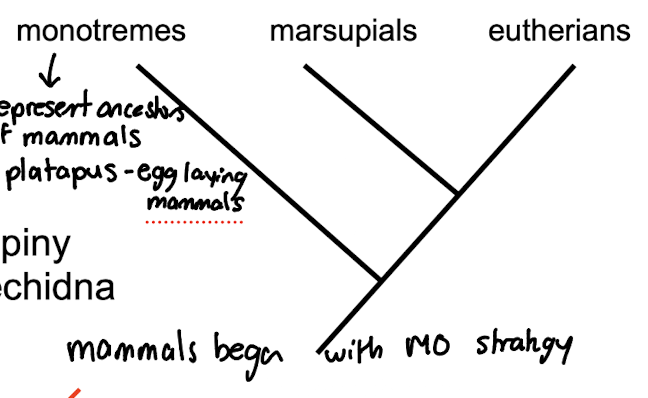
Examples of Matrotrophic Oviparity
Monotremes like platapi
some caecilian worms: develop outside the body and feed on the skin of their mother
Matrotrophic Viviparity in Non-Amniotes
trophonemata: ex. southern stingray
glandular filaments that develop from the inner uterine surface and secrete a nutritive fluid for the embryo
oophagy: ex. sand tiger shark
no direct connection to mother but mom provides nutritional support by producing extra eggs which the large embryos consume
trophotaenia: ex. goodeid teleosts
branching, ribbon-like structure that extends from the perianal region of the embryo
hindgut-derived pseudoplacenta, which contributes to absorbing maternal nutrients
oviducalphagy: ex. scolecomorphid caecilians
embryos eat the internal organs (oviduct) of the mother
yolk sac placentation: ex. sharpnose shark
Matrotrophic Viviparity in Mammals
Physiological needs of oxygen, food, waste, and calcium, are all managed by the placental connection
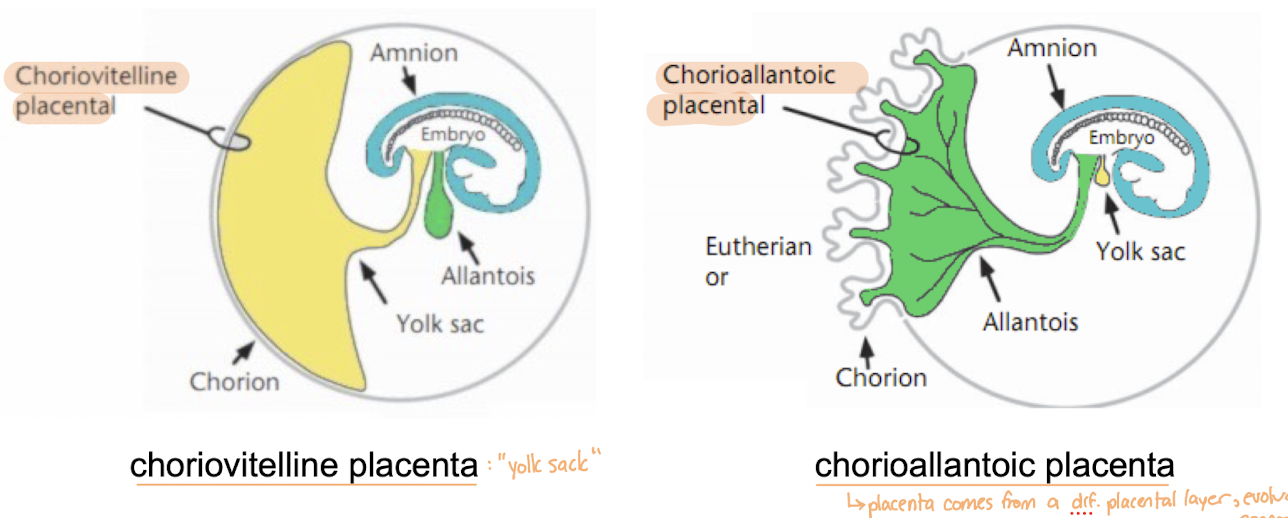
Two types of placental mammals:
Choriovitelline Placenta: yolk sack placenta
ex. marsupials (closest ancestor to eutherians)
marsupials have transient yolk sac placentation: develop for a short time via placenta, then are born and live in pouch of the mother (matrotrophic support switches to milk)
Chorioallatoic Placenta: placenta comes from a different placental layer, the allantois
ex. eutherians, the true placental mammals
How did the placenta evolve?
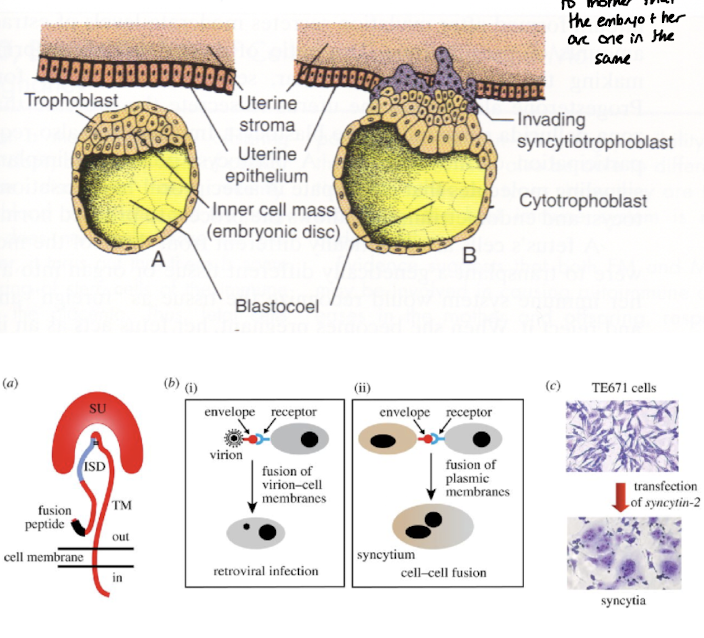
ERVs: endogenous retrovirus penetrates the cell and takes over its DNA
ERV docks to the cell and syncytins (an envelope protein) allow it to open up the cell and enter
In each case of placentation, in the germ line (egg) an ERV got into the egg and gave the genome the envelope proteins
When envelope proteins, syncytins, are expressed in both the mother and the fetus, they can form a syncytial trophoblast
embryo attaches to endometrium (uterine lining)
chorioalantoic (fetal) layer gives forth cells that then merge with maternal cells and give rise to the syncytial trophoblast
syncytial trophoblast: merging of cells between embryo and endometrium where nuclei are contributed from the mother and the fetus
as this layer grows, it develops into the placenta
signals to the mother that the embryo and her and one and the same
Where/What is the interface between mother and fetus and what is it’s key component?
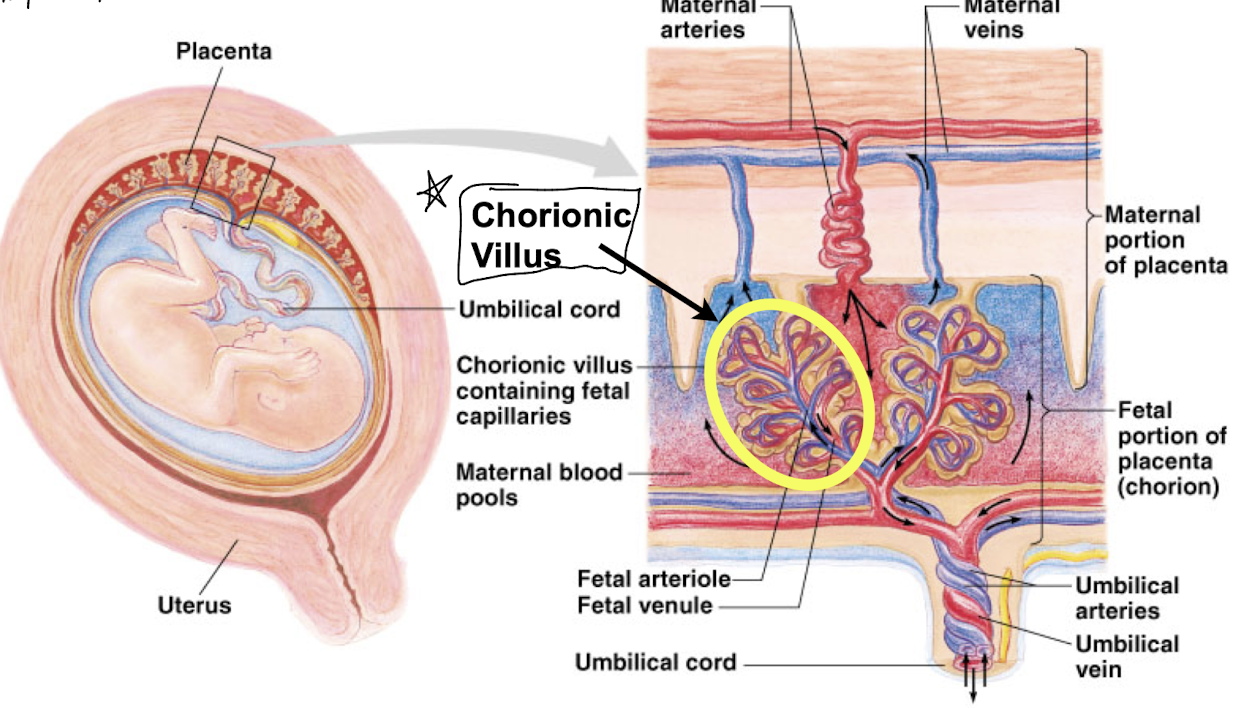
placenta is the interface between mother and fetus
key component is the chorionic villus: finger-like projections that extend from the chorion, the outermost membrane surrounding the developing fetus
covered by syncytiotrophoblast, which facilitates the exchange of nutrients, oxygen, and waste products between the mother and fetus
They contain blood vessels that carry fetal blood, allowing for the exchange of substances.
Chorionic villi enable the placenta to provide the fetus with oxygen, nutrients, and antibodies and remove waste products and carbon dioxide from the fetal blood.
Role of HPG Axis in Ovulation Occuring
Hypothalamus induced (by what we don’t know exactly) to release GnRH
The GnRH affects the pituitary to release Luteinizing Hormone and Follicle-Stimulating Hormone
LH and FSH stimulate the maturation of a few eggs in the ovary as well as follicle development
This developed egg is then released, and the developed follicle becomes the corpus luteum and produces progesterone (which drives the endometrium to thicken in preparation for embryo implantation)
The egg travels down the fallopian tube (+ may get fertilized)
If fertilized, the embryo will dock on the endometrium, and development begins
Role of HPG Axis on Ovulation when Low-Dose Estradiol is taken
the additional hormone taken in sets off the negative feedback loop of the HPG axis
little to no FSH and LH will be released, and thus no ovulation will occur
this is the basis of oral contraceptives
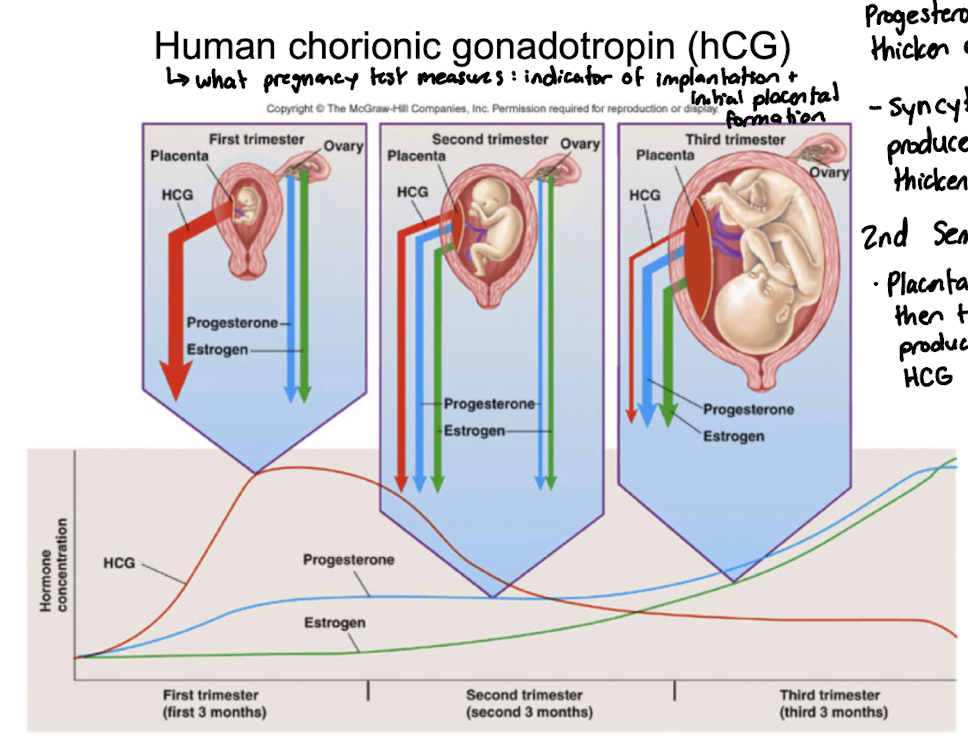
Role of hCG in Development
human chorionic gonadotropin is produced by the syncytial trophoblasts after implantation and serves to thicken the endometrium
most important during the first trimester, where progesterone is only being produced by ovaries
in the 2nd trimester: the placenta, the old syncytial trophoblast, then takes over the production of hCG, progesterone, and estrogen
OTC pregnancy tests sample the amount of hCG, indicate implantation and initial placental formation
If no implantation, menstruation occurs and the endometrium sloughs off
Evolution Tradeoffs
Definition: the process through which a trait increases in fitness at the expense of decreased fitness in another trait
Causes:
Resource limitations (energy, habitat/space, time)
Physical constraints
Results: Simultaneous optimization of two traits cannot be achieved
Results of a Tradeoff: Length of Human Gestation: Basics
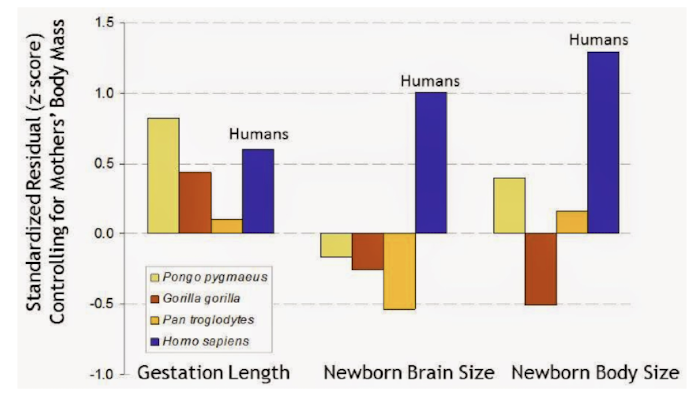
human gestation length is shorter than expected for our mass when compared to primates
Why?
Length of Gestation Tradeoff: Obstetric Dilemma
Basis:
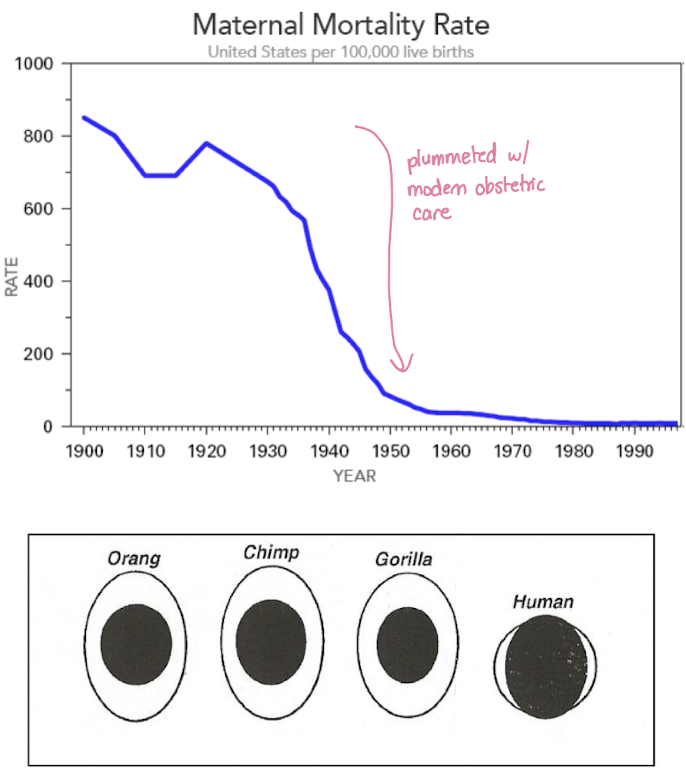
Childbirth is difficult and risky
Humans born with brains 30% adults brain size
Phenotype 1: Large Fetus:
Neoteny: evolutionary process where juvenile traits are retained into adulthood (how we have and keep large brains)
Being large at birth is generally advantageous
Humans are very large at birth, especially that we have a really large brain
Phenotype 2: Hip Width and Locomotion
humans are bipedal, not brachiators
the wider we make the hips, the more de-stabilized walking becomes (negatively impacts the pendulum movement)
Larger brained babies require wider maternal hips but hips can only be so wide for us to still be able to walk properly
baby must come out before its too big to fit through the birth canal
Human bipedalism constrains brain size, limiting gestation time
Length of Gestation Tradeoff: EGG Theory
Energetic and metabolic constraint on fetal Growth and Gestation
Phenotype 1: Large Fetus:
Neoteny: evolutionary process where juvenile traits are retained into adulthood (how we have and keep large brains)
Being large at birth is generally advantageous
Humans are very large at birth, especially that we have a really large brain
Phenotype 2: Maternal Metabolic Scope
metabolic scope definition: baseline metabolism compared to the highest metabolism we can reach
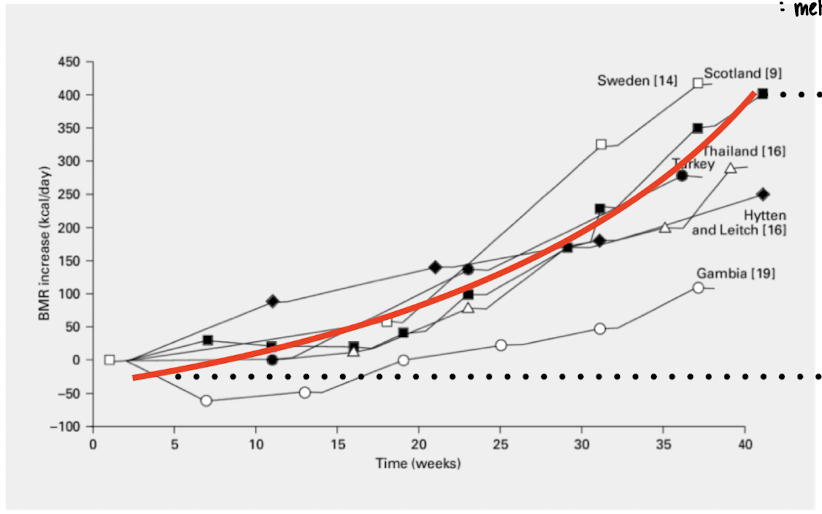
during gestation, a woman’s metabolic scope increases, but it isn’t infinite
if gestation got any longer, the fetus’ metabolic needs exceed the mother’s metabolic range
more accepted theory: also is supported by our data from multiples (twins, triplets, etc)
multiple fetuses require more energy, which. is why we see gestational time shorten
if obstetric theory was correct, 2 fetuses would not impact gestation length
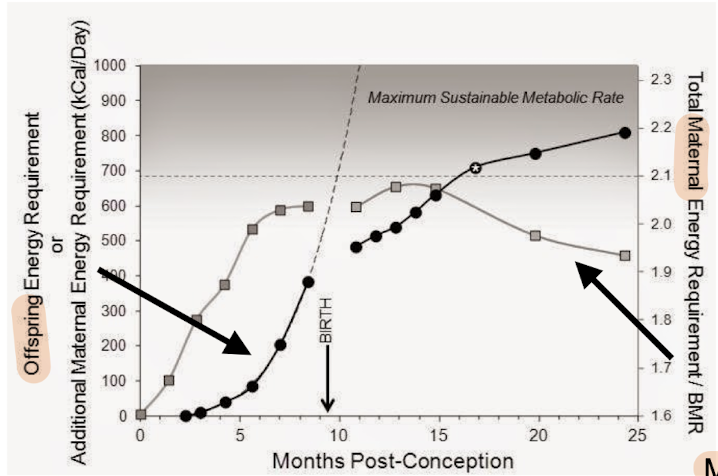
Summary of Obstetric Dilemma and EGG Hypothesis
Obstetric: Out before the hips are too small for an enormous brain to be birthed
EGG: Out before the hungry brain kills the mother
more accepted theory
Divisions of the Brain: Noting Developmental and Functional Term Differences
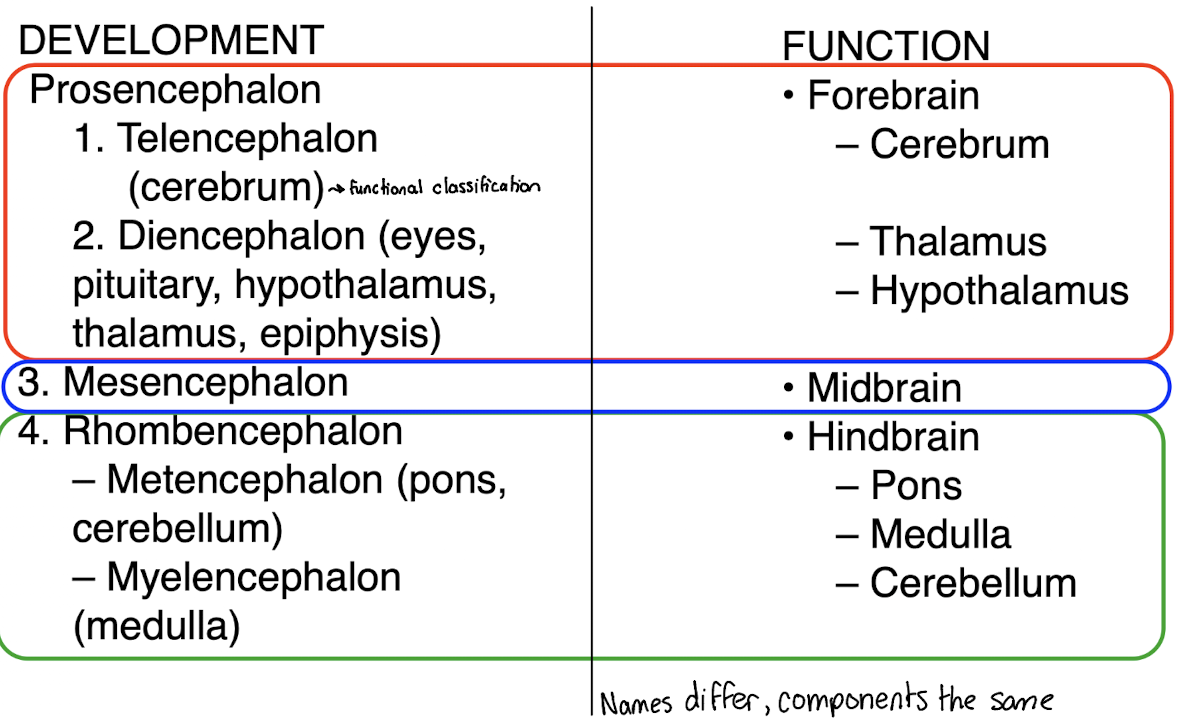
Evolutionary Patterns of Brain Region Size in Mammals
Hindbrain: relatively smaller
Midbrain: relatively smaller
Forebrain: relatively larger
ESPECIALLY the cerebrum aka telencephalon
telencephalon expansion is also seen in birds

Brain Changes Across Phylogenies
Starting with vertebrates
Cephalic expansion (new head)
Four-partite brain
LGE and MGE
Basal ganglia and dopamine system
Medium spiny neurons
Migration of GABAergic interneurons (telencephalon)
Three-layered pallium
amgdala (pallial + subpallial)
habenula
reticulospinal
Starting with jawed vertebrates
Cerebellum
myelinating glia
the neuroglia oligodendricytes and astrocytes
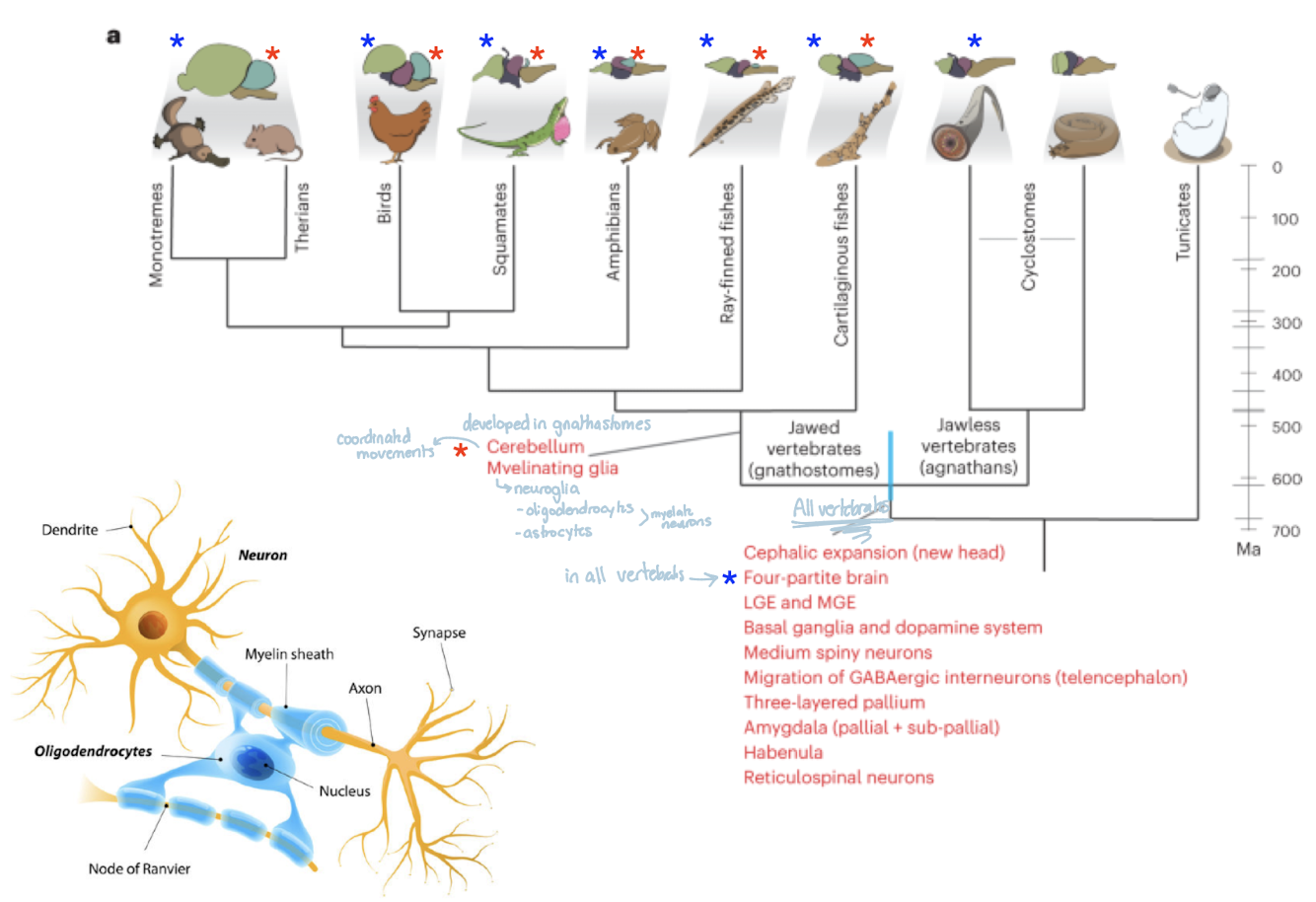
Cerebellum (“little brain”)
developed first in gnathastomes
as many neurons as rest of brain
monitors sensory input from body and coordinates with outgoing motor commands from cerebrum
gross motor function
posture/balance
muscle tone
coordination
damage leads to loss of control on contralateral side
limbic system
functional compartment of the brain
cortical/subcortical structures around brainstem; generation/regulating emotions/learning
key regions
hypothalamus
hyppocampus
amygdala
cingulate gryus
septal area
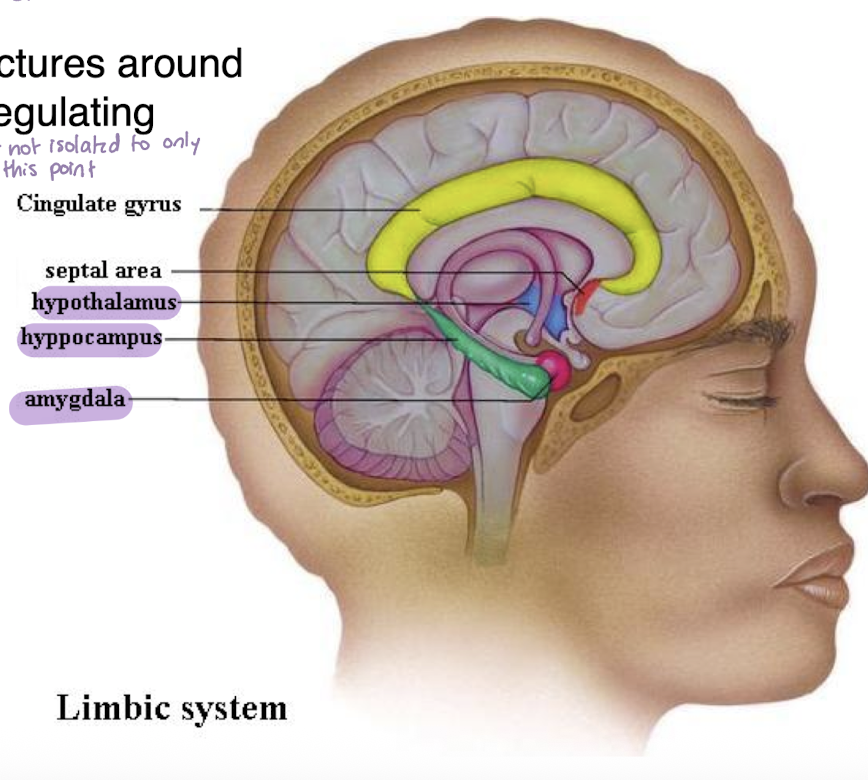
What links the two hemispheres of the brain?
corpus callosum: a thick bundle of myelinated fibers
damages to one side of the brain can be recovered by the other side of the brain through the corpus callosum’s connection
Phineas Gage
used as an example of damage to the left frontal lobe (site of the limbic system and damage to this allegedly led to his emotional dysregulation)
today this idea of localization of function has been disproved, and instead accounts of Gage’s good personality after the accident demonstrate the concept of brain plasticity
How does brain mass scale with body mass across different species?
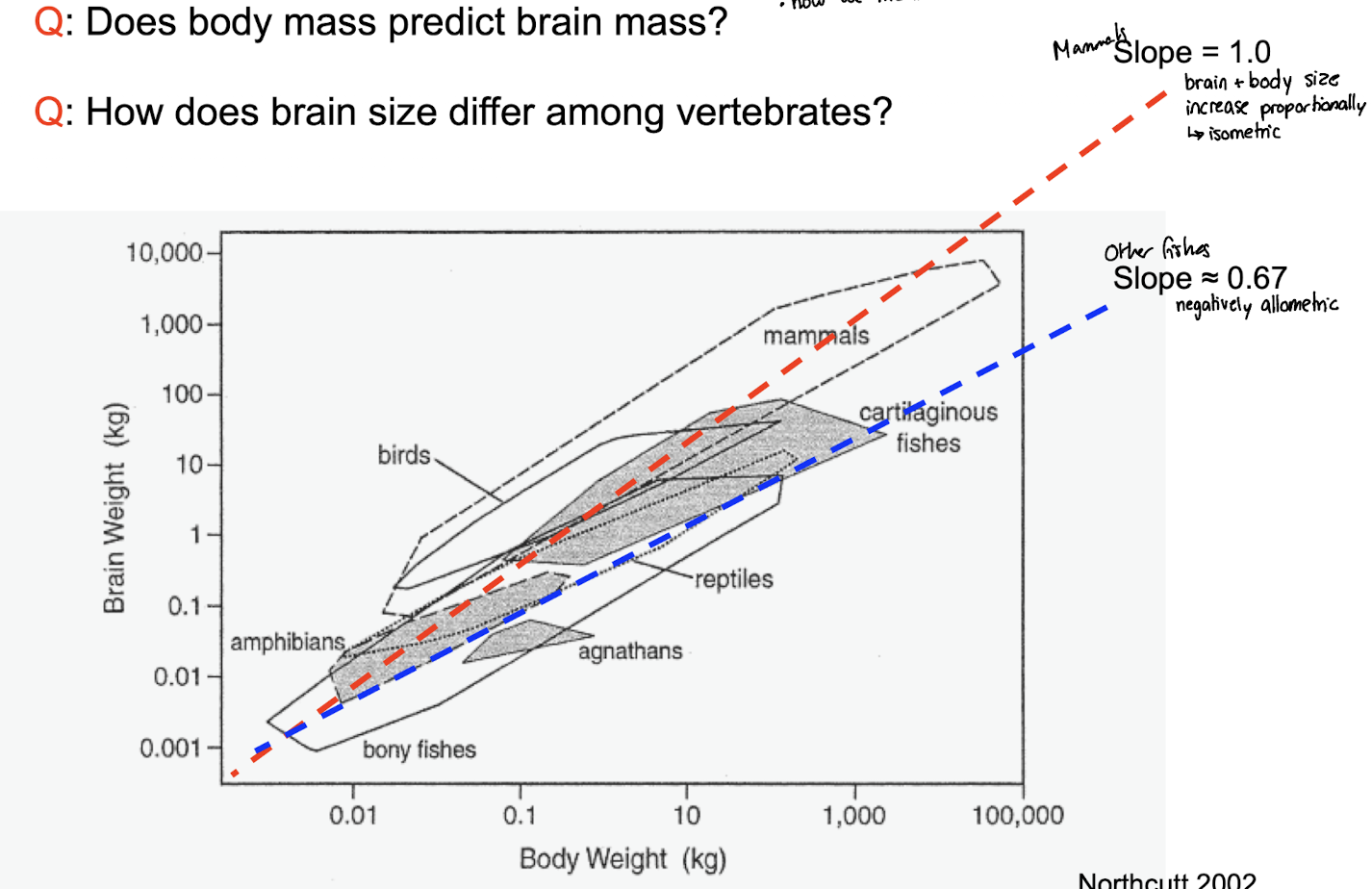
Mammals: brain and body size increase proportionally (slope of 1) and have an isometric relationship
Other fishes: body weight v brain weight is negatively allometric (slope 0.67), as body weight increases, brain weight does not increase by the same amount
Encephalization Quotient (EQ)
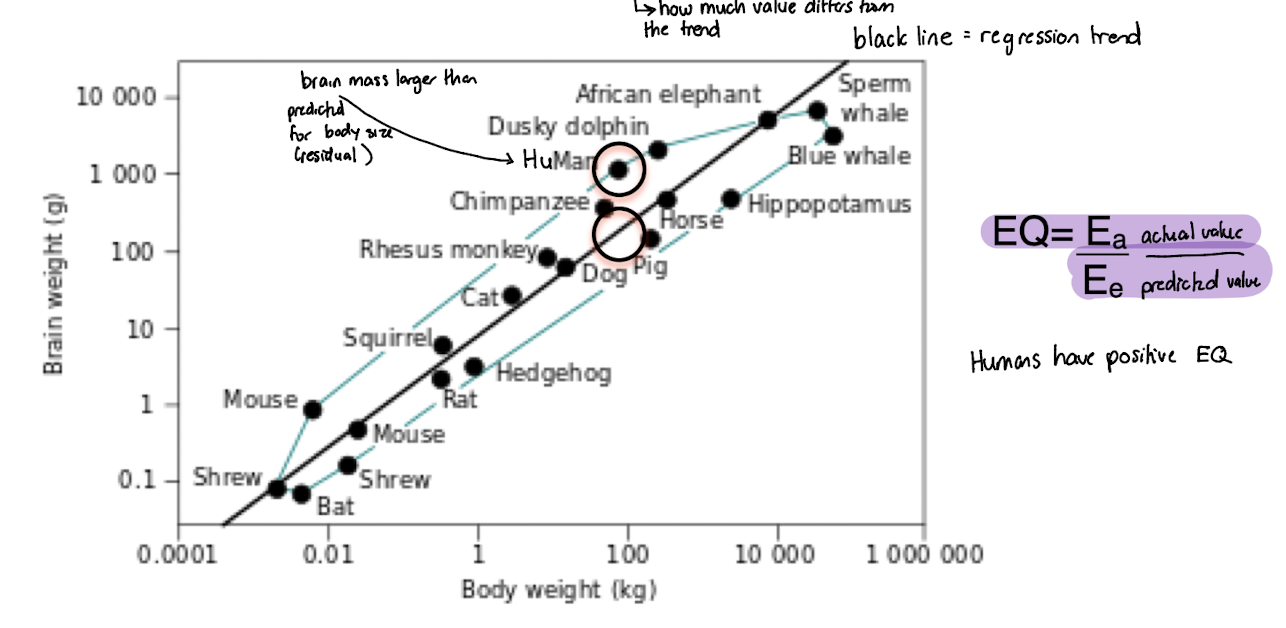
Accounts for brain mass in determination of brain size; removes the effect of body size on comparing brain sizes between species
calculated based on normalized residual (how much value differs from the trend) of general trend
EQ= Ea(actual value)/ Ee (predicted value)
Humans have a positive EQ
Alternative Ways to Estimate Brain Size and Complex Cognition
Estimate the size of a brain subunit: the neocortex of mammals (not used much today)
Rhinal fissure placement: serving as a landmark, particularly in comparative neuroanatomy and paleontology. It marks a crucial boundary between the ancient olfactory cortex (paleocortex) and the newer neocortex (neocortex). By using the rhinal fissure and other sulci, researchers can estimate the relative sizes of different brain regions, such as the neocortex and olfactory lobe, in both living and fossil specimens to understand brain evolution and size.
Cerebral sulcation: how many crevices (sulci) there are. More sulci, more brain volume and better cognition
Are birds really “bird-brained?”
birds have smaller brains compared to mammals and less sulci
BUT
very densely packed neurons
expanded telencephalon
pigeons
telencephalic fraction (proportion of brain covered by telencephalon) of 0.552
loose social interactions (covey), so lower cognitive ability
BUT even with telecephalic fraction of 0.5 can be trained to decipher art
corvids (crows, ravens, jackdaws, jays)
some of the smartest birds
can handle complex cognitive tasks such as droping walnuts in road to be opened by cars
non-mammals with brain expansion also have high level cognition
General v. Special Senses
General sensation: enters the CNS via the sensory component of the general cranial nerves (afferent and efferent fibers): V, VII, IX, X as well as spinal nerves from the rest of the body
Chemical: taste
Electromagnetic: thermo-reception
Mechanical: touch
Special sensation: enters the CNS via special sensory nerves, CN I, II, and VIII. They lack motor components and are located only in the head (afferent, to CNS, NOT efferent)
Chemical: smell, CN I
Electromagnetic: vision, CN II
Mechanical: hearing and balance, CN VIII

Brain Areas for Special Senses
The same basic brain areas that:
are stimulated by a particular type of environmental energy
transduced in a specialized sense organ
reaches the brain via a “dedicated” special sensory cranial nerve
Can be recognized in ALL vertebrate brains
Smell, CN I: Forebrain
Vision, CN II: Midbrain
Hearing and Balance, CN VIII: Hindbrain
Note: for mammals, our enlarged cortex can often intercept these APs going to their intended location
How can you identify the dominant sensory modality of non-mammals?
Perform a size comparison of the special sense referral areas
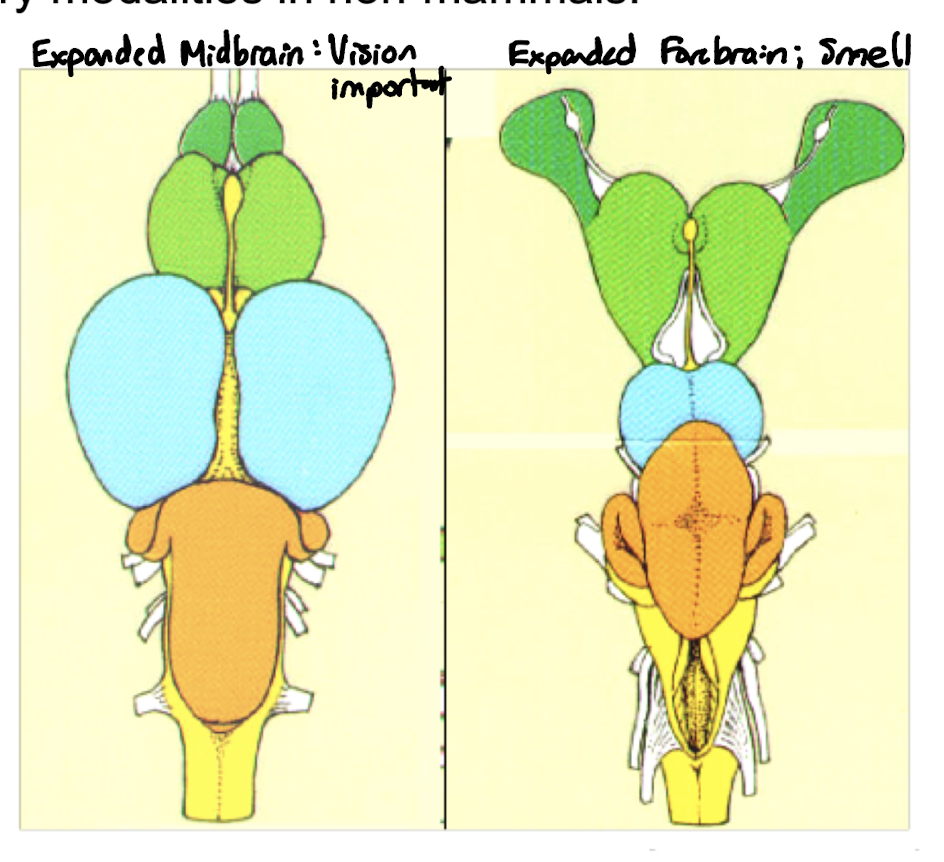
Expanded Forebrain: Smell important
Expanded Midbrain: Vision important
Expanded Hindbrain: Hearing and Balance important
Note: In mammals, secondary integration in our enlarged cerebrum obscures this pattern
Principle of Labeled Lines for Special Sensation
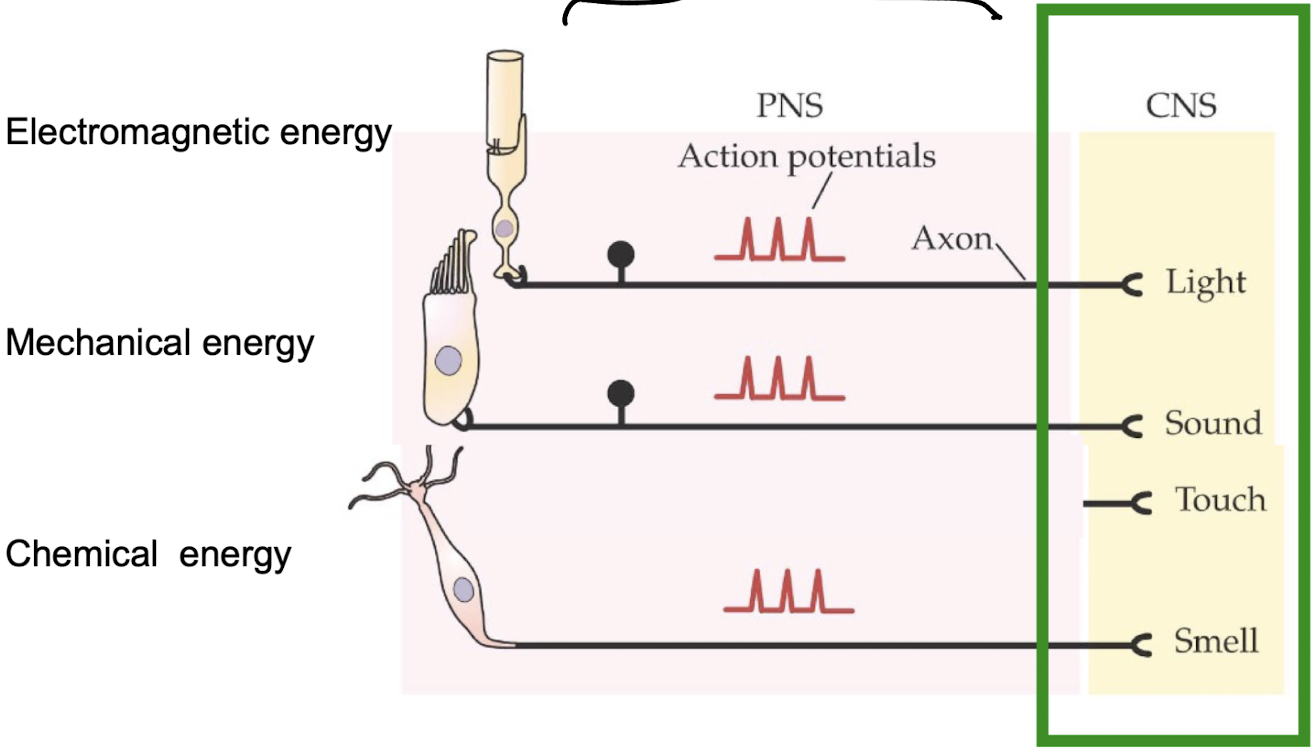
each sense has its own pathway back to the brain
all info goes back to the brain as APs, so which pathway the AP arrives on allows the brain to interpret what sense the AP is coming from
Does an incoming sensory AP reflect the environmental modality that generated it? The APs don’t look any different, but where they go is different
Signal Cascade of Olfaction in Mammals
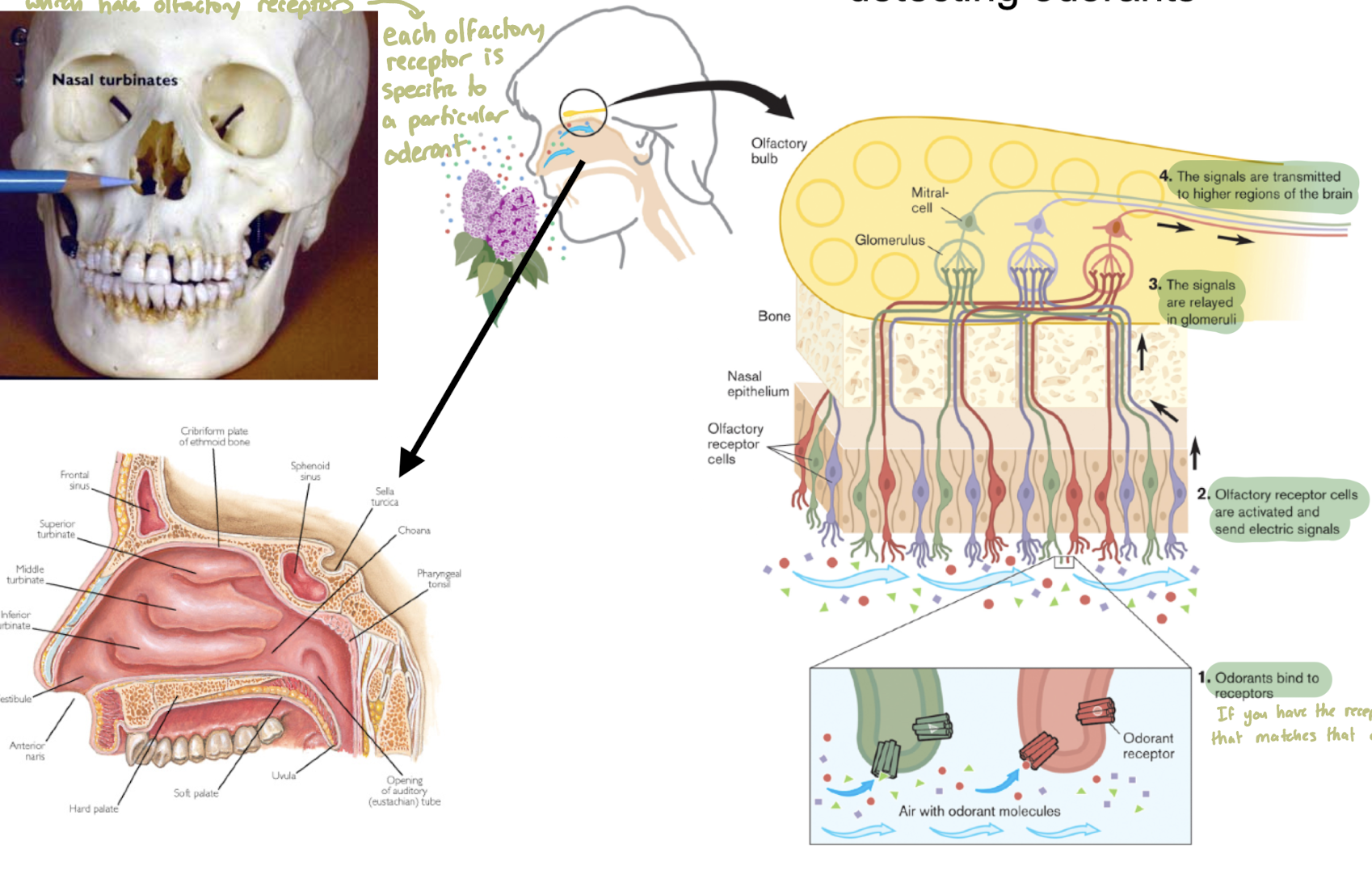
We have nasal turbinates: wafer-like bones that have olfactory epithelial layer (skin) which contains olfactory receptors
Each olfactory receptor is specific to a particular odorant
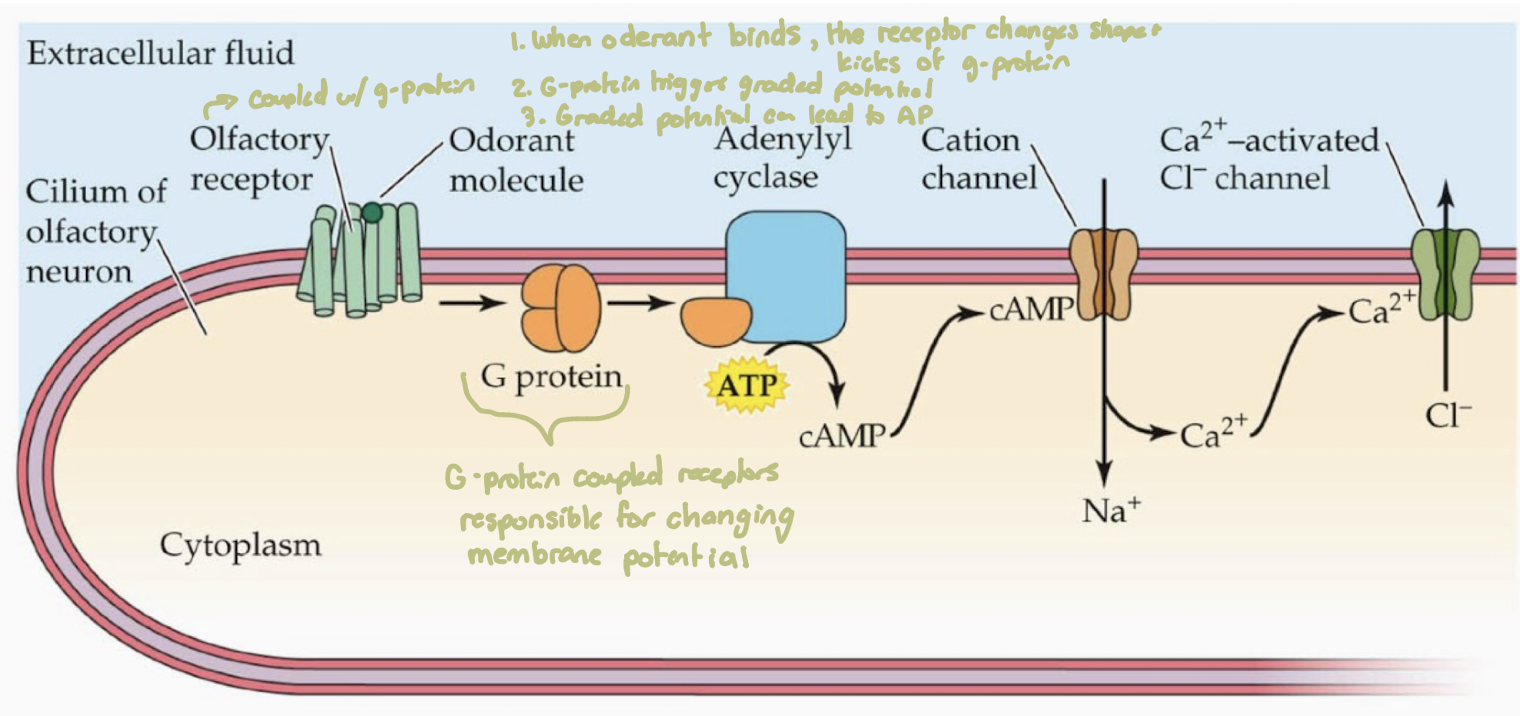
When an odorant binds to olfactory receptor, the receptor changes shape and kicks off a g-protein
G-protein triggers a graded potential, and these graded potentials can lead to APs
APs generated by olfactory neurons are integrated in glomeruli of the olfactory bulb (get here via CN I)
Each glomerulus receives input from one particular olfactory receptor cell
Olfactory info is relayed from olfactory bulb to the olfactory cortex and the hypothalamus and ultimately many other parts of the brain after integration in olfactory bulb

Uses for Olfaction
near sensing: able to detect what is near you
ex. pig sniffing for truffles, kiwi sticking nose in soil to sense insects
remote sensing: sensing things that are far away
ex. pacific salmon smell way back to natal stream and birds smell way back to same island they breed at yearly
signal territories or sexual receptivity
leave odorants and detect them for territory marking
How Well do Humans Smell?
Evidence that we might not smell well
relatively small olfactory bulbs
fewer functioning olfactory receptors (ORs)
fewer olfactory neurons (ONs)
Humans don’t rely on olfaction
Bipedal: 2 meters away from olfactory environment on the group bc we stand up
Don’t sniff deeply very often; we rely on vision and touch to interact with others more
How well do humans smell when we try?
when deprived of other senses and follow 10 m long scent trail…students able to detect and complete trail with 67% accuracy
deprived of touch (gloves), vision (blindfold), and hearing (headphones)
also able to detect direction (is smell detected in left v. right nose)
Vomeronasal: A sixth sense
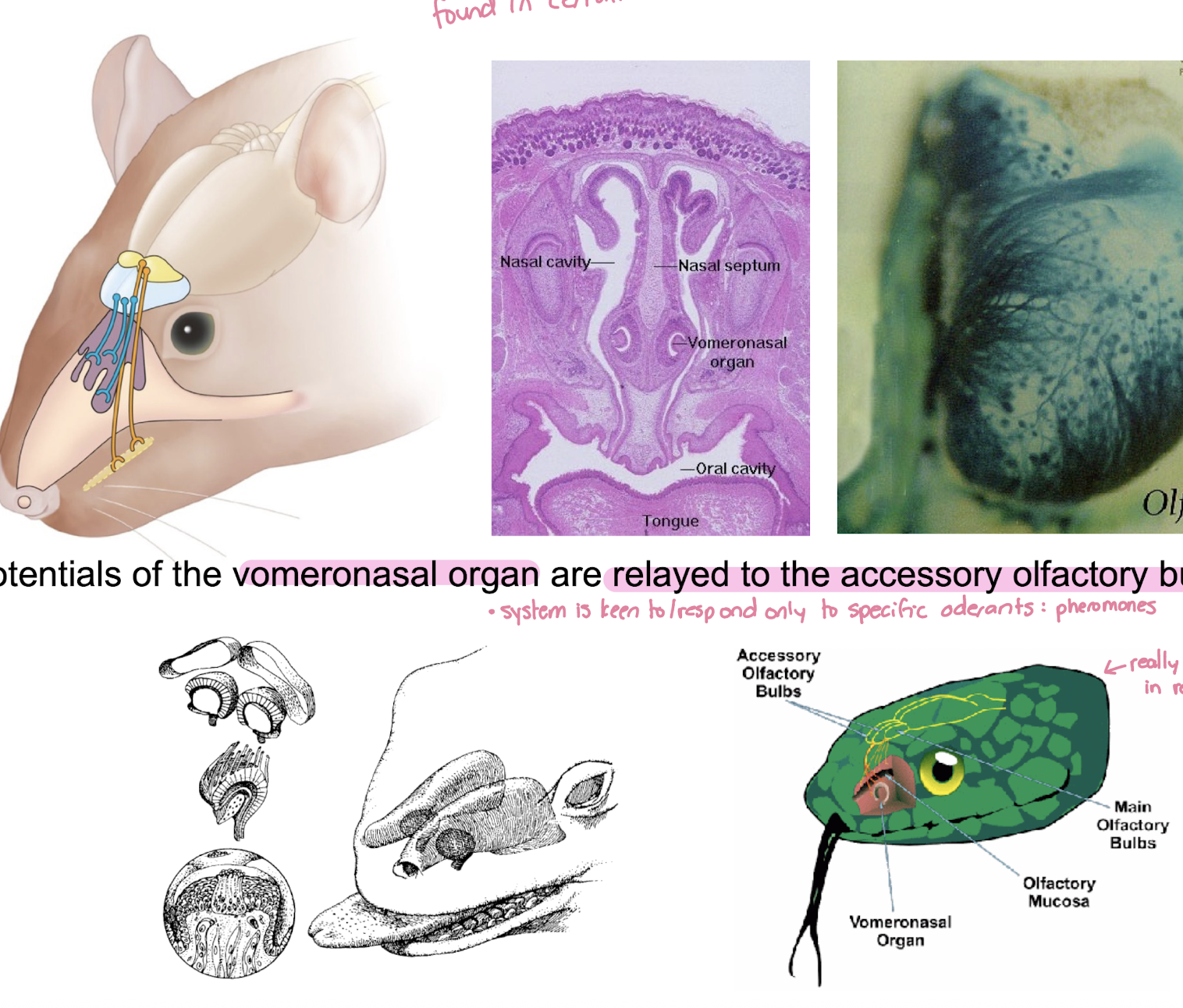
System is keen to/responds only to specific odorants called pheromones
APs of the vomeronasal organ (VNO) are relayed to the accessory olfactory bulb
found in certain mammals, like rats, and very important to reptiles
Flehmen response: curling of the lips in response to pheromones (typically related to reproductive behavior)
VNO in humans?
thought for a while that humans must have lost VNO
Nowadays modern imaging shows most people have VNO but it is very small
we do use pheromones to communicate in some sense
potentially seen in McClinktock effect where women’s menstrual cycles align in close quarters due to detection of pheromones by VNO
How does the retina generate receptor potentials? 1878 experiments by Wilhelm Kuhne
Rods and Cones in the retina use pigments to transduce electromagnetic radiation into APs
Kuhne’s experiment
Kuhne ground up rabbit retinas and made a solution with it
started in dark, then opened window: solution changed color where light was most intense: retinas use pigments
Role of Rhodopsin in Vision
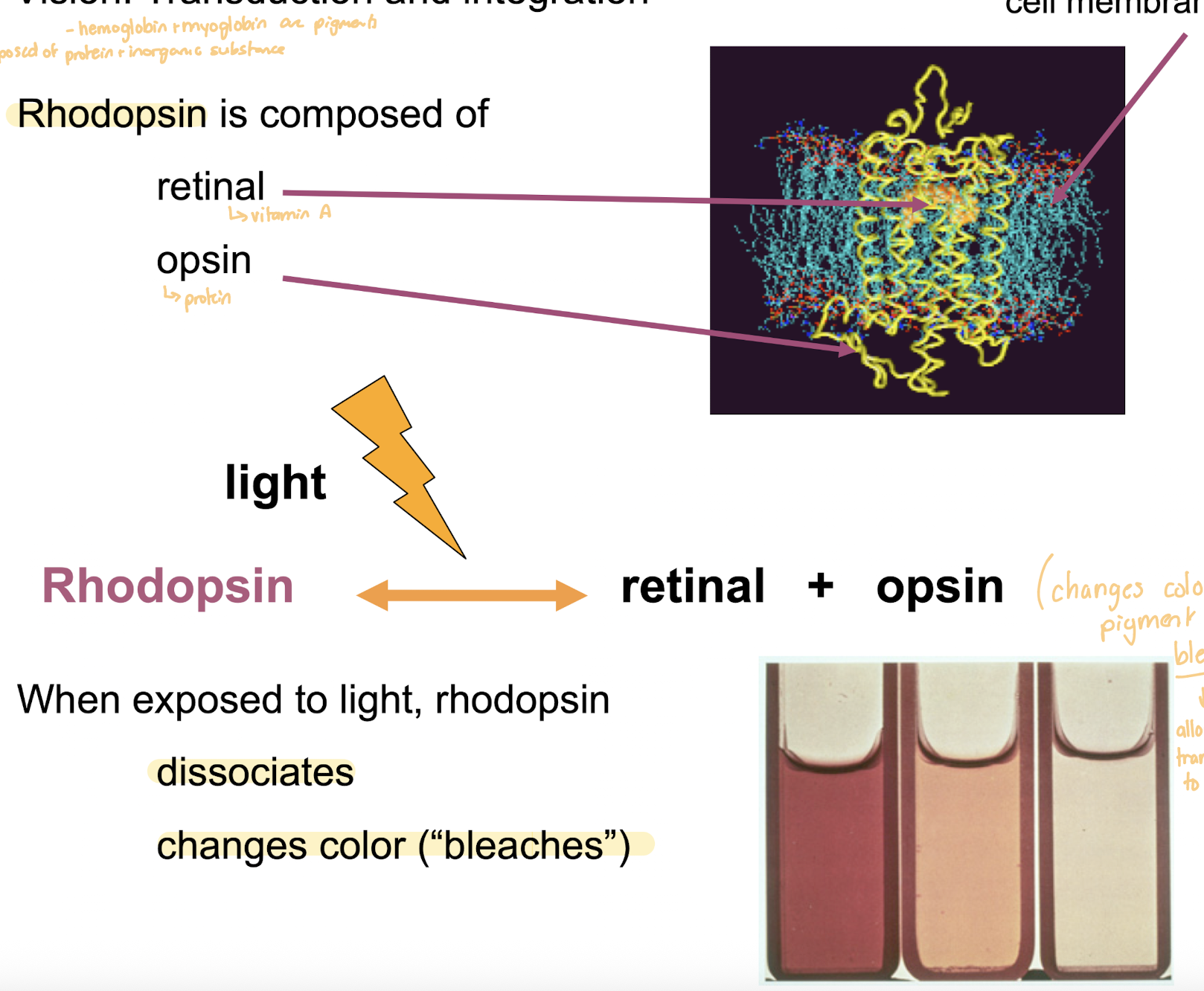
Rhodopsin (a pigment) composed of
Retinal (Vitamin A)
Opsin (protein)
When exposed to light, rhodopsin dissociates into retinal + opsin and changes color (“bleaches”)
This color change allows transduction to occur
Two Vision Pathways: What Happens in the Dark v. What Happens in the Light
In the Dark: “Off Pathway”
Na+ channels are open (cGMP is bound)
Na+ entry and K+ exit is countered by Na+/K+ pump
constant glutamate release
up-regulates and excites dark pathway
In the Light: “On Pathway”
cGMP is enzymatically degraded
Na+ channels close, and receptor cells hyperpolarize
reduction of glutamate release
glutamate leaking stops: and since glutamate is inhibitory for the on pathway (down-regulates it), the on pathway can now act
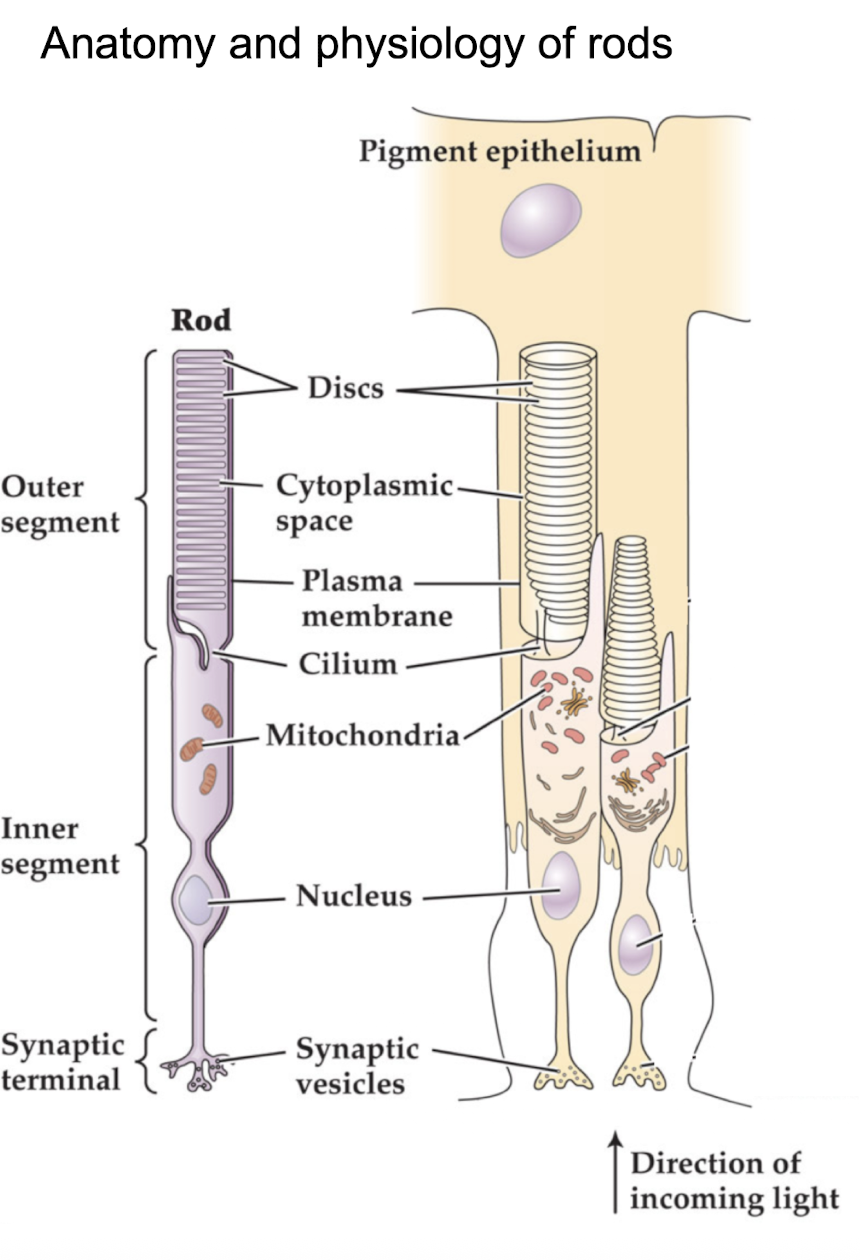
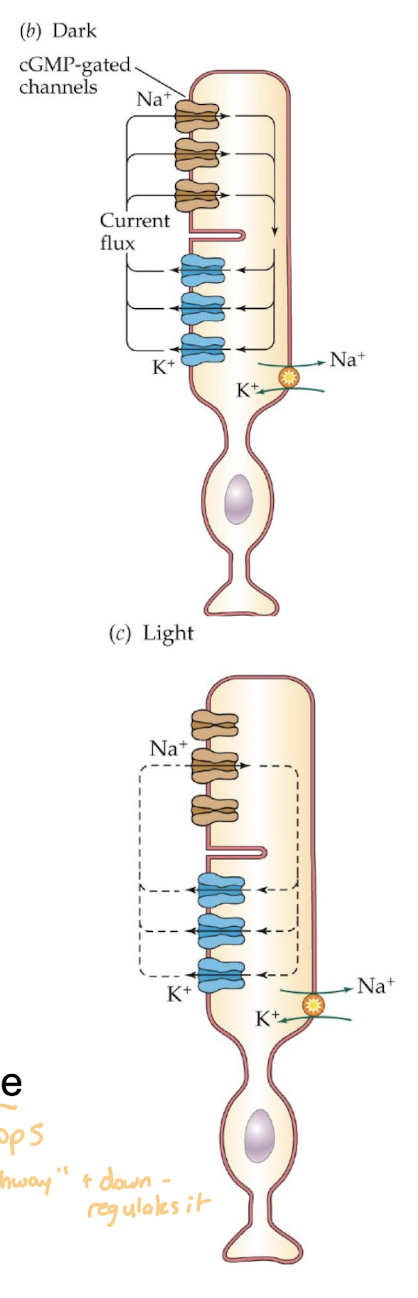
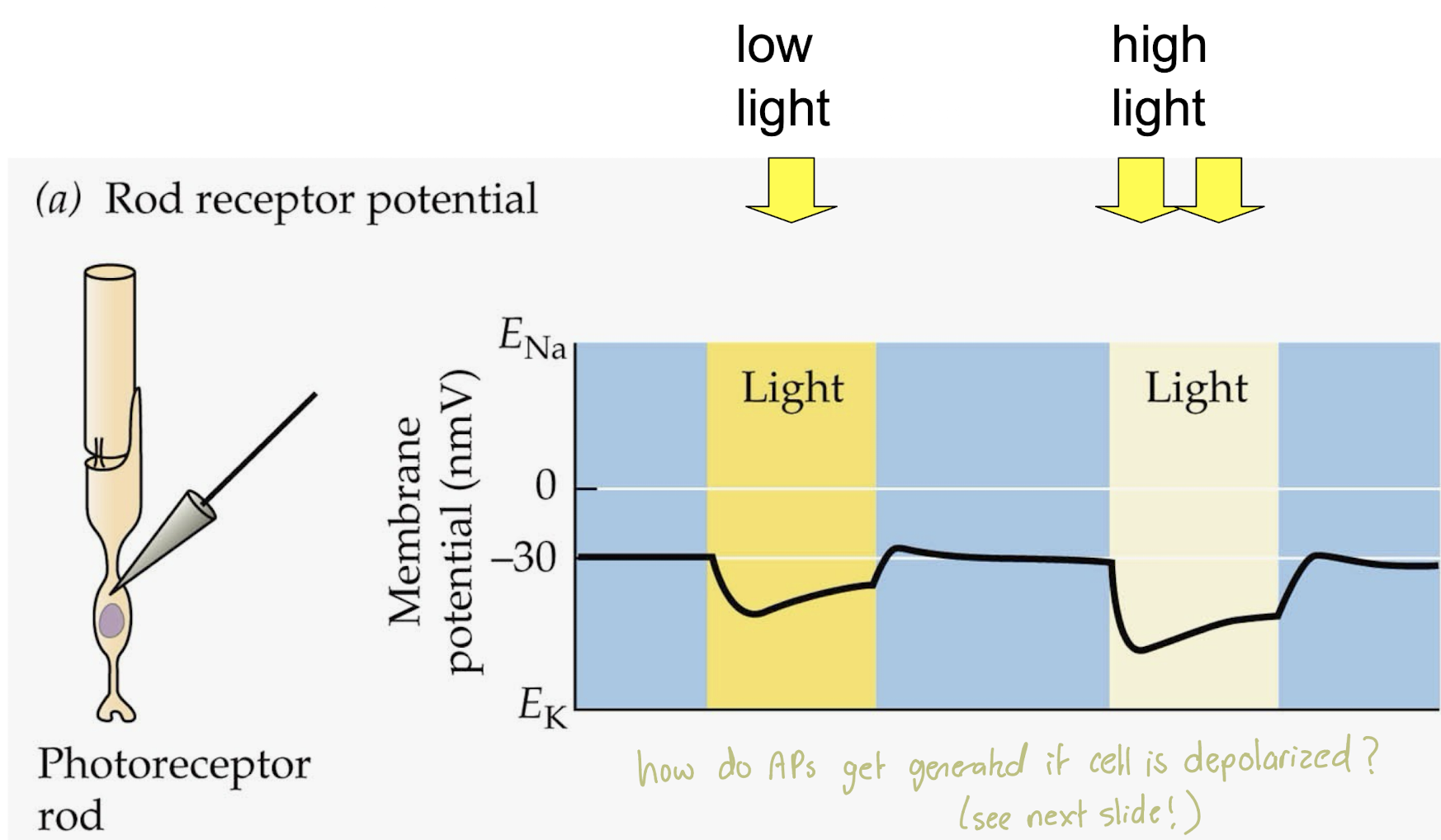
Vision: Graded Hyperpolarization to Light
hyperpolarization response to light is graded
light causes hyperpolarization which shuts down glutamate release
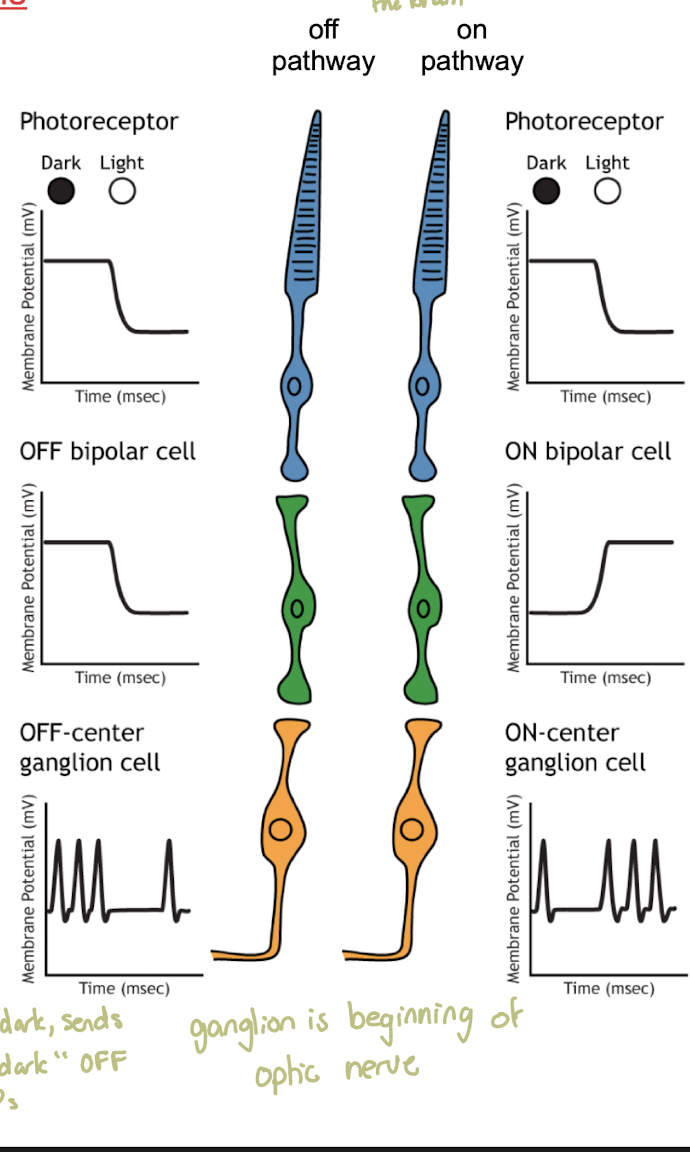
Vision: Scheme of Visual Integration for Dark and Light Pathways
Receptor potential generated in receptor cells (rods and cones)
no APs, only graded potentials
In the Dark: Glutamate leaks into synapses
hyperpolarization of ON BPC (bipolar cell)
depolarization of OFF BPC
depolarization of OFF ganglion cell (beginning of optic nerve)
In the Light: Glutamate reduced in synapses
depolarization of ON BPC
hyperpolarization of OFF BPC
depolarization of ON ganglion cell (beginning of optic nerve)
Note: each pathway has a dedicated line back to the brain
Integrative Cell Layers in the Retina, Eye Structure, and Blind Spot
Surface: Rods (low light) and Cones (high light)
Horizontal cell
Bipolar Cell BPC arranged under rods and cones
Amacrine cell: helps integrate info to ganglia
Ganglion cell → Axons of ganglion cell exit as optic nerve, creating a blind spot
For each ganglion, there are hundreds of photoreceptors it gathers info from

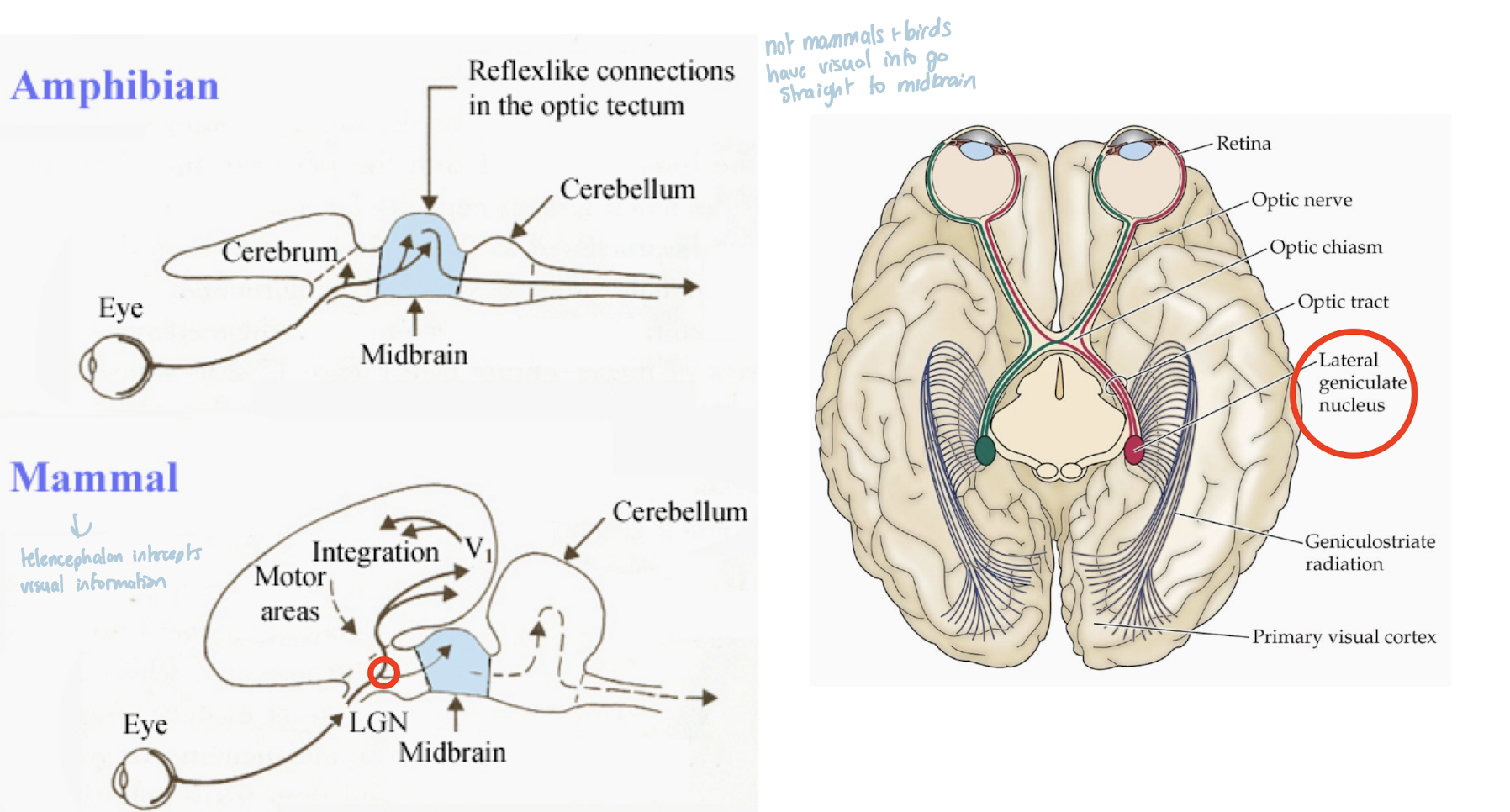
Pathways of Visual Information from the Eye
optic nerve carries light and dark signals to the brain
non-mammals and non-birds have visual info go straight to the midbrain
mammals (and birds) have the telencephalon intercept visual information
Vision: Accommodation
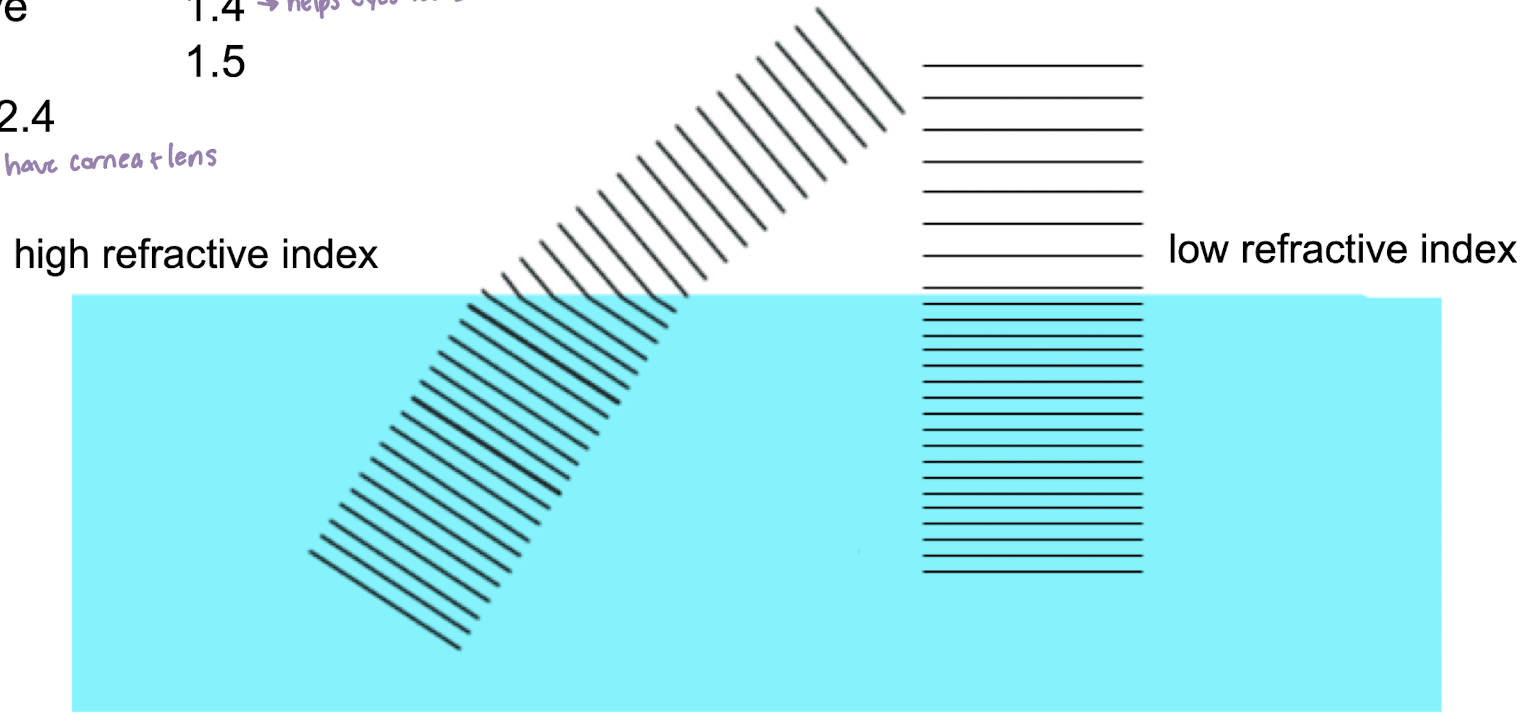
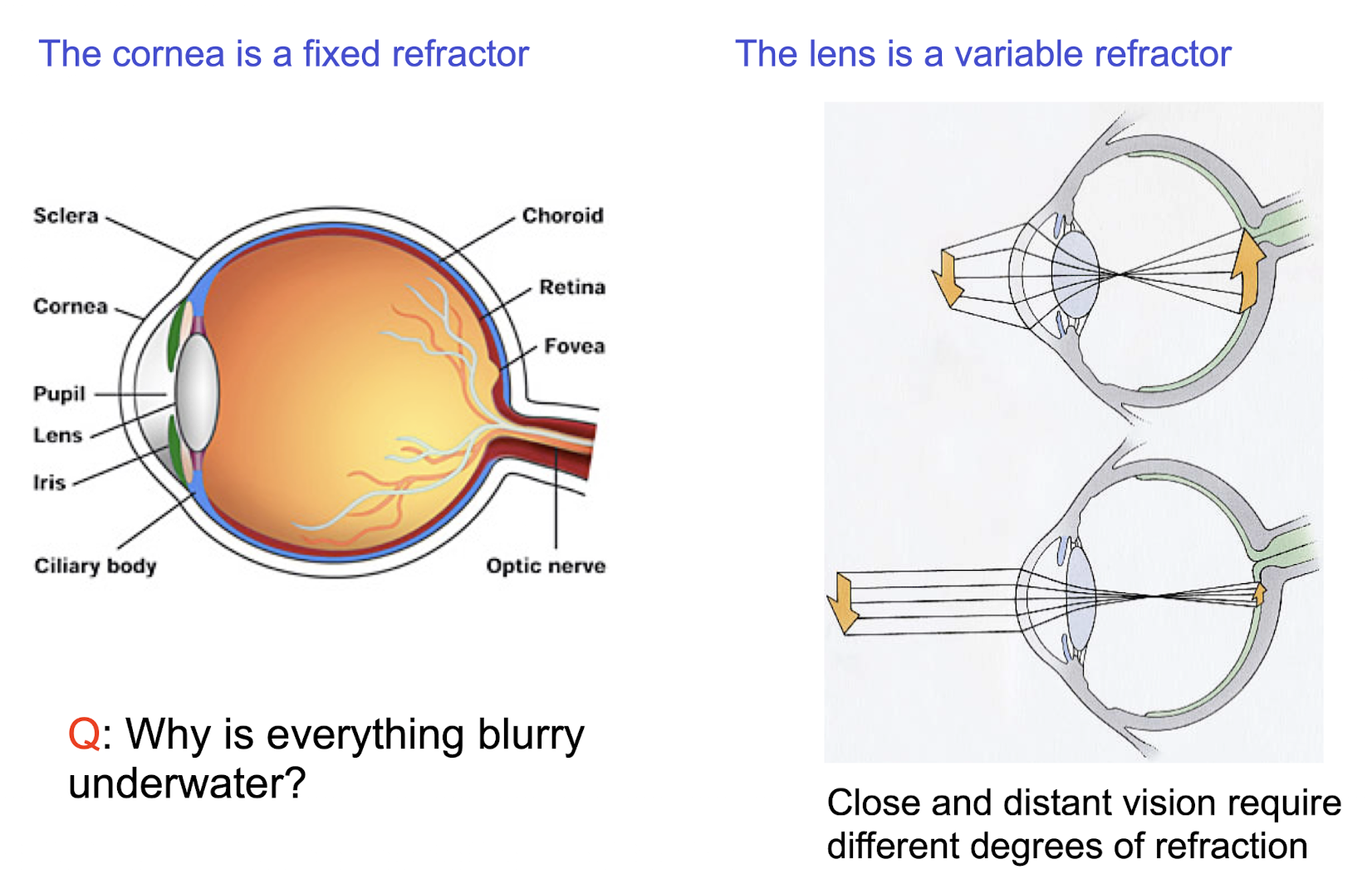
Accommodation (focusing light on the retina) requires:
materials of different refractive index (changes the path of light → concentrates protons on retina)
oblique orientation of light and refractor
Refractice Indices
air 1.0
water 1.3
cornea 1.3
lens of eye 1.4
glass 1.5
diamond 2.4
Terrestrial vertebrates have two refractors: one fixed (cornea) and one variable (lens)
Aquatic vertebrates only have one refractor, a variable lens
bc water and cornea have same refractive index so it is ineffective underwater
Vision: Tuning
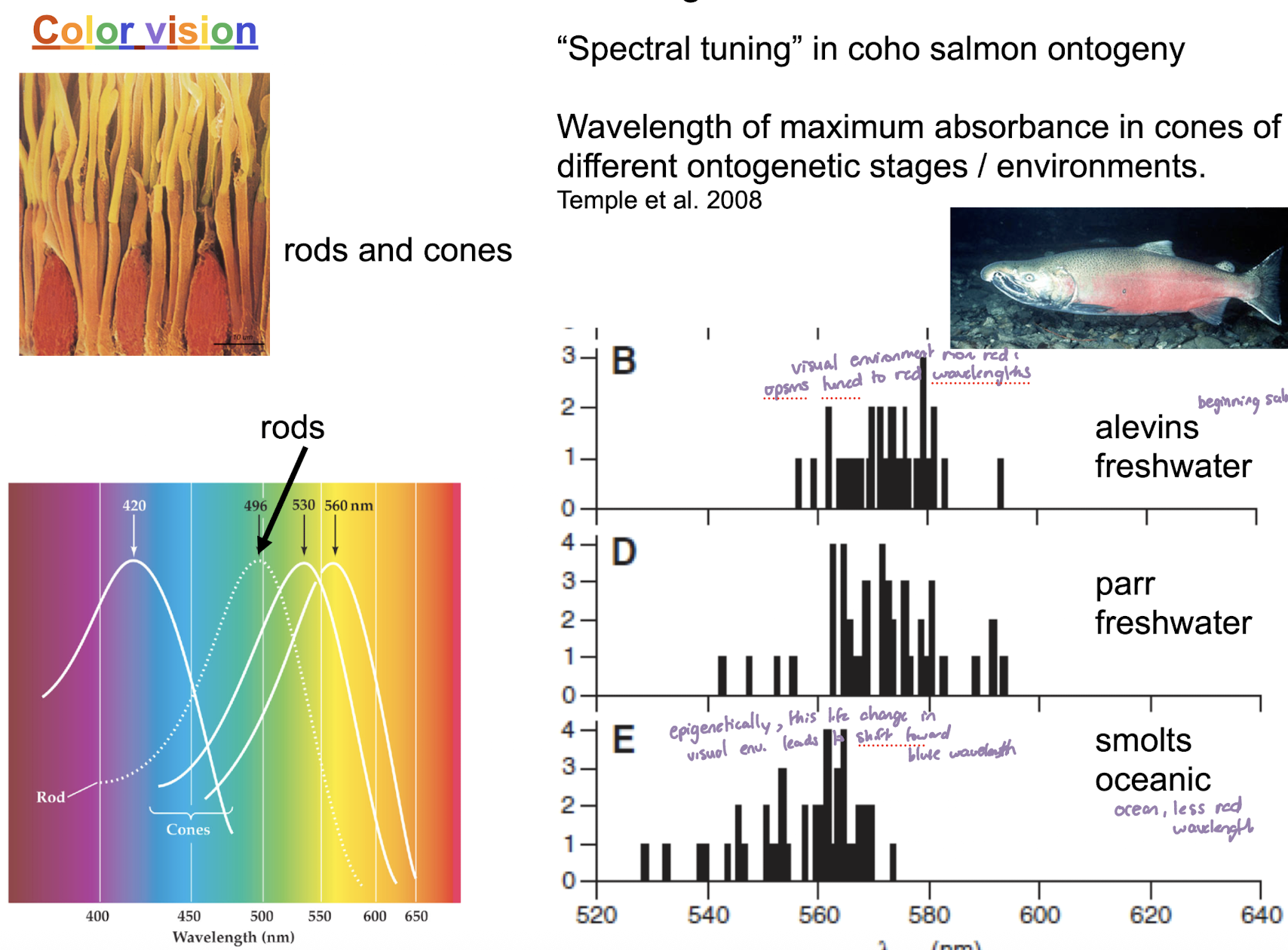
spectral tuning: process of modifying the wavelengths of light that a system absorbs or emits to meet a specific need
spectral tuning in coho salmon ontogeny: wavelength of max absorbance in cones of different ontogenetic stages/environments
alevins freshwater: opsins shift to tune to red wavelengths
smolts oceanic: life change of visual environment leads to shft toward blue wavelength bc ocean has less red wavelength
NOTES
close to surface of the water there is full range of light visible
humans have red, green, and blue cones
Special Mechanical Sense CN VIII: Transduction Mechanism
External structure (hair cells) deflected/deformed
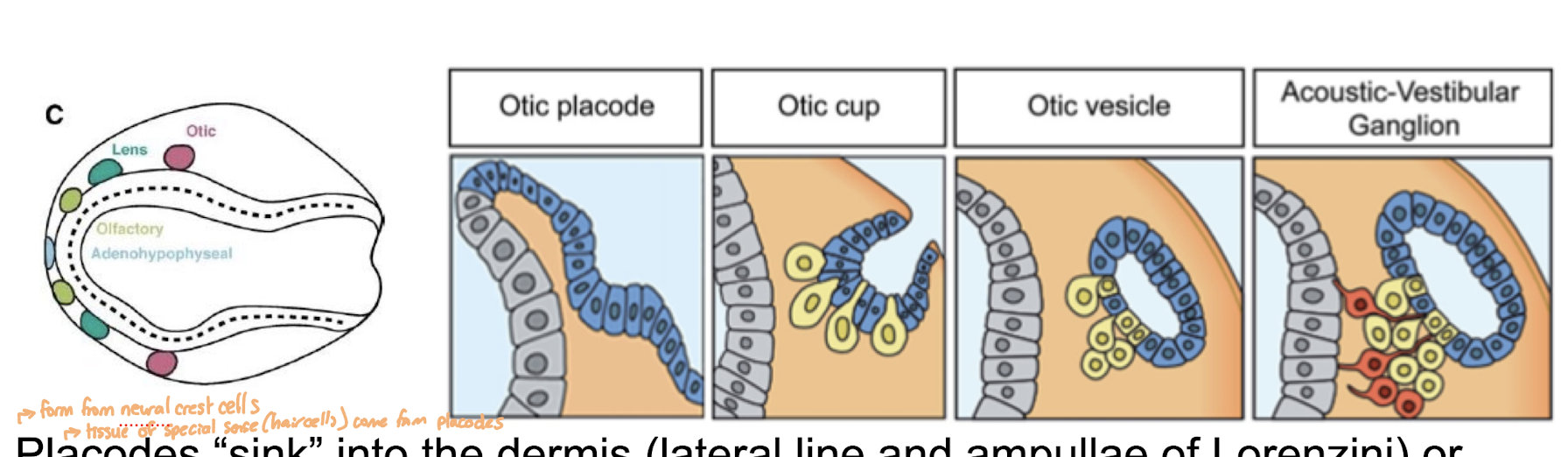
hair cell tissue comes from placodes
Deformation opens K+ cation channels
Changes membrane potential
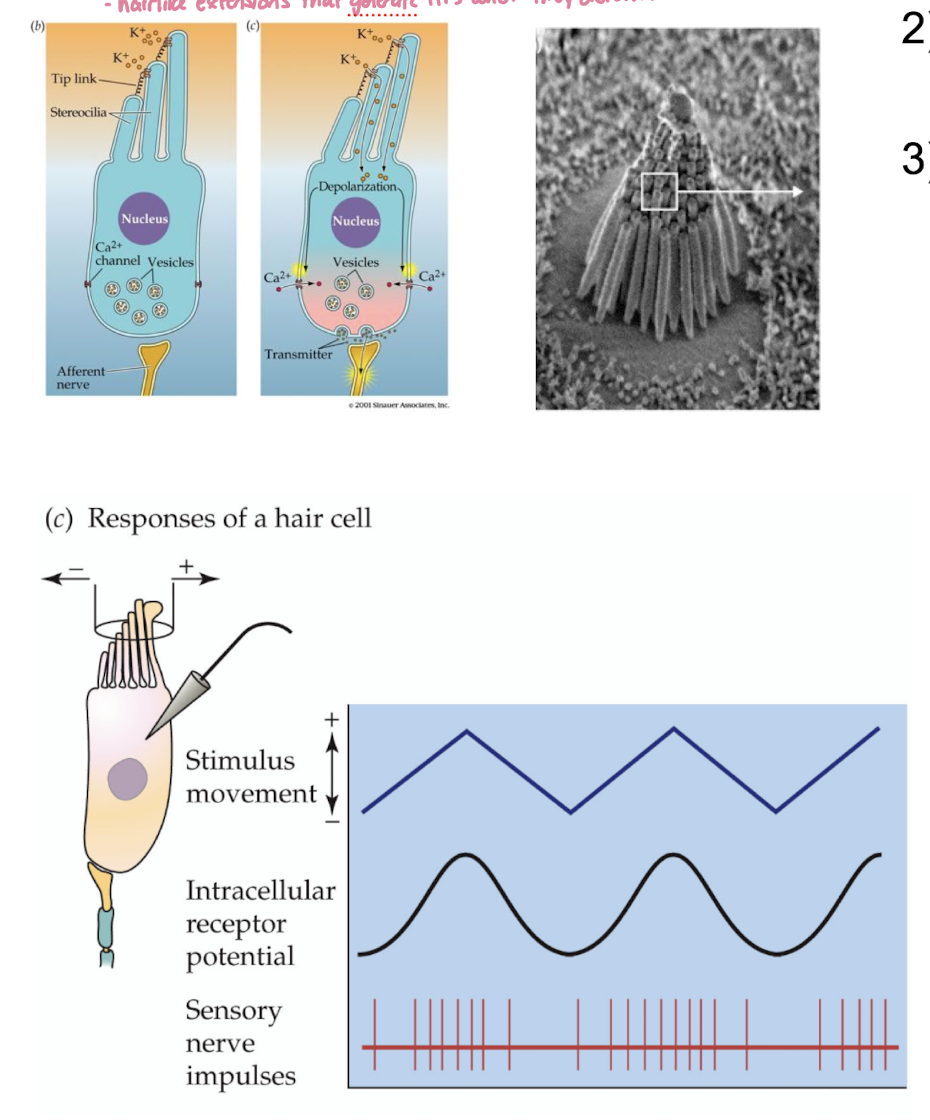
Special Mechanical Sense CN VIII: Where are the Hair Cell Placodes Found in Diffferent Species?
Placodes (form from neural crest cells and result in hair cells) “sink” into the dermis (lateral line and ampullae of Lorenzini) or dermal bone (inner ear) during development
Lateral Line: mechanical sense
ability to detect mechanical disturbances in the water
sense aquatic environment and determine velocity in water
Ampullae of Lorenzini: electroreception
sense change in electromagnetic field in water
Vestibular and Acoustic System of the Inner Ear: mechanical sense
Special Mechanical Sense CN VIII: Hair Cells of the Lateral Line System
located superficially in frogs
located linear canals beneath the scales of many “fishes”
hair cells contained in pores right under the skin which are open to the aquatic environment
able to detect mechanical disturbances in the water
blinded fish can still school if their lateral line system is intact
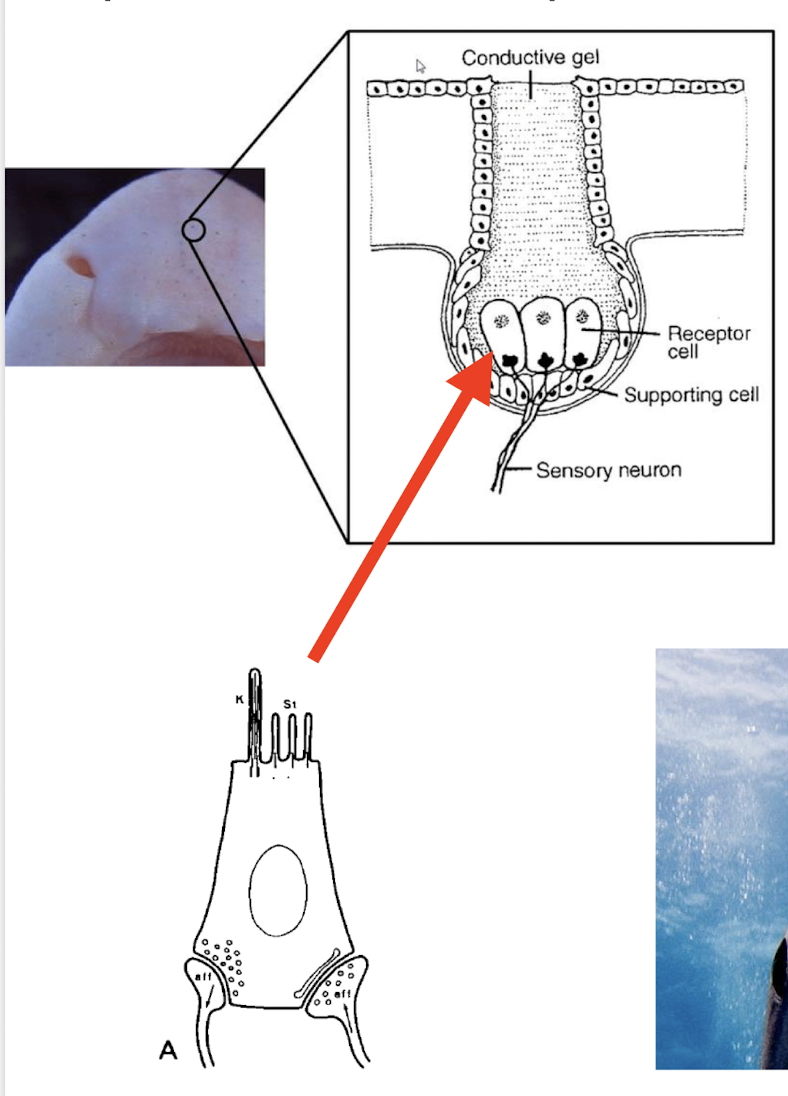
Special Mechanical Sense CN VIII: Ampullae of Lorenzini
ability to have passive electroreception
can detect muscles contracting: helps find prey hiding or buried in sand
found in sharks, skates, rays, and chimera
pits on the noses of sharks are ampullae: pores beneath the skin contain hair cells embedding in conductive jelly
conductive gel changes shape, which then causes hair cells to be deformed and release APs
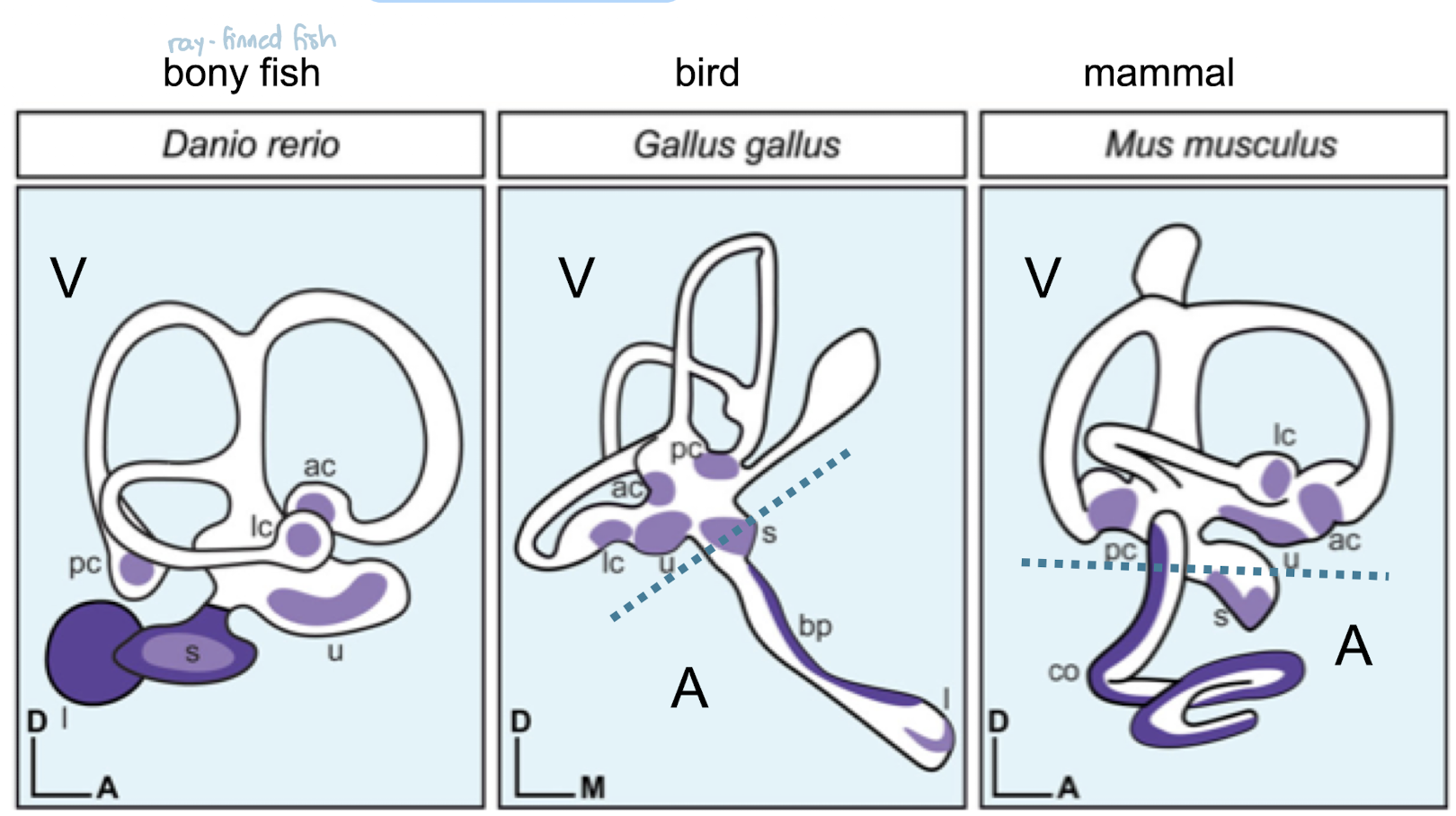
Special Mechanical Sense CN VIII: Acoustic (hearing) and Vestibular (balance) Systems Intro
located in the INNER EAR: water-based system
still water-based in mammals that are terrestrial
based on fluid movement and the deflection of hair cell cilia
inner ear structure has not changed much over evolution
all based upon the movement of water deflecting hair cells since mechanical energy has to move through water
Special Mechanical Sense CN VIII: Vestibular System
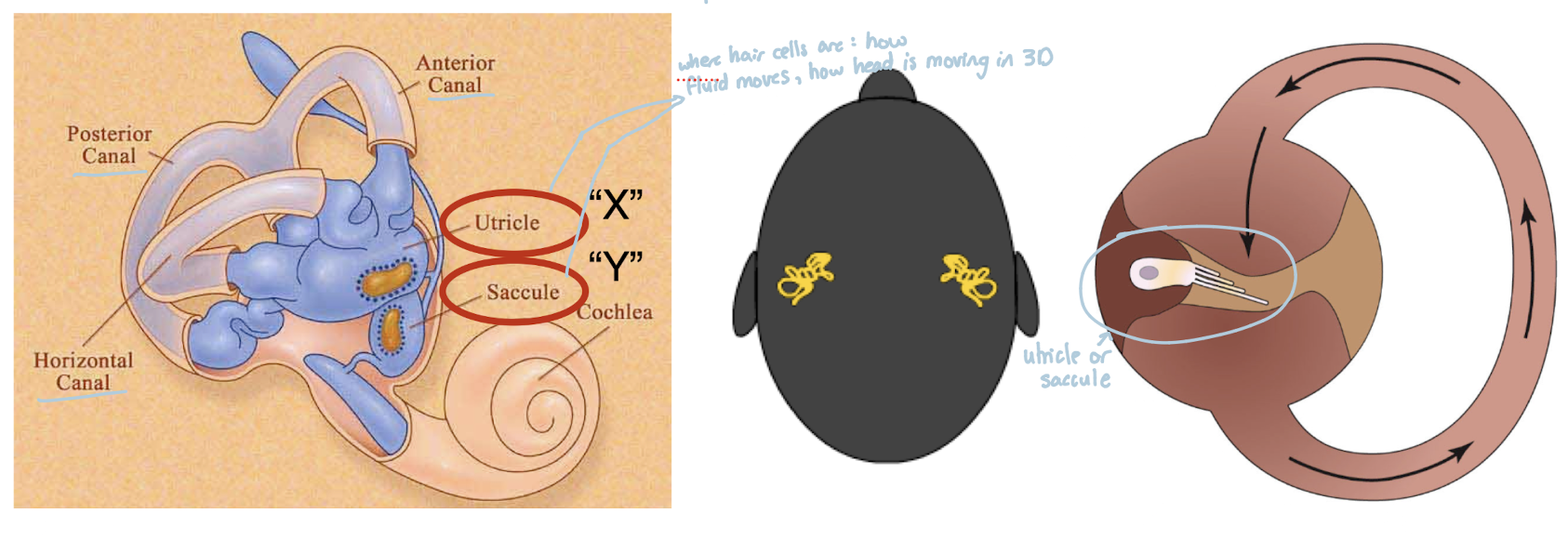
hair cells in the semicircular canals (anterior, posterior, horizontal) detect angular movements of the head
hair cells in the maculae of utricle (x-plane) and sacculus (y-plane) detect linear acceleration
Special Mechanical Sense CN VIII: Acoustic System
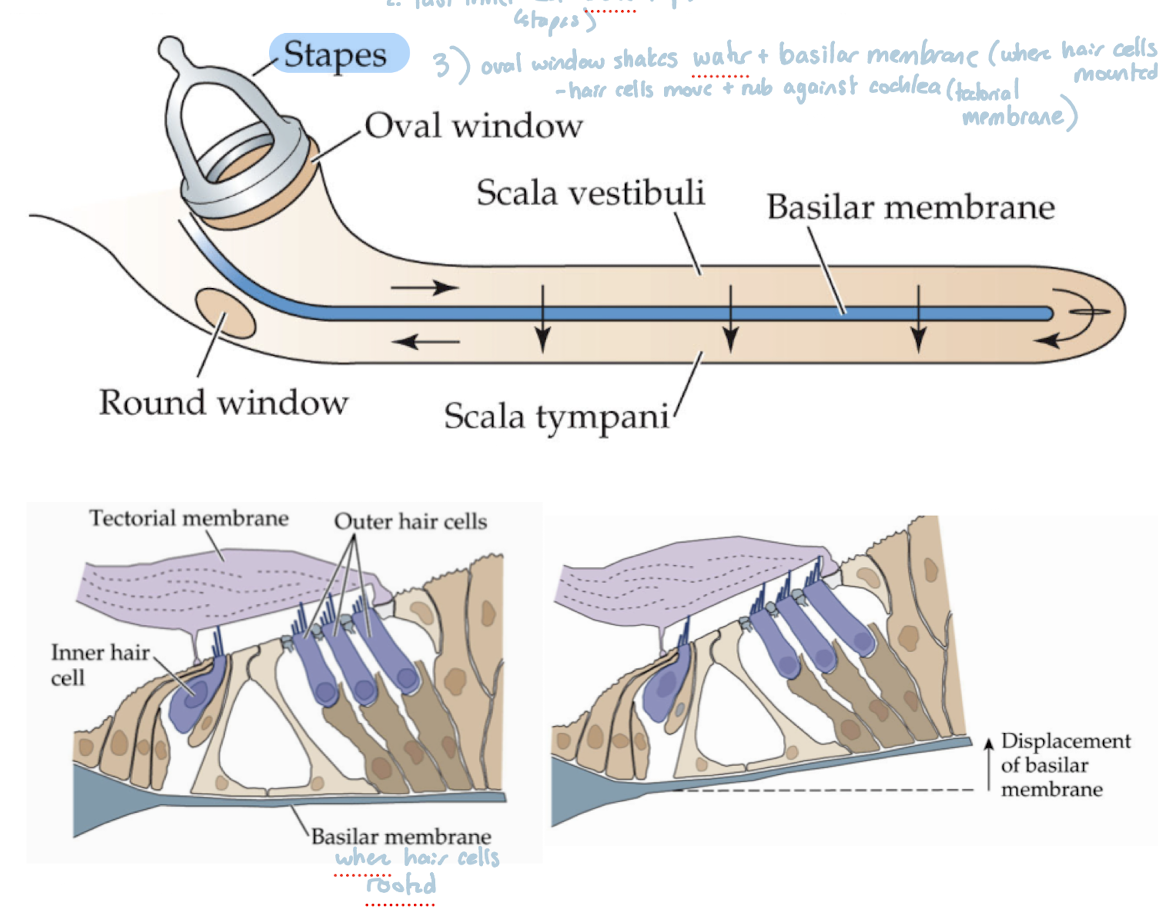
mechanical disturbances of the environment, transferred to the endolymph of the cochlea, are detected by hair cells
deflection of stereocilia (hair cells) during basilar membrane vibration)
steps:
mechanical energy (sound waves) moves stapes
last inner ear bone, stapes, taps on the oval window (a membrane)
oval window shakes water and the basilar membrane (where hair cells are mounted)
hair cells move and rub against the cochlea (tectoral membrane)
Evolution of Ear from Water to Land: Acoustic Impedance
acoustic impedance: measure of pressure generated by sound waves that varies with frequency and acoustic medium
at the air:water interface, less that 1% of sound energy passes to the second medium due to impedance mismatch
reflection and refraction of sound energy occurs, energy lost as move from one medium to the next
Evolution of Ear from Water to Land: Ancestral (aquatic) Ears
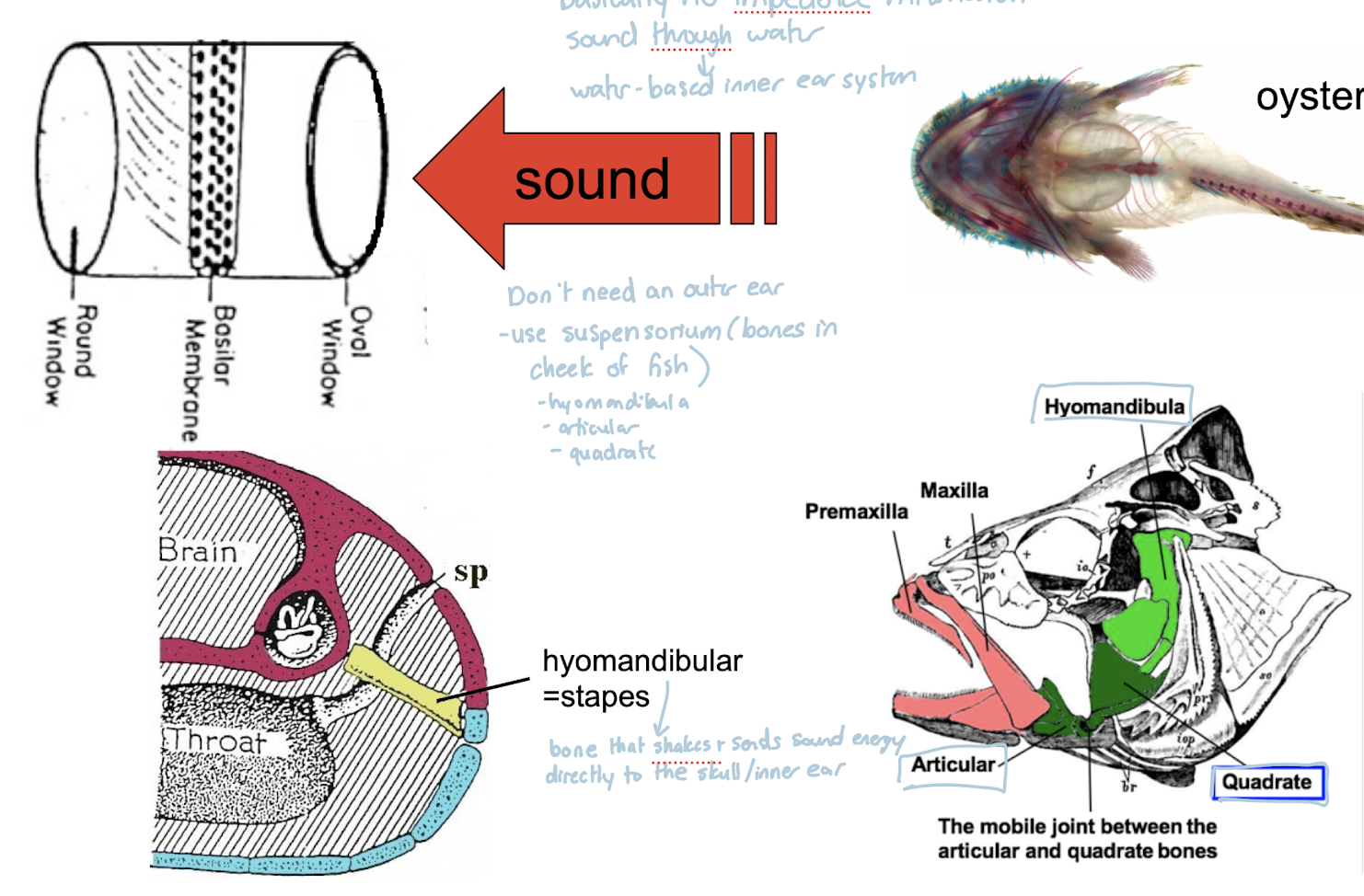
fish have inner ears: basically no impedance mismatch because sound goes from water through the water-based inner ear system
don’t need an outer ear: use suspensorium (bones in the cheek of fish)
hyomandibular = stapes: shakes and sends sound energy sirectly to skull/inner ear
articular
quadrate
Evolution of Ear from Water to Land: Terrestrial Ears for Amphibians, Reptiles, and Birds
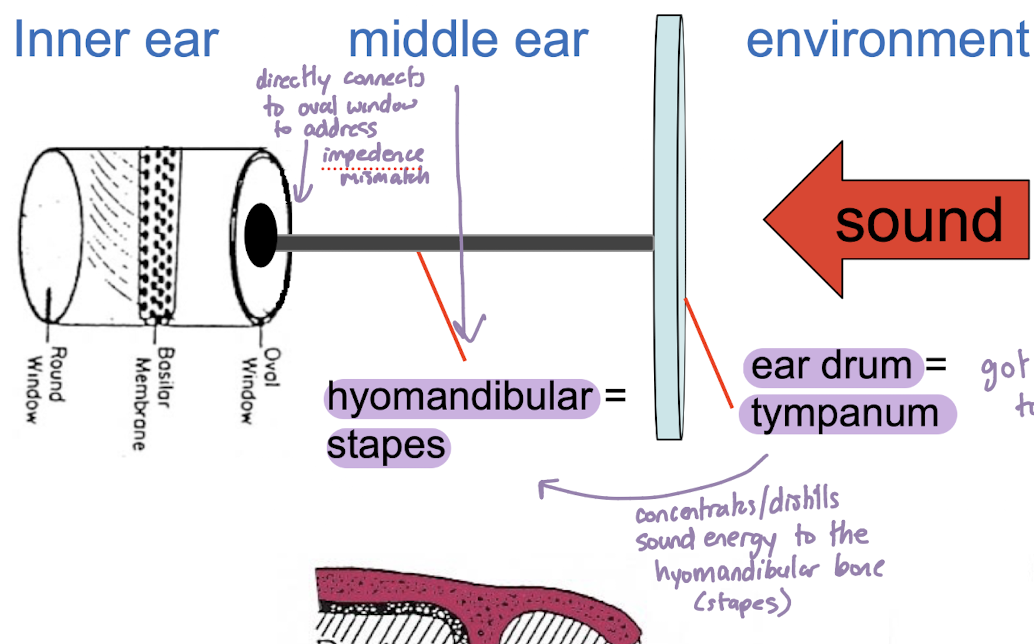
amphibians, reptiles, and birds have inner and middle ears
have to address the impedance mismatch of mechanical energy from the air environment to the water-based inner ear
surface between environment and middle ear: eardrum (tympanum)
concentrates/distills sound energy onto the hyomandibular bone (stapes) of the middle ear
middle ear: contains hyomandibular bone (stapes) which directly connects to the oval window to address the impedance mismatch
middle ear acts as an amplification device
Evolution of Ear from Water to Land: Terrestrial Ears for Mammals
mammals have inner, middle, and outer ears
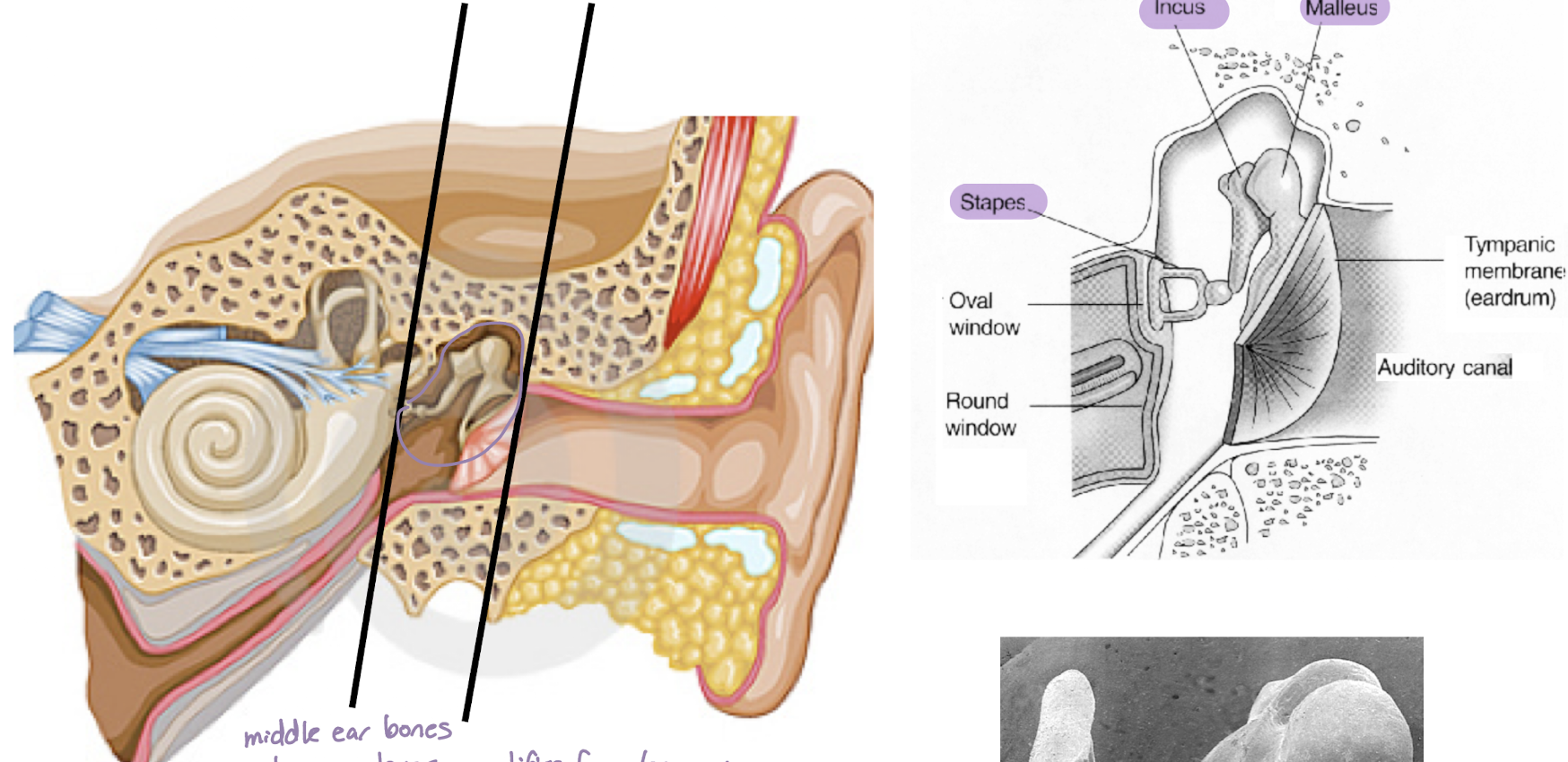
middle ear bones (incus, malleus, and stapes) act as a lever, amplifying force/energy
3-ossicle mammalian ear converts tympanum displacement into smaller oval window displacements of higher force
What is a hominid?
Great Apes: orangutans, bonobos, gorillas, chimps, and humans
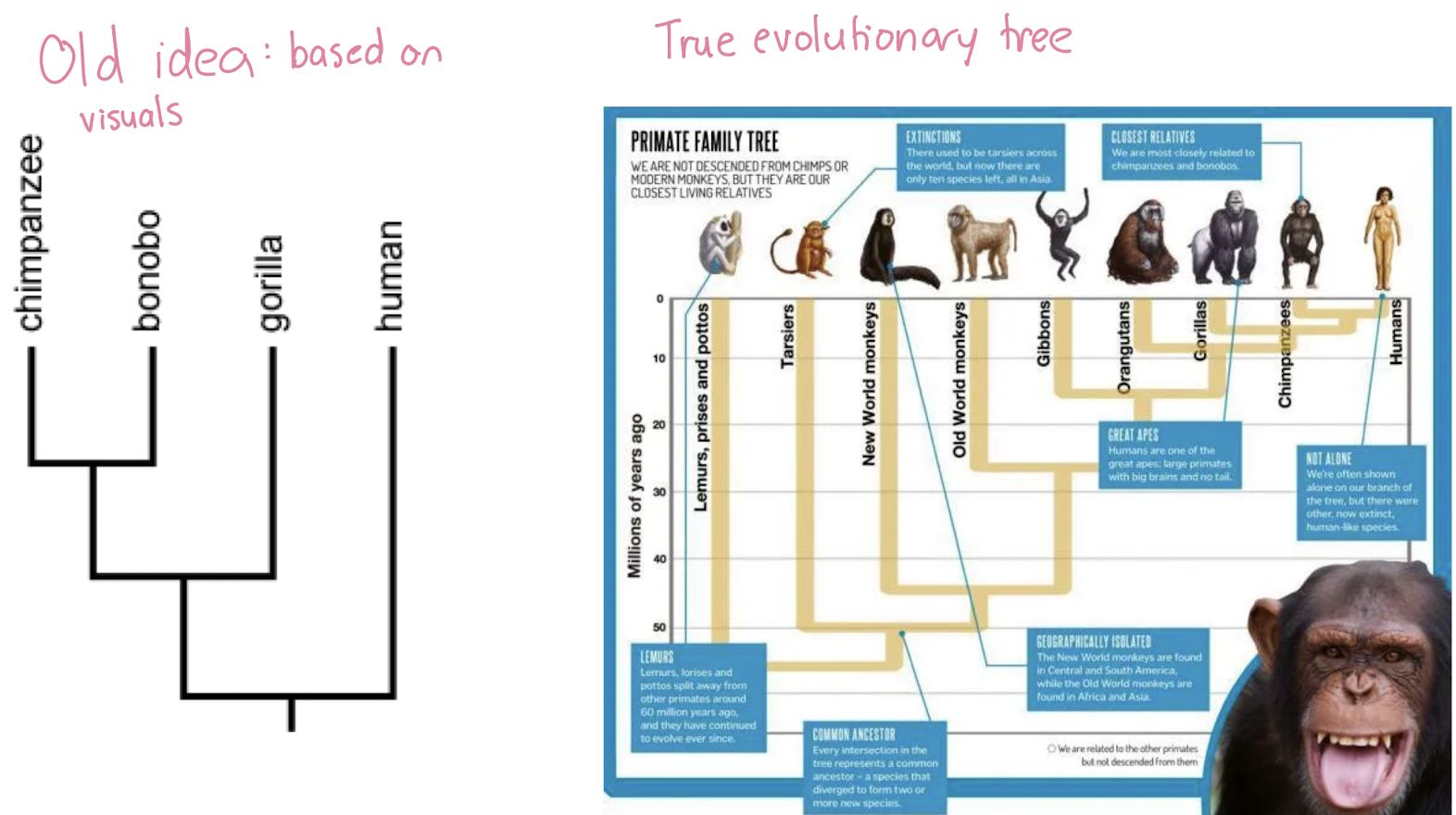
Old Idea of hominid evolution vs true evolutionary tree
Old idea: based on visuals, suggests humans are most separated from other great apes
True evolutionary tree: humans are most closely related to chimps, and chimps are more closely related to us than other great apes
we share a MRCA and 99.9% of genome
What is a hominin?
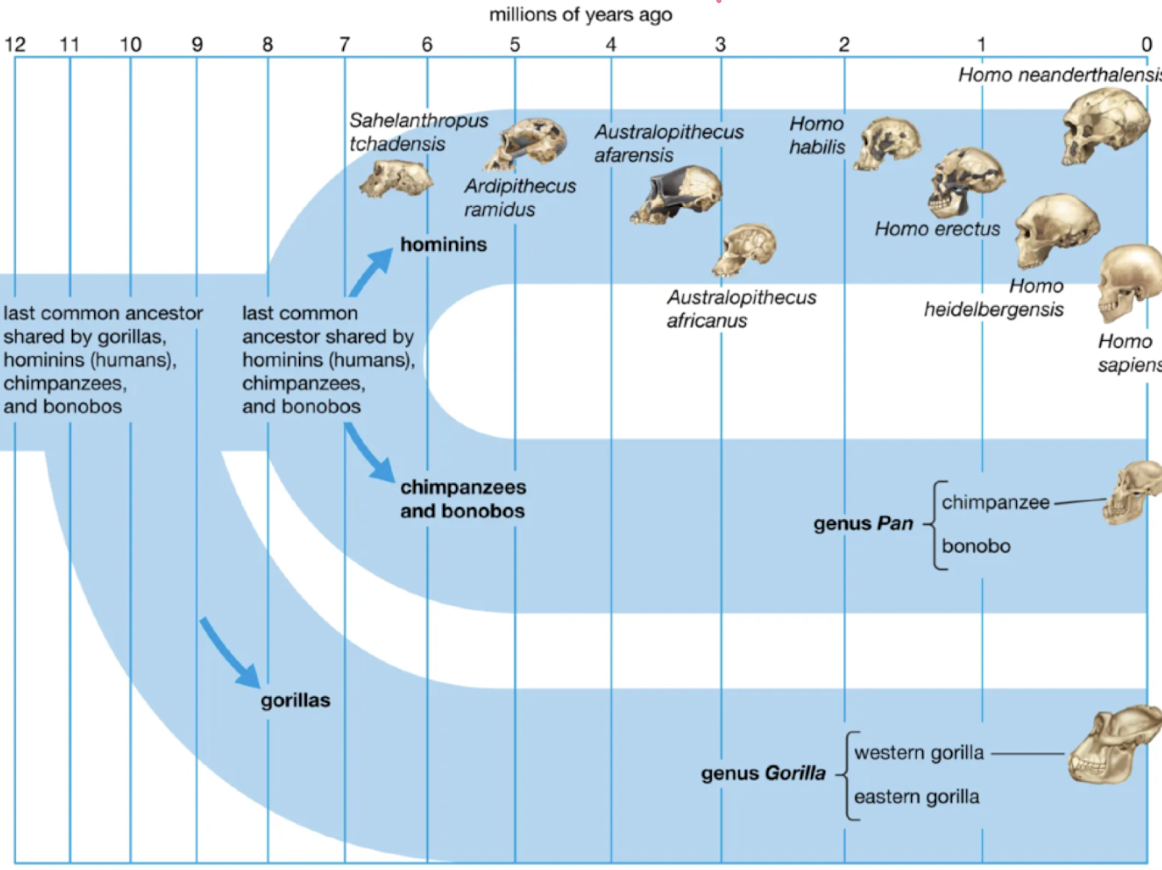
lineage that led to modern humans: split from chimps
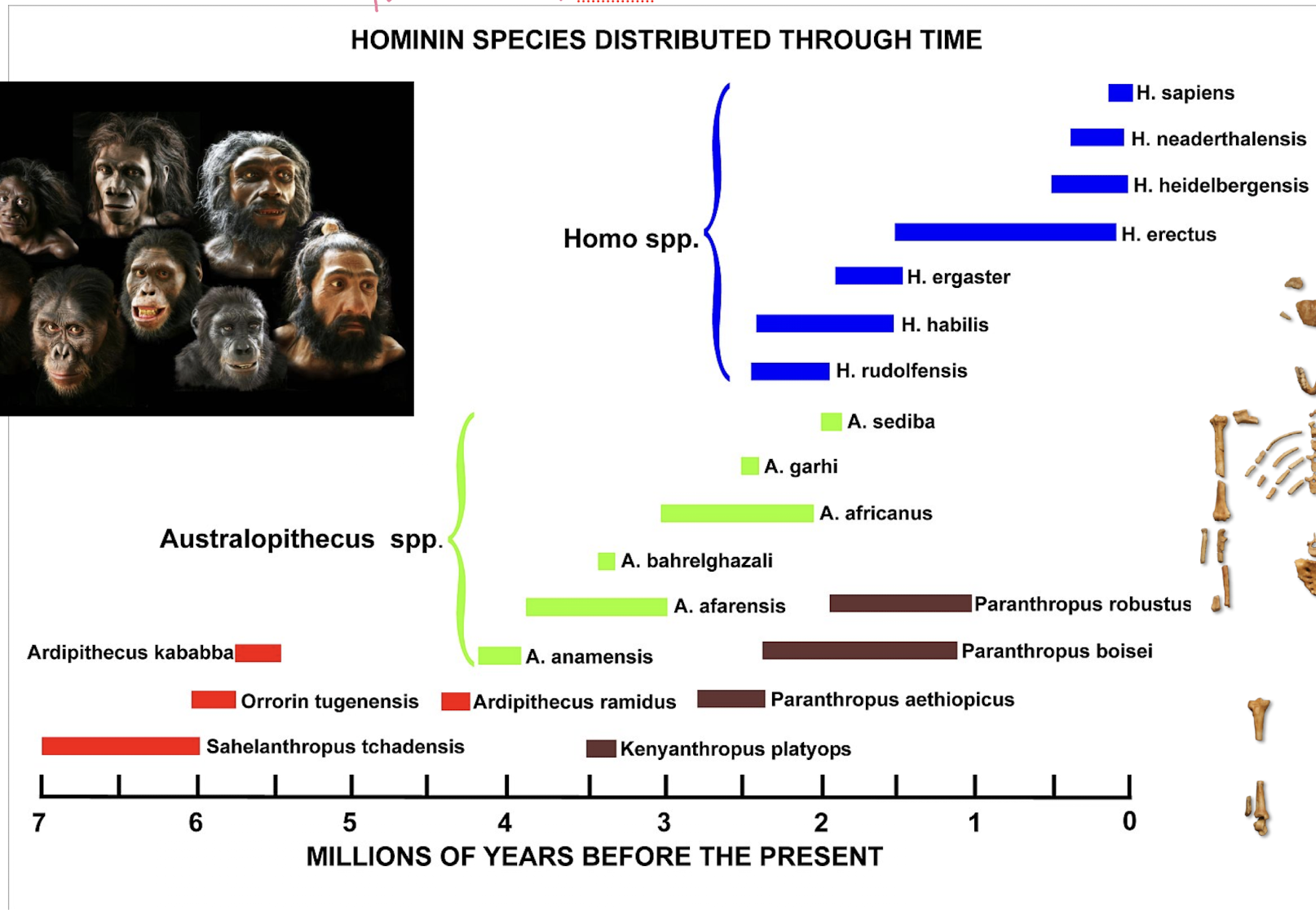
modern humans are the only extant hominins, all others are extinct
homo neanderthalensis very recently extinct: northern europeans may have neanderthal mitochondria because they at some point had neanderthal mother
What makes a human (hominin) different from a non-human hominid?
Bipedalism
Big brains
Large Energy Budgets
HQ (high quality) diet
Being fat
Shorter gestation
Delayed development
Major Events in Hominin Evolution
Bipedalism: when split from chimps 7 mya
3 mya split from paranthropus to homo species
brain expansion
childhood (protected development)
adiposity (fatness)
HQ diets
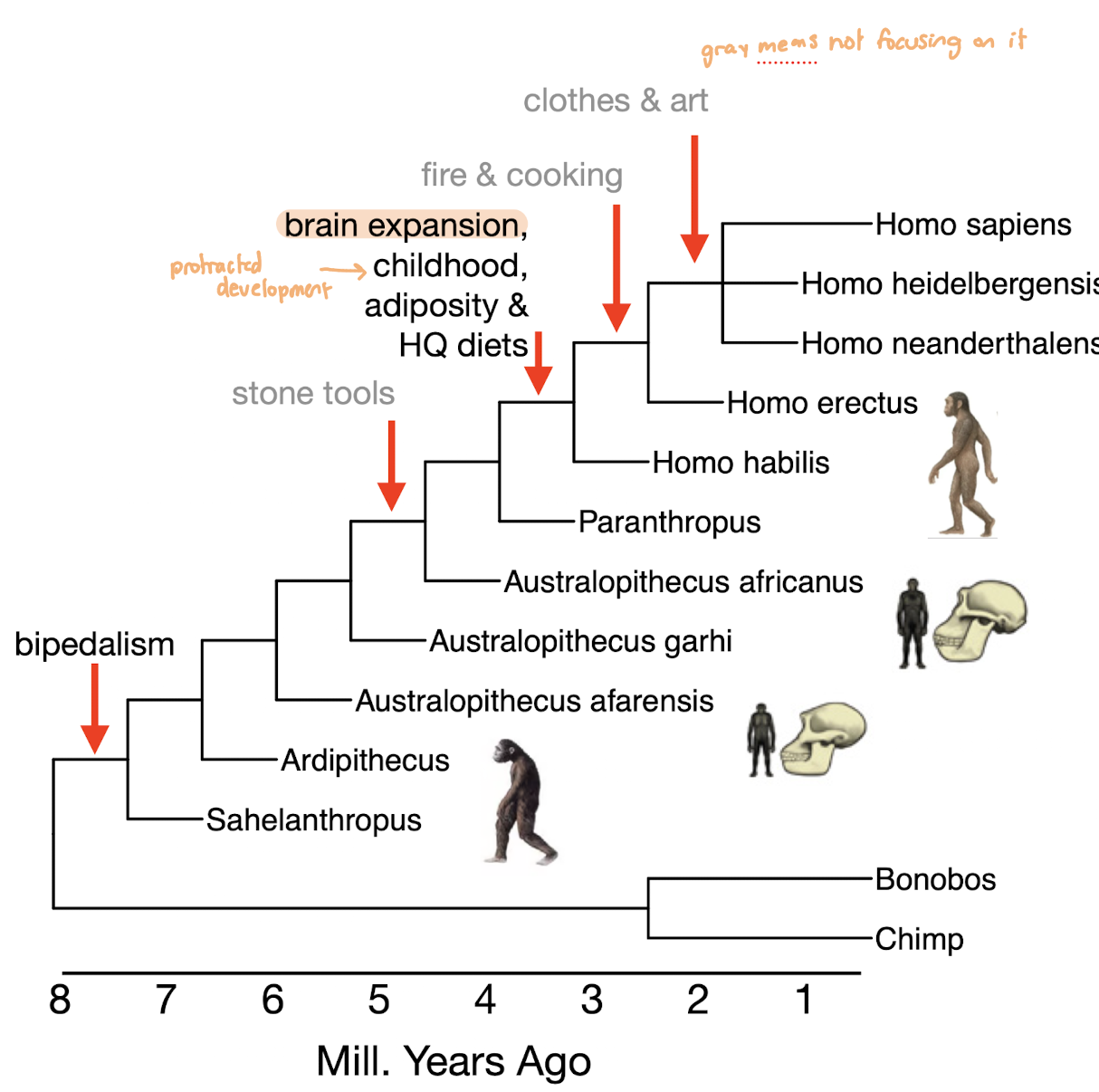
What was the selective force for bipedalism?
Savannah Hypothesis
humans all came from Africa, north of equatorial Africa, east Africa
10 mil/6mya African ecosystem changed from dense forests to savannah: spreading out resources
other great apes don’t have to move much to find food, but now we have to move around to find resources
fruit main diet for other great apes, very plentiful
bipedalism has lower COT than quadrupedal locomotion, is more efficient
helps us expend less energy now that we have to travel longer distances for food

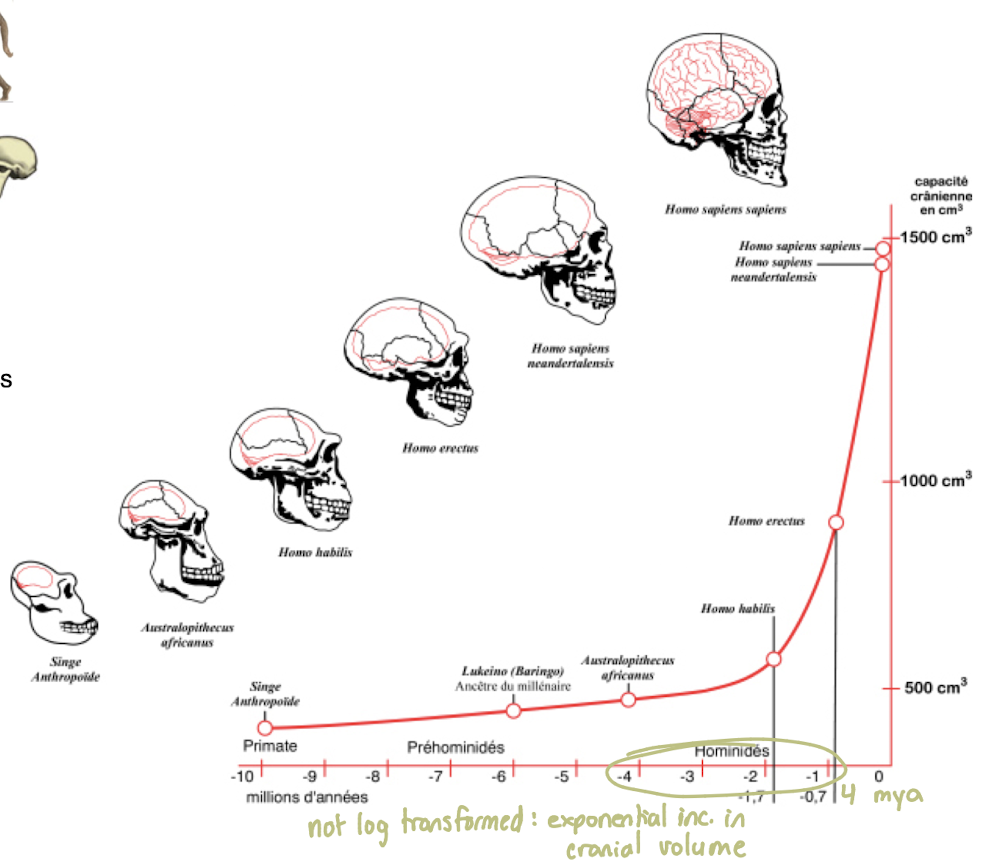
What was the selective force for brain expansion in hominins?
brain expansion occurred another 4-5 mya after bipedalism
originally, we walked around to find the starchiest/most sugary food
fruit rarely found
transitioned too starchy root organs, but they weren’t incredibly nutrient dense
12-15 species all looking for root organs: competition led to a Red Queen Event
arms race for increased brain size to have the biggest brain (best cognitive abilities) to be the best at finding food
better communication, can find resources more effectively
exponential increase in cranial volume
Social Brain Hypothesis: Pros of Having a Larger Brain
Cognitive improvements
avoid predation
allomaternal care: care for others’ children
food and water sharing
stabilized resources during ecological fluctuation: stash resources for tough times
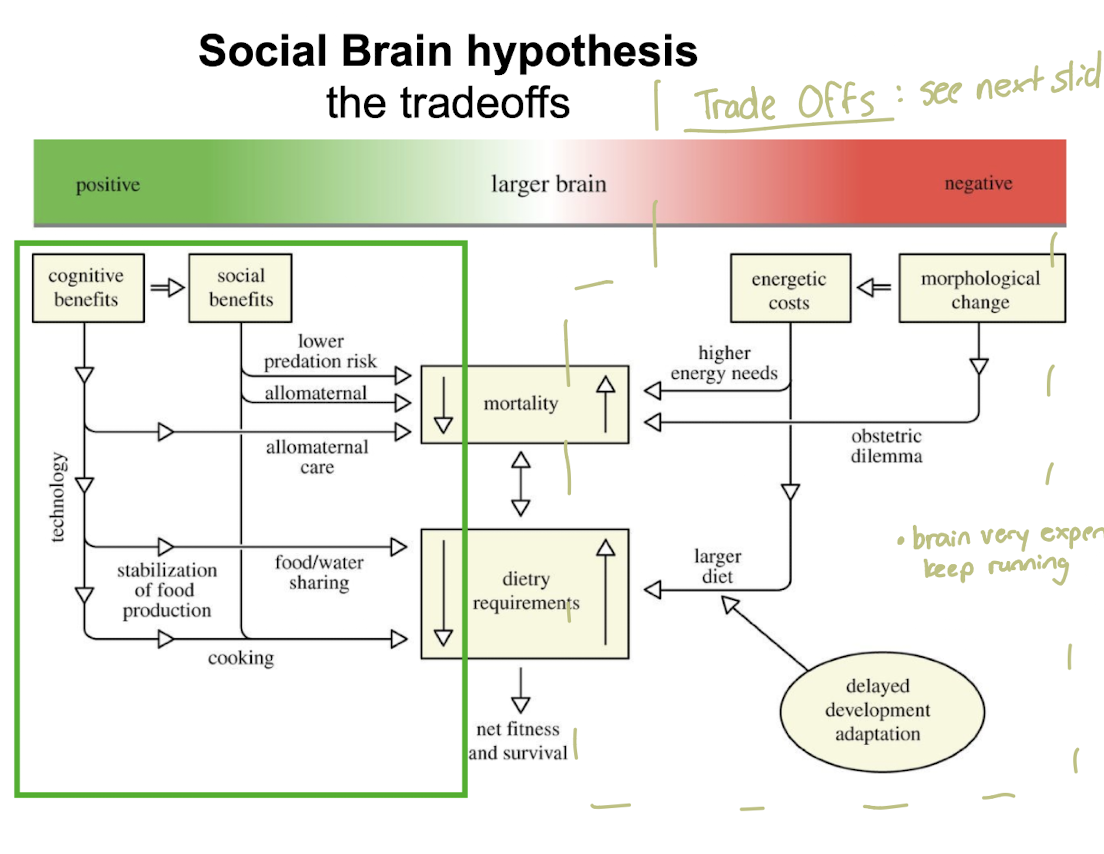
Social Brain Hypothesis: Trade-Offs of Having a Larger Brain
Brain is very expensive!
increased energetic costs
broader diet
increased adiposity
shorter gestation (obstetric dilemma)
delayed development
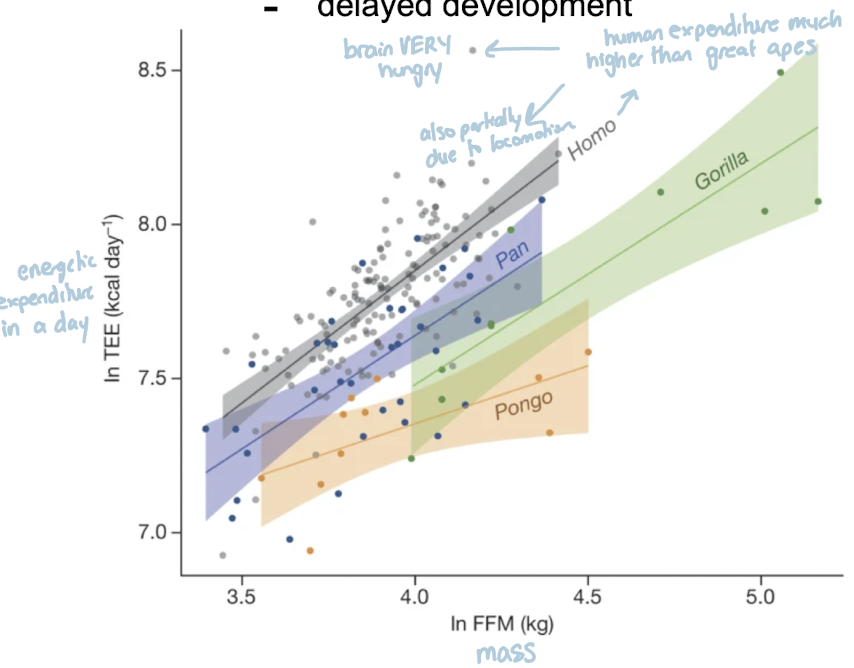
Social Brain Hypothesis: Trade-Offs of Having a Larger Brain: Increased Energetic Costs
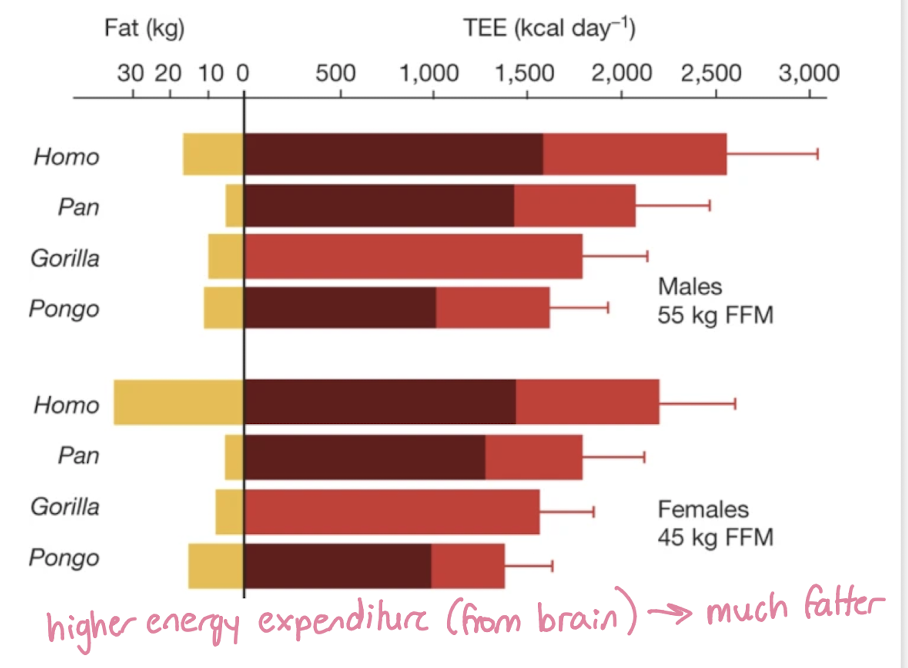
homo has highest energy expenditure in a day per mass compared to great apes
because our large brain is very hungry (and also a little due to our increased locomotion)
Social Brain Hypothesis: Trade-Offs of Having a Larger Brain: Broader Diet
roots organs we used to eat weren’t high enough quality to support our big brain so…
hominins are the only ones who eat meat: we need a much more HQ diet
Social Brain Hypothesis: Trade-Offs of Having a Larger Brain: Increased Adiposity
Hominins are much fatter than other great apes
Fat needed to store energy for when food resources are patchy/scarce
Fat storage provides stability for hungry brain when food resources are low
High energy expenditure from brain requires us to be much fatter
Crafty Genotype Hypothesis of adiposity: no matter your environment, you have a gene that will turn on to increase adiposity. Adiposity is encoded for ALL throughout your genome: no single “fat gene”
Leanest Human = Fattest Primate
Male: 3-8% human v. 0.005% bonobo
Female: 10-12% human v. 3.6 % bonobo
Social Brain Hypothesis: Trade-Offs of Having a Larger Brain: Shorter Gestation
longer gestation is understood as a good thing, but our large brain prohibits long gestation time
direct trade off
obstetric dilemma and EEG
Social Brain Hypothesis: Trade-Offs of Having a Larger Brain: Delayed Development
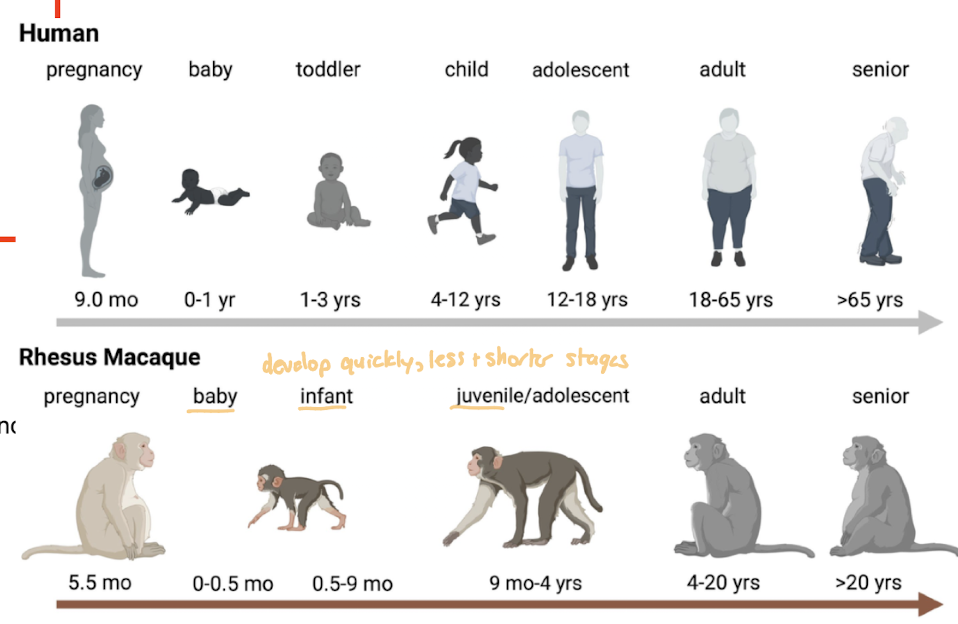
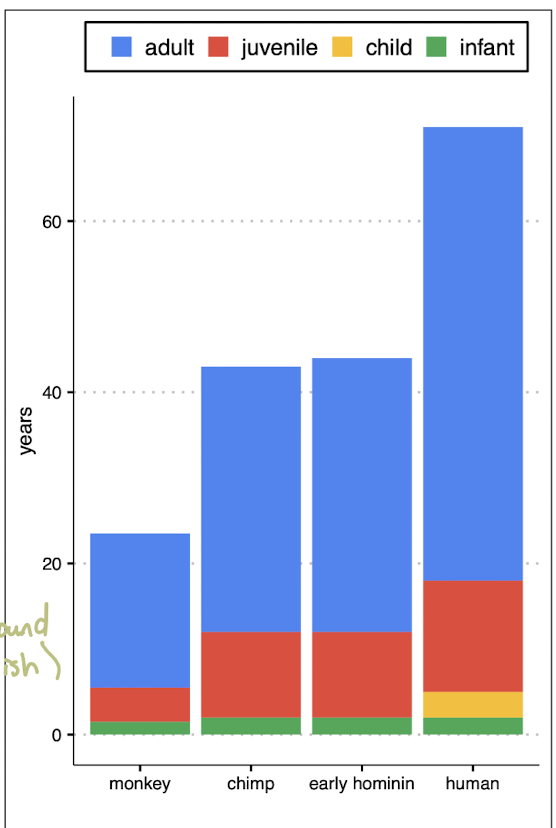
since we have less gestation time, we are less developed when we are born
we need more developmental time when we are young before becoming adults
in youth, we require a lot of care to support our costly brain while our body doesn’t develop as quickly
we spend more time developing before reaching adulthood than other species
What have hominins become? In what context did we become this?
We’ve Become…
clever
big-brained
bipedal
fat
slow-maturing
Context:
evolved over course of 8 million years and is now 4 myo
evolved in this evolutionary context that we no longer live in
savannah subsistence hunting
resources were scarce
activity was required
small social units were essential
Hominin Evolution: Recent Changes → Agriculture
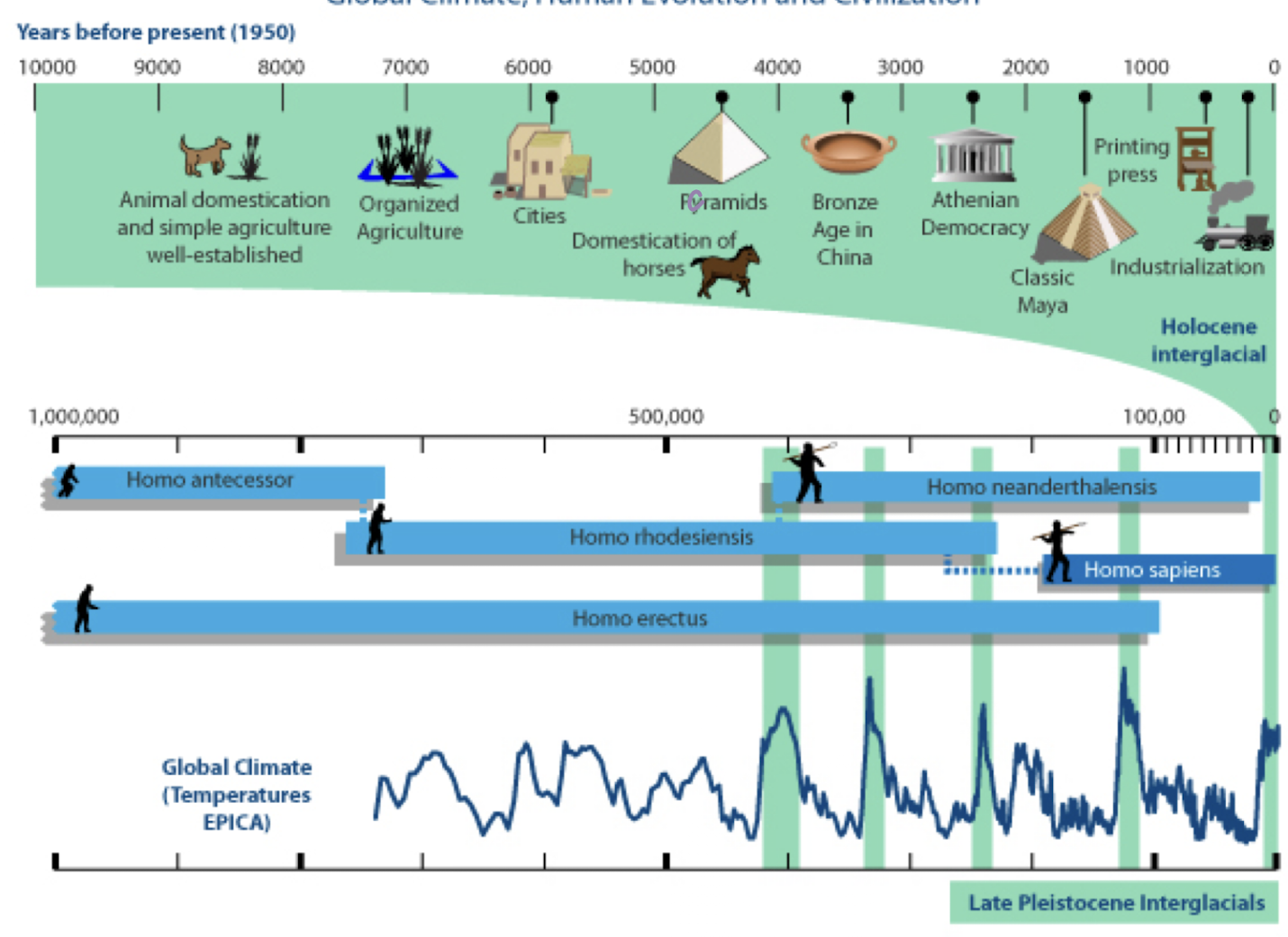
10k years ago shifted from hunter-gatherer to agriculture (very recent considering took 8 million years to get to this point)
evolved to stabilize food resources in changing/fluctuating climates
domesticated plants to grow them
allowed us to live in more urban environments: concentrate living next to food production
large social groups introduce disease
diminished diet variety
Left Africa 100k years ago: Wherever humans went, we established agriculture, shifting diet and way of life
Hominin Evolution: Recent Changes → Industrialization
all of our production due to machines: agriculture, labor, products we buy/sell
type of industrialization has changed in past few decades
completely changed the way we live and communicate
mismatches to our ancient environment: affects health
Hominin Evolution: Summary of What Has Changed
Through 8 million years of:
savannah subsistence hunting
resources were scarce
activity was required
small social units were essential
In last 10k years or even few hundred years:
Agriculture
Food on demand (ad libidum)
Low activity levels
Huge, complex social units (cities and towns)
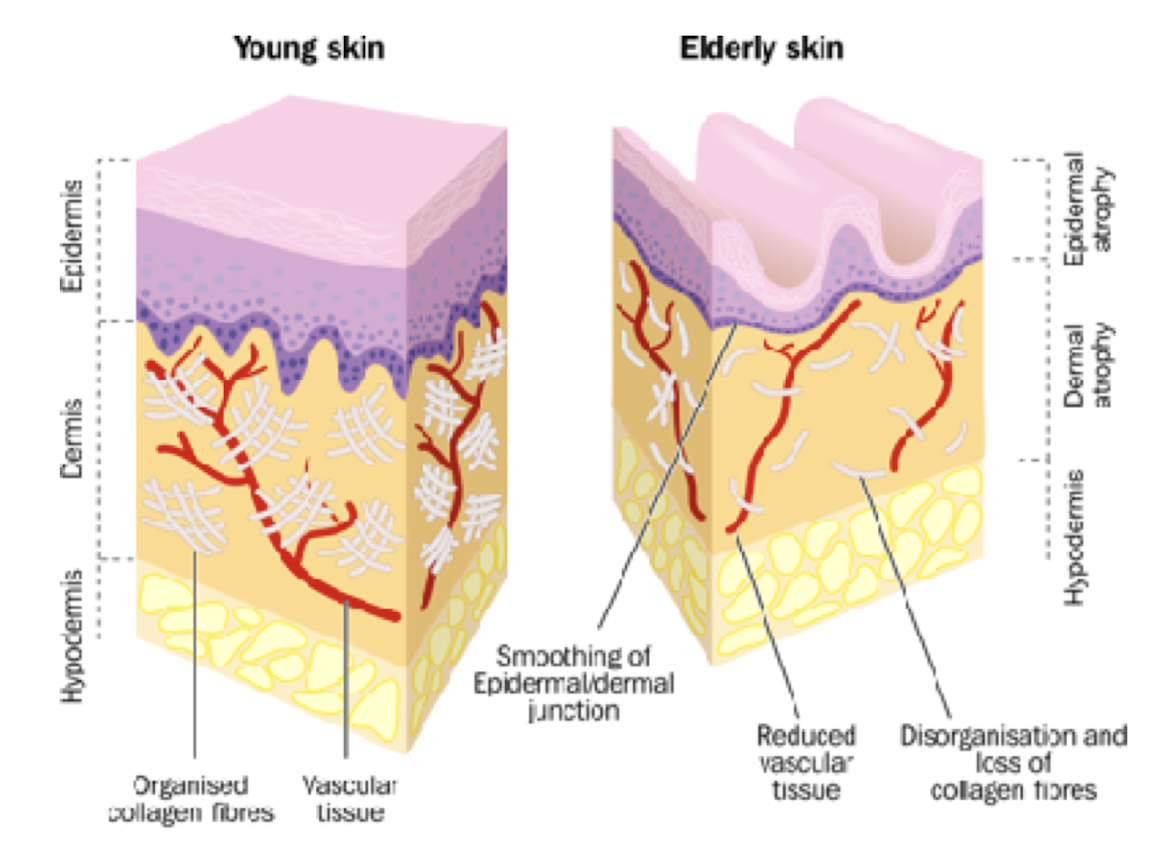
Difference between Aging and Senescence
Aging: change in phenotype with age (neutral)
note: from here on our when we say aging we really mean senescence
Senescence: functional deterioration with age in absence of disease
deleterious effects of aging without disease
as we senesce, function starts to decline
decrease function and reproductive success
increase morbidity and mortality
Universality of Aging
no evidence that prokaryotes undergo senescence
populations of single-celled eukaryotic organisms are immortal
in multicellular organisms, senescence occurs in those that undergo somatic (body) cell differentiation
Primary Senescence Process
deterioration of function over time in the relative absence of disease
influence maximum life span: senescence limits lifespan bc function will deteriorate so much so that we die
underlying causes of senescence across species
Pace of Senescence
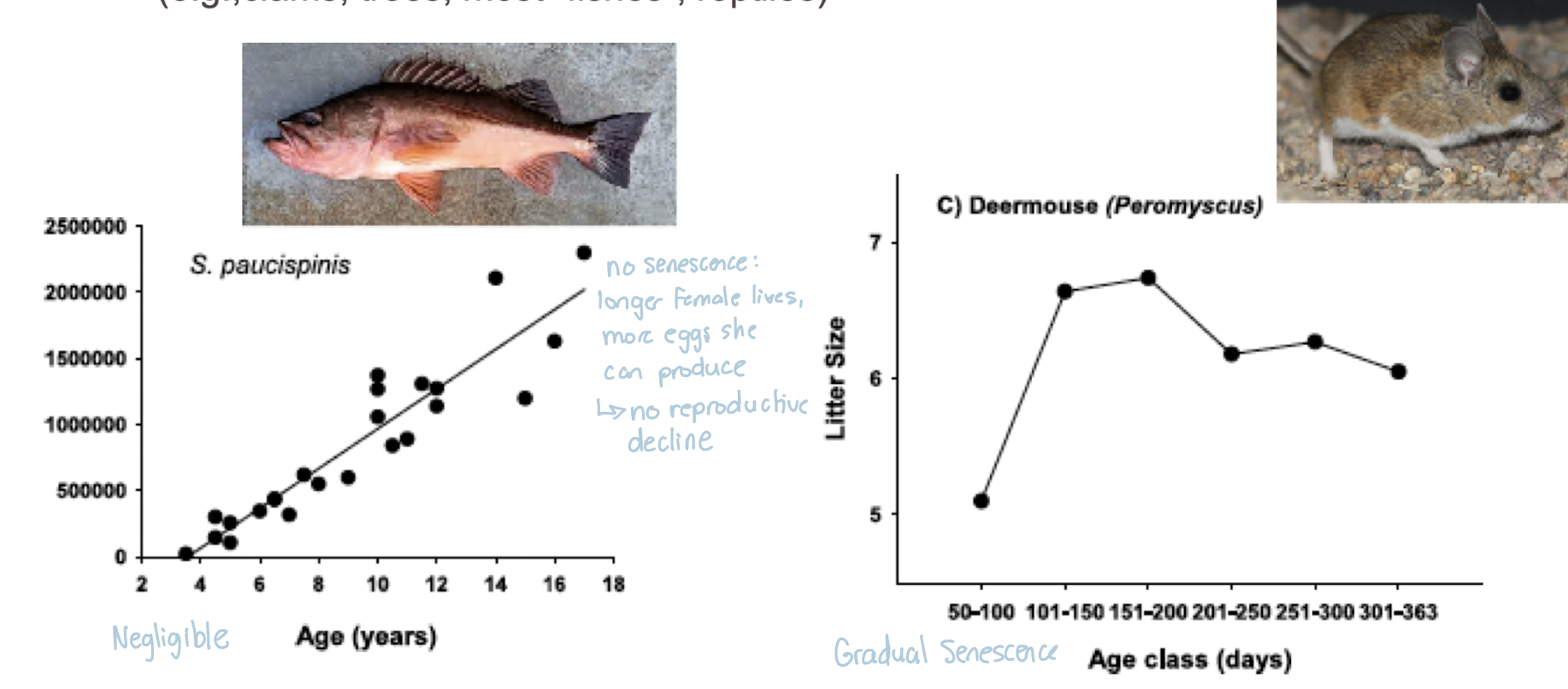
Rapid: occurs abruptly after maturation (ex. nematodes, flies) or soon after reproduction (ex. annual plants, Pacific salmon)
Gradual: slow but persistent deterioration after maturation (all placental mammals, birds)
Negligible: no clear evidence for post-maturation increases in mortality (ex. clams, trees, most “fishes”, reptiles)
Who Lives the Longest (Avoids the Terminal Effects of Senescence)?
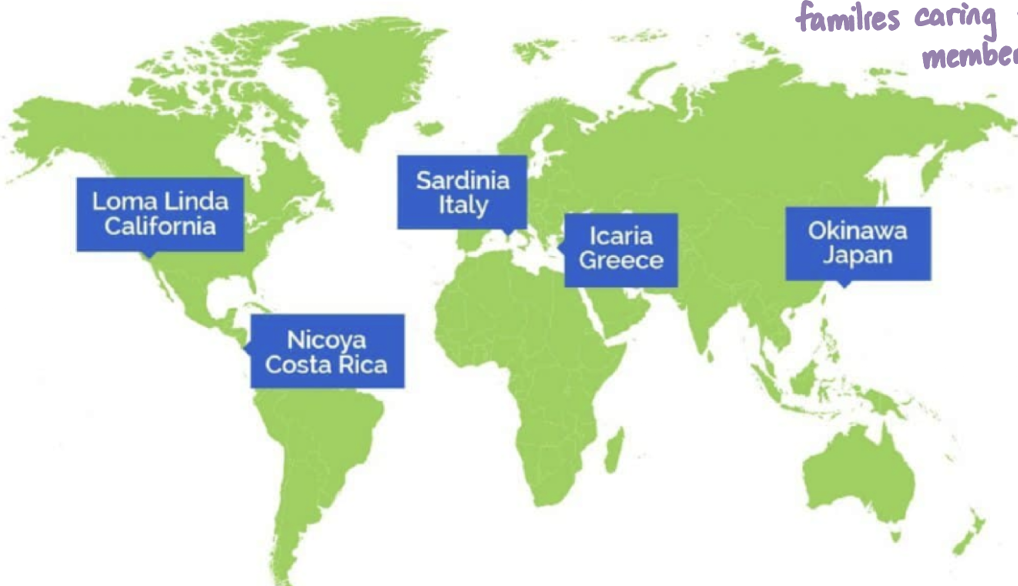
Blue Zones: exceptional number of 100 year olds
Okinawa (Diet)
Sardinia (Genetics/Diet)
genetics: founder effect → founded 2k years ago by settlers with really good genes
Loma Linda, CA (Social)
same US healthcare system but have social system of families caring for older members in their nuclear families
Japanese Women
Have been adding 3 months of expected life each year since WWII
(those born in 2025 expected to live 3 mo longer than those born in 2024)
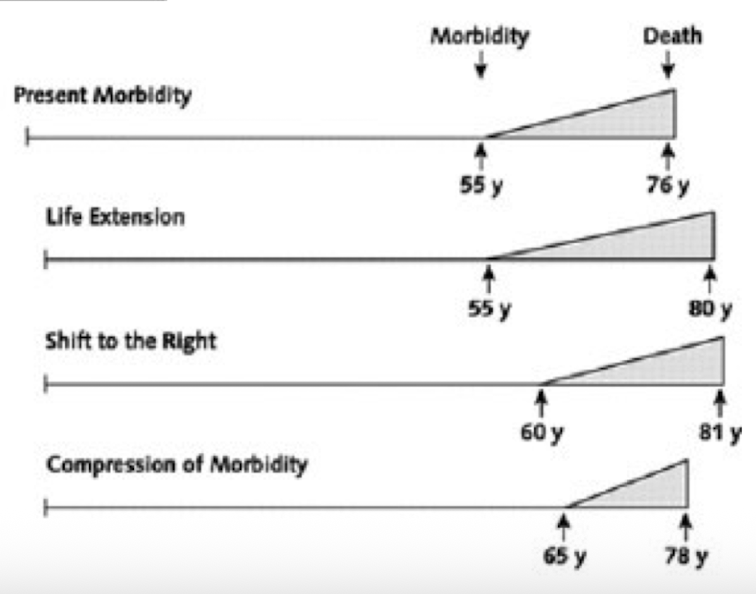
But: Does living longer compress morbidity or do we just live longer with function loss?
Morbidity: total loss of some important function (that occurs as result of senescence)
Theories of Aging: Cumulative Oxidative Stress
Proximate Theory: How? of Aging
when we metabolize and burn fuel (oxidize) this produces free radicals which are dangerous and compromise the functioning of cellular machinery
longer we live, the accumulation of oxidative stress on tissues affects aging

Theories of Aging: Genetic Mechanisms
Proximate Theory: How? of Aging
Support for genetic mechanisms being an important proximate factor
High conservation of maximum life span between species
similarity of attained age between monozygotic twins compared to dizygotic twins
examples of exceptional longevity within families
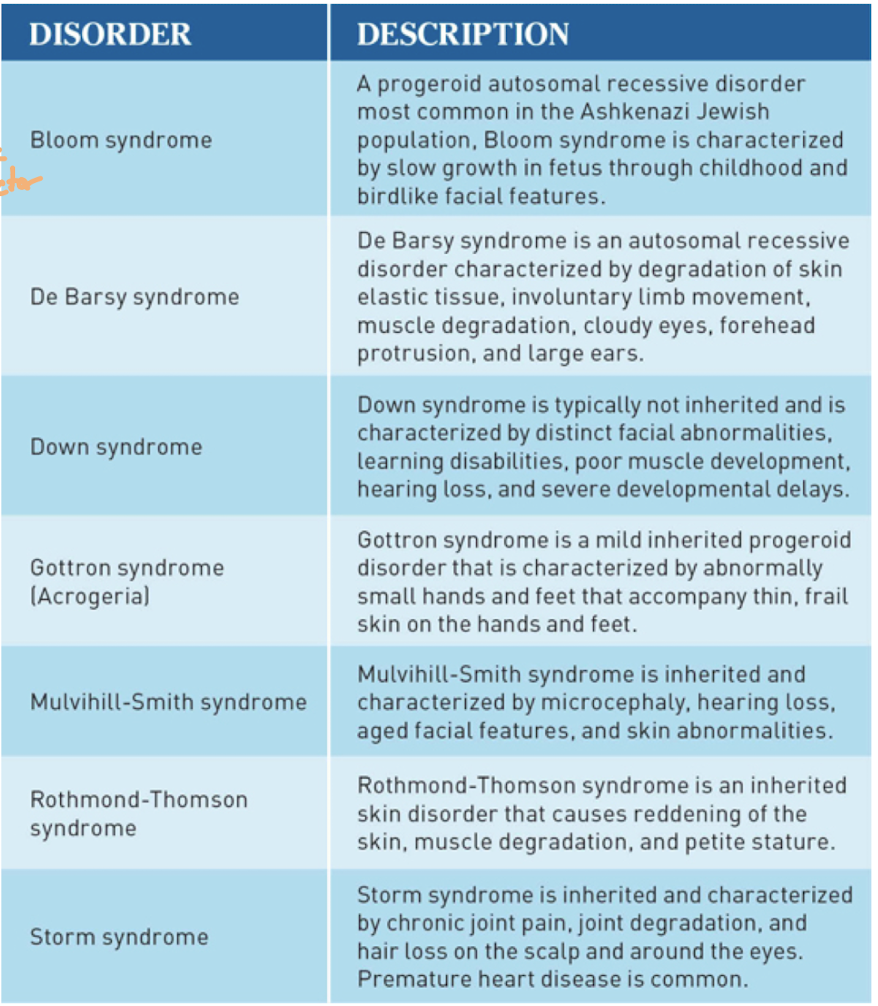
aging features in human progeria genetic symptoms (see chart)
Theories of Aging: Somatic Division and Telomerase
Proximate Theory: How? of Aging
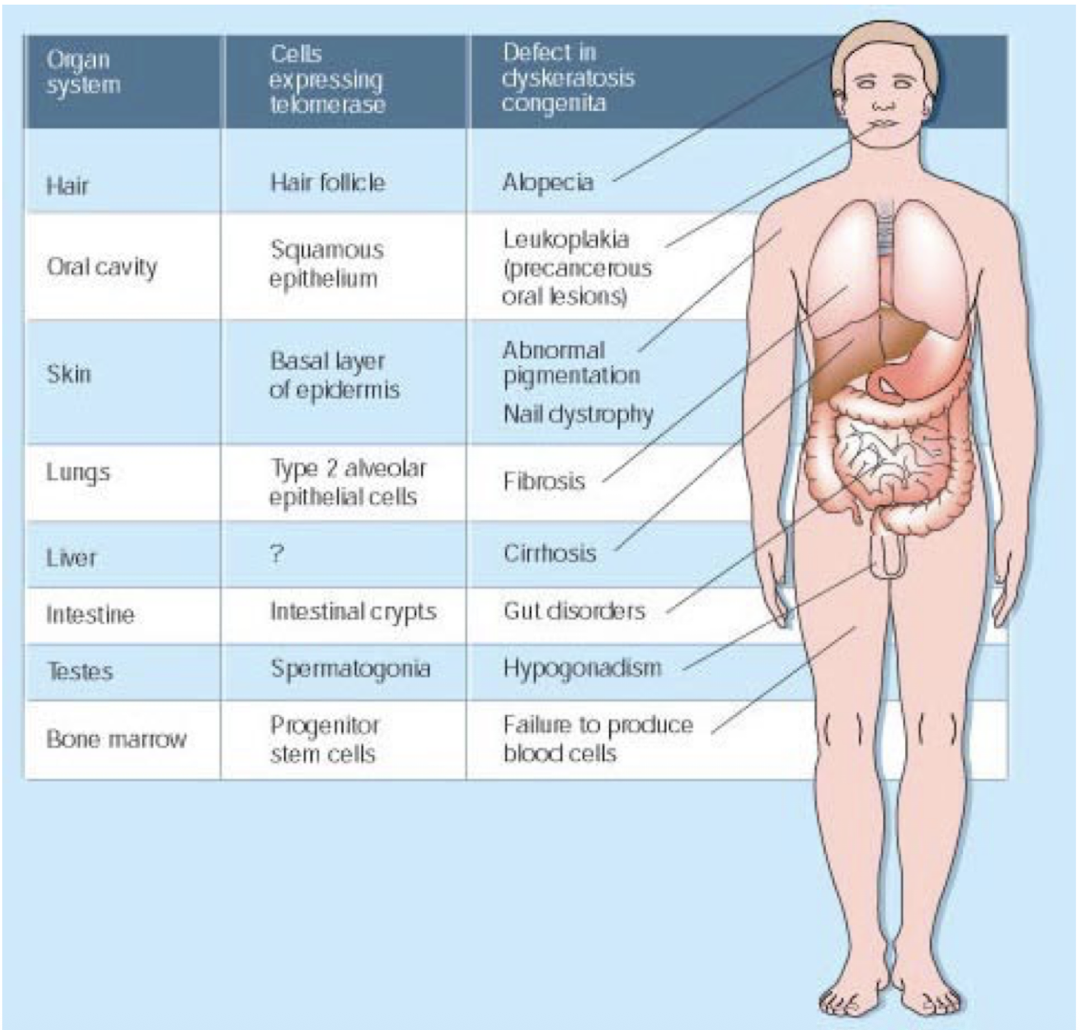
When we engage in mitosis, issues can arise with telomerase (which repairs damage at the end of the genome, protecting it from shortening)
low levels of telomerase result in telomere shortening and effects on cellular function
when less telomerase is present, certain diseases associated with aging can occur (see chart)
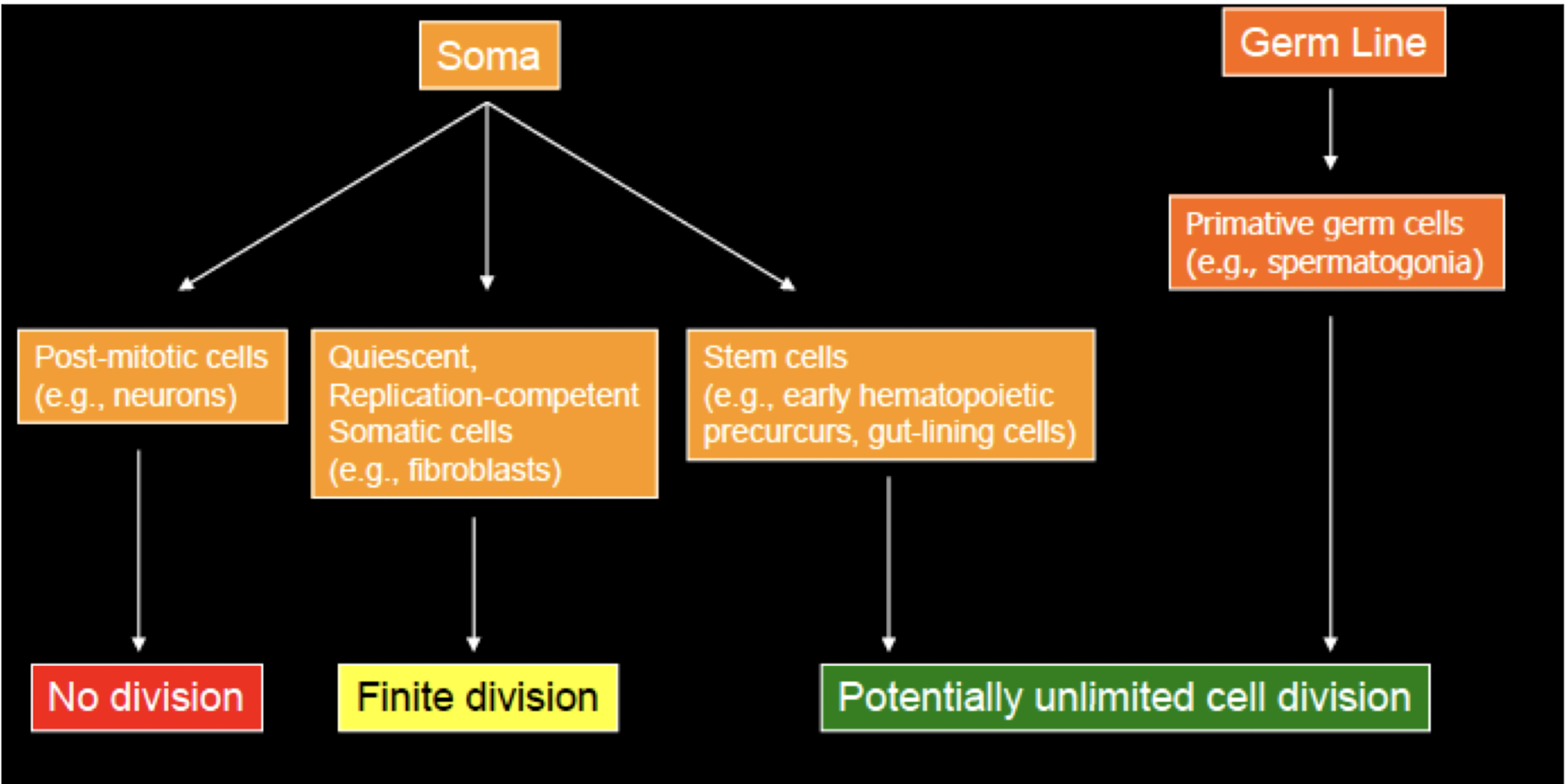
Replication Potential of Human Cells
Theories of Aging: Evolutionary Mechanisms
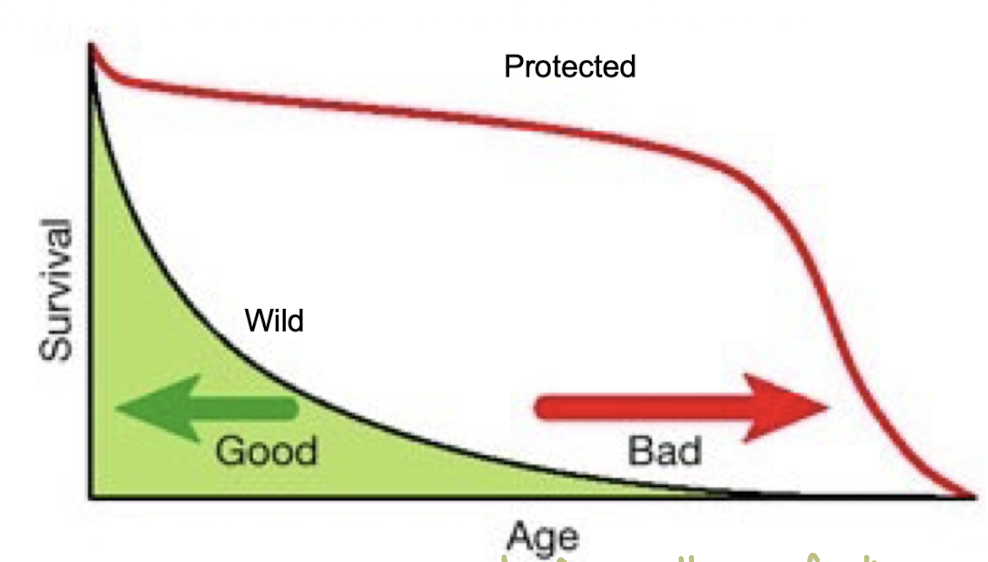
Ultimate Theory: Why of Aging
Antagonistic pleiotropy: genes with early benefits are deleterious later
ex. genes producing testosterone are later in life implicated in prostate cancet
Mutation accumulation: decline of selection against deleterious mutations after reproduction
if deleterious mutations develop after reproduction, there is no way for natural selection to act on it because it has already been passed on to future generations
Disposable body: body is useless after reproduction
in an evolutionary sense, you’ve done what you need to do (especially after you’re done raising children in people)
2 main periods of senescence (40s and 70s): 40s matches theory bc that’s after you have children
Interventions for Senescence: Diet
caloric restriction extends average and maximum lifespan by 30-40% if initiated in early adulthood and by 20% in early middle age
effect seen in a variety of texa including rodents, fish, flies, and worms
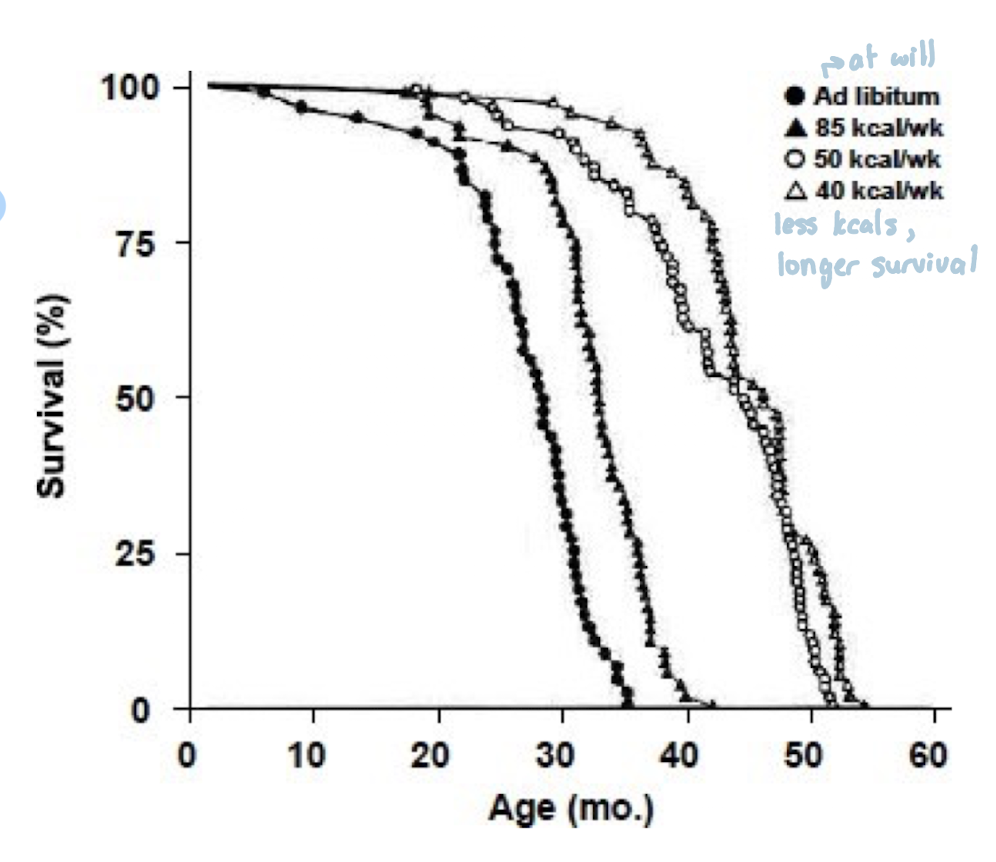
Primate Study: one given calorie restricted diet and other given SAD (Standard American Diet)
senesce faster on SAD, body loses ability to fight disease so more instances of cancer and diabetes seen
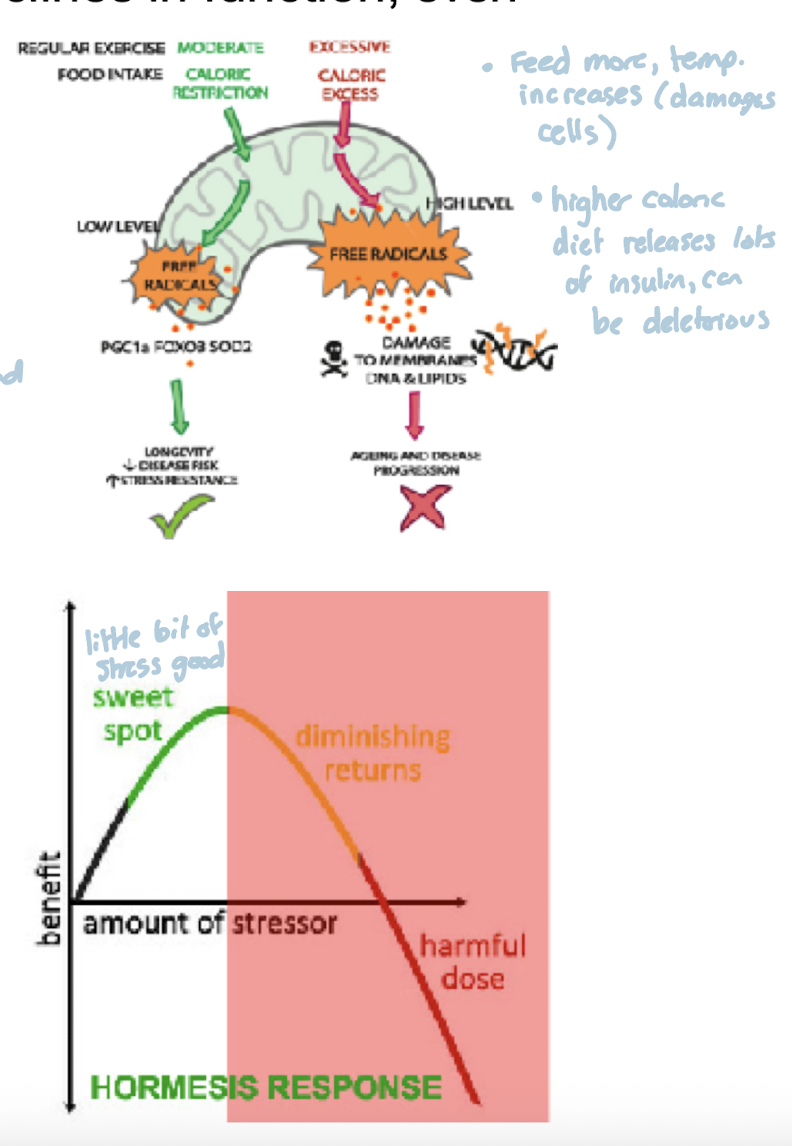
How does a CR (calorie restricted diet) reduce age-related declines in function?
reduced temperature
lower insulin and increased repair
reduced ROS (free radicals: reactive oxidative species) and reduced DNA damage
cellular hormesis (low-dose hunger stress is beneficial)
hormesis: process in a cell or organism that exhibits biphasic response to exposure to increasing amounts of a substance or condition
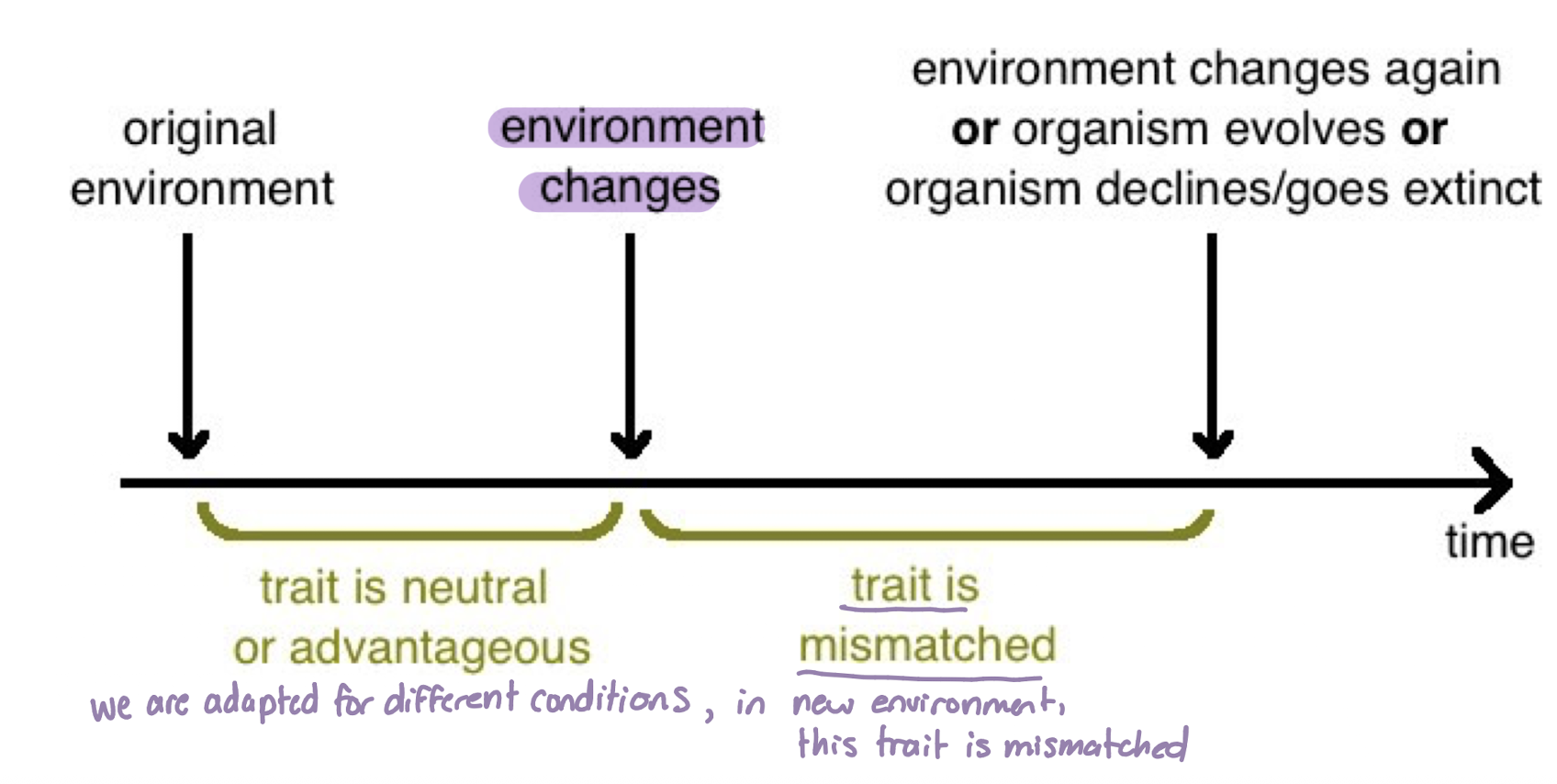
Mismatch Hypothesis
many illnesses arise because we are adapted to very different conditions, so a trait in our current environment is mismatches
when a mismatch occurs, either the environment needs to change again, organism needs to evolve, or organism declines/goes extinct
the way we now work, live, and feed have evolved fairly recently, and we are not adapted to these circumstances
only 600 generations ago we were pre-agricultural and pre-industrial
Example of Pre-Agricultural Human Existence Today: Hadza
modern link to human existence and survival abandoned by most of humanity
hunter-gatherer society
no domesticated livestock, o large-scale agriculture (they grow and store their own food)
does not imply simplicity or unsophistication: they choose to maintain the ancestral lifestyle
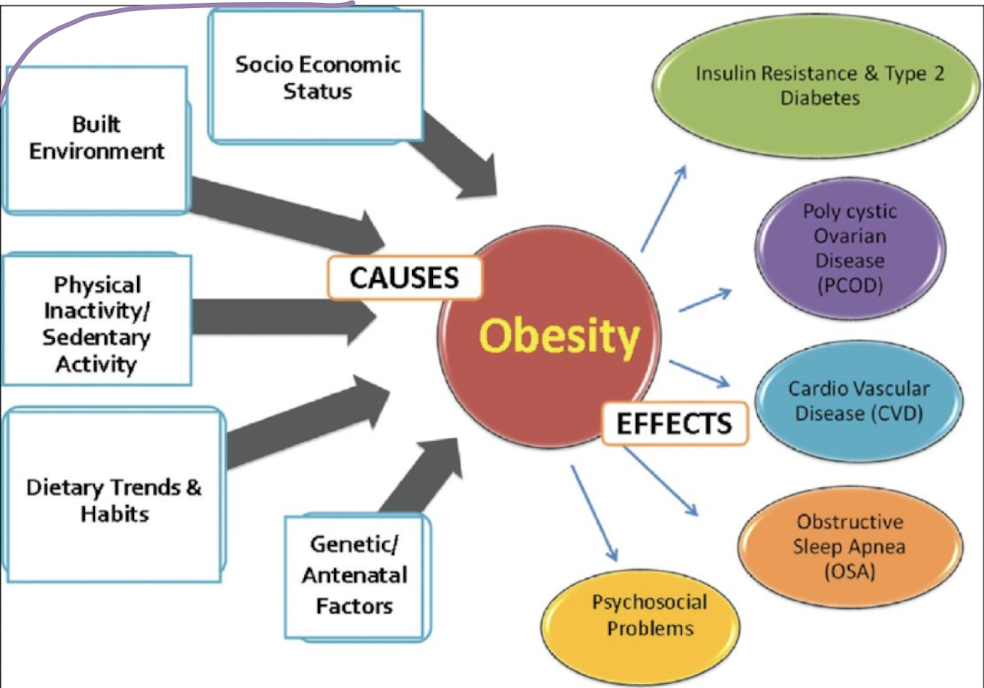
Other Influences on Obesity Besides Diet
socioeconomic status
built environment
physical inactivity/sedentary activity
genetic/antenatal factors
Diet has a profound impact on our health BUT diet is just one factor that leads to poor health outcomes: too complex to shame or judge those who experience those outcomes
 Note
Note  Flashcards (20)