IB Psychology 2 Depression Test
 Call Kai
 Learn
Learn Practice Test
 Spaced Repetition
 Match
Match Flashcards
 Knowt Play
1/53

There's no tags or description
Looks like no tags are added yet.
Name | Mastery | Learn | Test | Matching | Spaced | Call with Kai |
|---|
No analytics yet
Send a link to your students to track their progress
54 Terms
Name a study that might be a Biological Depressive study, explain how its biological.
Caspi et al. (2003), which investigates the interaction between the serotonin transporter gene and stressful life events. This study is biological as it examines how genetic predisposition to depression interacts with environmental stressors, impacting serotonin levels and mood regulation.
Name a study that might be a Cognitive Depressive study, explain how its cognitive.
Seligman and his dogs; shows the cognitive process of developing a trait such as learned helplessness which can lead to depression when individuals feel they cannot control their environment.
Name a study that might be a Sociocultural Depressive study, explain how its sociocultural.
Parker et. al; it’s sociocultural as it examine how different cultures view depression differently and blame different factors for it, example: Chinese more health related problems “caused” their depression while Westerns believed it was due to expressing more “emotional” factors
Major Depressive Disorder is heterogeneous in its symptoms but not prognosis
False
One of the symptoms you HAVE to experience when having depression is disturbance with sleep
False
According to the DSM-5, depression affects mood and behavior but not cognition (eg. concentration, focus or decision making).
False
If one clinical psychologist diagnoses a person with depression, others would also likely provide the same diagnosis.
False
Name 6 of Beck’s Cognitive Distortions of Depression
Selective Abstraction
Minimisation
Personalisation
Arbitrary inference
Magnification
Overgeneralisation
What is Selective Abstraction (Beck’s CDD)?
Drawing conclusions on the basis of just one of many elements of a situation
What is Minimisation (Beck’s CDD)?
Downplaying the importance of a positive thought, emotion or event
What is Personalisation (Beck’s CDD)?
Attributing personal responsibility for events which aren’t even under a person’s control
What is Arbitrary Inference (Beck’s CDD)?
Drawing conclusion when there is little or no evidence
What is Magnification (Beck’s CDD)?
“Making a mountain out of a molehill” - blowing things out of proportion
What is Overgeneralisation (Beck’s CDD)?
Making sweeping conclusions based on a single event
What age range is more likely to become depressed? Young adults or Older People (60+)?
Young Adults
According to the DSM-5 men and women with depression often show different symptoms. In other words, it often “presents itself” differently based on gender.
TrueThese differences may include variations in behavior, emotional expression, and physical symptoms.
According to the DSM-5 depression is very rarely seen in adolescence. Onset is usually much later
False
What is Onset and what is it’s course?
In adolescence (peaks 20’s), episodes last 3 months to a year, can remit after one episode (sometimes won’t disappear, and can last for years)
What is Beck’s Cognitive Triad?
Personal = I’m bad/flawed (self)
Permanent = things will always be bas (future)
Pervasive = everything will be bad. (world)
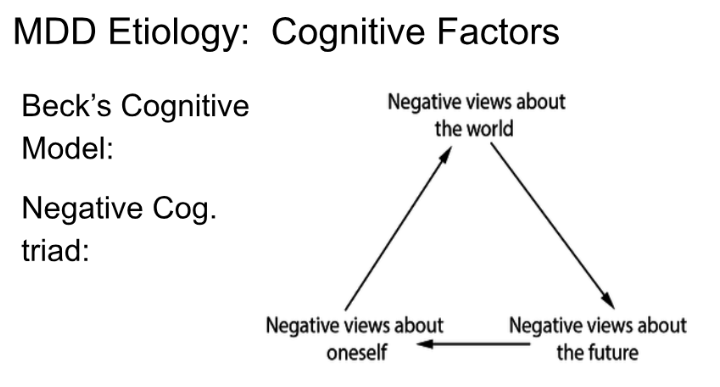
The course of depression is that it is lifelong; once it starts, it almost never resolves on its own without medication or treatment.
False
What are disorders Depression is often paired with?
Anxiety, substance abuse and trauma
What are the three etiologies of Depression?
Biological, sociocultural, cognitive
What kind of approach towards depression does Beck’s theory take?
Cognitive approach
DSM-V Criteria: Major Depressive Episode, 5(+) of 9 symptoms lasting 2 weeks (+):
Depressed mood most of the day
Less interest or pleasure in activities
Significant weight change (+ or -)
Too much or too little sleep
Psychomotor agitation or retardation
Fatigue
Excess feelings of worthlessness or guilt
Difficulty concentrating, or deciding
Recurrent thoughts of death or suicide
Major Depressive Disorder is dangerous because it increases the likelihood of suicide.
True
Childhood trauma, deprivation and neglect make people strong and resilient against depression later in life.
False
What were the conditions of Seligman’s dogs?
1) Dogs were exposed to inescapable shocks, leading to learned helplessness
2) Dogs exposed to escapable shocks learned to escape and avoid shocks, demonstrating resilience.
Seligman found that the dogs who got more shocks learned to be helpless, the ones with fewer shocks learned to escape later on. This statement is false because?
It suggests that the dogs experienced different experiences at the end but both dogs were allowed to escape their conditions showing how the dogs with the inescapable shocks picked learned helplessness
The “no control” dogs in Seligman’s study transferred (generalized) their helplessness to a novel situation.
True
What can be a take home message for Seligman’s study?
When an organism learns that it lacks control over one set of stressors they can overapply that learning to other situations/stressors- it can become a way of being
Beck’s cognitive triad of negative thinking involves self, future and world (like personal, permanent and pervasive)
True
There is a coherence among the ideas of attribution theory (FAE, pessimism, blame the victim, etc.) and Beck’s theory of cognitive distortions in depression
True
An arbitrary inference is when a person draws a conclusion that is not justified by evidence
True
Gertrude receives the following feedback on her essay: “95% A. Excellent thesis and support, logical and clear. Powerful examples throughout. Superlative use of metaphor and analogy. To improve, review comma rules.” Gertrude turns to her friend and says, “I am a terrible writer- no skill with commas.” Which of the Cognitive Distortions is she using?
Selective Thinking
“One bad element of a situation ruins the whole thing” is an example of what Cognitive Distortion?
Selective Thinking
“Drawing a negative conclusion without evidence” is an example of what Cognitive Distortion?
Arbitrary Inference
“Making a sweeping (pervasive) conclusion based on a specific event.” is an example of what Cognitive Distortion?
Overgeneralization
“Over-or under evaluating an event to maximize its negative or minimize its positive impact.” is an example of what Cognitive Distortion?
Magnification or Minimization
“Taking personal responsibility for negative events that is not warranted.” is an example of what Cognitive Distortion?
Personalization
In Cognitive Behavior Therapy (CBT) involves…
actively challenging distorted thinking using logic and evidence. Later clients are taught how to challenge their own destructive thinking habits.
Regardless of how good the environment is, if you employ negative cognitive distortions, it will be experienced as a harsh environment.
True
The thinking distortions found in depression by Beck (and others) are almost never found in people who do not have MDD
False
Three other cognitive causes for depression may be an
over sensitivity to negative stimuli (attention), a tendency to ruminate and thoughts of hopelessness.
There is evidence that some cognitive biases in depression have a basis in brain dysregulation. (note: “brain dysregulation” refers to brain activity that is not adaptive- the brain is behaving in a way that causes problems)
True
According to Auerback (2013) the three areas of brain dysregulation lie in the…
Amygdala reactivity, frontal lobe impairment re-negative stimuli, and left hemisphere less active than right hemisphere
Genes likely play little role in depression.
False, 40% heritability!
Because drugs that increase serotonin and norepinephrine tend to reduce depression in many people with severe cases, depression is thought to be caused by an imbalance of neurotransmitters
True
Brain plasticity is real- your … and the … can alter the brain
Behavior and environment
Behavior can influence the environment (and vice versa)
True
From what we have learned it is obvious that thinking distortions are the primary cause of depression
False
From wwhl it is obvious that the brain is the primary cause of depression
False
From wwhlit is obvious that the environment is the primary cause of depression.
False
Depression reflects a complex interaction of…
internal cognitive and brain factors as well as external, environmental factors
Given what you learned in your short presentations, the DSM-5 TR would not be very helpful for learning about the etiology of a disorder.
False, the DSM IS useful

