4.1-4.11 - Blood Bank (aka Immunohematology)
 Studied by 0 people
 Call Kai
 Learn
Learn Practice Test
 Spaced Repetition
 Match
Match Flashcards
 Knowt Play
1/224

There's no tags or description
Looks like no tags are added yet.
Name | Mastery | Learn | Test | Matching | Spaced | Call with Kai |
|---|
No analytics yet
Send a link to your students to track their progress
225 Terms
Genetics and Immunology of Blood Groups
What type of serological testing does the blood bank technologist perform when determining the blood group of a patient?
A. Genotyping
B. Phenotyping
C. Both genotyping and phenotyping
D. Polymerase chain reaction
B
Phenotyping, or the physical expression of a
genotype, is the type of testing routinely performed in the blood bank. An individual, for example, may
have the AO genotype but phenotypes as group A.
If anti-K reacts 3+ with a donor cell with a genotype KK and 2+ with a Kk cell, the antibody is demonstrating:
A. Dosage
B. Linkage disequilibrium
C. Homozygosity
D. Heterozygosity
Blood bank/Apply knowledge
A
Dosage is defined as an antibody reacting stronger with homozygous cells (such as KK) than with heterozygous cells (such as Kk). In addition to Kell, dosage effect is seen commonly with antigens M, N, S, s, Fya, Fyb, Jka, Jkb, and the antigens of the Rh system.
Carla expresses the blood group antigens Fya, Fyb and Xga. James shows expressions of none of these antigens. What factor(s) may account for the absence of these antigens in James?
A. Gender
B. Race
C. Gender and race
D. Medication
C
The frequency of Duffy antigens Fya and Fyb varies with race. The Fy(a−b−) phenotype occurs in almost 70% of African Americans and is very rare in whites.
The Xga antigen is X-linked and, therefore, expressed more frequently in women (who may inherit the antigen from either parent) than in men.
Which of the following statements is true?
a. An individual with the BO genotype is homozygous for B antigen
b. An individual with the BB genotype is homozygous for B antigen
c. An individual with the OO genotype is heterozygous for O antigen
d. An individual with the AB phenotype is homozygous for A and B antigens
B
An individual having the BB genotype has inherited
the B gene from both parents and, therefore, is
homozygous for B antigen.
Which genotype is heterozygous for C?
A. DCe/dce
B. DCE/DCE
C. Dce/dce
D. DCE/dCe
A
The genotype DCe/dce contains one C and one c
gene and is heterozygous for C and c antigens.
Which genotype(s) will give rise to the Bombay phenotype?
phenotype?
A. HH only
B. HH and Hh
C. Hh and hh
D. hh only
D
The Bombay phenotype will be expressed only when
no H substance is present. The Oh type is expressed
by the genotype hh. Bombays produce naturally
occurring anti-H, and their serum agglutinates group
O red cells in addition to red cells from groups A, B,
and AB persons.
Meiosis in cell division is limited to the ova and sperm producing four gametes containing what complement of DNA?
A. 1N
B. 2N
C. 3N
D. 4N
1N
A cell that is not actively dividing is said to be in:
A. Interphase
B. Prophase
C. Anaphase
D. Telophase
Interphase
Which of the following describes the expression of most blood group antigens?
A. AB
B. A or B
C. O
D. All are possible
Codominant
What blood type is not possible for an offspring of an AO and BO mating?
A. Direct/primary/first order
B. Probability
C. Random
D. Indirect/secondary/second order
All are possible
The alleged father of a child in a disputed case of paternity is blood group AB. The mother is group O and the child is group O. What type of exclusion is this?
A. Direct/primary/first order
B. Probability
C. Random
D. Indirect/secondary/second order
Indirect/secondary/second order
If the frequency of gene Y is 0.4 and the frequency of gene Z is 0.5, one would expect that they should occur together 0.2 (20%) of the time. In actuality,they are found together 32% of the time. This is an example of:
A. Crossing over
B. Linkage disequilibrium
C. Polymorphism
D. Chimerism
Linkage disequilibrium
In the Hardy-Weinberg formula, p^2 represents:
A. The heterozygous population of one allele
B. The homozygous population of one allele
C. The recessive allele
D. The dominant allele
The homozygous population of one allele
In this type of inheritance, the father carries the trait on his X chromosome. He has no sons with the trait because he passed his Y chromosome to his sons; however, all his daughters will express the trait.
A. Autosomal dominant
B. Autosomal recessive
C. X-linked dominant
D. X-linked recessive
X-linked dominant
Why do IgM antibodies, such as those formed against the ABO antigens, have the ability to directly agglutinate red blood cells (RBCs) and cause visible agglutination?
A. IgM antibodies are larger molecules and have the
ability to bind more antigen
B. IgM antibodies tend to clump together more
readily to bind more antigen
C. IgM antibodies are found in greater
concentrations than IgG antibodies
D. IgM antibodies are not limited by subclass
specificity
IgM antibodies are larger molecules and have the ability to bind more antigen
Which of the following enhancement mediums decreases the zeta potential, allowing antibody and antigen to come closer together?
A. LISS
B. Polyethylene glycol
C. Polybrene
D. ZZAP
LISS
This type of antibody response is analogous to an anamnestic antibody reaction.
A. Primary
B. Secondary
C. Tertiary
D. Anaphylactic
Secondary
Which antibodies to a component of complement are contained in the rabbit polyspecific antihuman globulin reagent for detection of in vivo sensitization?
A. Anti-IgG and anti-C3a
B. Anti-IgG and anti-C3d
C. Anti-IgG and anti-IgM
D. All of these options
Anti-IgG and anti-C3d
ABO Blood Group System
Which of the following distinguishes A1 from A2 blood groups?
A. A2 antigen will not react with anti-A, A1 will
react strongly (4+)
B. An A2 person may form anti-A1; an A1 person
will not form anti-A1
C. An A1 person may form anti-A2, an A2 person
will not form anti-A1
D. A2 antigen will not react with anti-A from a
nonimmunized donor; A1 will react with any
anti-A
An A2 person may form anti-A1; an A1 person will not form anti-A1
A patient's serum is incompatible with O cells. The patient RBCs give a negative reaction to anti-H lectin. What is the most likely cause of these results?
A. The patient may be a subgroup of A
B. The patient may have an immunodeficiency
C. The patient may be a Bombay
D. The patient may have developed alloantibodies
The patient may be a Bombay
What antibodies are formed by a Bombay individual?
A. Anti-A and anti-B
B. Anti-H
C. Anti-A,B
D. Anti-A, B, and H
Anti-A, B, and H
Acquired B antigens have been found in:
A. Bombay individuals
B. Group O persons
C. All blood groups
D. Group A persons
Group A persons
Blood is crossmatched on an A positive person with a negative antibody screen. The patient received a transfusion of A positive RBCs 3 years ago. The donors chosen for crossmatch were A positive. The crossmatch was run on the Ortho Provue and yielded 3+ incompatibility. How can these results be explained?
A. The patient has an antibody to a low-frequency
antigen
B. The patient has an antibody to a high-frequency
antigen
C. The patient is an A2 with anti-A1
D. The patient is an A1 with anti-A2
The patient is an A2 with anti-A1
A patient's red cells forward as group O, serum agglutinates B cells (4+) only. Your next step would be:
A. Extend reverse typing for 15 minutes
B. Perform an antibody screen including a roomtemperature
incubation
C. Incubate washed red cells with anti-A1 and
anti-A,B for 30 minutes at room temperature
D. Test patient's red cells with Dolichos biflorus
Incubate washed red cells with anti-A1 and anti-A,B for 30 minutes at room temperature
Which typing results are most likely to occur when a patient has an acquired B antigen?
A. Anti-A 4+, anti-B-3+, A1 cells neg, B cells neg
B. Anti-A 3+, anti-B neg, A1 cells neg, B cells neg
C. Anti-A 4+, anti-B 1+, A1 cells neg, B cells 4+
D. Anti-A 4+, anti-B 4+, A1 cells 2+, B cells neg
Anti-A 4+, anti-B 1+, A1 cells neg, B cells 4+
Which blood group has the least amount of H antigen?
A. A1B
B. A2
C. B
D. A1
A1B
What type RBCs can be transfused to an A2 person with anti-A1?
A. A only
B. A or O
C. B
D. AB
A or O
What should be done if all forward and reverse
ABO results as well as the autocontrol are positive?
A. Wash the cells with warm saline, autoadsorb the
serum at 4°C
B. Retype the sample using a different lot number
of reagents
C. Use polyclonal typing reagents
D. Report the sample as group AB
What should be done if all forward and reverse ABO results are negative?
A. Perform additional testing such as typing with
anti-A1 lectin and anti-A,B
B. Incubate at 22°C or 4°C to enhance weak
expression
C. Repeat the test with new reagents
D. Run an antibody identification panel
Incubate at 22°C or 4°C to enhance weak expression
N-acetyl-D-galactosamine is the immunodominant carbohydrate that reacts with:
A. Arachis hypogaea
B. Salvia sclarea
C. Dolichos biflorus
D. Ulex europeaus
Dolichos biflorus
A stem cell transplant patient was retyped when she was transferred from another hospital. What is the most likely cause of the following results?
Patient cells: Anti-A, neg; Anti-B, 4+
Patient serum: A1 cells, neg; B cells, neg
A. Viral infection
B. Alloantibodies
C. Immunodeficiency
D. Autoimmune hemolytic anemia
Immunodeficiency
What reaction would be the same for an A1 and an A2 person?
A. Positive reaction with anti-A1 lectin
B. Positive reaction with A1 cells
C. Equal reaction with anti-H
D. Positive reaction with anti-A,B
Positive reaction with anti-A,B
A female patient at 28 weeks' gestation yields the following results:
Patient cells: Anti-A 3+; Anti-B 4+
Patient serum: A1 cells, neg; B cells 1+; O cells, 1+
A. Hypogammaglobulinemia
B. Alloantibody in patient serum
C. Acquired B
D. Weak subgroup
Alloantibody in patient serum
Which condition would most likely be responsible for the following typing results?
Patient cells: Anti-A, neg; Anti-B, neg
Patient serum: A1 cells, neg; B cells, 4+
A. Immunodeficiency
B. Masking of antigens by the presence of massive
amounts of antibody
C. Weak or excessive antigen(s)
D. Impossible to determine
Weak or excessive antigen(s)
Which of the following results is most likely discrepant?
Anti-A, neg; Anti-B, 4+
A1 cells, neg; B cells, neg
A. Negative B cells
B. Positive reaction with anti-B
C. Negative A1 cells
D. No problem with this typing
Negative A1 cells
A 61-year-old male with a history of multiple myeloma had a stem cell transplant 3 years ago. The donor was O positive and the recipient was B positive. He is admitted to a community hospital for fatigue and nausea. Typing results reveal the following:
Anti-A = 0; Anti-B =0; Anti-A,B = 0; Anti-D = 4+; A1 cells = 4+; B cells = 0
How would you report this type?
A. O positive
B. B positive
C. A positive
D. Undetermined
Undetermined
Rh Blood Group System
A complete Rh typing for antigens C, c, D, E, and e revealed negative results for C, D, and E. How is the individual designated?
Rh negative
How is an individual with genotype Dce/dce classified?
Rh positive
If a patient has a positive direct antiglobulin test, should you perform a weak D test on the cells?
No, the cells are already coated with antibody
Which donor unit is selected for a recipient with anti-c?
r'ry
Which genotype usually shows the strongest reaction with anti-D?
D-/D-
Why is testing for Rh antigens and antibodies different from ABO testing?
a. ABO reactions are primarily due to IgM antibodies and usually occur at room temperature; Rh antibodies are IgG and agglutination usually requires a 37°C incubation and enhancement media
b. ABO antigens are attached to receptors on the outside of the red cell and do not require any special enhancement for testing; Rh antigens are loosely attached to the red cell membrane and require enhancement for detection
c. Both ABO and Rh antigens and antibodies have similar structures, but Rh antibodies are configured so that special techniques are needed to facilitate binding to Rh antigens
d. There is no difference in ABO and Rh testing; both may be conducted at room temperature with no special enhancement needed for reaction
ABO reactions are primarily due to IgM antibodies and usually occur at room temperature; Rh antibodies are IgG and agglutination usually requires a 37°C incubation and enhancement media
Testing reveals a weak D that reacts 1+ after indirect antiglobulin testing (IAT). How is this result classified?
Rh positive
What is one possible genotype for a patient who develops anti-C antibody?
rr
A patient developed a combination of Rh antibodies: anti-C, anti-E, and anti-D. Can compatible blood be found for this patient?
rr blood could be used without causing a problem
A patient tests positive for weak D but also appears to have anti-D in his serum. What may be the problem?
A D mosaic may make antibodies to missing antigen parts
Which offspring is not possible from a mother who is R1R2 and a father who is R1r?
DcE/DcE
Why is testing a pregnant woman for weak D not required?
An Rh-positive fetus may yield false positive results in a fetal maternal bleed
What antibodies could an R1R1 make if exposed to R2R2 blood?
Anti-E and anti-c
What does the genotype —/—represent in the Rh system?
Rh null
What techniques are necessary for weak D testing?
37°C incubation + IAT
A patient types as AB and appears to be Rh positive on slide typing. What additional tests should be performed for tube typing?
Rh negative control
According to the Wiener nomenclature and/or genetic theory of Rh inheritance:
There are multiple alleles at a single complex locus that determine each Rh antigen
The Wiener nomenclature for the E antigen is:
rh"
A physician orders 2 units of leukocyte-reduced red blood cells. The patient is a 55-year-old male with anemia. He types as an AB negative, and his antibody screen is negative. There is only 1 unit of AB negative in inventory. What is the next blood type that should be given?
A negative
Which technology may report an Rh-weak D positive as Rh negative?
Gel System
A patient has the Lewis phenotype Le(a−b−). An antibody panel reveals the presence of anti-Lea. Another patient with the phenotype Le(a−b+) has a positive antibody screen; however, a panel reveals no conclusive antibody. Should anti-Lea be considered as a possibility for the patient with the Le(a−b+) phenotype?
Anti-Lea is not a likely antibody because even Leb individuals secrete some Lea
A technologist is having great difficulty resolving an antibody mixture. One of the antibodies is anti-Lea. This antibody is not clinically significant in this situation, but it needs to be removed to reveal the possible presence of an underlying antibody of clinical significance. What can be done?
Neutralize the serum with saliva
What type of blood should be given to an individual who has an anti-Leb that reacts 1+ at the IAT phase?
Blood that is negative for the Leb antigen
Which of the following statements is true concerning the MN genotype?
Dosage effect may be seen for both M and N antigens
Anti-M is sometimes found with reactivity detected at the immediate spin (IS) phase that persists in strength to the IAT phase. What is the main testing problem with a strong anti-M?
Anti-M may not allow detection of a clinically significant antibody
A patient is suspected of having paroxysmal cold hemoglobinuria (PCH). Which pattern of reactivity is characteristic of the Donath-Landsteiner antibody, which causes this condition?
The antibody attaches to RBCs at 4°C and causes hemolysis at 37°C
How can interfering anti-P1 antibody be removed from a mixture of antibodies?
Neutralization with hydatid cyst fluid
Which antibody is frequently seen in patients with warm autoimmune hemolytic anemia?
Anti-e
An antibody shows strong reactions in all test phases. All screen and panel cells are positive. The serum is then tested with a cord cell and the reaction is negative. What antibody is suspected?
Anti-I
Which group of antibodies is commonly found as cold agglutinins?
Anti-M, anti-N
Which of the following antibodies characteristically gives a refractile mixed-field appearance?
Anti-Sda
What does the 3+3 rule ascertain?
95% confidence that the correct antibody has been identified
The k (Cellano) antigen is a high-frequency antigen and is found on most red cells. How often would one expect to find the corresponding antibody?
Rarely, because most individuals have the antigen and therefore would not develop the antibody
Which procedure would help to distinguish between an anti-e and anti-Fya in an antibody mixture?
Run an enzyme panel
Which characteristics are true of all three of the following antibodies: anti-Fya, anti-Jka, and anti-K?
Detected at the IAT phase; may cause hemolytic disease of the newborn and hemolytic transfusion reactions
A patient is admitted to the hospital. Medical records indicate that the patient has a history of anti-Jka. When you performed the type and screen, the type was O positive and screen was negative. You should:
Crossmatch using units negative for Jka antigen
A technologist performs an antibody study and finds 1+ and weak positive reactions for several of the panel cells. The reactions do not fit a pattern. Several selected panels and a patient phenotype do not reveal any additional information. The serum is diluted and retested, but the same reactions persist. What type of antibody may be causing these results?
High titer low avidity
An antibody is detected in a pregnant woman and is suspected of being the cause of fetal distress. The antibody reacts at the IAT phase but does not react with DTT-treated cells. This antibody causes in vitro hemolysis. What is the most likely antibody specificity?
Anti-Lub
What sample is best for detecting complement-dependent antibodies?
Serum stored at 4°C for no longer than 48 hours
Which antibody would not be detected by group O screening cells?
Anti-A1
Refer to Panel 1. Which antibody is most likely implicated?
Anti-Jkb
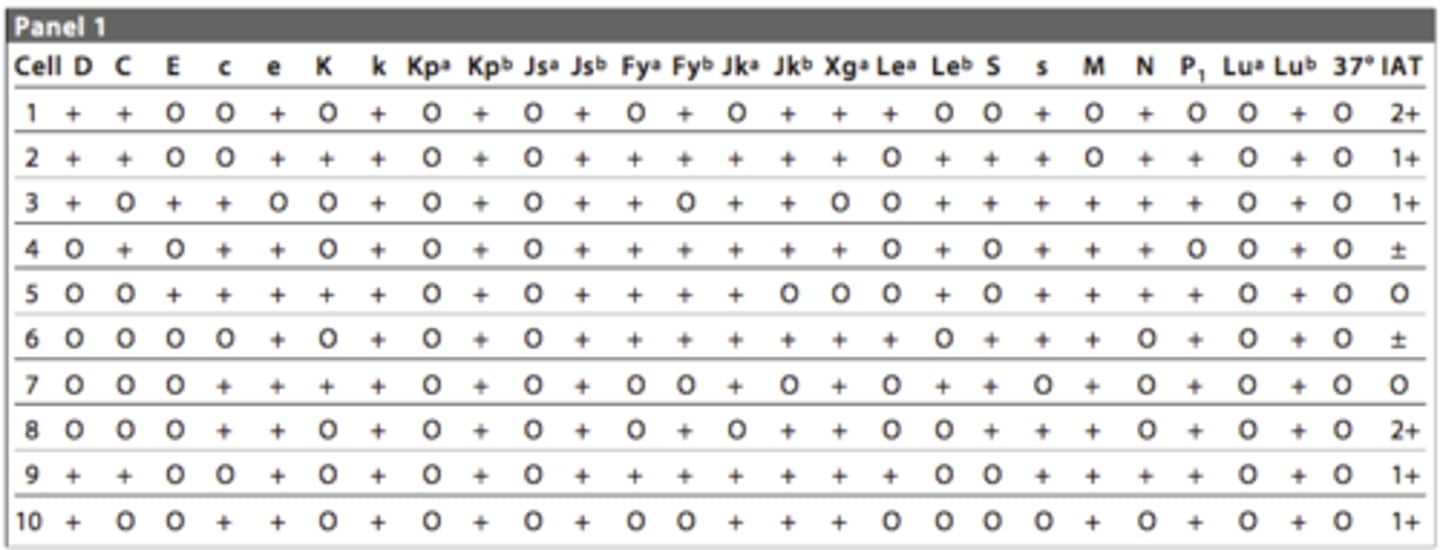
Refer to Panel 2. Which antibody specificity is most likely present?
Anti-C and anti-K
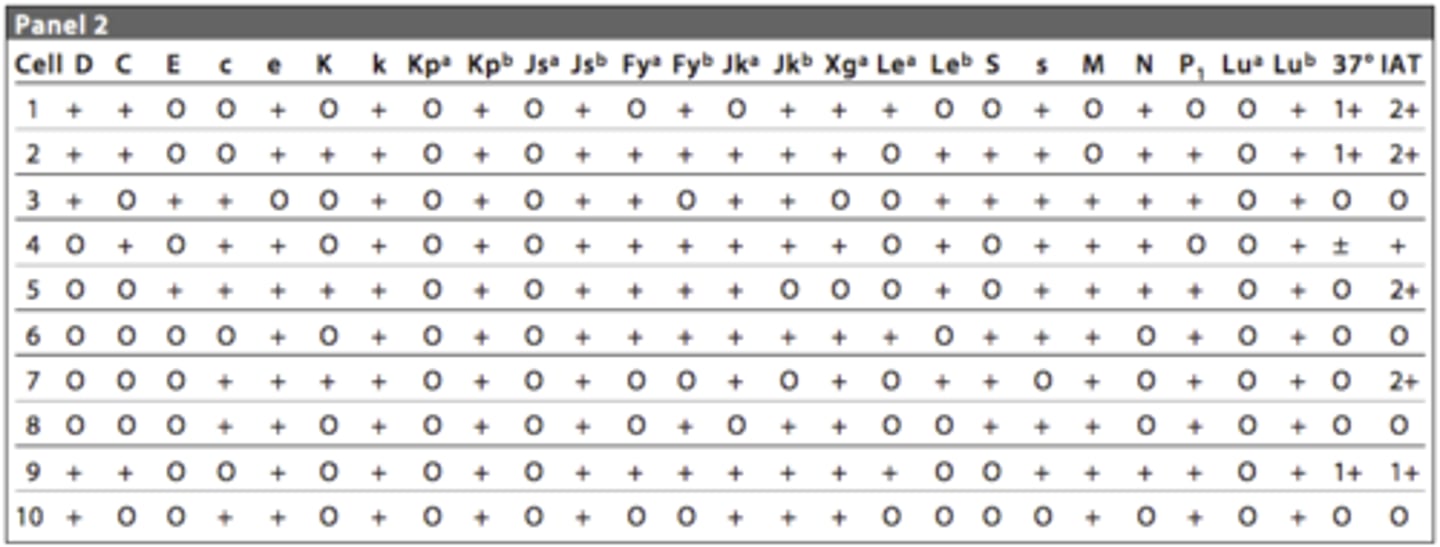
On Panel 2, which of the following antibodies could not be ruled out?
Anti-C
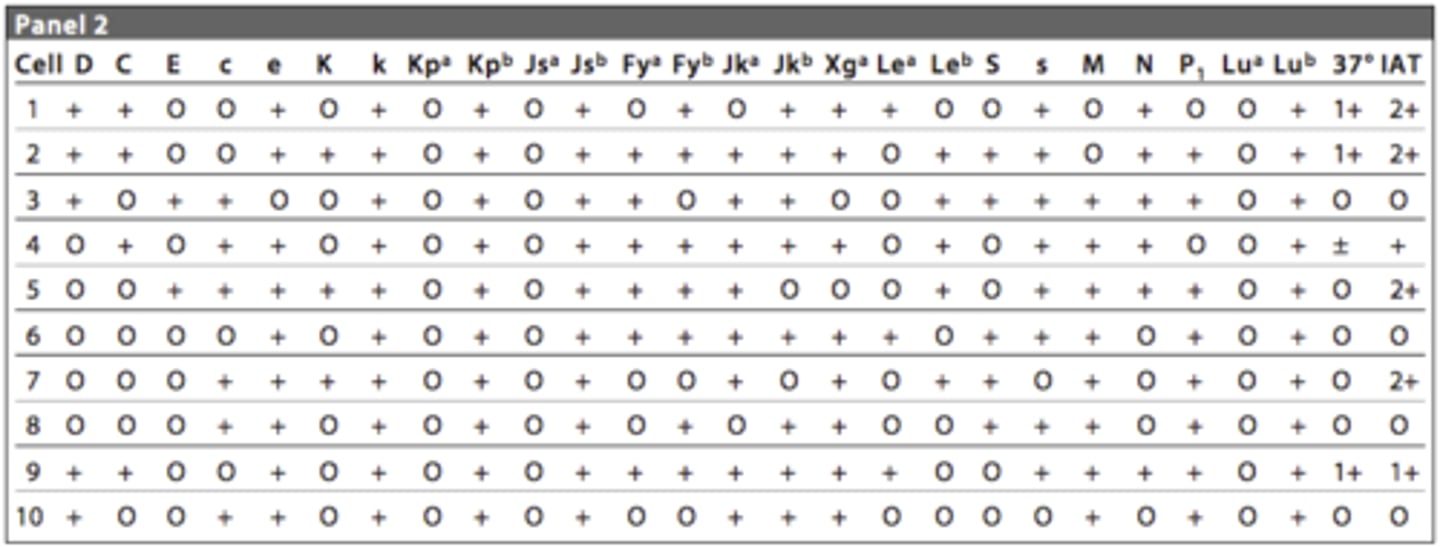
On Panel 2, which cells are homozygous for C?
1, 2, 9
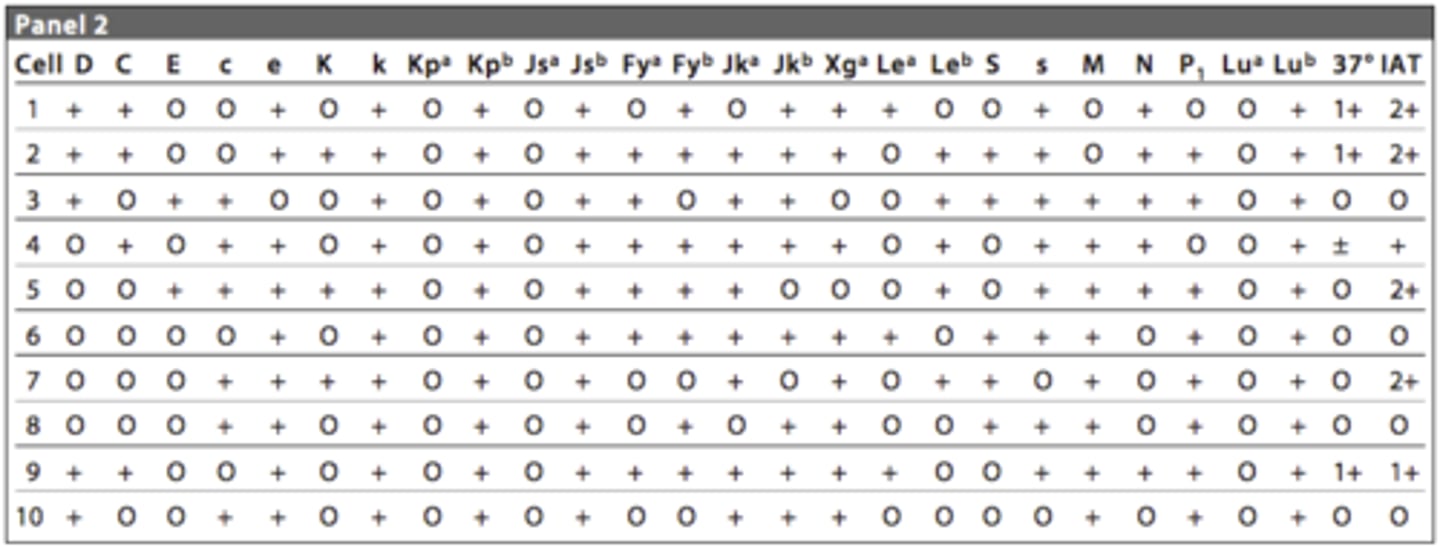
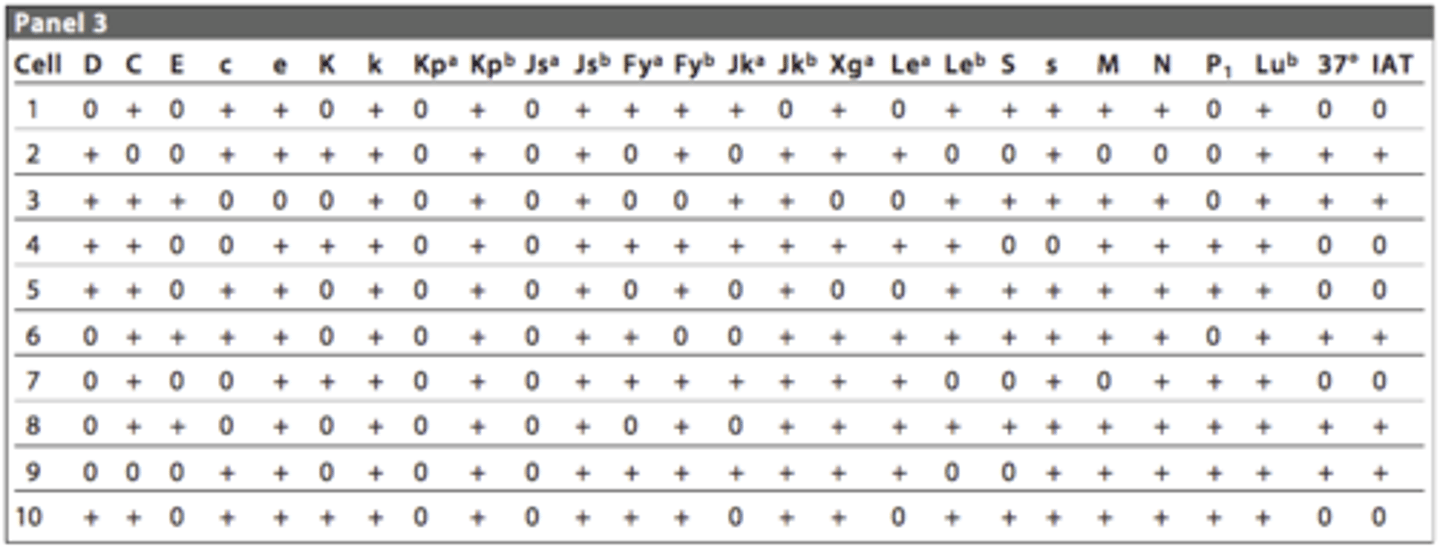
A 77-year-old female is admitted to a community hospital after a cardiac arrest. History includes an abdominal aortic aneurysm 2 years ago in which she received 6 units of packed cells. Her blood type is A positive and antibody screen is positive at AHG phase in screening cells II and III. A panel is performed using LISS. Referring to panel 3, which antibodies are likely implicated?
E and c
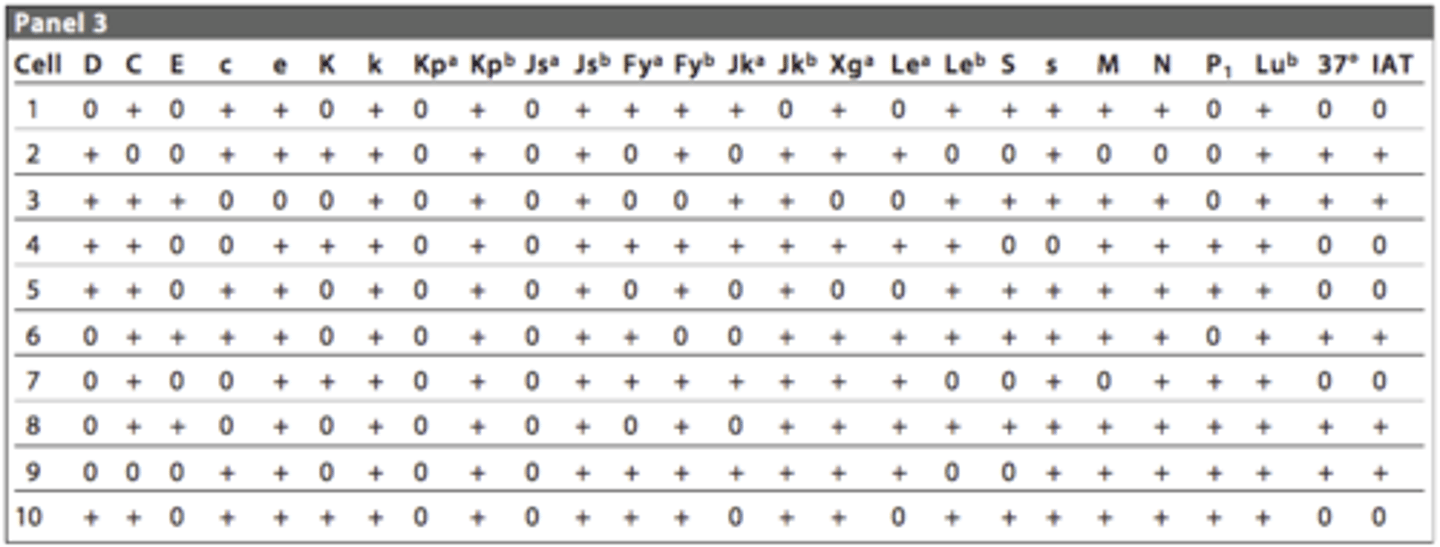
What observation is apparent with one of the antibodies present on Panel 3?
One antibody is only reacting with homozygous cells
SITUATION: An emergency trauma patient requires transfusion. Six units of blood are ordered stat. There is no time to draw a patient sample. O-negative blood is released. When will compatibility testing be performed?
Compatibility testing will be performed when a patient sample is available
How would autoantibodies affect compatibility testing?
ABO, Rh, antibody screen, and crossmatch may show abnormal results
An antibody screen is reactive at IAT phase of testing using a three-cell screen and the autocontrol is negative. What is a possible explanation for these results?
High-frequency alloantibody or a mixture of alloantibodies
What does a minor crossmatch consist of?
Recipient red cells and donor plasma
Can crossmatching be performed on October 14th using a patient sample drawn on October 12th?
Yes, a new sample would not be needed
A type and screen was performed on a 32-year-old woman, and the patient was typed as AB negative. There are no AB-negative units in the blood bank. What should be done?
Check inventory of A-, B-, and O-negative units
What ABO types may donate to any other ABO type?
O negative
What type(s) of red cells is (are) acceptable to transfuse to an O-negative patient?
O negative
A technologist removed 4 units of blood from the blood bank refrigerator and placed them on the counter. A clerk was waiting to take the units for transfusion. As she checked the paperwork, she noticed that one of the units was leaking onto the counter. What should she do?
Discard the unit
A donor was found to contain anti-K using pilot tubes from the collection procedure. How would this affect the compatibility test?
Compatibility testing would not be affected
Which of the following is not a requirement for the electronic crossmatch?
There are concordant results of at least one determination of the recipient's ABO type on file
A patient showed positive results with screening cells and 4 donor units. The patient autocontrol was negative. What is the most likely antibody?
Anti-k
Screening cells and major crossmatch are positive on IS only, and the autocontrol is negative. Identify the problem.
Cold alloantibody
Six units are crossmatched. Five units are compatible, one unit is incompatible, and the recipient's antibody screen is negative. Identify the problem:
Donor unit may have a positive DAT
An incompatible donor unit is found to have a positive DAT. What should be done with the donor unit?
Discard the unit
 Note
Note  Flashcards (42)