KNES 363 - Midterm Review (Theory)
 Studied by 0 people
 Call Kai
 Learn
Learn Practice Test
 Spaced Repetition
 Match
Match Flashcards
 Knowt Play
1/67

There's no tags or description
Looks like no tags are added yet.
Name | Mastery | Learn | Test | Matching | Spaced | Call with Kai |
|---|
No analytics yet
Send a link to your students to track their progress
68 Terms
What does the moment of inertia determine?
the resistance of an object to rotational acceleration
The more closely mass is distributed about the axis of rotation, the ____________ it is to produce angular acceleration.
easier
What is the function of the axial skeleton vs. the appendicular skeleton?
axial → protect internal organs, maintain posture
appendicular → movement, locomotion, object manipulation
What is trabecular bone? What are other names for it? Where is it found? Is it high or low porosity? What are trabeculae?
type of bone
cancellous or spongy bone
found in cuboidal bones, flat bones, ends of long bones
high porosity (75%-95%)
trabeculae are plates + rods formed by the bone matrix, sometimes organized orthogonally, more often randomly arranged
What is cortical bone? What is another name for it? Where is it found? Is it high or low porosity? What are Haversian canals? Volkmann’s canals? Resorption canals?
dense bone
compact bone
found in shafts of long bones + forming shells around vertebral bodies + other spongy bone
low porosity (5%-10%)
Haversian canals → canals aligned longitudinally, contain capillaries and nerves
Volkmann canals → short, transverse aligned canals connecting Haversian canals, contain blood vessels + nerves
Resorption cavities → temporary spaces created by osteoclasts during initial stage of bone remodeling
How much cardiac output does our bone receive?
5-10%
What is lamellar bone?
slowly-formed, highly organized
parallel layers of anisotropic matrix of mineral crystals + collagen fibers
What is woven bone?
quickly formed, poorly organized
randomly arranged mineral + collagen fibers
sites of fracture healing, tendon/ligament attachments
What is primary bone?
new tissue laid down on existing surface
circumferential lamellar bone + plexiform bone
What is secondary bone?
bone resulting from remodeling
in compact bone consists of secondary osteons (Haversion canal)
most adult bone is secondary bone
What are the components of bone and their percentages?
water (25%)
organic matrix (32%)
apatite mineral (calcium phosphates) (43%)
What are osteoclasts? What is their function?
multi-nucleated cells formed by the fusion of monocytes originating in bone marrow
resorb bone
What are osteoblasts? What is their function?
mononuclear cells that produce osteoid (organic portion of the bone matrix)
osteoblasts form bone
What are osteocytes? What is their function? Where are they located?
osteoblasts that have become buried in bone
mechanosensory cells that communicate with each other via dendritic processes called canaliculi
sit in cavities called lacunae
What is the difference between bone modeling and bone remodeling?
Bone modeling reshapes a bone's overall size and shape by independently adding or removing bone on different surfaces to adapt to mechanical loads during growth and development, while bone remodeling replaces old or damaged bone with new bone
What is bone modeling? What changes does it produce and when is it the most active? What influences it?
independent action of osteoclasts + osteoblasts on different surfaces
produces changes in bone size + shape
highly active during growth + development + greatly decreases after skeletal maturity
highly influenced by physical activity during childhood
What is bone remodeling? What changes does it produce and when does it occur?
the sequential, coupled action of osteoclasts and osteoblasts
does not influence bone size + shape
removes a portion of old bone + replaces it with newly formed bone
occurs throughout life but decreases after growth
What is the A-R-F sequence?
A - activation: differentiation of precursor cells to produce osteoclasts (time required is 3 days)
R - resorption: osteoclasts start to resorb bone (time is about 30 days)
F - formation: osteoblasts appear and begin to refill, but leave a Haversian canal to support metabolism of the bone remodeling unit + carry nutrients (time is about 3 months)
Loss of estrogen in females during menopause _____________ bone remodeling.
increases
What is stress? What is the formula for stress? What are the units of stress?
intensity of the force in a given area
sigma = F/A
units: Pa (N/m2)
What are the conversions for 1 N/m2, 1 N/cm2, and 1 N/mm2 in Pa and MPa?
1 N/m2 = 1 Pa = 1 × 10⁻⁶ MPa
1 N/cm2 = 1 × 10⁴ Pa = 1 × 10⁻² MPa
1 N/mm2 = 1 ×10⁶ Pa = 1 MPa
What is axial or “normal” stress?
the internal force per unit area acting on a material along its axis (caused by an axial force)
can be compressive (-) or tensile (+)
What is shear stress? What is the formula for shear stress?
measure of force acting parallel to a material’s cross-sectional area, causing layer to slide past one another
tau = F/A
At what angles does the maximum and minimum axial/normal stress occur, respectively?
max stress occurs at 0 degrees
min stress occurs at 90 degrees
At what angle does the maximum shear stress occur at?
± 45 degrees
What is shear stress at maximum or minimum normal stress?
0 at both
What are principal stresses? What angle separates principal stresses?
the normal stress acting on principal planes, which are orientations where the shear stress is 0, stresses are oriented 90 degrees apart
What is strain? What is the formula? What are the units?
the deformation of an object relative to its original size when subjected to a force (stress)
epsilon = (l - original length)/original length
unitless
What type of measurements are stress and strain?
tensor → have magnitude and 2 directions
How do axial (normal) stress and shear stress affect the size and shape of an object?
axial (normal) stress changes the size of an object by compression or tension
shear stress changes the shape of an object
What is Poisson’s ratio? What is the formula?
a material loaded in one direction will undergo strains both parallel and perpendicular to the direction of load (object tries to conserve volume)
v = - epsilont (transverse strain) / epsilona (axial strain)
What is the elastic (Young’s) modulus? What are the units?
E = sigma (axial stress) / epsilon (strain)
units: N/m2 or Pa
What does a higher elastic (Young’s) modulus mean?
stiffer material that can more easily resist elastic deformation
What is Hooke’s law? What is the formula?
defines the linear relationship between stress + strain
sigma (normal stress) = (E)(epsilon (strain))
Modulus is a ____________ property, it depends only on _____________.
material, material
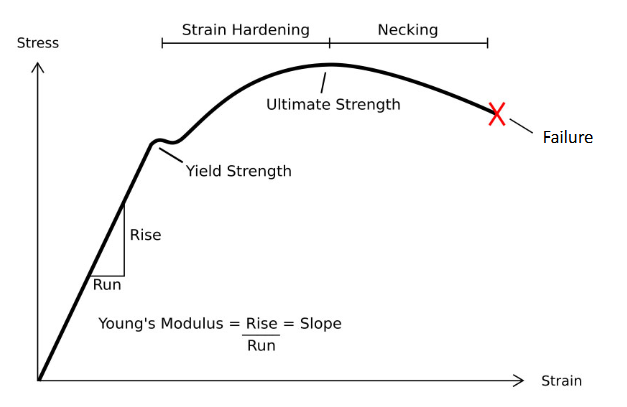
What is yield strength? What is ultimate strength? What is failure? What is toughness? Describe where each of these properties are on a stress-strain curve.
yield strength → stress at which the material will no longer be able to return to its original shape when unloaded (material is damaged), occurs when curve becomes non-linear
ultimate strength → maximum stress a material can withstand before failure (maximum stress point on the graph)
failure → point where the material fractures or ruptures (unable to withstand load), (last point on the curve)
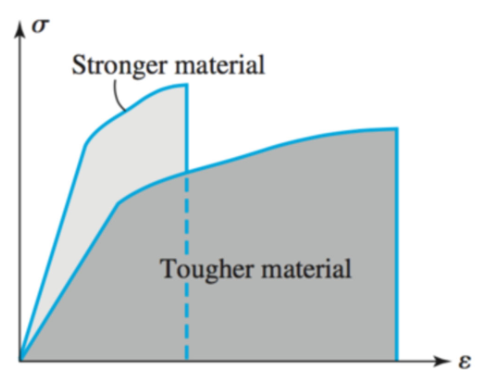
toughness → total energy a material can absorb prior to failure (area under the stress-strain curve)
What is the difference between strength and toughness?
strength is a material’s resistance to deformation, toughness is a material’s ability to absorb energy and deform without fracturing
What is an isotropic material? What is an anisotropic material? What is the difference between transverse isotropy and orthotropy?
isotropic → has uniform physical + mechanical properties in all directions
anisotropic → properties that vary with direction
transverse isotropy → material property where a material's properties are the same in all directions within a specific plane but are different in the direction perpendicular to that plane
orthotropy → type of anisotropy where properties are unique along 3 perpendicular axes
What directional dependence do trabecular bone and cortical bone have?
trabecular → orthotropy
cortical → transverse isotropy
What is the difference between elastic deformation and plastic deformation?
elastic → if the stress applied is equal or less than the elastic limit (yield strength), the deformation will be completely recovered when the load is removed
plastic → if the stress applied is beyond the elastic limit, the deformation will be permanent (material has been damaged)
Between cortical bone and trabecular bone, which is stronger and which is tougher?
cortical → stronger
trabecular → tougher
What are the 4 characteristics of loading that primarily affect the mechanical properties of bone?
1) sample orientation
2) sample hydration
3) strain rate
4) loading mode (compression, tension, bending, torsion)
How does sample orientation affect the mechanical properties of bone?
bone is stiffer + stronger in the longitudinal direction than the transverse direction (anisotropic)
How does sample hydration affect the mechanical properties of bone?
hydrated bone is more ductile (can deform significantly before fracture) and tough, dehydrated bone is stiffer and more brittle
How does strain rate affect the mechanical properties of bone? What is viscoelasticity?
bone is stiffer and stronger the faster you load it (viscoelastic, less strain), but also becomes more brittle
material has time-dependent mechanical behaviour (deformation of a material is dependent on the rate at which the force is applied)
Cortical bone is strongest in ___________ >____________ >____________. Trabecular bone is weaker in both _____________ and _____________.
compression > tension > shear, tension, compression
What is beam theory? What are the assumptions of beam theory?
theory used to calculate the normal and shear stresses and strains acting on a cross-section of bone
assumptions:
1) beam has a constant cross sectional geometry
2) beam has a longitudinal plane of symmetry
3) beam is made of homogenous material
What is the formula for the average normal strain on a cross-section of a bone produced by axial loading?
epsilon = delta length / original length or F/AE (where E is Young’s modulus)
What is I?
the area moment of inertia
What is the formula for the normal stress on a cross-section of bone produced by bending?
sigma = Mx/I (where M is the moment at the cross-section, x is the position and I is the areal moment of inertia)
What is the formula for the normal strain on a cross-section of bone produced by bending?
epsilon = Mx/EI (where E is the elastic or Young’s modulus)
What is the formula for the normal stress on a cross-section of bone produced by axial loading and bending?
the sum of the two normal stress components
sigma = F/A + Mx/I
What are the 3 types of cartilage? What are the characteristics of each?
1) hyaline cartilage → most prevalent cartilage found in adults, includes the articular cartilage that covers joint surfaces
2) elastic cartilage → found in the external ear, eustachian tubes, + epiglottis, is more flexible and elastic than hyaline cartilage
3) fibrocartilage → found in intervertebral disks, meniscus, tendon-bone attachments, can form when hyaline cartilage is damaged
What is the composition of the extra-cellular matrix of articular cartilage? What produces the ECM?
mostly type II collagen + proteoglycans (mostly aggrecan), 20-35%
produced by cartilage cells (chondrocytes) that live inside lacunae
majority made up of interstitial fluid/water (65-80%)
What do chondrocytes do when they are metabolically active? What signals them to be active? How do they get nutrients, and where do they get them from?
synthesis + degradation of the ECM (for structure of cartilage)
they are soft, so mechanical compression signals them to be active
gets nutrition from synovial fluid, which can circulate better when the joint is compressed + then unloaded (exercise)
What are the characteristics of proteoglycans? What do they provide to the cartilage?
negatively-charged, hydrophilic
provide high compressive strength
Is cartilage structure homogenous or heterogenous?
heterogenous
What are the 4 zones of articular cartilage?
1) superficial tangential zone (STZ)
2) middle zone
3) deep zone
4) calcified zone
Which zone of articular cartilage is 40-60% of the thickness, has a randomly arranged collagen orientation, has the highest proteoglycan content, and the chondrocytes are round + randomly distributed?
middle zone
What zone of articular cartilage has tangential fibers, is 10-20% of the tissue thickness, has the highest collagen + water content, the lowest proteoglycan content, collagen fibers oriented parallel to the surface and the chondrocytes are elliptical with their axes aligned with the surface?
superficial tangential zone (STZ)
What zone of articular cartilage is a layer of calcified cartilage anchored to underlying subchondral bone?
calcified zone
What zone of articular cartilage is 30% of the tissue thickness, has collagen oriented perpendicular to the surface and the chondrocytes are arranged in a columnar fashion perpendicular to the calcified cartilage?
deep zone
Is cartilage a “shock-absorber”? What are its other functions?
NO!
transfers + distributes loads between bones, lowering joint stress
allows load-bearing surfaces to articulate with very low friction
What are the mechanical properties of cartilage?
inhomogeneous (heterogeneous)
biphasic (fluid phase + solid phase)
viscoelastic (time-dependent response)
anisotropic (different properties in all directions)
What is creep?
time-dependent permanent plastic deformation of a material under a constant load
What is stress-relaxation?
the time-dependent reduction of stress within a material or body that is held under a constant strain or deformation
Permeability of articular cartilage ___________ with increasing strain.
decreases
The toe-region in the stress-strain curve is due to what?
the reorientation of of collagen fibers in the direction of the tension
 Note
Note  Flashcards (22)