Oral Liquids -[Raw Materials, Adjuvants and Manufacturing Considerations]
 Call Kai
 Learn
Learn Practice Test
 Spaced Repetition
 Match
Match Flashcards
 Knowt Play
1/59

Earn XP
Description and Tags
Proverbs 16:3
Name | Mastery | Learn | Test | Matching | Spaced | Call with Kai |
|---|
No analytics yet
Send a link to your students to track their progress
60 Terms
Solution
Are liquid preparations that contain one or more substances dissolved in water
Solution
Are co-solvent mixtures of mutually miscible solvents.
Solution
Are homogenous one-phase system consisting of 2 or more components.
Solution
The most commonly used liquid dosage form.
Solution
Solute + Solvent = ____ ?
Oral solutions
Topical solutions
Ophthalmic solutions
Nasal and Otic solutions
Vaginal solutions
Rectal solutions
Type of Solution as to its Use [6]
Aromatic waters
Syrups
Elixirs
Spirits
Tinctures and fluidextracts
Douches, enemas, and gargles
Liniments, collodions, and others
Type of Solution as to Composition [7]
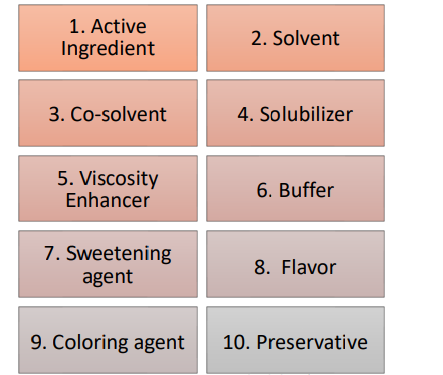
General Formula for Solution
Co-solvent
[Common Components in Oral Liquids]
Are water-miscible organic solvents used to improve the solubility of poorly water-soluble drugs
Solubilizer
[Common Components in Oral Liquids]
Are surfactant with solubilizing ability (Solubilization)
Viscosity Enhancer
[Common Components in Oral Liquids]
Improves pourability and, to some extent, palatability
Buffer
[Common Components in Oral Liquids]
Controlling pH to maintain solubility and stability (Most common: pH 4–7)
Preservatives
[Common Components in Oral Liquids]
Prevent microbial growth
Ethanol
Sorbitol
Glycerin
Propylene Glycol (PPG)
Polyethylene Glycol (PEG)
📌Mnemonic: “ESG” PP
Example of Co-solvent [5]
Solubilizer
Tween is a _____ ?
Sugar
Polyvinylpyrrolidone (PVP)
Cellulose derivatives
📌Mnemonic: “SPC”
Example of Viscosity Enhancer [3]
Glutaric acid
Lactic acid
Citric acid
📌”GLC”
Example of Buffer [3]
Benzoic acid and its salts
Parabens
Thimerosal
Chlorobutanol
Benzyl alcohol
Benzalkonium chloride
📌”BPT” “CBB”
Example of Preservatives [6]
Preparation of formulation materials and equipment
Compounding
Storage and Aging
Filtration and Clarification
Filling and Packaging
General Steps In Manufacturing Solutions [5]
increase
[Factors Affecting Solubility]
Increase Temperature = ____ [increase / decrease] rate of solubility
increases
[Factors Affecting Solubility]
Decrease Particle Size = ____ [increase / decrease] rate of solubility
increases
[Factors Affecting Solubility]
Increase mixing/agitation = ____ [increase / decrease] rate of solubility
soluble
insoluble
[Factors Affecting Solubility]
"Like dissolves like"
polar + polar = _____ [soluble/insoluble]
non polar + polar= ____ [soluble/insoluble]
Mixing tanks equipped with agitators
Measuring and weighing devices
Filtration / Clarification System
Manufacturing Equipments For Liquids [3]
Mixing tanks equipped with agitators
[Manufacturing Equipment for Liquids]
Constructed of polished stainless steel and jacketed to allow for heating and cooling of the contents (using steam for heat).
Agitator
This equipment mixes the product during storage.
Mixers / Compounding tanks
Storage tanks
Portable transport tanks.
Types of Agitator [3]
Nylon
[Examples of Filter Cloth Media]
_____-
Superior type
Unaffected by Molds / Fungi
Nylon
[Examples of Filter Cloth Media]
Can be resterilized by autoclaving
Nylon
[Examples of Filter Cloth Media]
Have negligible absorption properties.
Filter Cloth
[Examples of Filter Cloth Media]
For straining syrupy liquids
Stainless Wire Cloth
[Type of Filter Media]
For filtration processes
Nylon
Filter Cloth
Stainless Wire Cloth
Examples of Filter Cloth Media [3]
Felt Cloth
[Example of Filter Media, non woven]
Fibrous mass free from bonding agents.
Felt Cloth
[Example of Filter Media, non woven]
Mechanically interlocked to yield pore diameters with CONTROLLED POROSITY.
Felt Cloth
[Example of Filter Media, non woven]
For gelatinous solutions
Bonded Fabrics
[Example of Filter Media, non woven]
Binded textile fabrics with resins, solvents, and plasticizers.
Bonded Fabrics
[Example of Filter Media, non woven]
Not widely used due to interaction with ADDITIVES
Kraft Paper
[Example of Filter Media, non woven]
Inexpensive
Kraft Paper
[Example of Filter Media, non woven]
Used as a pharmaceutical standard.
Kraft Paper
[Example of Filter Media, non woven]
____-
Have Controlled porosity
Limited absorption capacity
Low cost (inexpensive)
Membrane filter media
[Types of Filter Media]
_______-
Composition:
Esters of cellulose
Nylon, Teflon, PVC, silver
Porosity of 0.05–14 microns
Membrane filter media
[Types of Filter Media]
For sterile solutions
Membrane filter media
[Types of Filter Media]
______-
Properties:
150 micron thickness
Ideal for MICROFILTRATION
Kieselgur
Infusorial earth
Diatomite
Asbestos
Celite
Cellulose
📌Mnemonic: “KID” “ACC”
Example of Filter Aids [6]
Filter Aids
[Types of Filter Media]
Form a highly porous and non-compressible cake which retains solids.
Filter Aids
[Types of Filter Media]
____-
This forms a fine surface deposit which screens out all solids
This prevents the clogging of supporting filter media.
Gravity Filtration
[Classification of Filtration]
Slow filtration process.
Vacuum Filtration
[Classification of Filtration]
Used for very large quantities.
Pressure Filtration
[Classification of Filtration]
Fast process
Pressure Filtration
[Classification of Filtration]
Used to achieve a highly polished product.
Parallel Filtration
[Classification of Filtration]
Uses one type of filter.
Series Filtration
[Classification of Filtration]
Uses more than one filter in sequence.
Gravimetric method
Volumetric Method
Constant Level Method
Basic Liquid Filling Methods [3]
Gravimetric method
[Basic Liquid Filling Methods]
Limited to very large containers or highly viscous products
Gravimetric method
[Basic Liquid Filling Methods]
Also used for mobile and frothy solutions.
Volumetric Method
[Basic Liquid Filling Methods]
Involves pumping liquid at constant pressure
Volumetric Method
[Basic Liquid Filling Methods]
Used for ampules and syringes
reservoir
Volumetric Method has a _____.
Constant Level Method
[Basic Liquid Filling Methods]
Makes use of container height as the means of controlling the fill amount of each bottle.

