Animal Nutrition
0.0(0)
Studied by 1 person Call Kai
 Learn
Learn Practice Test
 Spaced Repetition
 Match
Match Flashcards
 Knowt Play
Card Sorting
1/138

There's no tags or description
Looks like no tags are added yet.
Last updated 2:35 AM on 5/9/23
Name | Mastery | Learn | Test | Matching | Spaced | Call with Kai |
|---|
No analytics yet
Send a link to your students to track their progress
139 Terms
1
New cards
The Science of Nutrition
the study of the nutrients and other substances in foods and how the body handles them
2
New cards
Animal Nutrition
Animal nutrition includes the processes by which food is Ingested, digested, and absorbed into body cells and fluids
3
New cards
Ingestion
the feeding method used to take food into the digestive cavity
4
New cards
Digestion
splitting of carbohydrates, proteins, lipids, and nucleic acids in foods into chemical subunits small enough to be absorbed into an animal’s body fluids and cells
5
New cards
Absorption
movement of organic molecules, electrolytes (inorganic ions), vitamins, and water across the digestive epithelium and into the interstitial fluid of the digestive tract
6
New cards
Herbivores
such as antelopes, horses, bison, giraffes, kangaroos, manatees, and grasshoppers obtain organic molecules primarily by eating plants (plant-eating)
7
New cards
Carnivores
such as cats, tasmaniandevils, penguins, sharks, and spiders, primarily eat other animals (meat-eating)
8
New cards
\n Omnivores
such as crows, cockroaches, and humans, eat both plants and animals and, with appropriate digestive enzymes, may consume any source of organic matter
9
New cards
calorie
amount of energy required to raise the temperature of 1.0g of pure water by 1°C
10
New cards
kilocalorie
\[1 kcal = 4.2 kilojoules\] equals 1,000 calories or one Calorie(capital C)
11
New cards
Nutrients
Chemical substances obtained from food and used in the body to provide energy, structural materials, and regulating agents to support growth, maintenance, and repair of the body’s tissues
12
New cards
Simple inorganic nutrients ( Do not contain carbon)
Minerals : Each mineral is a chemical element; its atoms are all alike.▪E.g., Calcium, magnesium, zinc, iron, potassium etc.
13
New cards
Complex organic nutrients
Carbohydrates, lipids, proteins, and vitamins▪In addition to hydrogen and oxygen, they all contain carbon, an element found in all living things▪They are therefore called organic▪Protein and some vitamins also contain nitrogen and may contain other elements as well
14
New cards
Malnutrition
Malnutrition refers to deficiencies, excesses, or imbalances in a person’s intake of energy and/or nutrients
\
The term malnutrition addresses 3 broad groups of conditions:
**Undernutrition**, which includes wasting (low weight-for-height), stunting (low height-for-age) and underweight (low weight-for-age)
**Micronutrient-related malnutrition**, which includes micronutrient deficiencies (a lack of important vitamins and minerals) or micronutrient excess
**Overweight, obesity and diet-related noncommunicable diseases** (such as heart disease, stroke, diabetes and some cancers)
\
The term malnutrition addresses 3 broad groups of conditions:
**Undernutrition**, which includes wasting (low weight-for-height), stunting (low height-for-age) and underweight (low weight-for-age)
**Micronutrient-related malnutrition**, which includes micronutrient deficiencies (a lack of important vitamins and minerals) or micronutrient excess
**Overweight, obesity and diet-related noncommunicable diseases** (such as heart disease, stroke, diabetes and some cancers)
15
New cards
Essential Nutrients
Essential amino acids, fatty acids, vitamins, and minerals are known collectively as an animal’s essential nutrients
Organic molecules serve as building blocks for carbohydrates, lipids, proteins, and nucleic acids. Animals synthesize many organic molecules –however, they cannot make certain **essential amino acids** and **essential fatty acids**, which must be obtained in the diet
Example: in the absence of essential amino acids in the diet, an animal would have to break down its own proteins to provide amino acids for new protein synthesis
Organic molecules serve as building blocks for carbohydrates, lipids, proteins, and nucleic acids. Animals synthesize many organic molecules –however, they cannot make certain **essential amino acids** and **essential fatty acids**, which must be obtained in the diet
Example: in the absence of essential amino acids in the diet, an animal would have to break down its own proteins to provide amino acids for new protein synthesis
16
New cards
Vitamins
are organic molecules required in small quantities that the animal cannot synthesize for itself –many are coenzymes, nonprotein organic subunits that assist in enzymatic catalysis
17
New cards
\n Essential minerals
required inorganic elements such as calcium, iron, and magnesium
18
New cards
\n Undernutrition
An animal suffering from undernutrition is starving for one or more nutrients –**taking in fewer calories than needed for daily activities**
Animals with chronic undernutrition lose weight because they have to use energy-providing molecules of their own bodies as fuels.
Mammals use stored fats and glycogen first, then proteins.
Use of proteins as fuel leads to muscle wastage and, in the long term, organ and brain damage, which leads to death
\
form of malnutrition, a condition resulting from an improper diet. Undernutrition is defined as insufficient intake of energy and nutrients to meet an individual’s needs to maintain good health. Socioeconomic and geopolitical factors (availability and supply) can result in undernutrition
Animals with chronic undernutrition lose weight because they have to use energy-providing molecules of their own bodies as fuels.
Mammals use stored fats and glycogen first, then proteins.
Use of proteins as fuel leads to muscle wastage and, in the long term, organ and brain damage, which leads to death
\
form of malnutrition, a condition resulting from an improper diet. Undernutrition is defined as insufficient intake of energy and nutrients to meet an individual’s needs to maintain good health. Socioeconomic and geopolitical factors (availability and supply) can result in undernutrition
19
New cards
Overnutrition
form of malnutrition (imbalanced nutrition) arising from excessive intake of nutrients, leading to accumulation of body fat that impairs health. Over time, regular intakes in excess of needs may also have adverse effects
20
New cards
Amino acids that cannot be synthesized by the human body, but that have to be supplied in their diet are called ______________. \*\*\*slide question
essential amino acids
21
New cards
Fluid feeders
ingest liquids that contain organic molecules in solution \[E.g., Mosquitoes (feed on blood), hummingbirds (feed on nectar)
22
New cards
Suspension feeders
ingest small organisms that are suspended in water (E.g., Clams, baleen whales)
23
New cards
Deposit feeders
ingest particles of organic matter from solid material they live in or on (E.g., Earthworms, crabs)
24
New cards
Bulk feeders
consume sizeable food items whole or in large chunks (most adult mammals, reptiles, birds, amphibians)
25
New cards
Based on how they obtain food nutrients, mammals belong to the category of ___________. \*\*\*slide question
bulk feeders
26
New cards
Digestive Processes
Digestive processes break food molecules into molecular subunits(an absorbable form), that can be absorbed into body fluids and cells.
Breakdown occurs by enzymatic hydrolysis, in which chemical bonds are broken by the addition of H+and OH.
Breakdown occurs by enzymatic hydrolysis, in which chemical bonds are broken by the addition of H+and OH.
27
New cards
Amylases
hydrolyze starches
28
New cards
lipases
a pancreatic enzyme, hydrolyzes the fats in micelles into monoglycerides and free fatty acids
29
New cards
proteases
hydrolyze proteins
30
New cards
nucleases
hydrolyze nucleic acids
31
New cards
Intracellular Digestion
Sponges and some cnidarians break down food exclusively by intracellular digestion.
\
Cells take in food particles (organic material and microorganisms) by endocytosis through pores in body wall of animal’s sac-like body. An endocytic vesicle containing food particles fuses with a lysosome containing hydrolytic enzymes (forming endolysosomes). Molecular subunits produced by hydrolysis pass from the vesicle to the cytosol. Undigested material remaining in the vesicle is released to the outside of the cell by exocytosis
\
Cells take in food particles (organic material and microorganisms) by endocytosis through pores in body wall of animal’s sac-like body. An endocytic vesicle containing food particles fuses with a lysosome containing hydrolytic enzymes (forming endolysosomes). Molecular subunits produced by hydrolysis pass from the vesicle to the cytosol. Undigested material remaining in the vesicle is released to the outside of the cell by exocytosis
32
New cards
Intracellular Digestion (Choanocytes in sponges)
Inside the body cavity, specialized cells called choanocytesor collar cells line the body wall.
Choanocytes trap food particles, take them in by endocytosis and transport them to amoeboid cells which digest the particles intracellularly.
Choanocytes trap food particles, take them in by endocytosis and transport them to amoeboid cells which digest the particles intracellularly.
33
New cards
The specialized cells called choanocytes are present in the body walls of sponges which trap food ingested through the pores in their body walls. True or False?
True
34
New cards
Extracellular Digestion
Most invertebrates and all vertebrates digest food primarily by extracellular digestion –outside body cells, in a pouch or tube that is enclosed within the body.
Specialized compartments prevent the animal from digesting its own body tissues.
Epithelial cells secrete enzymes that digest the food. Extracellular digestion greatly expands the range of available food sources, and allows animals to eat large batches of food.
Specialized compartments prevent the animal from digesting its own body tissues.
Epithelial cells secrete enzymes that digest the food. Extracellular digestion greatly expands the range of available food sources, and allows animals to eat large batches of food.
35
New cards
Digestive Tubes
Most invertebrates and all vertebrates have a tubular digestive tract system with two openings - the digestive contents move in one direction, from the mouth (proximally and anteriorly) to the anus (distally)
\
The inside of the digestive tube (**lumen**) is functionally external to all body tissues, because they open to external environment (outside of the body)
\
The inside of the digestive tube (**lumen**) is functionally external to all body tissues, because they open to external environment (outside of the body)
36
New cards
Five Steps in Digestion
Mechanical processing: Mastication
Secretion of enzymes and other digestive aids
Enzymatic hydrolysis
Absorption
Elimination
Secretion of enzymes and other digestive aids
Enzymatic hydrolysis
Absorption
Elimination
37
New cards
Mechanical processing: Mastication
Chewing, grinding, and tearing food chunks into smaller pieces increases their mobility and the surface area exposed to digestive enzymes
38
New cards
Secretion of enzymes and other digestive aids
Release of enzymes and other substances that aid the process of digestion, such as acids, emulsifiers, and lubricating mucus, into the tube
39
New cards
**Enzymatic hydrolysis**
Food molecules are broken down through enzyme-catalyzed reactions into absorbable molecular subunits
40
New cards
Absorption
The molecular subunits are absorbed from the digestive contents into body fluids and cells
41
New cards
Elimination
Undigested materials are expelled through the anus
42
New cards
Digestion In An Annelid
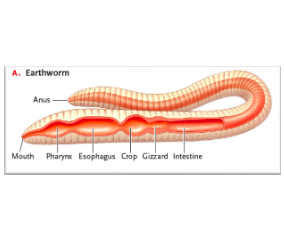
The earthworm is a deposit feeder that feeds on organic soil particles
Muscular activity moves particles through the esophagus into the crop, where they are stored and mixed with mucus.
This mixture enters the gizzard, which contains grains of sand, and is ground into fine particles (mechanical processing of food)
The mixture enters a long intestine, Organic matter is hydrolyzed by enzymes, Muscular contractions move the mixture along, Cells lining the intestine absorb molecular subunits
Undigested residue is expelled through the anus
Muscular activity moves particles through the esophagus into the crop, where they are stored and mixed with mucus.
This mixture enters the gizzard, which contains grains of sand, and is ground into fine particles (mechanical processing of food)
The mixture enters a long intestine, Organic matter is hydrolyzed by enzymes, Muscular contractions move the mixture along, Cells lining the intestine absorb molecular subunits
Undigested residue is expelled through the anus
43
New cards
The organ which is involved in mechanical processing of food in annelids such as earth worm is _____________. \*\*\*\*slide question
gizzard
44
New cards
Digestion In An Insect
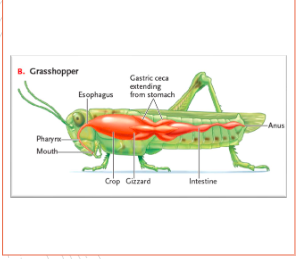
Herbivorous insects such as the grasshopper tear plant parts into small particles with hard external mouth parts :
Salivary secretions in the pharynx begin digestion
Food moves through the esophagus, crop, and gizzard to the stomach.
In the stomach, the food is hydrolyzed by enzymes in gastric ceca –products are absorbed through walls of the ceca
Undigested contents move to the intestine for further digestion and absorption
At the end of the intestine, water is absorbed, and remnants are expelled through the anus
Salivary secretions in the pharynx begin digestion
Food moves through the esophagus, crop, and gizzard to the stomach.
In the stomach, the food is hydrolyzed by enzymes in gastric ceca –products are absorbed through walls of the ceca
Undigested contents move to the intestine for further digestion and absorption
At the end of the intestine, water is absorbed, and remnants are expelled through the anus
45
New cards
Digestion In A Bird
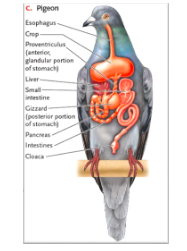
A pigeon picks up seeds and swallows them whole :
Seeds are moistened by mucus-filled saliva in the mouth
Seeds pass through the pharynxand tube-like anterior end of the esophagusto the pouch-like crop, which stores food
The glandular anterior portion of the stomach (**proventriculus**) secretes digestive enzymes and acids
Seeds are ground up in the posterior end (gizzard)
In the intestine, the liver secretes bile, and the pancreas adds digestive enzymes
Products are absorbed, and undigested residues are expelled through the anus
Seeds are moistened by mucus-filled saliva in the mouth
Seeds pass through the pharynxand tube-like anterior end of the esophagusto the pouch-like crop, which stores food
The glandular anterior portion of the stomach (**proventriculus**) secretes digestive enzymes and acids
Seeds are ground up in the posterior end (gizzard)
In the intestine, the liver secretes bile, and the pancreas adds digestive enzymes
Products are absorbed, and undigested residues are expelled through the anus
46
New cards
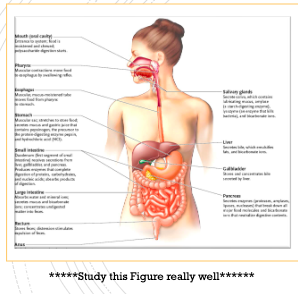
Digestion In Humans And Other Mammals \*\*\*\*KNOW FIGURE REALLY WELL ON EXAM
The mammalian digestive system is a series of specialized digestive regions under control of the nervous and endocrine systems
The digestive system consists of a muscular tube
The digestive tract, also called the gastrointestinal (GI) tract or alimentary canal
The mouth, pharynx, esophagus, stomach, small and large intestines, rectum, and anus
Various accessory organs: Accessory organs include the salivary glands, teeth, tongue, pancreas, liver, and gallbladder. The glandular organs secrete their products into ducts that empty into the digestive tract.
The digestive system is not identical in all mammals – Specific adaptations have produced variations such as the digestive system of ruminants
The digestive system consists of a muscular tube
The digestive tract, also called the gastrointestinal (GI) tract or alimentary canal
The mouth, pharynx, esophagus, stomach, small and large intestines, rectum, and anus
Various accessory organs: Accessory organs include the salivary glands, teeth, tongue, pancreas, liver, and gallbladder. The glandular organs secrete their products into ducts that empty into the digestive tract.
The digestive system is not identical in all mammals – Specific adaptations have produced variations such as the digestive system of ruminants
47
New cards
![Refer to the figure below and match the correct structures labeled in the figure in the right hand column (represented by numbers from 1 to 10) with their appropriate functions in the left hand column.\[Please note that the numbers in the right most column represent the labels in the figure and taking this into consideration, select the correct choice A, B, C D, etc.\].](https://knowt-user-attachments.s3.amazonaws.com/2d7475b02b144006bbd52a03bbb48edc.jpeg)
Refer to the figure below and match the correct structures labeled in the figure in the right hand column (represented by numbers from 1 to 10) with their appropriate functions in the left hand column.\[Please note that the numbers in the right most column represent the labels in the figure and taking this into consideration, select the correct choice A, B, C D, etc.\].
1\. Mouth (Oral cavity) - muscular tube , the contraction of which pushes the food to the stomach
2\. Pharynx - muscular contractions move food to esophagus by swallowing reflex
3\. esophagus - muscular moistened tube moves food from pharynx to stomach
4\. stomach - muscular sac; stretches to store food; secretes mucus/gastric juice that contains pepsinogen the precursor to pepsin and HCl
5\. small intestine - duodenum (first seg of small intestine) recieves secretions and produces enzymes that complete digestion of proteins, carbs, nucleic acid. absorbs nutrients.
6\. large intestine - absorbs water/mineral ions; secretes mucus/bicarbonate ions; make feces
7\. Pancreas - Secretes bicarbonate ions and absorbs water and other ions
8\. Gallbladder - stores and concentrates bile secreted by the liver
9\. salivary glands - secrete saliva containing mucus/amylase/lysozome/bicarbonate ions
10\. liver - secrete bile
2\. Pharynx - muscular contractions move food to esophagus by swallowing reflex
3\. esophagus - muscular moistened tube moves food from pharynx to stomach
4\. stomach - muscular sac; stretches to store food; secretes mucus/gastric juice that contains pepsinogen the precursor to pepsin and HCl
5\. small intestine - duodenum (first seg of small intestine) recieves secretions and produces enzymes that complete digestion of proteins, carbs, nucleic acid. absorbs nutrients.
6\. large intestine - absorbs water/mineral ions; secretes mucus/bicarbonate ions; make feces
7\. Pancreas - Secretes bicarbonate ions and absorbs water and other ions
8\. Gallbladder - stores and concentrates bile secreted by the liver
9\. salivary glands - secrete saliva containing mucus/amylase/lysozome/bicarbonate ions
10\. liver - secrete bile
48
New cards
There are eight essential amino acids for adult humans:
lysine, tryptophan, phenylalanine, threonine, valine, methionine, leucine, and isoleucine –
infants and young children also require histidine
infants and young children also require histidine
49
New cards
Two fatty acids, are essential in the human diet \*\*\*KNOW SPELLING
linoleic acid and linolenic acid.
Both are required for synthesis of phospholipids that form parts of biological membranes and certain hormones. Almost all foods contain these fatty acids –however, people on a low-fat diet that is deficient in linoleic acid and linolenic acid are at serious **risk for developing coronary heart disease**
Both are required for synthesis of phospholipids that form parts of biological membranes and certain hormones. Almost all foods contain these fatty acids –however, people on a low-fat diet that is deficient in linoleic acid and linolenic acid are at serious **risk for developing coronary heart disease**
50
New cards
Vitamins fall into two classes:
Water-soluble (hydrophilic) vitamins and Fat-soluble (hydrophobic) vitamins
The body stores fat-soluble vitamins in adipose tissues
Vitamin D differs from other vitamins because humans can synthesize it in the skin when exposed to ultraviolet light
The body stores fat-soluble vitamins in adipose tissues
Vitamin D differs from other vitamins because humans can synthesize it in the skin when exposed to ultraviolet light
51
New cards
Vitamin D Synthesis and Activation \*\*\*\*KNOW DIAGRAM
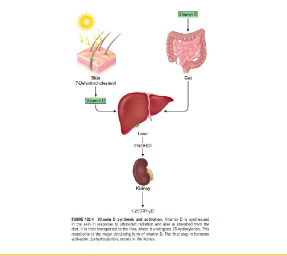
In response to ultraviolet radiation of the skin, a photochemical cleavage results in the formation of vitamin D from 7-dehydrocholesterol
Vitamin D enters the circulation, whether absorbed from the intestine or synthesized cutaneously, bound to vitamin D–binding protein, an α-globulin synthesized in the liver
Vitamin D is subsequently 25-hydroxylated in the **liver** by a cytochrome P450 oxidase in the mitochondria and microsomes
The second hydroxylation, required for the formation of the mature hormone, occurs in the **kidney.**
The 25-hydroxyvitamin D-1α-hydroxylase converts 25-hydroxy vitamin D to 1,25(OH)2D **(calcitriol)**
Vitamin D enters the circulation, whether absorbed from the intestine or synthesized cutaneously, bound to vitamin D–binding protein, an α-globulin synthesized in the liver
Vitamin D is subsequently 25-hydroxylated in the **liver** by a cytochrome P450 oxidase in the mitochondria and microsomes
The second hydroxylation, required for the formation of the mature hormone, occurs in the **kidney.**
The 25-hydroxyvitamin D-1α-hydroxylase converts 25-hydroxy vitamin D to 1,25(OH)2D **(calcitriol)**
52
New cards
vitamin K
Required for making blood-clotting factors in the liver
Humans cannot make vitamin K, but much of the requirement is supplied by bacterial activity in the large intestine
Humans cannot make vitamin K, but much of the requirement is supplied by bacterial activity in the large intestine
53
New cards
In Name the 4 fat-soluble vitamins. \*\*\*slide question
Vitamin A, D, E and K
54
New cards
Vitamin A (retinol) \*\*\*KNOW REALLY WELL (FAT SOLUBLE)
common sources: Liver; fish oils; milk; eggs. (Beta-carotene, which is converted to vitamin A in the body, is in many plant foods such as sweet potato, spinach, and carrots.)
\
main function: **Component of visual pigments**; bone metabolism; epithelial tissue maintenance
\
selected effects of chronic deficiency: Night blindness; total blindness; skin disorders; decreased immunity
\
main function: **Component of visual pigments**; bone metabolism; epithelial tissue maintenance
\
selected effects of chronic deficiency: Night blindness; total blindness; skin disorders; decreased immunity
55
New cards
Vitamin D \*\*\*KNOW REALLY WELL (FAT-SOLUBLE)
common sources: Fish liver oil; egg yolk; fortified milk; produced in skin exposed to sunshine
\
main function: Calcium and phosphorus absorption from gut
\
selected effects of chronic deficiency: Bone deformities (rickets) in children; bone softening in adults
\
main function: Calcium and phosphorus absorption from gut
\
selected effects of chronic deficiency: Bone deformities (rickets) in children; bone softening in adults
56
New cards
Vitamin E (tocopherol) \*\*\*\*KNOW REALLY WELL (FAT-SOLUBLE)
common sources: Nuts; seeds; vegetable oils
\
main function: Antioxidant; maintenance of cell Membranes
\
selected effects of chronic deficiency: Neuromuscular problems
\
main function: Antioxidant; maintenance of cell Membranes
\
selected effects of chronic deficiency: Neuromuscular problems
57
New cards
Vitamin K \*\*\*KNOW REALLY WELL (FAT-SOLUBLE)
common sources: Intestinal bacteria; green vegetables
\
main function: **Promotes synthesis of blood-clotting protein by liver**
\
selected effects of chronic deficiency: Abnormal blood clotting, bleeding
\
\
main function: **Promotes synthesis of blood-clotting protein by liver**
\
selected effects of chronic deficiency: Abnormal blood clotting, bleeding
\
58
New cards
vitamin B1 (thiamin) - water soluble \*\*KNOW REALLY WELL
common sources: Yeast; cereal grains; beans; nuts; meat
\
main function: Connective tissue formation; needed for folate utilization; coenzyme forming part of enzyme in oxidative reactions
\
selected effects of chronic deficiency: Beriberi (nervous system disorder that includes impaired sensory perception, limb weakness and pain, weight loss, cardiovascular malfunction)
\
main function: Connective tissue formation; needed for folate utilization; coenzyme forming part of enzyme in oxidative reactions
\
selected effects of chronic deficiency: Beriberi (nervous system disorder that includes impaired sensory perception, limb weakness and pain, weight loss, cardiovascular malfunction)
59
New cards
vitamin B2 - (riboflavin) - water soluble \*\*\*KNOW REALLY WELL
common sources: Whole grains, poultry, fish, egg white, milk, lean meat
\
main function: coenzyme
\
selected effects of chronic deficiency: skin lesions
\
main function: coenzyme
\
selected effects of chronic deficiency: skin lesions
60
New cards
vitamin B6 (pyridoxine) - water-soluble \*\*\*\*KNOW REALLY WELL
common sources: Spinach, whole grains, tomatoes, potatoes, meat
\
main function: Coenzyme in amino acid and fatty acid metabolism
\
selected effects of chronic deficiency: Skin, muscle, and nerve damage
\
main function: Coenzyme in amino acid and fatty acid metabolism
\
selected effects of chronic deficiency: Skin, muscle, and nerve damage
61
New cards
vitamin B12 (cobalamin) - water-soluble \*\*\*\*KNOW REALLY WELL
common sources: Eggs; meats; dairy products
\
main function: Coenzyme in nucleic acid metabolism; red blood cell formation
\
selected effects of chronic deficiency: Anemia; brain and nervous system damage
\
main function: Coenzyme in nucleic acid metabolism; red blood cell formation
\
selected effects of chronic deficiency: Anemia; brain and nervous system damage
62
New cards
Biotin - water-soluble \*\*\*KNOW REALLY WELL
common sources: Legumes; egg yolk; some synthesized by colon bacteria
\
main function: Coenzyme in fat and glycogen formation and amino acid metabolism
\
selected effects of chronic deficiency: Scaly skin (dermatitis); sore tongue; brittle hair; depression; weakness
\
main function: Coenzyme in fat and glycogen formation and amino acid metabolism
\
selected effects of chronic deficiency: Scaly skin (dermatitis); sore tongue; brittle hair; depression; weakness
63
New cards
vitamin C (ascorbic acid) - water-soluble \*\*\*KNOW REALLY WELL
common sources: Fruits and vegetables, especially citrus, berries, cantaloupe, cabbage, broccoli, green pepper
\
main function: Vital for collagen synthesis; antioxidant
\
selected effects of chronic deficiency: **Scurvy** (weakness, anemia, gum disease, and skin problems); delayed wound healing; impaired immunity
\
main function: Vital for collagen synthesis; antioxidant
\
selected effects of chronic deficiency: **Scurvy** (weakness, anemia, gum disease, and skin problems); delayed wound healing; impaired immunity
64
New cards
folic acid (folate) - water-soluble \*\*\*KNOW REALLY WELL
common sources: Leafy vegetables; legumes; whole grains; yeast; liver; egg yolks
\
main function: Coenzyme in nucleic acid and amino acid metabolism
\
selected effects of chronic deficiency: Anemia; diarrhea; impaired growth; **birth defects (spina bifida)**
\
main function: Coenzyme in nucleic acid and amino acid metabolism
\
selected effects of chronic deficiency: Anemia; diarrhea; impaired growth; **birth defects (spina bifida)**
65
New cards
Niacin - (water-soluble) \*\*\*KNOW REALLY WELL
common sources: Fruits and vegetables; nuts; grains; meats
\
main function: Coenzyme of oxidative phosphorylation
\
selected effects of chronic deficiency: Pellagra (diarrhea, dermatitis, dementia)
\
main function: Coenzyme of oxidative phosphorylation
\
selected effects of chronic deficiency: Pellagra (diarrhea, dermatitis, dementia)
66
New cards
pantothenic acid (water soluble) \*\*\*\*KNOW REALLY WELL
common sources: In many foods (meat, yeast, egg yolk especially)
\
main function: Coenzyme in carbohydrate and fat oxidation; fatty acid and steroid synthesis
\
selected effects of chronic deficiency: Fatigue; tingling in hands; headaches; nausea
\
main function: Coenzyme in carbohydrate and fat oxidation; fatty acid and steroid synthesis
\
selected effects of chronic deficiency: Fatigue; tingling in hands; headaches; nausea
67
New cards
\n The vitamin which is a component of the visual pigment in the photoreceptor cells in the eyes is ____________. \*\*\*\*slide question
Vitamin A or retinol
68
New cards
The vitamin which is involved in the synthesis of blood clotting proteins in the liver is ____________. \*\*\*\*\*slide question
vitamin K
69
New cards
Scurvy is a disease caused by the deficiency of _______________. \*\*\*slide question
Vitamin C
70
New cards
Pick the two fat soluble vitamins from the options below. Choose the best option.
\*\*\*slide question
A. Vitamin B6 and vitamin B12
B. Vitamin B1 and vitamin B2
C. Vitamin E and vitamin K
D. Vitamin B12 and ascorbic acid
E. Biotin and folic acid
F. Pantothenic acid and niacinamide
G. None of the above H. All of the above
\*\*\*slide question
A. Vitamin B6 and vitamin B12
B. Vitamin B1 and vitamin B2
C. Vitamin E and vitamin K
D. Vitamin B12 and ascorbic acid
E. Biotin and folic acid
F. Pantothenic acid and niacinamide
G. None of the above H. All of the above
C. Vitamin E and Vitamin K
71
New cards
Macrominerals
required in large amounts (100 mg to more than 1 gram per day)
Calcium, phosphorus, magnesium, sodium, potassium, chloride, and sulfur
Calcium, phosphorus, magnesium, sodium, potassium, chloride, and sulfur
72
New cards
\n Trace minerals
rerequired in small amounts (some less than 1 mg per day)
Iron, manganese, copper, iodine, zinc, cobalt, fluoride, and selenium
Iron, manganese, copper, iodine, zinc, cobalt, fluoride, and selenium
73
New cards
hypernatremia
too much sodium - elevated blood pressure
74
New cards
hemochromatosis
excessive iron. Liver, heart, pancreas and blood vessel damage
75
New cards
Potassium (K) \*\*\*\*KNOW REALLY WELL
common sources: Many vegetables and fruits; whole grains; dairy products
\
main function: Muscle and neural function; water balance; acid–base balance; main positive ion in cell
\
selected effects of chronic deficiency: Muscular weakness; cardiac abnormalities or failure
\
main function: Muscle and neural function; water balance; acid–base balance; main positive ion in cell
\
selected effects of chronic deficiency: Muscular weakness; cardiac abnormalities or failure
76
New cards
Sodium (Na) \*\*\*KNOW REALLY WELL
common sources: Table salt; dairy products; eggs; meat
\
main function: Acid–base balance; water balance; muscle and neural function; main positive ion in extracellular fluid
\
selected effects of chronic deficiency: muscle cramps
\
main function: Acid–base balance; water balance; muscle and neural function; main positive ion in extracellular fluid
\
selected effects of chronic deficiency: muscle cramps
77
New cards
Sulfur (S) - \*\*\*KNOW REALLY WELL
common sources: Proteins from food sources, including legumes, nuts, dairy products, eggs, and meat
\
main function: Component of body proteins
\
selected effects of chronic deficiency: Same as protein deficiencies
\
main function: Component of body proteins
\
selected effects of chronic deficiency: Same as protein deficiencies
78
New cards
**Iodine (I)** - \*\*\*KNOW REALLY WELL
common sources: seafood; iodizes salt
\
main function: **thyroid hormone formation**
\
selected effects of chronic deficiency: Goiter (enlarged thyroid), with metabolic disorders
\
main function: **thyroid hormone formation**
\
selected effects of chronic deficiency: Goiter (enlarged thyroid), with metabolic disorders
79
New cards
**Iron (Fe)** \*\*\*\*KNOW REALLY WELL
common sources: Green leafy vegetables; legumes; whole grains; nuts; eggs; meats (particularly liver)
\
main function: Component of hemoglobin, myoglobin, and **electron Carriers in mitochondria**
\
selected effects of chronic deficiency: Iron-deficiency anemia;weakness
\
main function: Component of hemoglobin, myoglobin, and **electron Carriers in mitochondria**
\
selected effects of chronic deficiency: Iron-deficiency anemia;weakness
80
New cards
Zinc (Zn) - \*\*\*\*KNOW REALLY WELL
common sources: Some vegetables; whole grains; legumes; nuts; fish; meats; many other foods
\
main function: Component of many enzymes and some transcription factors; protein synthesis; DNA synthesis; cell division; immunity; wound healing
\
selected effects of chronic deficiency: Impaired growth; loss of appetite; impaired immune function
\
main function: Component of many enzymes and some transcription factors; protein synthesis; DNA synthesis; cell division; immunity; wound healing
\
selected effects of chronic deficiency: Impaired growth; loss of appetite; impaired immune function
81
New cards
The mineral that is involved in thyroid hormone formation is ____________. \*\*\*slide question
Iodine
82
New cards
The trace mineral that is a component of the electron carrier proteins in the mitochondria is __________________. \*\*\*slide question
A. Calcium(Ca)
B. Manganese(Mn)
C. Chloride (Cl)
D. Phosphorus (P)
E. Iron (Fe)
A. Calcium(Ca)
B. Manganese(Mn)
C. Chloride (Cl)
D. Phosphorus (P)
E. Iron (Fe)
E. Iron (Fe)
83
New cards
Mucosa
The inner lining, mucosa, which contains epithelial and glandular cells, lines the inside of the digestive tract. Contains epithelial and glandular cells.
84
New cards
epithelial cells
Absorb digested nutrients, seal off the digestive contents from body fluids
85
New cards
Glandular cells
Secrete enzymes, lubricating mucus that aids digestion, and substances that adjust the pH of the digestive contents
86
New cards
submucosa
The submucosais a thick layer of elastic connective tissue that contains neuron networks (the enteric nervous system) and blood and lymph vessels
Neuron networks provide local control of digestive activity and carry signals between the gut and the central nervous system
Lymph vessels carry absorbed lipids to other parts of the body
Neuron networks provide local control of digestive activity and carry signals between the gut and the central nervous system
Lymph vessels carry absorbed lipids to other parts of the body
87
New cards
muscularis is formed by two smooth muscle layers
a circular and longitudinal layer
\
The stomach has an additional oblique layer running diagonally around its walls
These layers play an essential role in mechanical processing and in moving materials along the digestive tract
Contraction of circular muscles and relaxation of the longitudinal muscles lengthens the gut, and vice versa
these muscle produce **peristalsis**
\
The stomach has an additional oblique layer running diagonally around its walls
These layers play an essential role in mechanical processing and in moving materials along the digestive tract
Contraction of circular muscles and relaxation of the longitudinal muscles lengthens the gut, and vice versa
these muscle produce **peristalsis**
88
New cards
peristalsis
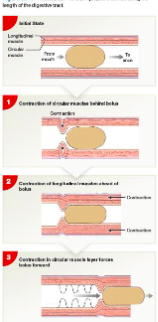
A wave of contractions that passes along the gut, constricting the gut and pushing the digestive contents onward
\
1. Peristalsis consists of waves of muscular contractions that move a bolus
2. During a peristaltic movement, the circular muscles contract behind the bolus while circular muscles ahead of the bolus relax
3. Longitudinal muscles ahead of the bolus then contract, shortening adjacent segments
4. A wave of contraction in the circular muscles then forces the bolus forward
\
1. Peristalsis consists of waves of muscular contractions that move a bolus
2. During a peristaltic movement, the circular muscles contract behind the bolus while circular muscles ahead of the bolus relax
3. Longitudinal muscles ahead of the bolus then contract, shortening adjacent segments
4. A wave of contraction in the circular muscles then forces the bolus forward
89
New cards
Serosa
The outermost layer of the digestive tract
Consists of connective tissue that secretes a slippery fluid (serous fluid) that lubricates the areas between the digestive organs and other organs
continuous w the **mesentery**
Consists of connective tissue that secretes a slippery fluid (serous fluid) that lubricates the areas between the digestive organs and other organs
continuous w the **mesentery**
90
New cards
mesentery
a tissue that suspends the digestive system from the inner wall of the abdominal cavity
Attaches digestive organs to the abdominal wall
Supports the digestive organs while allowing them to move during contractions for mixing
Attaches digestive organs to the abdominal wall
Supports the digestive organs while allowing them to move during contractions for mixing
91
New cards
sphincters
Powerful rings of smooth muscle called sphincters form valves between major regions of the digestive tract
By contracting and relaxing, sphincters control the passage of digestive contents from one region to the next, and ultimately through the anus
Pharyngoesophageal sphincter
**Gastroesophageal sphincter**
Pyloric sphincter
By contracting and relaxing, sphincters control the passage of digestive contents from one region to the next, and ultimately through the anus
Pharyngoesophageal sphincter
**Gastroesophageal sphincter**
Pyloric sphincter
92
New cards
mouth
Teeth cut, tear, and crush food items into small pieces during mastication(chewing)
The food mass forms a bolus, a ball of chewed or liquid food, in preparation for swallowing
The food mass forms a bolus, a ball of chewed or liquid food, in preparation for swallowing
93
New cards
salivary glands
secrete saliva containing salivary amylase (which hydrolyzes starches), mucus, bicarbonate ions (HCO3–), and lysozyme (which kills bacteria)
94
New cards
The enzyme responsible for digestion of complex starch in food is _____________. \*\*\*slide question
amylase
95
New cards
Pharynx and esophagus
The swallowing reflexmoves the bolus into the pharynx
The epiglottis prevents food from entering the trachea
The epiglottis prevents food from entering the trachea
96
New cards
The muscle that is weakened and due to which leads to the imperfect closure of the passageway to the movement of **bolus from the esophagus to the stomach, leading to acid reflux is** called ___________________. \*\*\*slide question
Gastroesophageal sphincter.
97
New cards
stomach
The stomach –a large distensible sac, muscular elastic organ with the largest diameter of any part of the gastrointestinal tract
Located in the epigastrium, just inferior to the diaphragm
Extended “J” shape
\
4 functions -
Storage of ingested food
Mechanical breakdown of ingested food
Disruption of chemical bonds in food through the action of acid and enzymes
Production of intrinsic factor, a glycoprotein needed for the absorption of vitamin B12 in the small intestine
Located in the epigastrium, just inferior to the diaphragm
Extended “J” shape
\
4 functions -
Storage of ingested food
Mechanical breakdown of ingested food
Disruption of chemical bonds in food through the action of acid and enzymes
Production of intrinsic factor, a glycoprotein needed for the absorption of vitamin B12 in the small intestine
98
New cards
chyme
Ingested substances combine with the secretions of the glands of the stomach, producing a viscous, highly acidic, soupy mixture of partially digested food
99
New cards
When the stomach is relaxed (empty), the mucosa has prominent folds called
rugae
100
New cards
The mucosal layer (epithelium) is covered with
gastric pits containing gastric glands
Shallow depressions called gastric pits open onto the gastric surface
Shallow depressions called gastric pits open onto the gastric surface

