BIOL 1102 Midterm 2
 Call Kai
 Learn
Learn Practice Test
 Spaced Repetition
 Match
Match Flashcards
 Knowt Play
1/162

There's no tags or description
Looks like no tags are added yet.
Name | Mastery | Learn | Test | Matching | Spaced | Call with Kai |
|---|
No analytics yet
Send a link to your students to track their progress
163 Terms
Temperature affects rates of biochemical reactions which are catalyzed by enzymes, protein function, and membrane structure. Name four facts regarding this
temperature increases molecular motion + rate of reaction
enzymes have optimal performance temperature ranges
proteins denature at high temperatures
membranes can become rigid at low temperatures or leaky at high temperatures
Metabolism produces heat. What issues do large organisms face? Smaller organisms?
Larger organisms must get rid of heat while smaller organisms struggle with retaining heat
Elephant Example from class
elephants put mud on themselves and have big ears
Big ears: high surface area to volume ratio → allows heat to dissipate through the ears
Babies have “brown fat” that generates heat. Why is this important?
Babies cannot shiver as they have no muscles
endotherms
rely on metabolic energy and physiological mechanisms to regulate body temperature
Internal temperature can be very different from environmental temperature
EX: mammals and birds
ectotherms
rely mainly on external energy sources to regulate body temperature
Internal temperature will match environmental temperature
EX: Reptiles, many fish, invertebrate
heterotherms
Includes members of the above two categories who behave as endotherms sometimes, ectotherms other times
EX: mammal that hibernates, groundhog
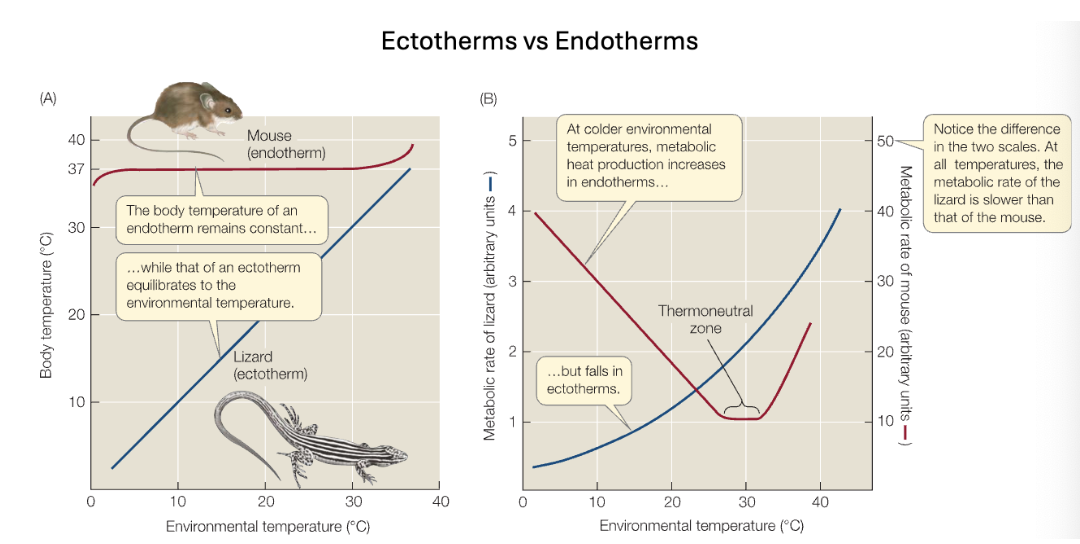
Interpret Body Temperature of both the mouse and lizard with graph
Mouse: Across most of the natural temperatures, mouse temperature stays constant. After a certain point, the mouse becomes unable to regulate its temperature, and it rises
Lizard: The lizard’s body temperature directly correlates to the temperature of the surrounding boxes
What is metabolic rate?
how fast your body burns energy (calories)
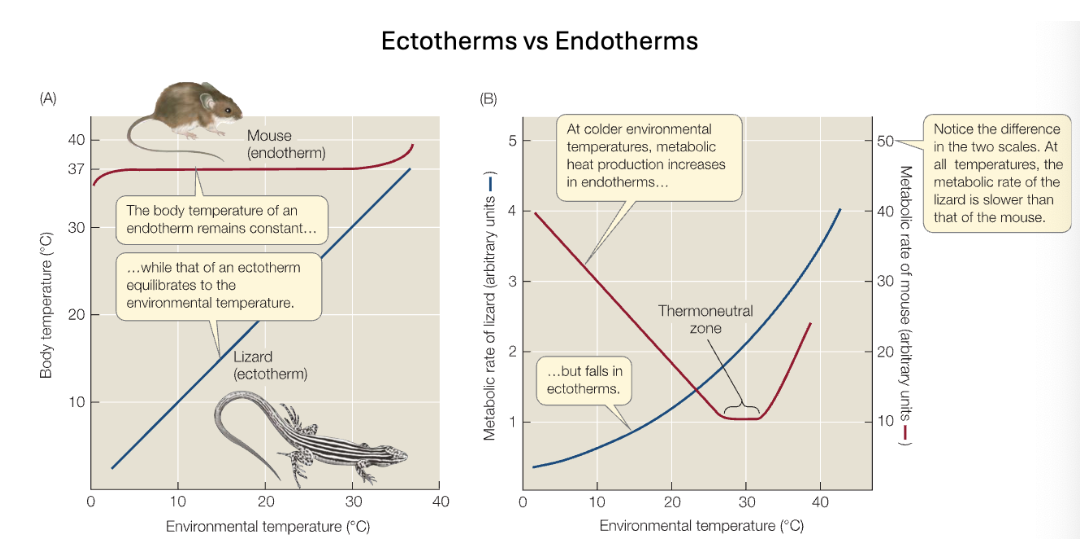
Interpret Metabolic Rate of both the mouse and lizard with graph
Mouse: Metabolic heat rate decreases for mouse so that mouse can keep its body temperature constant
At cold temperatures, mouse needs a lot of energy to maintain body temperature
As outside temperature gets closer to mouse’s internal temperature, mouse doesn’t need as much energy to keep body temperature constant
Thermoneutral zone: no additional metabolism is needed to maintain internal temperature of 37 degrees
Rise in metabolic rate after 30 degrees = The mouse must cool itself (panting, sweating) so metabolic rate increases again
Lizard: Don’t use any personal energy to generate heat
Get metabolic energy from the sun/environment (air, rocks, warm water, etc)
Lowest temp = lowest environmental temperature
As environmental temperature increases, so does metabolic rate
Generally ectotherms are ____ and endotherms are ____
cold-blooded, warm-blooded
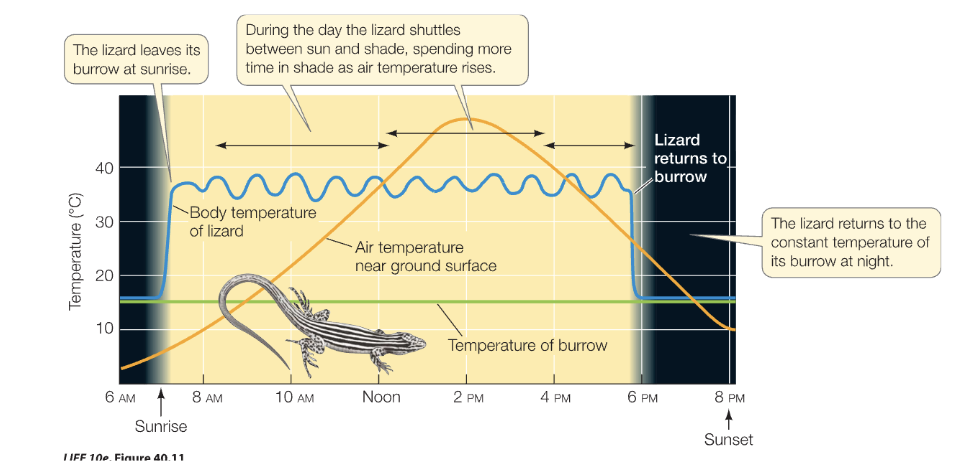
understand this picture
c:
Why don’t birds freeze when walking on ice?
Countercurrent heat exchange
Why is countercurrent heat exchange good?
While the blood in the foot gets really cold; it never actually gets to 0 so the blood is always flowing(or freezing)
Blood that returns to body doesn’t cool down internal organs
Explain what countercurrent heat exchange is + its advantage
Warm blood travels down artery to feet and cold blood returns to body via vein
The vessels are VERY close together → enables heat transfer from warm blood to cold blood (feet stay cold, body stays warm)
Advantage: system recycles heat before its lost to the environment; conserves energy and body heat
At extreme temperatures, maintaining body temperature as an endo is ____
energetically costly
How is metabolic rate measured in endotherms?
consumption of O2 per unit
What is basal metabolic rate?
amount of energy your body is using when you aren’t doing anything extra
How do SA/V ratio differ in animals adapted to cold vs warm climates? Why?
SA/V determines how quickly an animal loses heat
Cold climates: LOW Surface Area to Volume (SA/V) ratio
Features: larger/more compact bodies, shorter limbs/ears, thick fur and insulation
Reduced SA = less heat lost
Warm climates: HIGH SA/V ratio
Features: long limbs or large ears, lean bodies, short fur
Increased SA = maximize heat dissipation + prevent overheating
selectively permeable membrane
membrane chooses what goes in and out of cell
hypertonic
outside of cell is more concentrated; water leaves cell
animal vs plant cell in hypertonic colution
animal cell: shrinks
plant cell: wilts (plasmolysis)
isotonic
same concentration in and outside; no net movement of water
animal vs plant cell in isotonic solution
animal cell: normal cell; ideal
plant cell: flaccid (not firm)
hypotonic
inside of cell is more concentrated; water moves in
animal vs plant cell in hypotonic solution
animal cell: cell swells/bursts (lysis)
plant cell: turgid (ideal)
If the solution is ___, the cells are ____
hypotonic, hypertonic —> inversely related
Cytosol: what is it? what is its significance?
intracellular fluid
Since animal cells do not have a cell wall, they control their volume by maintaining a cytosol which is isotonic to the extracellular environment
Composition of cytosol and extracellular fluid are not identical. How are they different?
Outside (extracellular fluid): High Na, Low K
Inside (cytosol): High K, Low Na
goal: constant concentration between the extracellular and intracellular fluids
How can animal cells maintain their volume despite the constant movement of solutes in and out of the cell?
Sodium Potassium Pump
If too many solutes enter an animal cell, cytosolic solute concentration would increase causing an influx of water and cell lysis
Explain how the sodium potassium pump works
3 Na ions bind to cytoplasmic side of membrane (inside)
ATP hydrolyzed (ADP + P) and phosphate attached to pump → acts as energy
Phosphorylation causes pump to change shape and3 Na ions are released outside cell
2 K+ ions bind to pump from extracellular (outside) side
Phosphate group detaches from pump and pump returns to original
2 K+ ions are released into the cytoplasm (inside)
Main Points
3 NA out, 2 K in
ATP as energy (active transport)
Goal: maintain concentration gradient / prevent swelling
How do plant cells control cell volume?
Plant cells (plant, bacteria, fungi) have a rigid cell wall that limits change in cell volume
Influx of water when placed in a hypotonic solution leads to an intracellular increase in pressure, but not volume
extracelullar space is hypotonic so water tends to move into plant cells
water potential
potential energy of water; quantifies tendency of water to move from one area to another (high to low)
water potential of pure water (open container) is ___?
zero
In what direction does water move?
water moves towards more negative water potential
moves from HIGH to LOW concentration
More free water molecules means what?
higher water potential
More solute = more ___ Ψ
negative (solutes bind water, lowering its ability to move)
Water Potential Equation
Water potential = pressure potential + solute potential
Ψ = Ψp + Ψs
As water enters a plant cell, pressure potential increases
solute potential
Adding solutes lowers the water potential; the higher the solute concentration, the lower (more negative) the solute potential.
More solute = more negative ψs
Less solute = less negative ψs
the solute potential of pure water is zero
pressure potential
as plant cells take up water, they swell, but cell walls provide resistance which produces a pressure potential (greater pressure inside cell than out).
Pressure potential within a plant cell is typically ____. Explain how pressure potential could be both positive and negative.
positive
Can be positive or negative
Positive = pushing (EX: turgor pressure in plant cells)
Negative = pulling force (EX: water being pulled up xylem)
True or false? When water potential = 0 → no more water can enter the cell
True
Difference in water potential in turgid vs flaccid cell
Turgid Cell: ψ is 0 | Flaccid Cell: ψ is -
Flaccid cell would have a lower pressure potential than a turgid cell
If isolated plant cells with water potential of -0.5MPa are placed into a solution with water potential of -0.3MPa, what is the outcome?
Water potential will flow into the cell and pressure potential will increase
Value for water potential in root tissue was found to be -0.15MPa. If you place tissue in sucrose solution with water potential -0.23MPa, water flow would be ___
Root Tissue → sucrose solution
Which of the following will happen if a plant cell decreases its cytoplasmic solute concentration?
Less Ψs = less negative Ψs = higher Ψ = water moves OUT of the cell
look at canvas for extra optional water potential practice question!!
c:
osmotic pressure
pressure that must be applied to solution to prevent inward flow of water across semipermeable membrane
turgor pressure
osmotic pressure within plant cells that pushes plasma membrane against cell wall; keeps plants upright
osmoregulation
regulation of osmotic pressure or water content; keeps internal fluids from becoming too concentrated (high osmotic pressure) or too dilute (low osmotic pressure)
What happens when osmotic pressure is too high? Too low?
Too high: can damage cell, sometimes even causing it to burst and thus disrupting some of the animal’s functions
Too low: excessive dehydration impairs a cell’s metabolic function
To regulate water and solute levels, the cell controls the solute concentration of the inside of the cell relative to the solute concentration outside of the cell
osmoconformer
do not regulate internal osmolarity; changes with the environment
EX: mussels
osmoregulator
regulate internal osmolarity
EX: brine shrimp
True of False? Like endotherms, osmoregulators must adapt to their environments
true
Define hypoosmotic, its issue, and the solution
lower solute concentration, higher free H2O concentration; freshwater
Issue: water enters the body
Solution: excrete excess water (urine)
Define hyperosmotic, its issue, and the solution
higher solute concentration, lower free H2O concentration; salt water
Issue: water leaves the body
Solution: drink and/or retain water
Why is the ocean dehydrating to most animals?
Because ocean is so much saltier than internal fluids, water is lost from their bodies by osmosis
Marine bony fish are hypoosmotic to seawater. What does this mean and how do they osmoregulate?
Issue: Hypoosmotic to seawater → constantly lose water and gain salt by diffusion + food they eat
Solution: drink seawater, transport Cl ions out through skin and gills, very little urine
Freshwater fish are hyperosmotic to seawater. What does this mean and how do they osmoregulate?
Issue: hyperosmotic to water → constantly gaining water by osmosis and losing salt by diffusion
Solution: large amounts of dilute urine, regain salts in food and active uptake of salts from surroundings
Why do plants need water? (3)
Transpiration and water balance in plants
Photosynthesis: water is split (photolysis) to release electron to replace one in reaction center chlorophyll molecule that enters light reactions
Cell Structure: Interior of plant cells + compartments are filled with water (turgor pressure)
Nutrient Transport: Plants absorb minerals dissolved in water from soil
Importance of plant root hairs
root hairs increase SA, enabling plant to absorb more water + minerals from soil
What is the trade off between CO2 Diffusion and Water Loss?
To get CO2, plant stomata must open. When plant stomata opens, water vapor escapes (transpiration)
CO2 diffuses 10000x ___ in water than it does air
slower
Since CO2 diffuses much slower in water, how do plants work around this?
To assimilate a lot of CO2 in photosynthesis (efficiency!), chloroplasts must be close to air spaces inside leaf
Leaves contain internal air spaces in spongy mesophyll
Enable CO2 to diffuse quickly to photosynthetic cells
Inside cells, everything is surrounded by water/cytoplasm, so CO₂ would move very slowly if it had to travel far through water → air spaces in spongy mesophyll
How much water taken up is actually used by the plant?
~5%
What 2 forces enable water molecules to form continuous column in xylem?
Cohesion: water molecules stick to each other
Adhesion: water sticks to xylem walls
Path of water from xylem to stomata?
xylem → mesophyll cells → stomata
evaporation causes tension (negative pressure) that pulls water up xylem
What is the xylem? 2 types of xylem cells?
tracheids
vessels
Both are tubular, elongated cells that have cell walls made of hardened lignin and are dead
Xylem cells are dead at maturity (no cytoplasm or organelles)
tracheids
long, thin cells with tapered ends (end gets narrower/pointy)
Water moves from cell to cell through pits along their length
vessels
Wider, shorter, thinner-walled, and less tapered than tracheids
Align from end to end, forming pipes called vessels
How is water transported through xylem?
uses negative pressure; sucked up, not pushed
Cohesion-tension theory
What is the cohesion-tension theory?
Relies on fact water is polar
Water is constantly lost by transpiration in lead. When one water molecule is lost, another is pulled along
What is cavitation?
when a plant cannot supply xylem with adequate water so xylem gets an air bubble or embolism
What causes cavitation?
Because of the tension from tension (negative pressure) inside xylem, air bubbles can form (cavitation). If this occurs, the continuous water column breaks and water transport stops.
conditions that lead to cavitation
Hottest part of the day
Freezing conditions: solubility of gas in ice is very low, gas comes out of solution when water in xylem freezes
adaptations to minimize cavitation
Pits in xylem allow water to move laterally from cell to cell
Plates in between xylem cells trap air bubbles
Trachieds have narrower diameter than vessels → avoid cavitation because narrower column of water is better ablet o resist bubble formation/rupture
Narrower diameter = more stable water column = surface tension holds water together better = less prone to cavitation
trade off in type of xylem
Tracheids: slower water transport but safer from cavitation
Vessels: faster water transport but higher cavitation risk
stomata
pores on plant’s surface
stomata is the site of ___
CO2 diffusion AND water → must balance need for CO2 and water conservation
guard cells
change shape to open/close pore; each stoma is surrounded by two guard cells
Stomata behavior for turgid guard cell vs flaccid guard cell
Turgid guard cell = stomata open
Flaccid guard cell = stomata closed
In general, when is the stomata opened? Closed?
In general, stomata are open during the day when light is available for photosynthesis. At night, when CO2 uptake is not necessary, stomata close to prevent water loss.
Conditions that cause stomatal opening/closure (4)
Light: blue light receptors in plasma membrane of guard cells sense light → guard cells take in K+ ions → water enters → cells become turgid → stomata open
Low CO2 inside leaf: Low CO₂ signal → plant needs more CO₂ → stomata open
Internal Circadian Clock: plants naturally open stomata during day
Drought Stress: water stress → ABA → stomata close
Conditions that cause evaporative water loss
Open stomata
Low relative humidity
If outside air is dry, since water moves HIGH → LOW, water evaporates out quickly
Wind: wind blows away boundary layer
Boundary Layer: thin layer of moist air around leaf
Wind → removes moist boundary layer → faster transpiration
Adaptations to minimize water loss (4)
Reduce leaf surface area
Boundary layer protection → traps humid air
Sunken stomata → protects stomata
Thick waxy cuticle
Fick’s Law of Diffusion
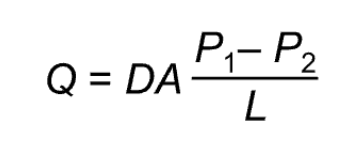
Define all the variables in Fick’s Law of Diffusion Equation
Q: rate of diffusion
D: diffusion coefficient (how easily molecule moves)
A: surface area of membrane
P1, P2: difference in partial pressure OR concentration
L: path length between locations / thickness of membrane
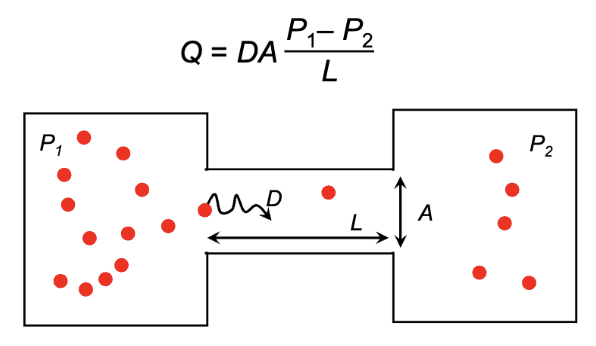
What changes would increase gas exchange across surfaces? Explain (3)
Surface Area Increases
more area = more space for diffusion
Partial Pressure Difference Increases
Bigger gradient = faster diffusion
Diffusion Path Length Decreases
Decreased distance = more diffusion (thin barrier)
How does the body keep refreshing gases on each side of the membrane? (increasing partial pressure gradients) (2)
increasing partial pressure difference (P1-P2)
reducing diffusion path length (L)
increasing partial pressure difference (P1-P2)
Ventilation (breathing): active movement of respiratory medium (air or water) over gas exchange surfaces; increases P1
Keeps fresh O2 rich air outside = stronger gradient
Perfusion (circulation): active circulation of blood over the gas exchange surfaces; decreases P2
Blood removes O2 quickly from exchange surface
ventilation keeps O2 high outside and perfusion keeps O2 low in blood to keep steep gradient = fast diffusion
Reducing Diffusion Path Length (L)
gases are carried close to target tissues by respiratory and circulatory systems → decreases path length to target tissues
Fish and Gas Exchange: How do they do it?
Bony fish use countercurrent flow through their gills to maximize gas exchange → water flows in one direction and blood flows in the other
Water enters mouth
Water flows over gills
Water exits under opercular flap
blood inside gills flows opposite direction of water
Gill Structure
Made up of gill filaments that are covered by folds (lamellae) which are very thin
Constant water flow maximizes O2 partial pressure on external gill
lamellae
folds that are the site of gas exchange; minimize diffusion path length (L) between blood and water
Very thin; filled with capillaries (blood vessels)
Large SA and short diffusion distance = faster diffusion
Explain how the gills work
Gill arch (main support) → gill filaments (long branches) → lamellae (tiny folds where gas exchange occurs)
Deoxygenated (afferent) blood enters, oxygenated (efferent) blood leaves
Key: Countercurrent flow improves diffusion efficiency
Respiratory System in Humans
Breathe → trachea → bronchi → bronchioles → alveoli (air-filled sacs)
Identify P1, P2, A, L in humans
P1: inside alveoli (O2 exchange)
P2: outside of alveoli (pink stripes on branches that lead to alveoli)
A: surface area of alveoli → cluster has great SA
L: distance between interior of alveoli and blood in capillaries (where diffusion/exchange is actually happening)
Identify P1, P2, A, L in fish
P1: partial pressure in water flowing over gill lamellae
P2: in blood entering gill capillaries
A: gill filaments + lamellae (large SA)
L: distance between water and blood across thin gill epithelium
emphysema
condition caused by smoking, air pollution, and other factors
Develops over time and invlves gradual damage of lung tissue (destruction of alveoli)
What parameters of Fick’s Law would be affected by emphysema? How would gas exchange be affected?
emphysema reduces SA available for gas exchange due to destruction of alveolar walls
Q and A decreases, L increases, gradient may decrease

