PH exam 1 lecture objectives
 Studied by 0 people
 Call Kai
 Learn
Learn Practice Test
 Spaced Repetition
 Match
Match Flashcards
 Knowt Play
1/156

There's no tags or description
Looks like no tags are added yet.
Name | Mastery | Learn | Test | Matching | Spaced | Call with Kai |
|---|
No analytics yet
Send a link to your students to track their progress
157 Terms
What are the various ways people rely upon and benefit from animals?
Food sources; companionship; transportation; biomedical research; health promotion; service; entertainment; sport; raising status; shelter; and religion.
Define zoonotic disease.
A disease communicable between humans and animals under natural conditions with two-way transmission. Can be direct (rabies parasites) or indirect (bug vectors).
Define zooeyia.
The benefits of pet ownership to individuals and communities. Derived from Greek roots zoion (animals) and Hygeia (health).
Define health.
A state of complete physical mental and social well-being and not merely the absence of disease or infirmity.
Define public health.
The science and art of preventing disease prolonging life and promoting health through the organized efforts and informed choices of society organizations public/private communities and individuals. Alternatively: what we do as a society collectively to assure the conditions in which people can be healthy.
Define One Health.
A collective multisectoral and transdisciplinary approach (working at local regional national and global levels) to achieve optimal health and well-being outcomes recognizing the interconnections between people animals plants and their shared environments.
Why is public health inherently controversial?
Must balance individual freedom versus collective responsibility. Controversial due to ideologies (US values personal freedom with minimal obligation to common good) conflict between market justice and social justice economics (long-term gains require costs now costs borne by wealthy benefit less wealthy) religion (sex education/contraceptives/abortion) and politics.
What is the difference between market justice and social justice?
Market justice emphasizes individual responsibility with minimal obligation to common good. Social justice advocates that minimal levels of income housing employment education and health care should be fundamental rights to minimize preventable death/disability.
What impact has public health had on life expectancy?
Public health has increased life expectancy at birth over the last 100 years in the US and throughout the world with declining child mortality. The top 10 achievements prevented about 50 million excess deaths.
List the Top 10 Great Public Health Achievements (1900-1999).
1. Immunizations 2. Motor vehicle safety (1.2M deaths prevented 1967-1999) 3. Workplace safety 4. Infectious disease control (21.6M deaths prevented 1900-1995) 5. Declines in heart disease and stroke deaths (19.9M deaths prevented 1960-2010) 6. Safer and healthier foods 7. Healthier moms and babies 8. Family planning 9. Water fluoridation 10. Tobacco control (1M deaths prevented 2003-2032).
Who pioneered criteria for determining causal association?
Austin Bradford Hill pioneered his own criteria for determining causal association.
Define social determinants of health.
Conditions in the environment where people are born live learn work play worship and age that affect a wide range of health functioning and quality-of-life outcomes and risks.
What are the five domains of social determinants of health?
1. Economic stability (poverty employment) 2. Education access and quality 3. Health care access and quality 4. Neighborhood and built environment 5. Social and community context.
Define health disparities.
Differences in health outcomes between groups within a population.
Define health inequalities.
Differences in health outcomes that are systematic avoidable or unjust. Socially disadvantaged populations carry the burden of disease/injury/violence.
Define primary prevention.
Avoiding development of a disease by removing risk factors. Examples: vaccines health promotion health policy in the form of social reform.
Define secondary prevention.
Preclinical diagnoses to reduce the severity of disease. Examples: screenings treatment therapy masks.
Define tertiary prevention.
After disease onset with goal to manage long-term and reduce harm. Examples: rehabilitation monitoring control with medications.
Define base rate fallacy.
Flawed reasoning pattern that causes people to believe that statistics are not relevant to the problem or question at hand. Important to look at the denominator. Example: 50% who died were vaccinated but of 50 vaccinated people only 10% died versus 50% of 10 unvaccinated people died.
What is the role of veterinarians in safeguarding public health according to the veterinarian's oath?
Promotion of public health through 6 domains: diagnosis surveillance epidemiology control prevention and elimination of zoonotic diseases.
What do private practice veterinarians do for public health?
Involved in routine practice treating diseases that may affect owners/families/environment provide exams/vaccines/parasite control promote human-animal bond report diseases to regulatory agencies collaborate with human doctors on zoonotic diseases and educate the public on disease threats.
What federal agencies regulate food drugs and biologics?
FDA (food + food ingredients minus meat/poultry/eggs) FDA CVM (animal drugs/feeds/vet devices) USDA (animal vaccines and biologics) EPA (pesticides) FSIS (foodborne illness - meat/poultry/egg products) APHIS (animal and plant health disease control/eradication).
What is a state veterinarian?
Works in state department responsible for directly protecting livestock poultry and aquaculture industries and indirectly protecting public through prevention/detection/containment/eradication of economically important livestock diseases transmissible to people.
What is a state public health veterinarian?
Works in state health departments (only 41 states/territories have them) focuses on zoonotic disease control and prevention directly focused on protecting public health.
What is NASPHV?
National Association of State Public Health Veterinarians - helps direct and develop public health procedures involving zoonotic diseases in the US.
Define reportable or notifiable diseases.
Diseases that physicians and other health care providers must report to health authorities. Typically infectious/communicable diseases or animal diseases with economic importance.
What is the CDC's NNDSS?
National Notifiable Disease Surveillance System - helps public health monitor control and prevent about 130 diseases. State health departments report cases of selected diseases to NNDSS.
What is WOAH?
World Organization for Animal Health - intergovernmental organization responsible for improving animal health worldwide maintains list of 207 reportable diseases.
List zoonotic diseases that veterinarians in Arizona are mandated to report.
Anthrax avian influenza brucellosis tuberculosis equine encephalomyelitis Q fever vesicular stomatitis rabies tularemia avian chlamydiosis leptospirosis West Nile virus.
Define environmental health.
Addresses all physical chemical and biological factors external to a person and all the related factors impacting behaviors - considered the neglected component of One Health. Environmental risks contribute to deaths and disease.
How does climate change affect infectious diseases?
Climate change has been termed the threat multiplier - it adversely affects infectious diseases zoonoses food security food safety and local/regional/global responses to them. Increased temperature leads to lifecycle changes in pathogens vectors and reservoirs.
Who is most affected by climate change?
Those without resources and in poverty are more intensely affected. There's debate on whether wealthier countries who contribute most to climate change should contribute monetarily to aid less fortunate countries.
How does biodiversity affect health?
Effects of climate and environmental change affect animals more than humans which affects biodiversity. Changes include reduced numbers of some animals/organisms increased numbers of others modified interactions between them and changes to their environment.
Define trophic cascades.
Bottom-up or top-down rearrangements of the food web caused by the disappearance or interruption of a keystone species. Example: otters eating sea urchins that block growth of kelp leaves.
What are the 5 common safety risks recognized by PLIT?
1. Mishandling of hazardous materials 2. Slip trip and fall risks 3. Lack of a formal safety program 4. Inadequate bite-prevention and animal-handling protocols 5. Poor ergonomics.
What is OSHA and NIOSH?
OSHA Act of 1970 created NIOSH (research agency) which is part of the CDC in US Department of Health and Human Services. NIOSH website has a veterinary section.
List the hierarchy of controls from most to least preferred.
1. Elimination (removes hazard - preferred) 2. Substitution (safer alternative) 3. Engineering controls (reduces contact) 4. Administrative controls (work practice/rule changes) 5. PPE (equipment to minimize exposure - least reliable due to human error).
Why are elimination and substitution most difficult to adopt?
They are best implemented during design/development phase and are most difficult to adopt but they're the most effective since they remove or reduce the hazard at its source.
Define solid waste.
Doesn't have to be solid covers most household/veterinary practice waste.
Define medical waste.
Any solid waste generated in the diagnosis treatment or immunization of human beings or animals in research pertaining thereto or in the production or testing of biologicals.
Define regulated medical waste.
Subset of medical waste that poses a significant risk of transmitting infection to people (infectious waste). Note: noninfectious animal tissue is not RMW.
Define hazardous waste.
Waste with properties that make it dangerous or capable of having harmful effects on human health or the environment.
What are the two categories of biological substances for shipping?
Category A (known to contain certain etiological agents like confirmed cultures - requires formal training) and Category B (shipper believes may contain etiologic agent being shipped for diagnosis/investigation - requires documented training). Exempt substances don't contain infectious material.
Who is responsible for proper shipping of biological samples?
Shippers are responsible and face financial penalties from DOT if rules aren't followed.
What are key considerations for manure management?
Do not contaminate waterways (due to nitrogen and phosphorus) protect air quality (reduce odors and gases through lagoons for anaerobic respiration) reduce nutrient content through feeding and animal genetics.
What is the pentobarbital concern in carcass disposal?
Pentobarbital can cause secondary poisoning to wildlife. Recommendations from US Fish and Wildlife: no rendering incinerate/cremate when possible bury deep enough according to local laws educate clients about implications.
What are approved methods for humane depopulation of animals?
Large animals: gunshot or penetrating captive bolt. Medium animals: non-penetrating captive bolt or CO2 chamber. Poultry: CO2 argon nitrogen or water-based foam.
What are proper disposal methods for diseased animal carcasses?
Incineration (preferred) burial (at least 4 feet deep) or rendering - must prevent exposure of other wildlife and humans to disease.
What are the phases of disaster response?
Prevention/preparation → Response → Recovery → Mitigation
What factors increase risk of disease in a disaster?
Stress overcrowding inclement weather conditions exposure to wildlife vector population proliferation disposal of animal waste food and water contamination and animal abandonment.
List zoonotic disease disasters.
Anthrax avian influenza brucellosis hantavirus plague rabies tuberculosis tularemia and West Nile virus.
What must be considered for euthanasia during disasters?
Methods of culling/depopulation following AVMA recommendations and disposal methods (burial incineration composting or rendering) governed by laws.
Define community engagement.
Process of enabling conversations and building relationships between people who have a role or interest in an issue in their community. Defines issues of interest assesses problems and designs/implements locally sustainable and suitable solutions. It's an ongoing process not one-time.
What makes community engagement approaches effective?
Inclusive (include pro and anti views) involve variety of engagement methods participatory planning (community identifies problem and stakeholders define success) and good communication.
What are the costs of community engagement?
Time consuming and quality of services concerns (must train and trust local populations avoid expert takeover).
What are the benefits of community engagement?
Sustainability resilience for the community impact (focusing on problems of greatest concern) effectiveness of intervention financial benefits (encouraging community action/support) welfare improvements and utilization of influencers.
List the levels of community participation from least to most involved.
1. Non-participation/passive (no members involved) 2. Co-option (token appointment with no power) 3. Compliance/informing (tasks assigned with incentives) 4. Consultation (opinions sought but outsiders decide) 5. Cooperation (work together but outsiders direct) 6. Co-learning (share knowledge and create new understanding together).
Define non-participation community participation.
no members involved
Define co-option community participation.
token appointment with no power
Define compliance/informing community participation.
tasks assigned with incentives
Define consultation community participation
opinions sought but outsiders decide
Define cooperation community participation
work together but outsiders direct
Define co-learning community participation
share knowledge and create new understanding together
Define workshop.
Single short educational program designed to teach or introduce practical skills techniques or ideas that participants can then use in their work or daily lives.
What are common workshop features?
6-15 participants with participatory aspects informal setting conducted by people with real experience self-contained and time limited.
What are the three phases of conducting a workshop?
1. Planning (guided by what audience believes is important size 8-12 golden number no more than 6 hours materials at 8th grade reading level or less) 2. Preparation (logistics welcoming space food/drink) 3. Implementation (introduction with warm tone substance with participation closure summarizing what was learned).
What is the goal of dog population management (DPM)?
Improvement in dog welfare alongside benefits for public and environmental health. Aims to have sustained influence on processes within dog population dynamics to change sub-populations in a targeted way.
What are the principles of dog population management?
Humane and ethical (killing alone is inhumane and ineffective) adapted to local dog population dynamics (every place is unique) sustained and adaptive (permanent community service) evidence-based design/monitoring/evaluation focus on root causes and central role of human behavior.
What problems are experienced BY dogs in unmanaged populations?
Environment (weather) nutrition (malnutrition) social issues (stress fear frustration pain) behavior (distress from aggression) health (disease/injury/inhumane death) welfare (high euthanasia rates).
What problems are linked TO dogs in unmanaged populations?
Risks to public health (rabies) negative public perception roaming dog density issues negative impacts on wildlife (predation disease stress) negative impacts on livestock.
Why is heavy removal/culling ineffective for dog population management?
Inefficient (takes as many dogs being spayed as removed) not sustainable can dilute effects of other interventions (like rabies campaigns) doesn't address root causes or sources of dogs.
What are the foundations of dog population management?
Legislation and enforcement (two levels that must be enforced) task force (sustained leadership long-term) advocacy (research-based coordinated activities) community engagement.
What are the key DPM services?
Promoting responsible behavior (pet owners human-animal bond) strengthening DPM professional capacity (training local professionals periodically) reproduction control (sterilization to limit growth) veterinary care (preventative care like vaccines/dewormers treating health problems humane euthanasia when needed).
Define epidemiology.
The science which deals with what falls upon people; bridge between biomedical social and behavioral sciences. Concerned with distribution and determinants of health and diseases morbidity injuries disability and mortality in populations. Study of disease patterns and transmission.
What knowledge areas do epidemiologists need?
Public health clinical medicine pathophysiology biostatistics social sciences math history sociology demography geography behavioral sciences and law.
List practical applications of epidemiology.
Discover disease burden describe natural history of disease observe historical trends to predict future identify specific disease causes and risks differentiate between natural and intentional diseases compare treatments/interventions assess community health services prioritize intervention strategies provide foundation of public health policy.
Who is considered the father of epidemiology and what did he study?
John Snow studied the cholera outbreak in London using a case-control natural experiment. He used mapping to mark cases of cholera versus water pumps by two companies discovering that one company that moved its water source had fewer cases in the 1854 outbreak.
Define epidemiologic transition.
Describes a shift in patterns of morbidity and mortality from causes related primarily to infectious and communicable diseases to causes associated with chronic degenerative diseases.
Define demographic transition.
Coincides with epidemiologic transition; shift from high birth rates and death rates found in agrarian societies to much lower birth and death rates in developed countries.
Define endemic.
Habitual presence (or usual occurrence) of a disease within a given geographic area.
Define epidemic.
The occurrence of an infectious disease clearly in excess of normal expectancy and generated from a common or propagated source.
Define pandemic.
A worldwide epidemic affecting an exceptionally high proportion of the global population.
Define natural history of disease.
Disease's ecology; the course of disease from its beginning to its final clinical endpoints. Understanding this allows identification of potential opportunities for intervention.
What is the difference between association and causation?
Causation means one thing directly makes the other happen (ex: smoking causes cancer). Association means two things happen together or are related but one doesn't necessarily cause the other.
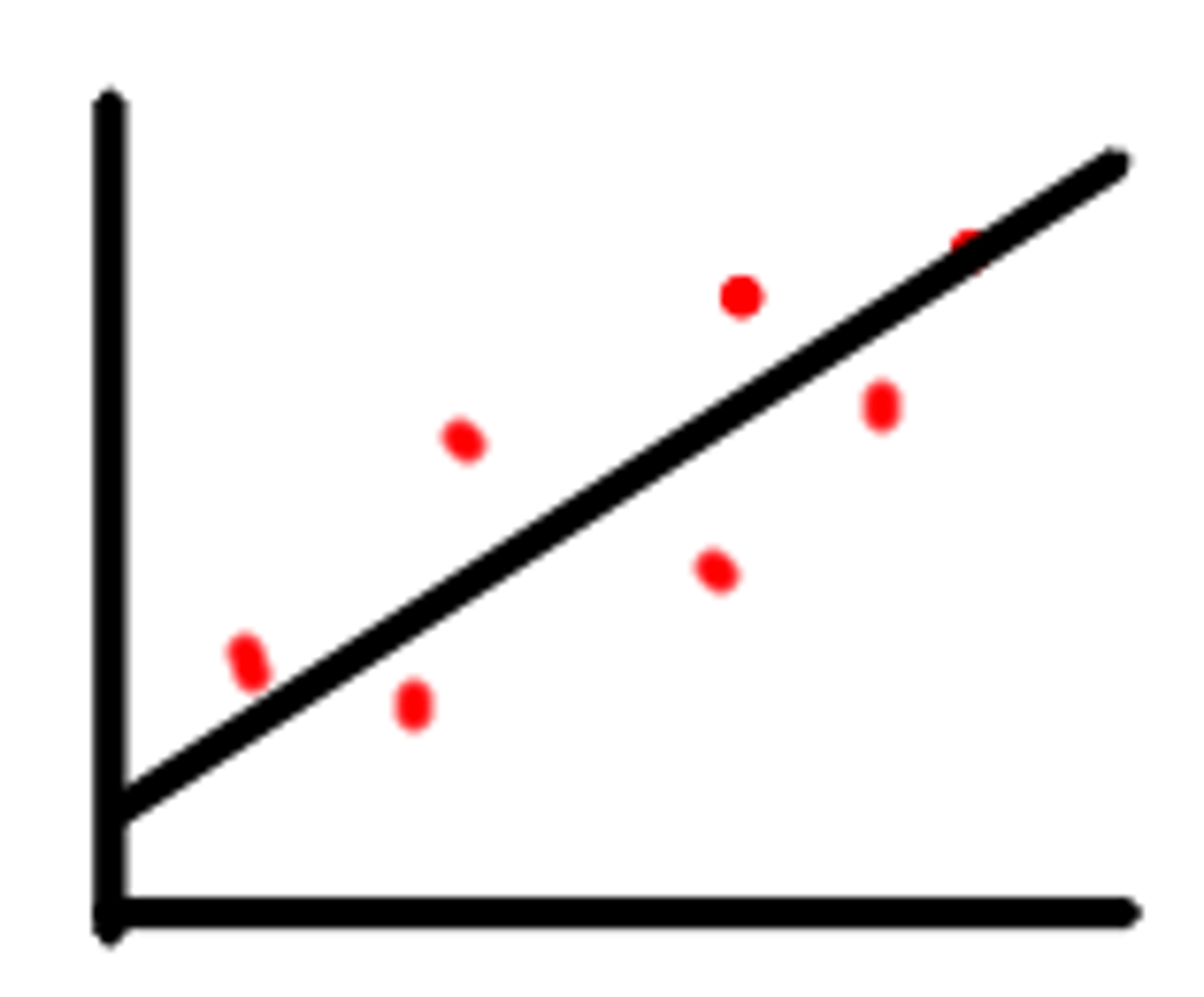
What does a scatter plot show?
Represents two variables (one on x-axis one on y-axis) with measurements plotted as data points. Line of best fit is the regression line - closer points are to this line the closer the association.
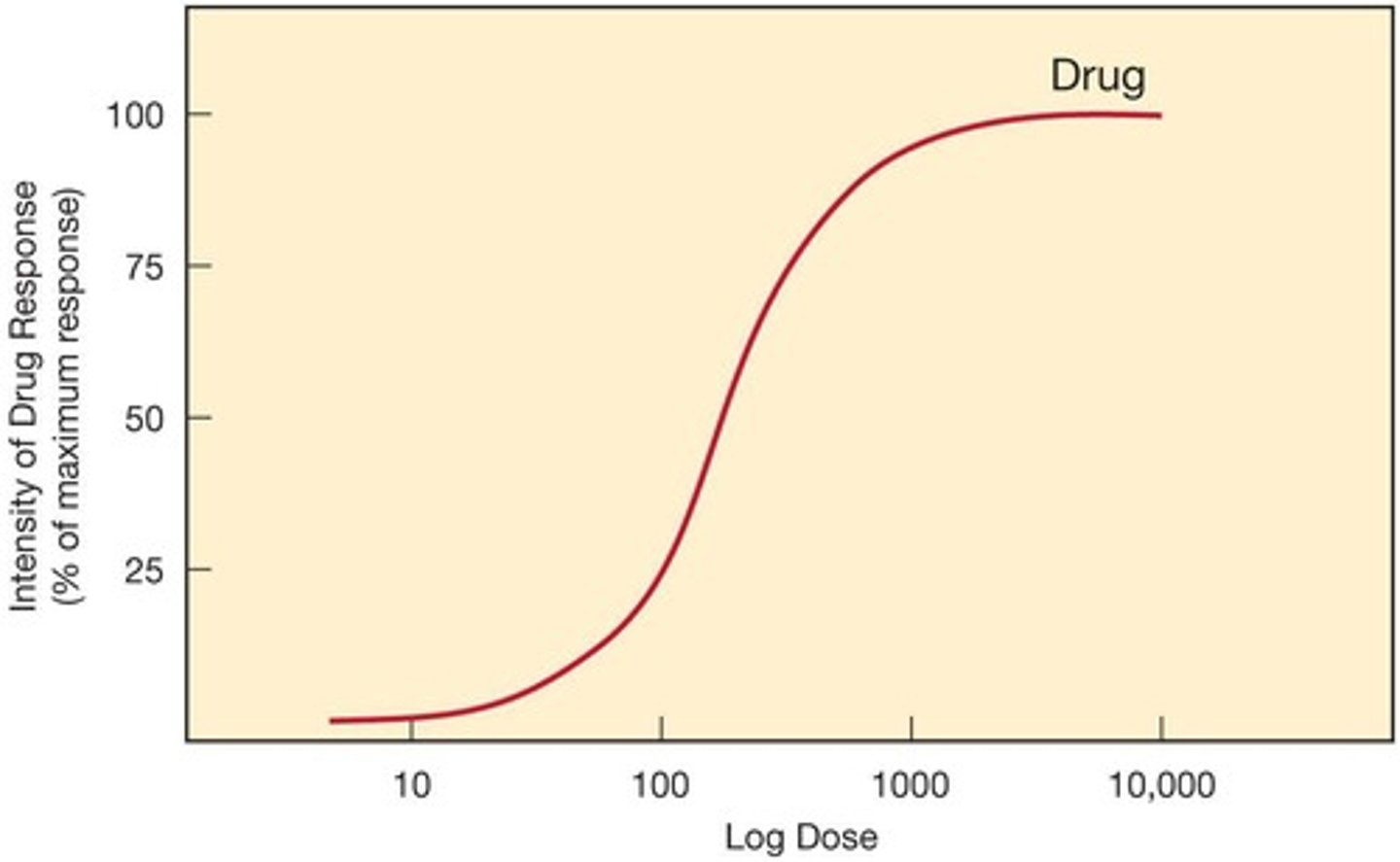
What is a dose-response curve?
Type of correlative association between an exposure and an effect; the threshold represents the lowest dose at which a particular response occurs (ex: number of cigarettes smoked daily vs lung cancer mortality).
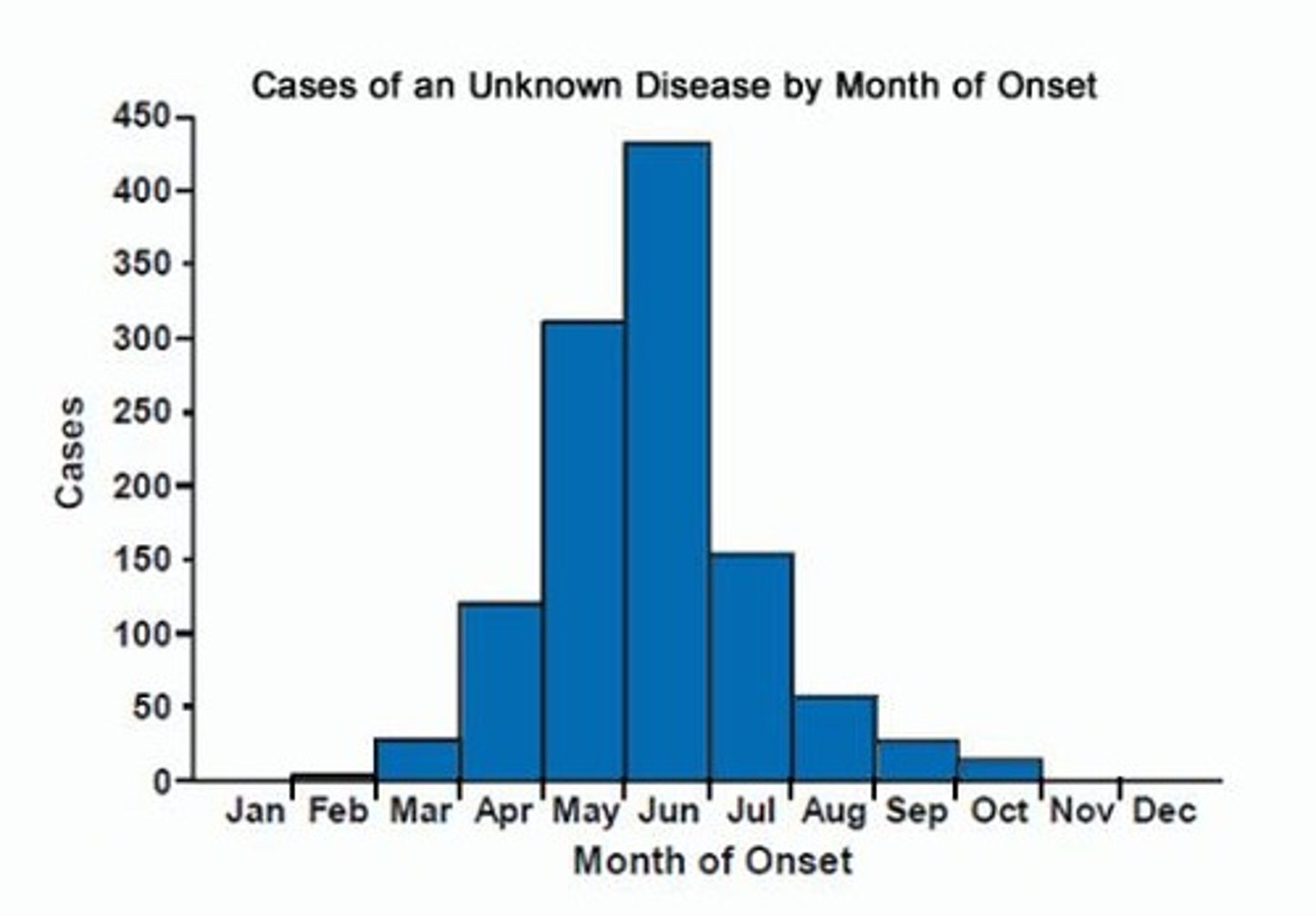
What is an epidemic curve?
Graphic plotting of distribution of cases by time of onset; aids in identifying the cause of a disease outbreak.
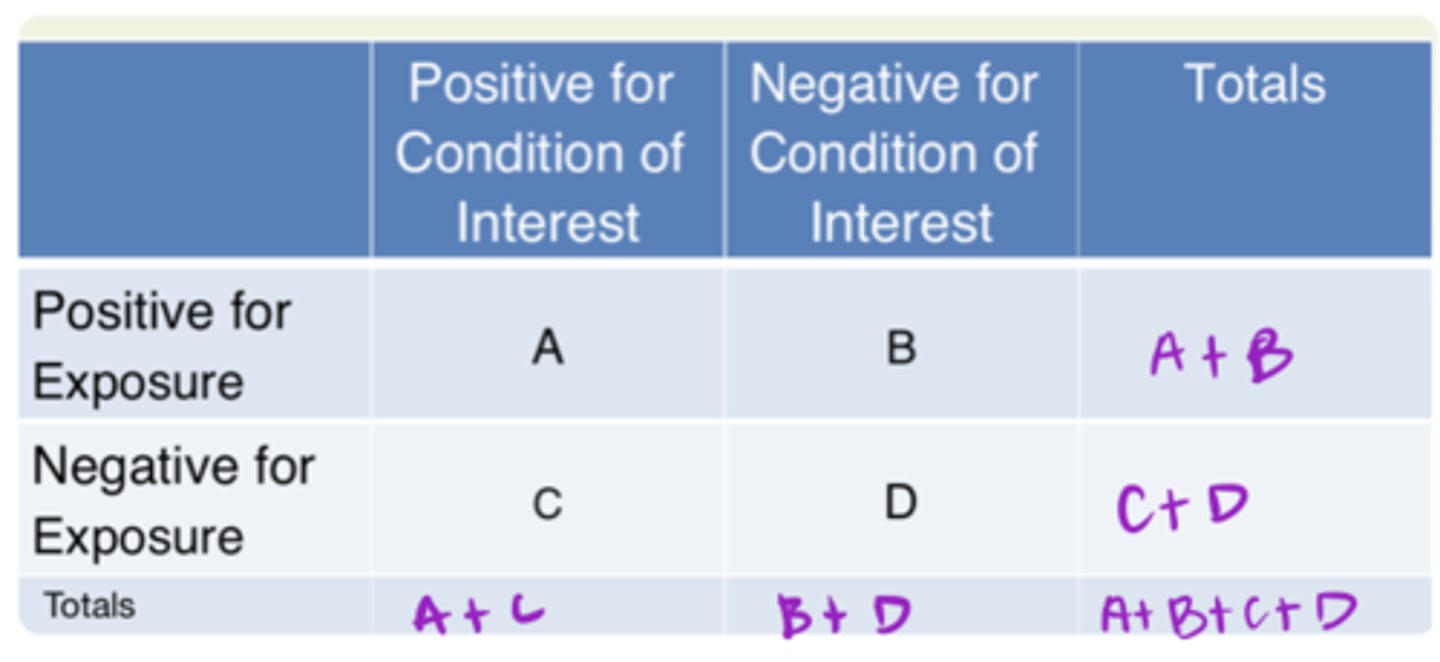
What is a contingency table?
A 2x2 table (like a Punnett square) that helps compare gold standard testing and new testing methods.
What were Koch's postulates?
1. Organism must be observed in every case of disease 2. It must be isolated and grown in pure culture 3. Pure culture must reproduce disease when inoculated into susceptible animal 4. Organism must be observed in and recovered from the experimental animal.
List Hill's Criteria for Causation.
1. Strength (strong R value associations) 2. Consistency (observed repeatedly) 3. Specificity (constrained to particular disease-exposure relationship) 4. Temporality (cause before effect) 5. Biological gradient/dose-response (linear trend) 6. Plausibility (biologically plausible) 7. Coherence (no major conflicts with known facts) 8. Experiment (preventative actions alter outcome frequency) 9. Analogy (similarities between known associations and one being evaluated).
Define strength from Hill's Criteria of Causation.
strong R value associations
Define consistency from Hill's Criteria of Causation.
observed repeatedly
Define specificity from Hill's Criteria of Causation.
constrained to particular disease-exposure relationship
Define temporality from Hill's Criteria of Causation.
observe cause before effect
Define biological gradient/dose-response from Hill's Criteria of Causation.
linear trend
Define plausibility from Hill's Criteria of Causation.
biologically plausible
Define coherence from Hill's Criteria of Causation.
no major conflicts with known facts of the disease
Define experiment from Hill's Criteria of Causation.
preventative actions alter outcome frequency
Define analogy from Hill's Criteria of Causation.
similarities between known associations and one being evaluated
What strategies reduce bias in epidemiologic studies?
Recall bias: be aware of limitation when selecting study method. Observer bias: blind/double-blind procedures scripts multiple observers. Selection bias: randomization. Confounding: think through potential confounders in design phase use analysis to control for confounders.
 Note
Note  Flashcards (20)