Digestibility | Animal Nutrition Exam 3
 Call Kai
 Learn
Learn Practice Test
 Spaced Repetition
 Match
Match Flashcards
 Knowt Play
1/68

There's no tags or description
Looks like no tags are added yet.
Name | Mastery | Learn | Test | Matching | Spaced | Call with Kai |
|---|
No analytics yet
Send a link to your students to track their progress
69 Terms
Produce
Nutrient Management Goals
“Eat More ___ More”
Why we want to increase consumption, typically we want animals that will eat more and be effecient
Dry Matter Intake (DMI)
Nutritional Management Goals (1/7)
Maximize (optimize) nutrient consumption: ________
We don’t actually know the max it can change over time
Digestibility
Nutritional Management Goals (2/7)
Maximize (Optimize) nutrient digestion: ___________
If the animal is consuming more digestibility is likely to decrease
Digestibility is a function of feed → want to feed digestible feed
Highly Digestible
Currently, the size of dog poop is smaller meaning dog food is more digestible than it was some time ago
Dog foods are now formulated to be ______
Firm poop → little food left
Nutrient Utilization Within the Body
Nutritional Management Goals (3/7)
Maximize (optimize) metabolism: _____________
Want nutrients to play a role in the body
Promote sweat
Nutrient Management Goals (4/7)
Maximize (optimize) animal welfare: ____
Producers want to keep animals healthy so they can continue producing
Global Changes
Nutrient Management Goals (5/7)
Minimize (optimize) enviornmental impact: _____
Livestock Operations Profits
Nutrient Management Goals (6/7)
Maximize (optimize) economical issues: _________
Can be very slim if you are a producer
Feeding organic might be a good way for producers to make more money → can charge more
Global Food Supply
Nutrient Management Goals (7/7)
Maximize (optimize) social issues: _______
Food is a National Security Issue
Animal
Dry Matter Intake (DMI)
Factors that affect DMI
_____: stomach capacity, food preferences, physiological state (gestation, lactation → increased food requirement), sickness (don’t like eating when sick)
Food/Dietary
Dry Matter Intake (DMI)
Factors that affect DMI
_____
Management
Dry Matter Intake (DMI)
Factors that affect DMI
_______: competition from other animals
Animal Factors
Factors that affect DMI: ______
Animal Health
Animal Physiology
Animal Production Levels
(Food) Passage Rate
(Food) Particle Size
Dietary Factors that affect DMI
Diet Digestibility: not linear → low quality feed can be made more digestible and eat more
___________: not linear → more you consume the faster it goes through
___________: not linear → smaller particles go through faster
Eat Less
Dietary Factors that affect DMI
Energy Density
Fiber Content (opposite of energy) → eat a lot of fiber to feel full and ____
Essential Nutrients
Dietary Factors that affect DMI
____________: If you have an essential nutrient that is missing the animal will eat MORE becuase they are trying to compensate for the nutrient, eventually through the lacking nutrient will cause the animal to eat LESS because it will limit the animals growth and production
Palatability
Dietary Factors that affect DMI
______: adding bacon will increase intake: increased palatability increased eating but it is difficult to measure/quantify
Aroma: animals may like different smells
Diet Avaliabiity
Management Factors that affect DMI
_______: animals eat more when it is availiable (common in production systems) → but there are differences between animals and species.
Feeding Frequency
Management Factors that affect DMI
_________ (how many times food is offered): usually increases intake
if you like snacking you always keep your blood glucose levels high → not great for your pancrease continously secreting insulin → prediabetic
Not a problem for producing animals because they do not live long enough for it to become problematic
Enviornmental Conditions
Management Factors that affect DMI
__________ (temperature, wind, light)
HOT: animals eat less when they are hot/heat stress
fans
feed less energy in the winter, feed more energy (oils/fats) because they are eating less.
**Lipids are considered “cool calories” because they generate less heat and pack calories (training horse in the sun → eats less → feed lipids)
In the wind animals don’t want to eat: need a barn/place to eat
Digestibility
______
Affects how much of any nutrient consumed actually reaches the animals tissues
Digestion
By definition, ____ refers to the changes which food undergoes within the digestive tract to prepare it for absorption
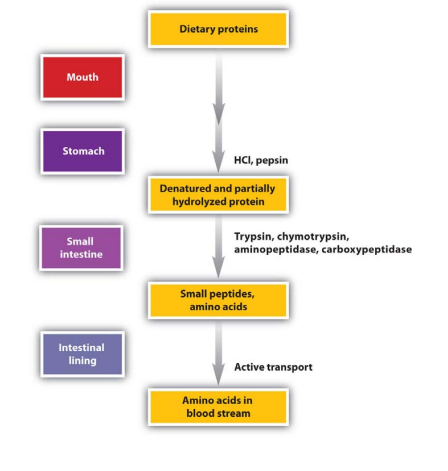
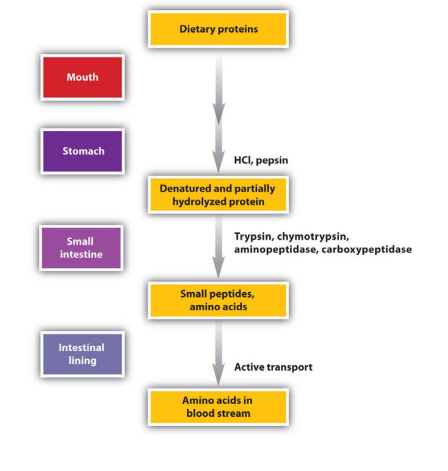
Digestion Protein Overview
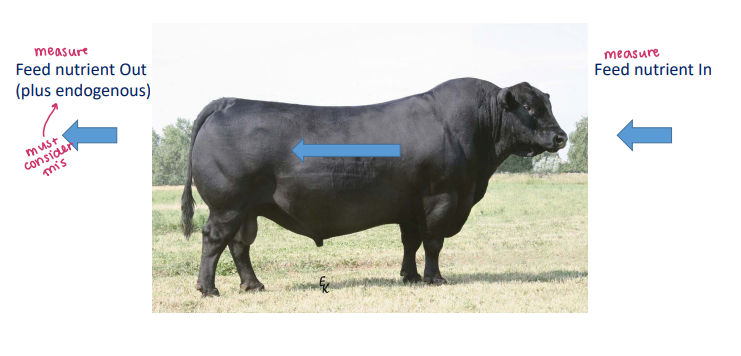
Digestibility Coeffecient
Digestibility
A certain fraction of each nutrient is consumed is digested (ie is absorbed by the GI tract)
This fraction is referred to as the ________

Digestibility coeffecient
_________ is the fraction of the consumed feed that is not excreted in the feces
Undigested nutrients
The feces are mainly composed of _____ of the diet
Endorgenous Nutrients
But feces also contain _________ (nutrients that don’t come from the feed/ come from body or within) such as materials secreted by the host animals into the intestine
Ex
Microbial protein
Pancreatic enzymes (other enzymes produced by the body)
Fiber CANNOT be endrogenous becuase we cannot produce it
Review
Review
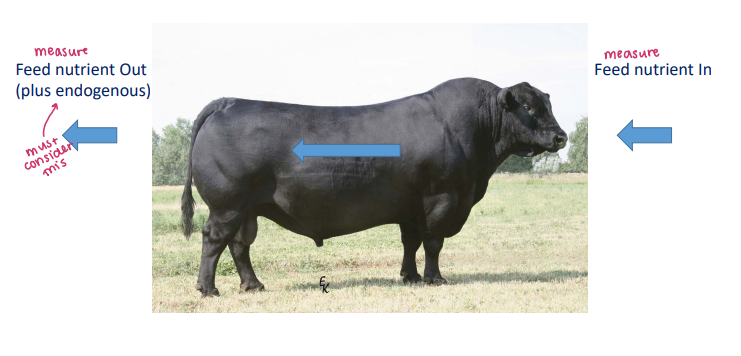
Apparent Digestibility
__________: Easier to measure, however it does not account for endogenous secretions. It assumes that all nutrients in feces are from food!
True Digestibility
_________: Accounts for endrogenous secretions (sloughed cells from intestine, digestive enzymes, and pancreatic secretions)
Underestimate
Apparent digestibility is an _____ of true digestibility because endogenous nutrients are presumed to be undigested feed nutrients
Negative
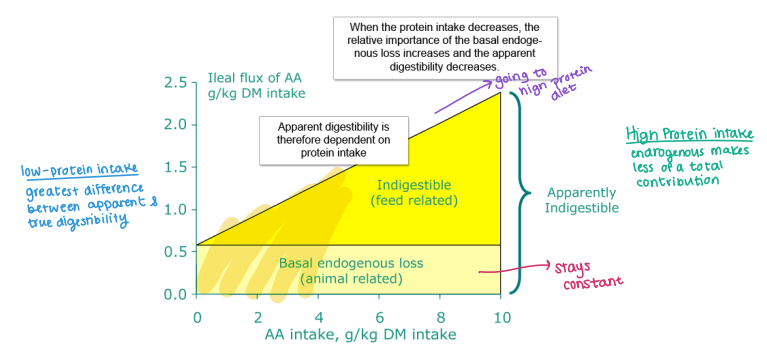
Think of an animal that is fed no protein. There would still be CP flowing into feces. So, the apparent digestibility would be _____, which is impossible!
Constant
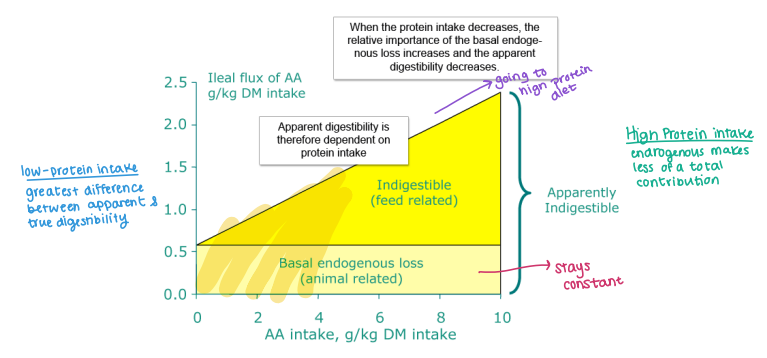
Endrogenous CP stays relatively _____ as dietary CP increases. Therefore, as the amount of dietary CP increases, the error associated with neglecting the endogenous CP contribution when calculating apparent CP becomes smaller.
Low-Protein Intake
Apparent vs. True Digestibility
_______________: greatest difference between apparent and true digestibility
High Protein Intake
Apparent vs. True Digestibility
__________: endrogenous makes less of a total contribution
Nutrient Composition
Factors that Affect Digestibility
________: (Protein, Fiber, degree of lignification in fiber, lipids)
Diet Composition
Factors that Affect Digestibility
_________: (ingredient composition, “associative effects” → A little bit of starch can increase fiber digestion)
Pasta has different digestibility than pasta with bacon → different ingredients (fats)
Food Processing
Factors that Affect Digestibility
________: (Grinding, heat, moisture, chemical)
Burn steak: get less protein
Grind Cellulose: decreases digestibility because it passes faster
Grind Starch: increases digestion
Dry Matter i
Factors that Affect Digestibility
_______: (DMI)
More consumed less total digestibility, but still increased energy
Chocolate bar example
Passage Rate
Factors that Affect Digestibility
__________: particle size and particle density
faster = less digestion
Animal Factors
Factors that Affect Digestibility
_________: (Influences on DMI and therefore passage rate)
Consumed
Excreted
Calculation of (Apparent) Digestibility
To calculate apparent digestibility, you need:
Amount of nutrient ______
Amount of nutrient ______
0.2 pounds
Calculation of (Apparent) Digestibility***
Calulcation #1
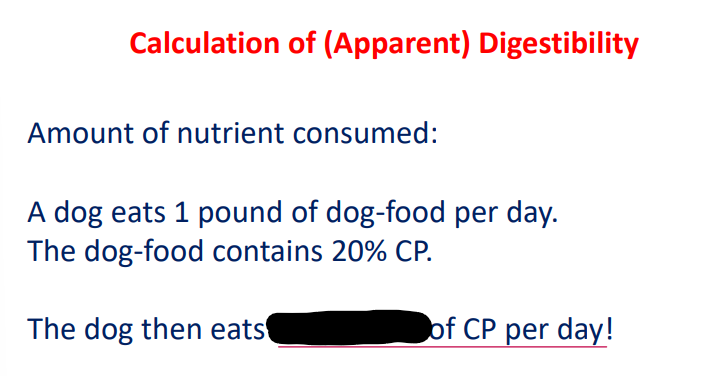
0.125 pounds
Calculation #2
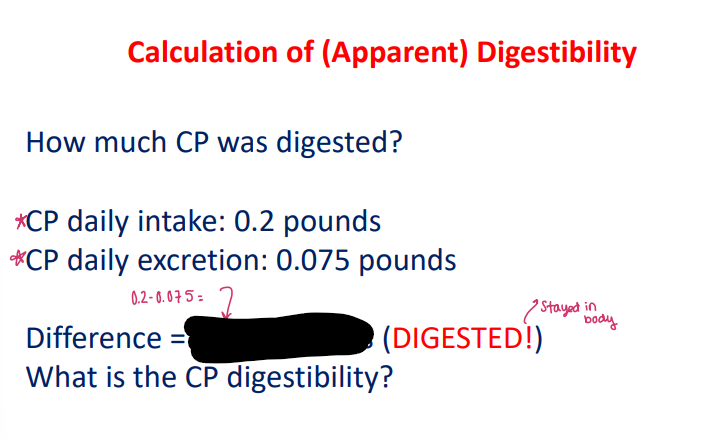
Underestimation
Apparent digestibility is always an ______
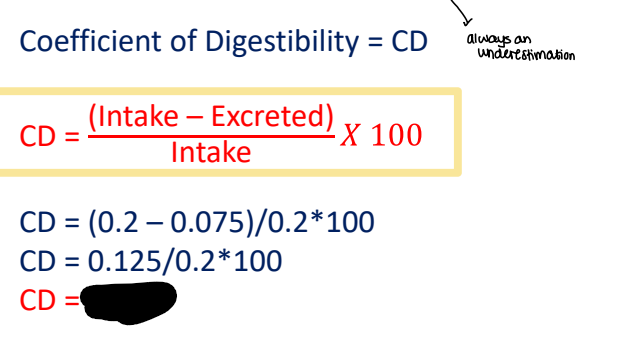
Coefficient of Digestibility
This is the equation for the ___________
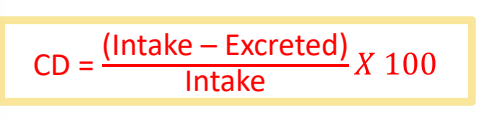
62.5%
Coeffecient of Digestiblity (Apparent)
Calculation #3
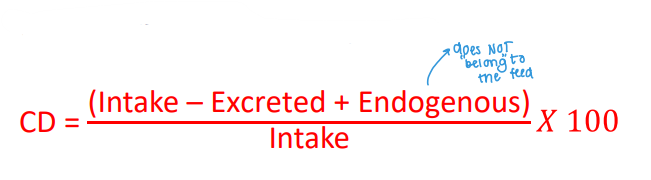
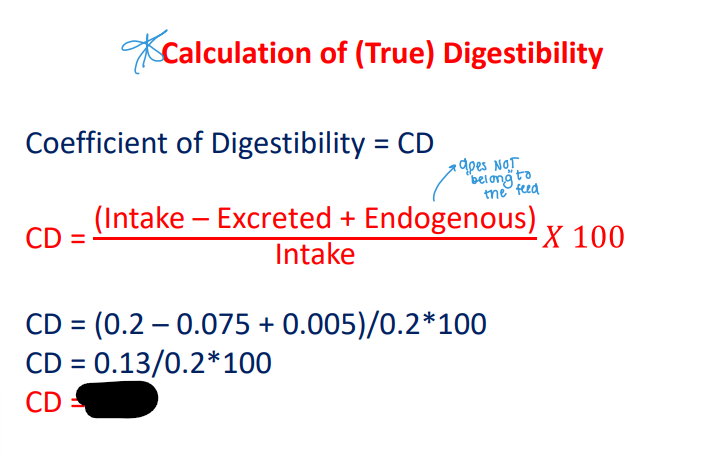
Coeffecient of Digestbility (True) Equation
65%
Energy
Digetsible Organic Matter (DOM) contains the _______
Digestible Organic Matter

Energy
Total Digestible Nutrients (TDN)
The EE Is multiplied by 2.25 to account for that it packs a lot of ____

DOM
Digestibility Terminology/Estimations of Energy Content
________ = digestible CP + digestible CF + digestible NFE + digestible EE
TDN
Digestibility Terminology/Estimations of Energy Content
**More Accurate _______ = digestible CP + digestible CF + digestible NFE + (digestible EE * 2.25)
Takes into account that fats contain more energy than starches & proteins
TEST Q: usage depends on the amount of lipids in the diet, if you have few lipids in the diet use DOM, high lipids use TDN
Energy Content
DOM and TDN are terms that provide an estimate of the _________ of the feed.
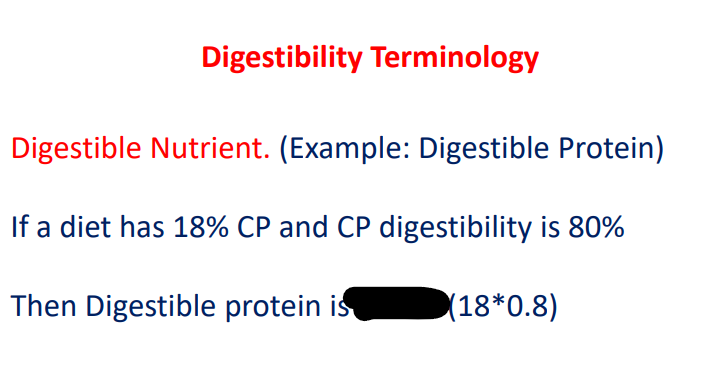
14.4%
Digestible Nutrient Calculation
Total Collection
Marker Methodology
Methods for Determining Digestibility
There are basically two methods for determining the digestibility of a diet
_______
_________
Total Collection
Methods for Determining Digestibility
The __________ method requires one to measure total feed intake, total fecal output, and the nutrient composition of the diet and feces.
Becomes more difficult with larger animals
Marker Method
Methods for Determining Digestibility
In the ______, the diet must contain something (a marker) that allows us to quantify specific nutrients.
Assayed
Marker Methodology
Marker Characteristics → must go through animal and be excreted
Indigestible
Non-absorbable
Inert (doesn’t affect digestibility) → cannot affect other nutrients
Easily _____
Color maker can be used to see how long something remains in the tract but it is difficult to measure and is expensive
Total Collection
The best methodology for determining digestibility is ________
Best approach because you have everything the animal consumed and excreted
difficult to measure fecal in wild animals → must use markers
Marker is an alternative to total collection but no marker is perfect
External
Some markers are _______ (ex, chromium or ytterbium → rare elements that are not part of the diet/being consumed, food coloring) in that they are applied to the feed.
Interal
Some markers are _______ in that they are a constituent of the feed (ex, lignin, iNDF, or insoluble ash)
ex) lignin in elephants is a good marker for carbohydrates but not proteins
Ratio
With the marker method small samples of feed and feces are acquired and assayed for the marker and the nutrients of interest.
The ____ of nutrient to marker is determined in the feed and feces
Concentration
With the marker we are looking to see if its ______increases in the feed.
Marker concentration should increase → how much of the feed disappeared?
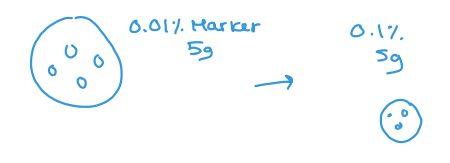
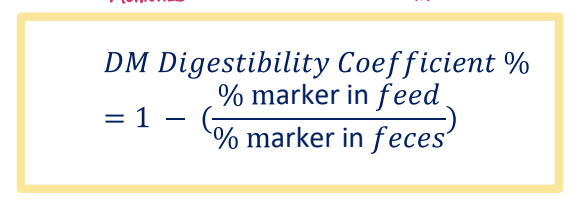
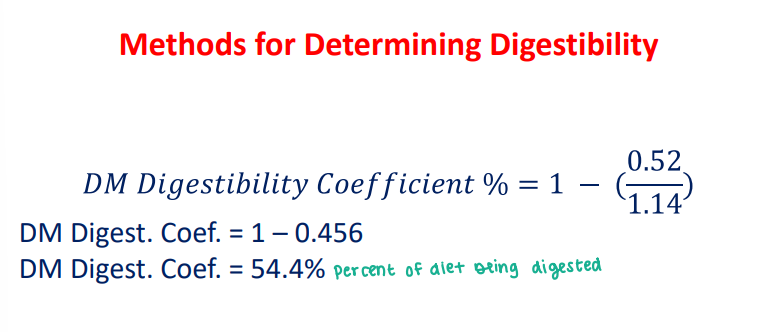
Marker Digestibility Calculation
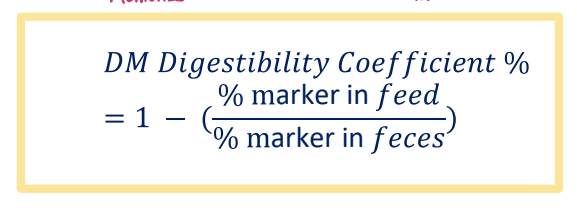
54.4%
If the marker concentration in feed is 0.52% and Marker concentration in feces is 1.14% then DM Digestiblility Coefficient is ______ (percent of diet being digested)
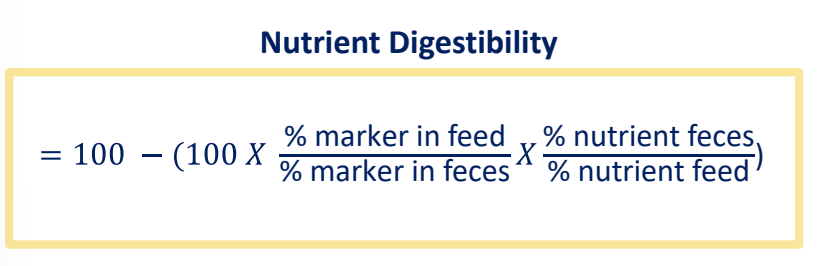
Formula for Nutrient Digestibility
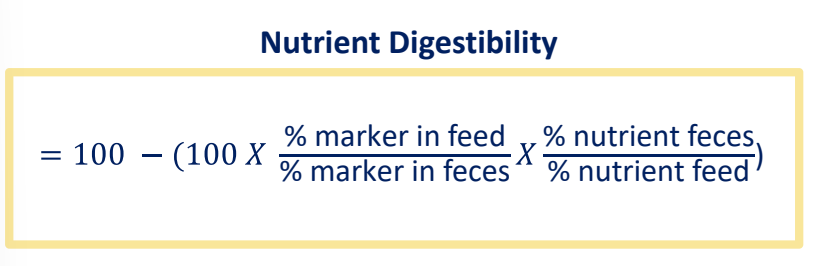
50%
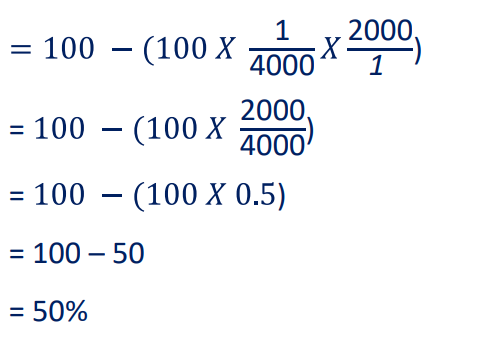
Example 1: If the ratio of marker to nutrient is 1:4000 in feed and 1:2000 in feces, then based on the assumption that some of the nutrient is absorbed but none of the marker is absorbed, we can calculate its digestibility
Answer = ______