arts appreciation
 Call Kai
 Learn
Learn Practice Test
 Spaced Repetition
 Match
Match Flashcards
 Knowt Play
1/218

There's no tags or description
Looks like no tags are added yet.
Name | Mastery | Learn | Test | Matching | Spaced | Call with Kai |
|---|
No analytics yet
Send a link to your students to track their progress
219 Terms
Art
Is one of the oldest and most important ways of expression by man primitive societies were creating art until now people create art
Art (2)
The ancient greek claims that art is an imitation of reality it is a imitative or representational the ancient greek claims that art is an imitation of reality it is a imitative or representational it copies something in the real world but in the 19th century photography took over that rule and in the 20th century the notion that art was representation was overtuned by modern art
Ars
The etymology of the term art came from the latin word______ which means art skill
Art as a representation or mimesis
Plato first developed the idea of art as mimises which in greek means copying or imitation
Art as expression of emotional content
became important during the romantic movement with artwork expressing a definite feeling as in the sublime dramatic audience response was important for the artwork
Art as form
Immanuel kant was one of the most influential of the early theories towards the end of the 18th century he believed that art should not have a concept but should be judged only on its formal qualities because the content of work of art is not of aesthetic interest
Art as a form
Was one of the most influential early theories towards the end of the 18 century he believed that art should not have a concept but should be judged only by only on its formal qualities because the content of a work of art is not of aesthetic interest
Formal qualities became particularly important when art become more abstract in the 20th century
Latin arti which means craftsmanship inventiveness mastery of form skill
The word art is from a latin?
Artiste
Comes from the French word of the art?
Artista which means performer
Arts come from the spanish words which mean?
Visual arts
These arts are those forms that create works which are primarily visual (forms perceived by the eyes) the man can take the beauty of nature through a piece of paper so that the other people may take time appreciating the captured image
Painting
This form of visual art aims to evoke an emotion from the viewers it is practiced by applying colors or other media to a surface with a brush or other objects
Sculpture
This form of visual arts characterized as the art of representing an imagine or observe object in hard materials such as glass metals or word in three dimensions
Architecture
This form of art provides as the physical structure we live it is a profound expression of a human culture in a particular period and it will endure and outlive as in forms of monuments that future generation will study and strive to understand
Drawing
This forms of art enhances the way we see the world around and conditions as to capture its details in a two dimensional medium this has been a critical element of art throughout history and in the contemporary artwork
Photography
This form of art is a process of creating portraits by recording radiation on a radiation sensitive medium such as electronic image sensors or photographic films
Art as representation or mimesis mesis
Art as expression of emotional content
Art as form
What are the 3 philosophy of art?
Artist
Is most often refers to those who create within a context of the fine arts such as the acting dancing drawing filmmaking painting sculpture writing photography and music they are those who use imagination and skill to construct works that may be judged to have aesthetic importance
The Creation of ideas.
The creation of the materials
The creation of forms
What are the three significant phases of arts or the creation of arts?
The creation of ideas the creation of ideas
Artists are usually impressionable persons they use their experience as their basis in the making of dance picture a poem or a play or a song for example a composer may write a song on the developing romance between a man and a woman or on the prince of a broken hearted
The creation of the materials
The artist uses different materials or medium to give form to an idea for example a painter uses pigments a sculpture uses wood metal or stone an author uses words and a composer who uses musical sounds to determine the notes
The creation of forms
There are diverse form used by the artist in expressing their ideas it is a medium of artistic expression recognized as fine art this form is used to explain the physical nature of the artwork like in a metal sculpture an oil painting etc
1.Create beauty
Provide decoration
Reveal truth
Express values
Commemorate experience
Create harmony
What are the purpose of art?
Create beauty
Art is an expression of our thoughts emotion and intuition it is the communication of concept that cannot be faithfully portrayed by words alone the artist has considered nature as the standard of beauty.
the example of the beauty can be in a snowy mountain scene and the art is the photograph of it shown to the family
Provide decoration
Artworks are used to create a pleasing environment it is intended to beautify things to please and amuse the viewers through its color and patterns
Reveal truth
Artwork help the pursue truth and attempted to reveal about how the world works it is a kind of language that allows artist to send a message to the souls of the recipients that help change their attitudes their sensibility and their ethics
Express value
Art can illuminate our inner lives and enrich our emotional world through arts the artist will be encouraged to develop their creativity challenge and communication skill it also promote self esteem and wellness
Commemorate experience
Arts serve to convey the personal experience of an artist and record his impression in his work
Create harmony
An artist makes use decomposition to put an order in the diverse content of his work
Classification of arts
Many changes in the arts took place during the early modern period its classification can be on many characteristics including form shape function use or social context
Painting
Sculpture
Architecture
Drawing
Photography
What are the example of the visual arts?
Visual arts
Performing arts
Literary arts
What are the classification of art?
Performing arts
This art are those form in which the artist uses her own body face and presence as a medium
Theater( drama)
This form of art uses performers to present the experience of a real or imagine event before a live audience in a specific place and time
Music
This form of art helps to express our mood and feel the way through our emotion and ideas based on a study different type of music may be suitable to different moods through classical music is still recommended as the most calming music option
Dance
This form of art express through body movement which entails social interaction or presented in a spiritual or performance setting
Film
This form of art allows us to explore the complexities of the human situation this is used to work out our emotion to make history comes alive science is explain and literary works are brought into life
Installation art
The fundamental nature of this form of art is the participation of the spectators and this work of art viewers become active and navigate the work in an environment that they can experience visually it also has the capacity of passing on particular information about any significant event around the world and interactively represent documentary issues
Opera
This form of art helps to tell stories through music this is also performed with a full orchestra composed of the various musical instrument section in this art form singers and musicians perform a dramatic work by combining text called libretto and musical score
Stagecraft
This form of art is a technical aspect of theatrical production this includes constructing and arranging scenery hanging and focusing of lighting the design of costumes makeup and procurement of props stage management and recording and mixing of sound
Literary arts
This art centers on a creative writing and other composition process which intended to read this includes pros and poetry examples novels short stories sonnet ballad epic and essay
Artistry
Intellectual value
Suggestiveness
Timelessness
Universality
Style
Form
What are the standard of arts?
Artistry
Art has the ability to appeal to our sense of beauty
Intellectual value
Art can stimulate our thought and reach our minds and help us understand the fundamental truths about ourselves others and the world around us
Suggestiveness
Art can move as profoundly and stirs our feeling and imagination
Spiritual value
Art can elevate the soul and has the ability to inspire hours to be a better version of ourselves
Timelessness
Art has an enduring quality it can be seen again and again as each viewing gives fresh the light and new insights and open up new worlds of meaning and experience
Universality
Great art can appeal to one and all anytime anywhere regardless of culture race sex and gender because it deals with elemental feelings fundamental truths and universal conditions
Style
This is the peculiar manner in which an artist presents or does his her craft to this seven qualities of great artworks we should add an eight aspect equally essential to art
Form
Is it is the organization and arrangement of an artwork the manner in which the elements of composition are created organized and coordinated for a pleasing or effective result it is the orderly method of arrangement and presentation of the artwork parts or ideas it is the course each reasoning its development and demander in which its element are coordinated
Artist
Engage in an activity related to the creation practice or demonstration of art the term art basically refers to the making of tangible or intangible products as an expression of creativity and imagination for purely aesthetic reasons
Artisan
True stimulated by the same impulses in creating tangible or intangible products produces craft which are meant for decoration and are distant to be practical or useful
The order of national arts ( order ng pambansang alagad ng sining)
Is the highest national recognition given to filipino individuals who have made significant contribution to the development of philippine arts namely music dance theater visual
The national living treasures award or gawad sa manlikha ng bayan (GAMABA)
Is conferred to a person or a group of artists recognized by the government of the philippines for their contribution to the country's intangible cultural heritage a recipient of the award known as national living treasures or manlilikha ng bayan is defined as a filipino citizen
Subject
Refers to the objects depicted by the artist
1.Factual meaning
2.conventional meaning
3.subjective meaning
What are the three subject matter different levels of meaning?
Factual meaning
Is the literal statement or the narrative content in the work which can be directly apprehend because the objects presented are easily organized
Conventional meaning
Refers to the special meaning that a certain objects or a color has for a particular culture or group of people the flag as they agreed upon symbol for a nation the cross is a symbol of faith the wheel is the buddhist symbol for the teachings of gautama buddha
Subjective meaning
Any personal meaning consciously or unconsciously conveyed by the artist using a private symbolism which stems from his own association of certain objects actions colors with past experience
Content
Refers to what the artist express or communicates on the whole in his work sometime it is spoken of the meaning of the work it reveals the artist attitudes towards his subject
Representational or object arts (with subject)
Artworks that depict something easily recognized by most people like painting sculpture graphic arts literature and theater arts although some painting and sculptures are without subject
Non-representational ( non objective arts)
Artworks have no resemblance to any real subject they do not represent anything and they are what they are they rather appeal directly to the senses primarily because of these satisfying organization of their elements
Figure
Such as nude does not simply represent the body but relate its by analogy to all structure that become part of man's imaginative experience
Portrait
The visual expression of a patron's self perception or aspiration within the society in which he or she lives
Religious
Serve as a framework based on theology it may operate on many levels but its role is to determine by religious doctrine
Myth
Are narratives that reinforce a society's cultural values mythical and allegorical subjects alluded to a wide range of values good and bad designed to encourage virtues behavior
Historical painting
The highest in the hierarchy of genres it includes contemporary events often wars or bottles critical moments in time paintings of historical events provided patrons with the means to represent their achievements and status for their own ends
Still life
The lowest rated genre of the academy it can represent domestic interior with casually or formally arranged objects often on a table it is also concerned with the representation of reality
Landscape, seascape cityscape
Reflects our relationship with the land nature and place we see a constructive view which carries a different narrative significance
Everyday life
Is defective in domestic setting or out among the community at markets or festivals debates on the mechanism used to paint realistic genre since revolve around whether artists use the camera obscura to capture precise details of perspective
Animals
The grace and vigor of animals in action have attracted painters and sculpture and inspired poet as well
Dreams and fantasies
Are usually vag and illogical a dream may be of life like situation
Organization
Refers to the order in a work of art it refers to the ways elements are arranged combined and configured to make a whole
Perception
Of an art is governed by different principle of art design this principles guide the artist in making his art more beautiful and
Design
The overall organization visual structure of the formal elements of a work of art
Harmony
The quality which produces an impression of unity through the arrangement of consistent object or ideas every orderly arrangement results in harmony
Balance
The quality of which gives a feeling of rest repose equilibrium or stability
Proportion
Quality of an art which shows pleasing relationship between a whole and its parts and among the parts themselves
Rhythm
The regular uniform or related movement made through the repetition of a unit or a motif
Emphasis
Quality of an art which tenders to carry the eyes from the center of interest or dominant part of any composition to the less important or subordinate parts
1.Harmony
Balance
Rhythm
Proportion
Emphasis
What are the principle of art designs?
Harmony
Also called unity harmony is achieved when all the elements of a thing are put together to come up with a coherent whole
Every part of a work of art is necessary to be composition to the extent that all the parts exhibit a sense of belonging together and a pleasing relationship with one another
1.Harmony of lines and shapes
Harmony of size
Harmony of color
Harmony of texture
Harmony of ideas
What are the five aspect of harmony?
Transitional lines
Softens and modifies other line it is a usually curve graceful line which connects two or more opposing lines
Repetition
If a small rectangle is placed within another bigger triangle so their sides are parallel
Repeating - repetition shows harmony
Opposing lines
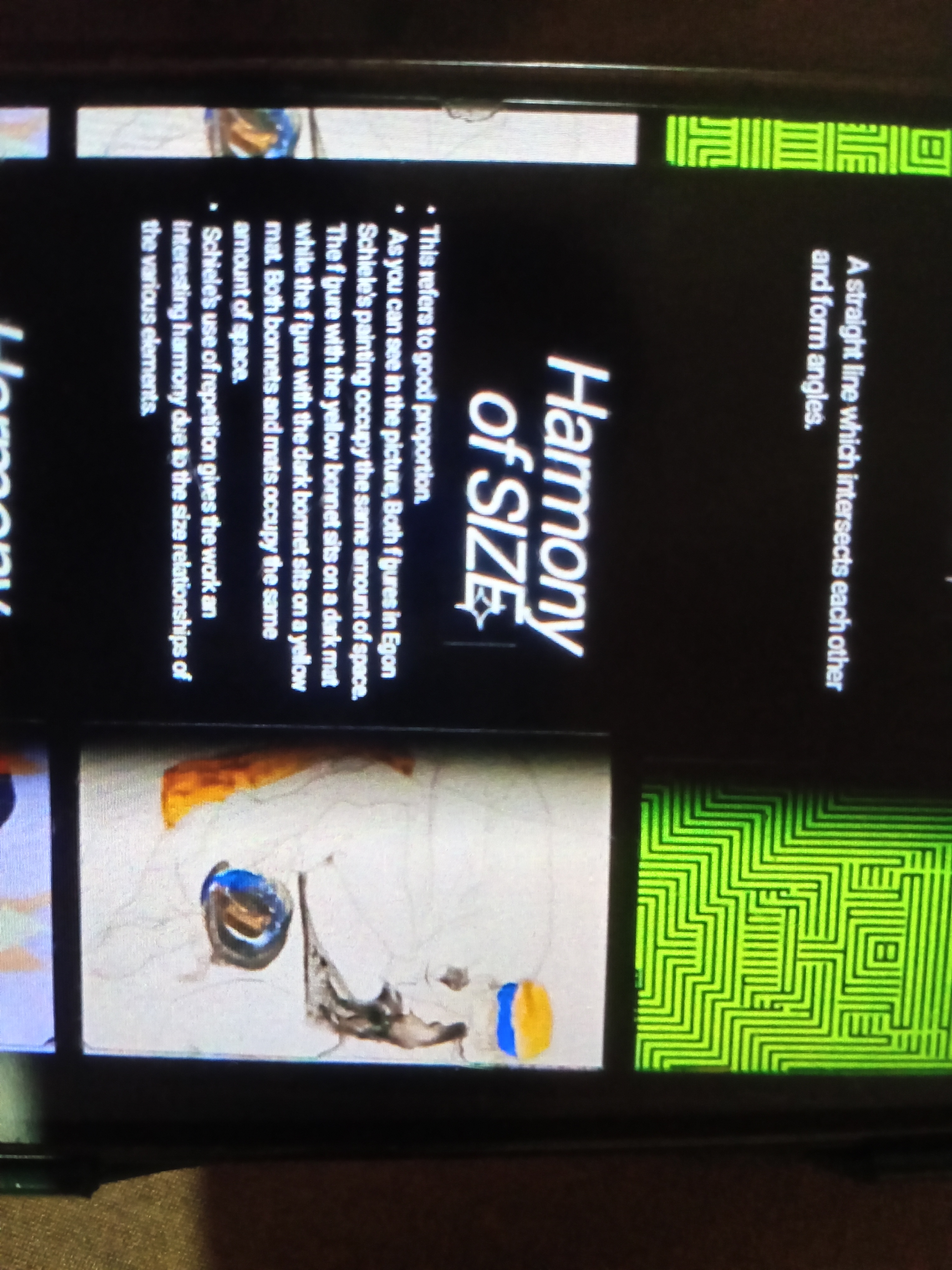
A straight line which intersects each other and form angles
Harmony of size
This refers to good proportion
Harmony Of color
Means using two or more colors in decorating an article or object
It does not mean mixing the color. Colored combination giving the most pleasure are most likely to be those possessing harmony or unity
Harmony of texture
The character of texture can be determined by filling the object with the fingertips or by looking at it.
Coarse and the material used together do not give hamonlous effect and so should be avoided
Harmony of idea
It is not enough that is shape size and textures have something in common there must be harmony in the idea presented together
Rhythm
The continuous use of motif or repeated patterns of a succession of similar or identical items it can be achieved by alternation use of two pattern alternately radiation repetition of the motif from the center or towards its progression use of motives of varying size from the smallest to the largest or vice versa or parallelism used pattern with
Is exemplified by concentric circles by an alteration of black and white stripes by checkered blue and orange stripes
Balance
Also known as the physical equilibrium balance is stability produced by even distribution of weight on each sides of the thing
It is classified into formal and informal
Formal balance
Exist if the weights at equal distance from the center are equal it is also called symmetrical balance because the thing display symmetry
Bilateral symmetry
Is present when the left and the right sides appear the same the right side mirrors the left
Radial symmetry
Exist when the same measure occurs from the central point to the end of every radius this kind of symmetry applies to round objects or those with like stars and starfishes
Informal balance
Is present when the left and the right sides of the thing though not identical in appearance still displays uneven distribution of weight it is also known as asymmetrical or occult balance
Proportion
Is the comparative relationship of the different parts in relation to the whole.
It is the proper and pleasing relationship of one object with the other in a design
Emphasis
Emphasis it is giving proper importance on one or more parts of the thing or the halting itself
It is achieved by means of size of or proportion shape color line position and variety
By arrangement or grouping of objects
The one to be emphasized should be located at the center and should be the biggest and brightest in color
By decoration
Object with decoration are given more emphasis than those without them

