Lecture 11 - Altruism
 Studied by 0 people
 Call Kai
 Learn
Learn Practice Test
 Spaced Repetition
 Match
Match Flashcards
 Knowt Play
1/32

There's no tags or description
Looks like no tags are added yet.
Name | Mastery | Learn | Test | Matching | Spaced | Call with Kai |
|---|
No analytics yet
Send a link to your students to track their progress
33 Terms
Define altruism.
The motive to increase another person’s well-being without consciously thinking about one’s own self interest.
What are the 3 theories that explain why we help others?
Social exchange
Social norms
Evolutionary psychology
Why does social exchange motivate us to help others?
This is because social exchange theory suggests that human interactions are transactional and that we are always looking for ways to maximise our personal rewards, and minimise our personal costs.
Therefore, arguing that people help others due to egoism, which is the idea that all our behaviour is driven by our self-interest.
What type of rewards can people get in social exchanges?
People can get both internal or external rewards. For example, increasing your self-worth, making yourself look good in front of others, reducing stress or guilt etc…
Explain a study examining the effects of social exchange on people’s helpfulness. What were the results and the conclusion?
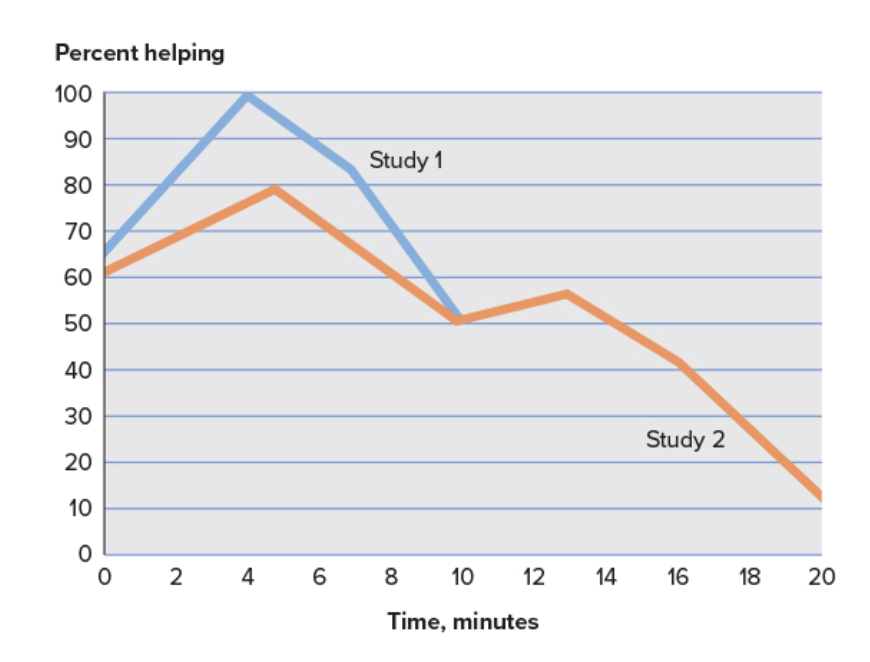
Isen et al. (1976)
They conducted a study where a confederate called participants who either received free stationary 0 to 20 minutes earlier.
The confederate explained over the phone that she had used her last dime to dial this (supposedly wrong) number and asked each participant to relay a message by phone to the person she wanted to contact (public telephones were a thing then and phone calls were only a dime).
The individuals’ willingness to relay the phone message increased during the first five minutes of getting the free stationary. However, at the 5 minute mark, the good mood from getting free stuff wore off and participants’ helpfulness dropped.
Hence, revealing the influence of social exchange of people’s helpfulness. This is because, closer to the time when people got rewards (free stationary), their moods were positive, which in turn, made them think positive thoughts and have a positive self-esteem. Therefore, leading to positive behaviour—such as helping people.
What specific social norms motivate people to help others?
The reciprocity norm and social responsibility norm.
Define the reciprocity norm. How does the reciprocity norm influence people to help others?
The reciprocity norm is the expectation that people will help (not hurt) those who have helped them.
Therefore, this norm motivates people to help others because they think that they will get something in return.
Define the social-responsibility norm. How does the social-responsibility norm influence people to help others?
The social-responsibility norm is the expectation that people will help those who are dependent on them.
Therefore, if we feel that someone depends on us (i.e., our kids, the elderly, the sick), we will help those people.
When do people go against the social-responsibility norm and not help those who are dependent on them?
People act against the social-responsibility norm when they feel that the person depending on them does not deserve the help.
Hence, people’s responses to help are closely tied to attributions. If we attribute the need to an uncontrollable predicament, we help. If we attribute the need to the person’s choices, we think it’s fair not to help because it’s the person’s own fault.
ie. if your friend doesn’t have enough money to buy the school textbook because they spent it all on their sick grandma, then you are more likely to help. However, if your friend has no money because they went out partying, then you will be less inclined to help them because it’s their own fault that they don’t have money.
How do gender roles affect the influence of social-responsibility norm?
Women generally help more than men because their societal gender role is to be communal and helpful.
Explain a study about the effects of the reciprocity norm on people’s motivation to help others. What were the results and conclusion?
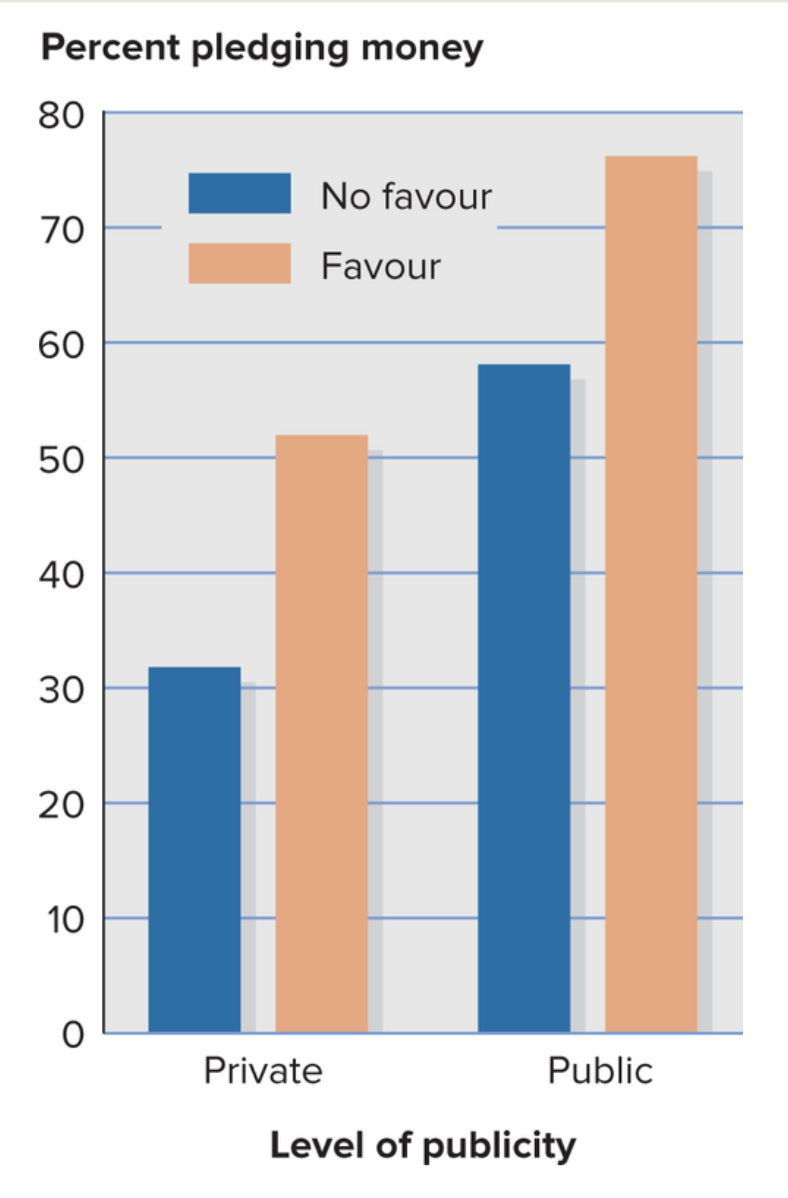
Whatley et al. (1999)
He found that more university students were willing to make a pledge to the charity of someone who had previously bought them some candy, compared to when they did not.
What are the 3 aspects of evolutionary psychology that explain what motivates people to help others?
Reciprocity
Kin protection
Group selection
When are reciprocity effects its strongest?
Reciprocity effects are strongest in small isolated groups.
Define direct and indirect reciprocity and how it motivates us to help others.
Direct reciprocity: You scratch my back, and I’ll scratch yours.
Indirect reciprocity: I’ll scratch your back, you scratch someone’s, and someone will scratch mine.
Therefore, we help others due to this incentive to get something in return.
Define kin protection and how it influences people to help others?
Kin protection is the idea that evolution made us want to be altruistic to close relatives in order to enhance the survival of mutually shared genes.
Hence, we help others in order to enhance the survival of people with similar genes to us.
How does group selection influence us to help others if we have evolved to help those with shared genes?
The idea of group selection is that sometimes people are willing to support a group of people, even if they do not share genes, just to protect people against others who are really in the out-group.
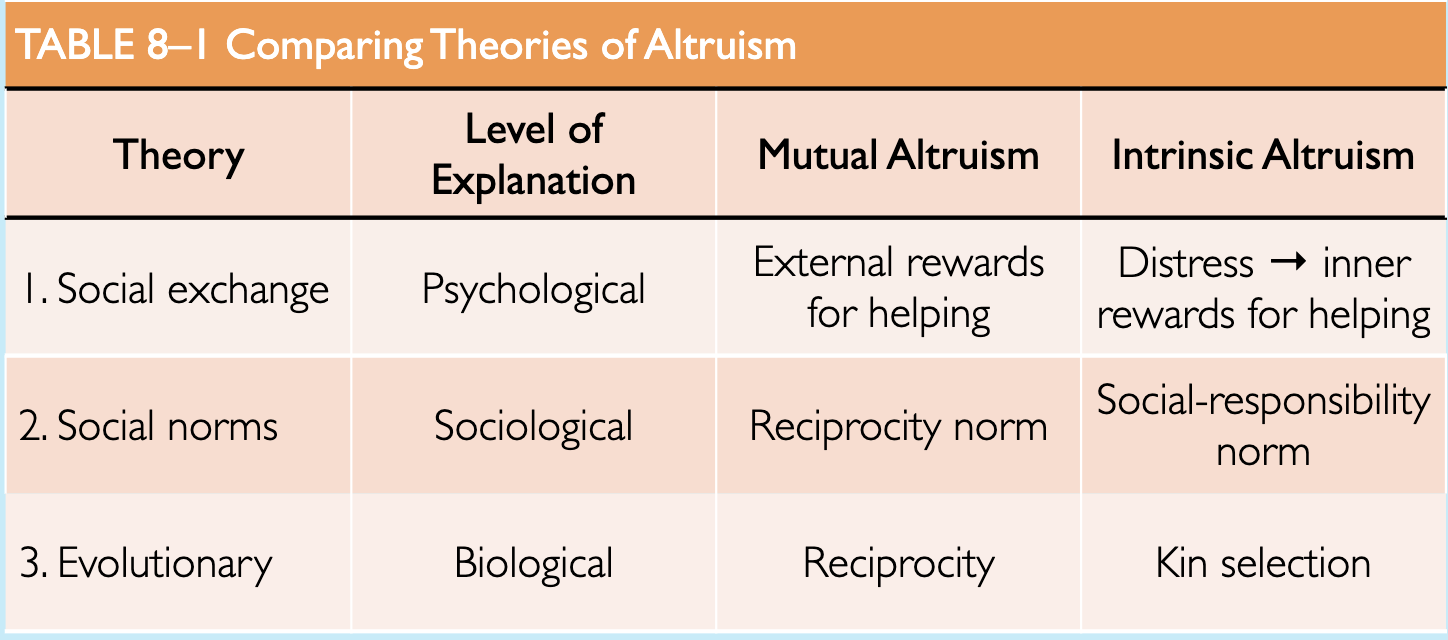
What is the level of explanation, mutual and intrinsic reasons for why people help others? Explain this for all 3 theories.
Define empathy.
The vicarious experience of another’s feeling.
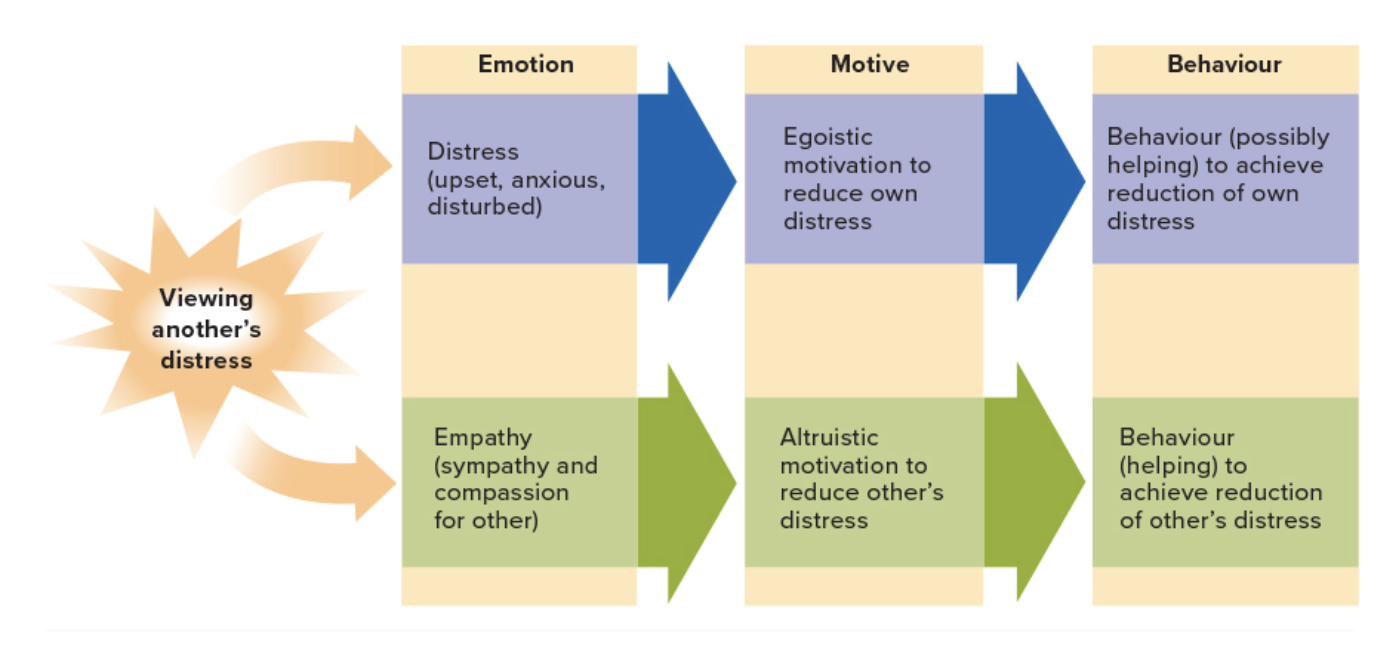
Explain Batson’s altruistic route when it comes to helping others.
you view others’ distress
you feel empathy for the person
you have an altruistic motive to reduce their distress
you behave in way that reduce the person’s distress
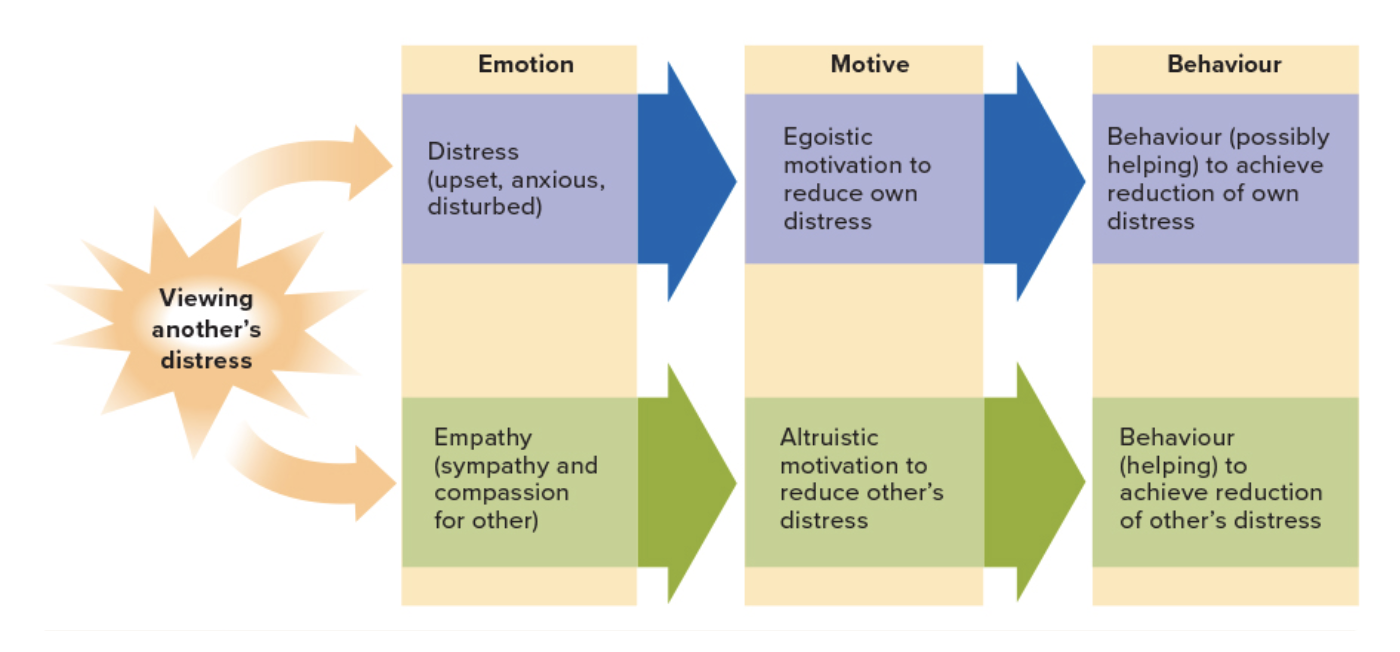
Explain Batson’s egoistic route when it comes to helping others.
you view others’ distress
you feel distressed and anxious as a result
you have an egoistic motive to reduce your own distress
you behave in way that reduce your distress
What sparked interest in understanding the factors that affect when people choose to help?
In the 70s there was a lot of crime in New York City. There was a woman who was brutally raped and murdered in her apartment one night after getting home late. However, there were 38 people who heard her screams and could see what was happening. Yet, no one helped.
This sparked curiosity into when people decide to help, and when they don’t.
What affects when people choose to help?
number of people around due to the bystander effect
helping when others help
time pressures
similarity of victim
Define the bystander effect.
When a person is less likely to provide help when there are other bystanders around.
Explain a study about the bystander effect influencing people’s behaviours.
Gilovich et al. (2000)
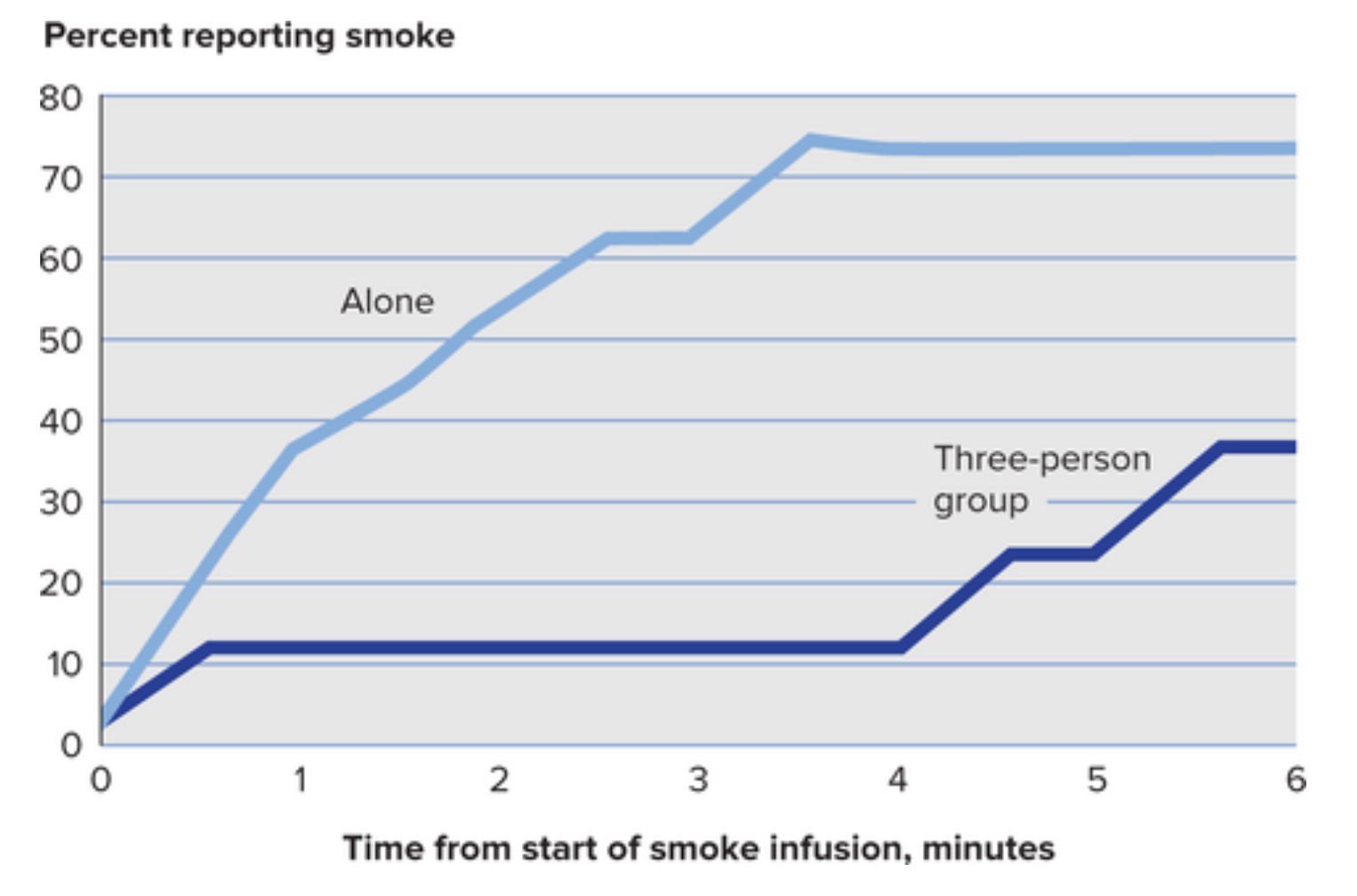
In this study participants were brought into a room with other people in it or were there alone.
Then smoke started to fill the room. The experimenters then measured how long it would take the participants to report the smoke when they were alone vs. with other people.
It was found that when people were with others it took them longer to report the smoke than when people were alone. For example, in only three of the eight groups did even a single person leave to report the problem.
Explain the helping decision tree.
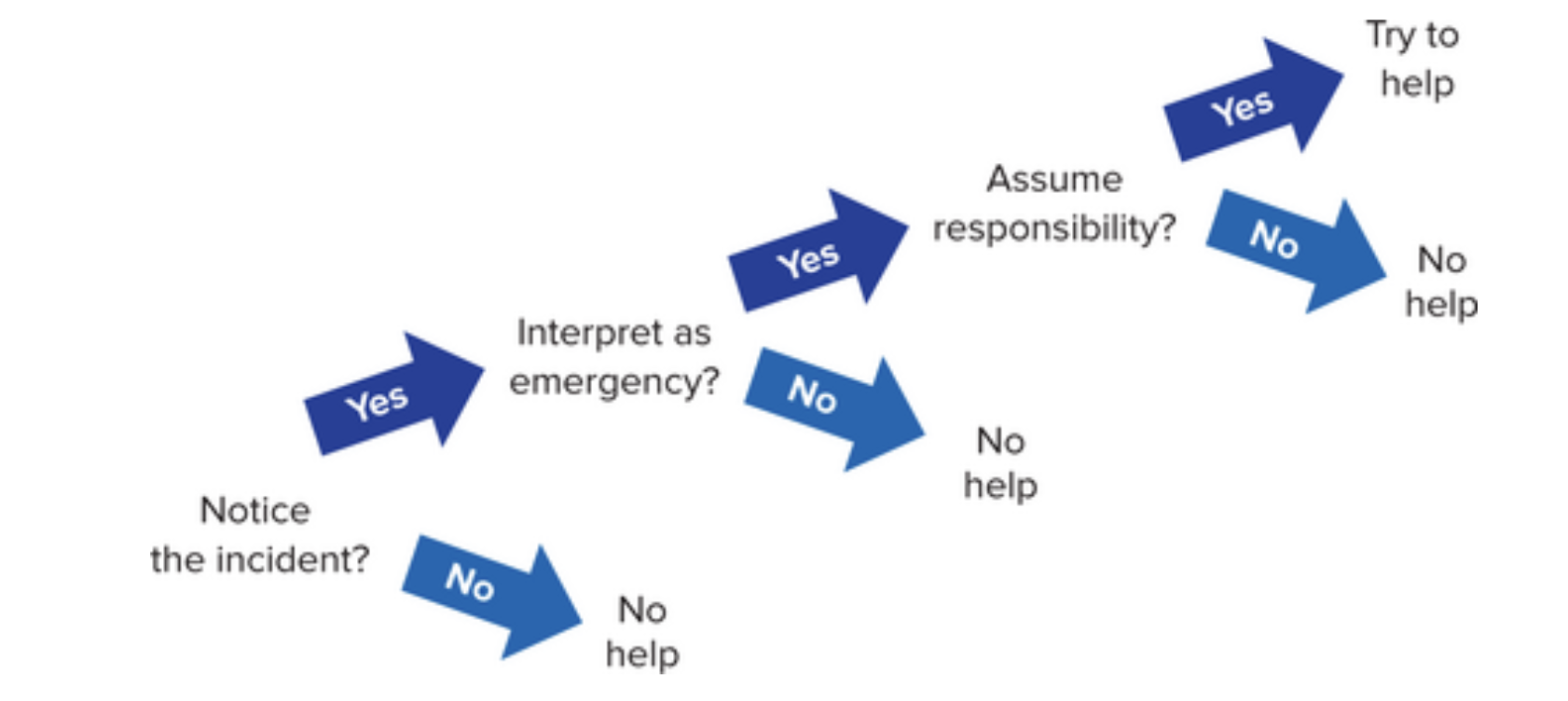
What influences how we interpret situations during the bystander effect? Why?
The illusion of transparency. This is because we automatically assume that everyone can see how we are really feeling. Therefore, if we see an emergency occur and no one else acts panicked, we will assume all is fine because despite our own panic, no one seems to feel it too.
Pluralistic ignorance also influences how we interpret situations because it creates a false impression of how other people are thinking, feeling, or responding. Therefore, making us interpret the situation differently.
How does responsibility diffusion affect how we act? Why?
The more people there are, the bystander effect comes into play as people feel less responsible we feel for whatever outcome occurs. This is because we feel that the responsibility can be shifted to others as well, and that we are not solely accountable.
How do time pressures affect when we help?
When we are busy/rushing, we are less likely to help because we are preoccupied by our own stresses.
How does our similarity to the victim affect when we help?
The more similar someone is to us, the more likely we are to help them (i.e., shared traits, in group member).
What personality type is most likely to help others?
High self-monitors and deeply empathetic people are most likely to help others.
What gender tends to help others more?
Depending on the situation, both men or women are expected to be more helpful.
For example, in caregiving settings, women are expected to be more helpful. Whereas, for more dangerous situations, men are expected to be more helpful.
How can we be more helpful?
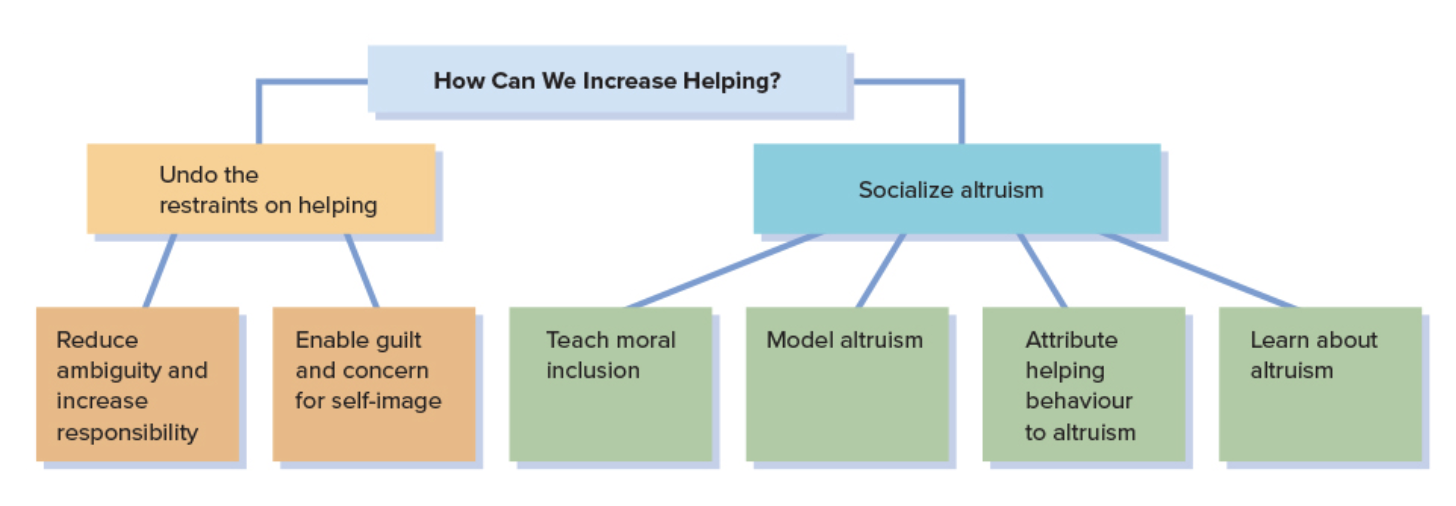
What does socialising altruism mean?
It means to make altruistic behaviour more normal in society.
 Note
Note  Flashcards (24)