MKT 300 [University of Michigan - Ross] my version
 Studied by 0 people
 Call with Kai
 Learn
Learn Practice Test
 Spaced Repetition
 Match
Match Flashcards
 Knowt Play
1/163

There's no tags or description
Looks like no tags are added yet.
Name | Mastery | Learn | Test | Matching | Spaced | Call with Kai |
|---|
No analytics yet
Send a link to your students to track their progress
164 Terms
Marketing Myopia
Myopia = nearsighted
When companies are too PRODUCT ORIENTATED instead of CONSUMER ORIENTED
What business are we really in?
Quarter inch drill = quarter inch hole`
Three Long-Held Concepts Every Marketer Should Rethink
1. Brand
- b4 ppl relied on brands to ensure quality, now there are others ways to do this (internet)
= less barries for entry into the market and MORE brand volatity bc consumers use reviews, social media, and expert opinion
2. LOYALTY
- ppl used to be very brand loyal and rely on past experiences, now ppl have more access to low cost information and can easily start from scratch
= LESS brand loyalty
3. POSITTIONING
- consumers evaluate multiple attributes due to the internet = you can no longer define your brand by one feature
low size of wallet (cant afford it) vs low share of wallet (market share would rather spend on other stufff)
---
experience search and credence
---
what comes first sales of profits peaking
----
what happens in all of the stages (esp declining stage and advertsiing efforts
----
heavy buyers vs light buyers
----
frontal vs flank
flank - (usually smaller companies) not naming competitor , frontal is more direct
segmentation by ___
pyschographics, demographics, ___ theres more i forget
push vs pull
pull: bringing in new customers directly to costumers
push: incentives to distrution channel- not directly to customers but pushing product where customers will see
conjoint analysis importance
you can see how much customers value something by looking at the tradeoffs (like in econ)
Fundamental Entity (FE)
The perspective from which you will create marketing strategy
- relevant when there is a PARENT BRAND with sub brands
how to work around marketing myopia?
answer the following question
1) what needs are we trying to fulfill? companies can drop limiting names (ex: apple computer becomes apple, dominos pizza becomes dominos)
2) is there something we are uniquely good at? find a core competence
3)what is our brand architecture
4)what are our goals
core competence
Firm skills that competitors cannot easily match or imitate.
- leads to sustainable compettive advantage
- can provide access to multiple markets
- can be technical but often intangible components (implicit learning, organizational coordination, corporate culture)
- an iNPUT not an output
- generates strategic assets, which in turn generate benefits for consumers
caveats of core competencies
1) some strategic assets are a consequence of core competencies but some are not -- for example google bought patents from IBM (this has nothing to do w core competency but were aquired externally)
2) Some companies do not have core competence but also some who do have it do not realize it and have a hard time identifying it
Brand Architecture
The relationship between different brands within a company's portfolio
(this may not be relevant to some companies that only sell 1 product or have 1 location)
umbrella brand
a family of products that all deliver the same higher-order benefit
ex: crest
advantages: once consumers trust the brand it can be extended in various ways such as product line extensions (ex: more doritos variations) and category extensions (moving across categories Harley Davidson motorcycles to perfume)
disadvantages: not flexible, damage from product failures can be especially high
product line extensions
ex: doritos: cool ranch, late night, spicy
same category - different products (ex: flavors)
category extensions
When a firm uses its brand to expand into new product categories
- much risker
ex: Swiss (watch, knife, perfume)
every category extension is a brand extension
why do we see so many brand extensions?
1) consumers can alleviate boredom but still stay in the same family
2) billboard effect
3)pricing breadth
4) lower cost to extend than create a new brand
- reduced promotion, packing, research costs
5) reduced risk of product failure
billboard effect
Brand extensions, same color/scheme make an assortment look like a billboard
makes you think of the central brand
brand dillution
occurs when a brand extension adversely affects consumer perceptions about the attributes the core brand is believed to hold
distinct branding
firms offer several products with distinct meanings, brand names, and logos, targeted to different audiences
ex: consumer packaged goods at Kraft, Unilever,
advanatages: offers flexibility, can target multiple groups of people with conflicting priorities
hybrid branding
A branding approach that combines two brands - the corporate brand plus separate brands - to designate differences in product or service lines.
ex: BMW (keeps mini cooper seperate from other cars to distinct it)
Product Extentions
items offered in addition to the product to make it more attractive to the target market
EX: law and order
= law and order special vitimes unit
law and order criminal intent
law and order trial by jury
who are the people that take time to write reviews
self appointed brand managers or people who love the brand
purposes of goals
1) simplify decision making
2) performance benchmark
but when goals are overly ambitious they can stimulate dishonesty
attributes of beneficial goals
prioritized
quantified
includes a temporal benchmark
realistic
internally consistent
it is important to consider the context
1) stakeholders
2) external events (PESTEL)
Levitt's argument
selling focuses on sellers needs
marketing focuses on consumers needs
*selling not equal to marketing
super consumers
1. combine big spending with high engagement and deep interest in new uses for a new product (not just heavy users)
- they exist in most businesses
- they WILL buy more - they account for 3x as much growth as other consumers
hose who make up a small portion of people, but a large portion of sales
80/20 Rule (Pareto Principle)
- 80% of a companies profits are derived from 20% of it's consumers
Customer Relationship Management (CRM)
a company-wide business strategy designed to optimize profitability, revenue, and customer satisfaction by focusing on highly defined and precise customer groups
product BUILT off the customer
RFM analysis
R and F are more important than M
RFM
RECENCEY
- how recent their pruchase was
FREQUENCY
- how often they buy it
MONETARY
- how much do they spend
types of customer relationships (aka when do u stop being a customer)
contractual -- we observe the time when people become in active or their churn rate (Netflix, gym membership, subscription based)
non-contractual -- we do not observe when they become inactive (nike shoppers, product based)
churn
the number of consumers who stop using a product or service, divided by the average number of consumers of that product or service
- EXIT
retention requires two components: proactive vs reactive campaigns
reactive: straightforward, a customer is going to leave and then you are REACTING to that news
proactive: preventing a customer from leaving
- can result in false negatives (failing to identify customers who intend to leave) AND false positives (offering incentives to stay to customers who never had any intention of leaving)
-- this can disrupt habits
-- some customers would have continued / renewed on autopilot
-- The offer (e.g., upgrade at a steep discount) can prompt them to review and change their consumption habits
attitude
what consumers think and feel about your brand
acquisition challenge
overcoming existing brand loyalties
loyalty
a deeply held commitment to rebuy a product or service despite situational influences and marketing effors having the potential to cause deection
typical assumption about loyalty
loyal customers are more valuable with time
true assumption about loyalty
loyal customers are more price sensitive and believe they deserve lower prices, also more knowledgeable about product offering and they get angry when only new customers get the perks
benefits of loyalty
can be a barrier to entry
inertia: allows time to respond to competitor innovation + protection against price attacks
source of price premiums (additional amount a customer will pay for a loyal brand versus a no loyalty one)
price premiums
additional amount a customer will pay for the brand in comparison with another brand offering similar benefits
see how much of a price increase a consmer will deal with before moving along and then the difference is the price premium
caveat to loyalty/disadvanatges
1) loyal consumers believe they deserve lower prices (angry when new people get perks)
2) they are more knowledgeable about products so they are more price sensitive
common categorization of a customer
1) profitability 2) longevity
butterflies
hi profitable, short term customers
true friends
high profitability, long-term loyalty
strangers
lo profitability, short term customers
barnacels + what we want to target
low profitability, long term customers
look for size of wallet (affordability) and share of wallet - we want to go after those with a share of wallet problem aka those who are buying from competitors
customer lifetime value (CLV)
present value of all future profits generated from a particular customer
function of : margins, annual retention rate, discount rate
heterogeneity
the variability of the inputs and outputs of services, which causes services to tend to be less standardized and uniform than goods
cohort level survival curve
-----
survivor bias
aggregate retention rate increases over time, even though the underlying retention rate for each customer has not changed
ex: views for season drop a lot after episode 1, barely drop after episode 2 - the retention rate shouldnt be different its just survivor bias
acquire new customers or retain existing customers?
try and retain customers you already have - those customers will then go on to spread positive word of mouth
Acquisition marketing objective
ex: advertising to build awareness. headon headache medicine: straightforward, almost annoying, but gets people's attention.
ex: leveraging awareness of stronger competitor: 7up "theres no cola like the Uncola"
Leveraging awareness of stronger competitor
retention marketing objective
ex: ads that focus less on the product: wassup budweiser commericial.
ex: kroger card, mcdonalds monopoly board, loyaly cardsd,
who do reward programs affect most
light buyers have the biggest increase, heavy uyers are already using a lot
loyalty programs
need to have good incentives but not TOO good
most grocery store membership cards reward card ownership, not loyalty
some companies starting to reward proitability over mere volume of purchases
creates barriers to exit (ex: airline miles that disappear if you leave)
- encourage purchases that woudlnt normally happen
-- win greater share of wallet by consolidating purchases
loyalty progams CANNOT:
- build emotional attachment
-- costs can be forgone due to product giveaways
- benefits frequent pruchases the most (is this who we want to offer discounts to?)
- difficult to reduce or restructure without disappointing customers
aquisition marketing can be done with
ads that build awareness
retention marketing can be done with
ads that focus less on a product
current state research
•Huge effort toward predicting churn (which customers are at the highest risk of leaving?)
•Still working on...
-Who to target (highest risk of churning or highest sensitivity to incentives to stay?)
-When to target, and with what incentives
-How to integrate retention programs with other marketing activities
category
the brand with which a brand competes and which function as close substitutes
if consumers to do commonly choose between two brands, they should probs not be considered in the same category
brands within a category have two features: POP and POD
Point of Parity
attributes or benefits that ALL brands within a category offer
necessary but not sufficient enough for success
liscence to compete in the category
Point of Difference
attiributes or benefits that consumers strongly associate with a brand, positively value, and believe they could not find to the same extent with a competitor
ex: in fast food service, subways POD is healthiness
good brands can have lots of pods
four types of customers
loyalists
competitor loyalits
multibrand consumers
people outside of the category
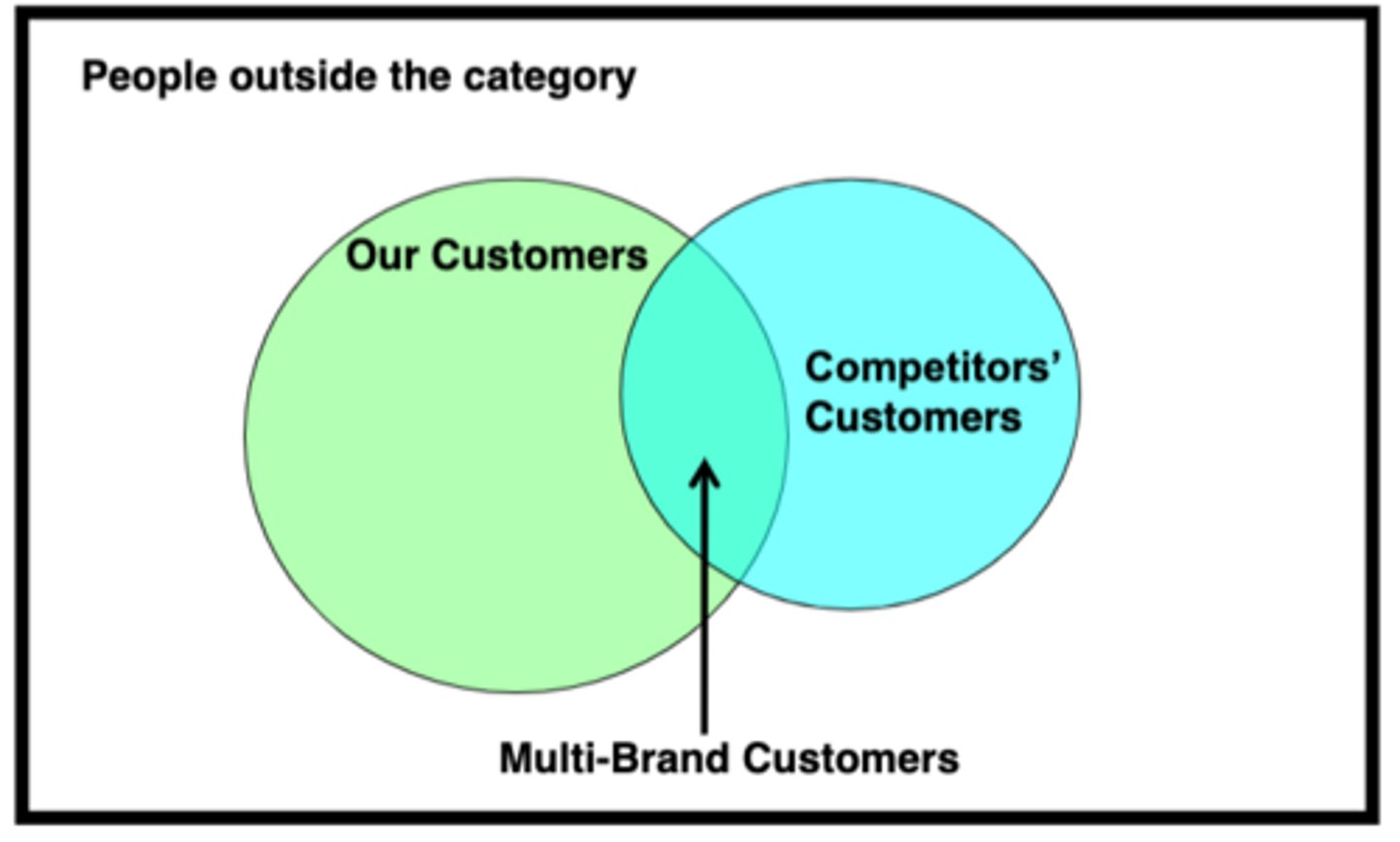
to attack competitors you can?
1) steal share (from comp)
2) stimulate demand ( the public/grow the pie)
stimulating demand
stimulate heightened usage among current customers
ways to stimulate:
1) bring people into the category (when market expands category leader usually gains the most because of name recognition)
2) stimulate heightened usage among current consumers
3) when you do this you are likley to help the WHOLE industry but leaders will come out on top
when the total market expands who benefits
the category leader usually gains the most = perk of being category leader
category leader will generally be motivated to expand the category - other competitors might not want to promote as it will just give the leader more recogniitioin
what happens when non-leaders promote the category
1) lead competitor takes sale
how do you grow a category where everyone is buying?
stimulate increased usage, price promotions (can encourage them to stockpile if the usage is inflexible and the product is non-perishable) focus on multi-brand customers
non leaders can steal share by
1) frontal attack -- attack the fundamental aspects of a leader and say urs is better (pepsi tastes better than coke)
2) flank attack -- attack a leaders weak spots
new companies should ___ and established companies should ___
1) focus on acquisition
2) focus on retention
prototypical
one brands name is synonymous with the category name
ex: tissue = kleenex
bandage = bandaid
price promotions
Promotions when products are offered at a discounted price
if usuage is inflexible and prodcut is non-perishable, price promotions can encourage consumers to stockpile
perishable goods are always flexible
flexible vs inflexible usage
flexible = if you have more you consume more (chocolate)
inflexible: toliet paper: you typically only consume a set amount
steal share
targeting competitors costomers
usually the strategy of choice for non category leders
ads that invoke comparision with the cateogry leader
cant create ambiguity about category membership (can create a need to reassure that the brand has the required POP)
frontal attack
-Head-on attack of fundamental aspects of leader (e.g.,
Pepsi tastes better than Coke)
- Challengers need high resources
flank attack
attack a leaders weak points, blind spots (internal)
ex: attack an area where leader is geographically weak
attack a segment that has been neglected by leader
try not to pick on a small competitor
COKE VS PEPSI
hypercompetition
Coca cola = inventor of marketing
- synonymous with happiness, santa, american values, home
Pepsi: young generation, music, modern, fun
Pepsi makes FRONTAL attack against coke: attacking the taste and everyone prefers Pepsi = coke create a NEW coke - but people were mad as coke isnt all about the taste, its about the BRAND
Coke now less focused on fighting pepsi, more focused on saving the category
why was the pepsi taste challenge not entirely accurage
1. we typically have more than one sip
2. we normally KNOW what we're consuming
do you want to have 100% market share
NO
Competition can be good
at some point when you get to 100% market share your profits go down - you want to maximize profitability not market share
getting to 100% market share requires a lot of additiioal costs - eventually the cost of adding an additional customer will outweight the value they bring you
STP
Segmentation, Targeting, Positioning
segment
group of consumers sharing at least one characteristic that should increase their responsiveness to a marketing effort
types of marketing
Mass Marketing (offering → customer 1,2,3,4,5)
Segment based Marketing (offering A → customer 1,2,3 + offering b → customer 4,5)
One-to-one Marketing (offering A → customer 1, offering B → customer 2, offering C → customer 3, etc.)
When should we segment?
When incremental value from customizing outweighs costs of developing separate offerings for each segment
when costs of customization are high -- companies develop large segments
when they are low offerings can be tailored
Why do we segment?
Increase efficiency, want to find the balance between size and conversion
target market size and probability of conversion are inversely related
variables on which consumers are commonly segemented
demographic: region, pop density, climate, gender, age, income, occupation
- demographic data is cheap and abundant, lots of sources
Issue: sometimes we fall into stereotyping
Drawbacks: only some behaviors are strongly predicted by demographics, and potentially limits growth and marketers cannot grow a demographic group
behavioral
- ads ofor nicorette gum in smoking lounges, wedding dress ads on the knot
- BUT purhcases dont always reflet our typical attitudes
Issue: lots of instances where our purchases do not reflect our typical attitudes (gifts, using the company credit card, on a date)
attitudinal
- we LOVE
- thoughts, feelings, beliefs, desires, aspirations
- we can translate these to NEEDs (ex: i am a very busy person = i have a high need for convienence)
People also think more green than they behave and translation of beliefs to needs are not always straightforward
difficult to collect
ex: CAMBELL:
- passionate kitchen master, uninvolved quick fixer, familiar taste pleaser, diciplined health manager
- toothpastes (fresh breath, white teeth, low price, romanc)
- airport personalities
- very difficult to collect
common segment defenition
a group of customers sharing at least one characteristic that should increase their responsiveness to a marketing effort
compromise between mass marketing and one to one marketing
mass marketing = least cost
one to one marketing = most cost
MECE
mutually exclusive and comprehensively exhaustive - segments should be sufficienty different form one another so that they do not overlap
idenfitifed segments should include ALL consumers in a given market
prizm premier
PRIZM Premier
Geoclustering technique that takes into account location, education, affluence, family cycle, urbanization, race, ethnicity, and mobility
gray powers
older couples in downtain areas, white collar, professional
one of the niche segments
pink tax
the higher price paid for women's consumer items compared to similar products marketed to men
-- however evidence suggests that price differences mainly come from product differentiation not a "tax"
successful segmentation either based on needs or behaviors should be
Identifiable (easily identify which customers fall into which category and measure)
Substantial (large enough to be profitable)
Accessible (should be reachable)
Stable (stable for long enough period of time to be marketed to)
Differentiable (similar needs that are different from other groups' needs)
Actionable (you have to actually be able to provide your product to these people {insurance, legal, geographical barriers})
what makes an UNattractive segment
Segment already contains several strong or aggressive competitors
Entry barriers are low and exit barriers are high
Many substitutes for the product
conjoint analysis is a method of discovering attitudinal segments
determines the importance of different attributes to different segments of consumers
relative importance of product attributes is better measured when attributes are considered JOINTLY
forces consumers to make realistic tradeoffs
perceptual maps
tool used to depict graphically the positioning of competing products
+ type of chart
blue ocean strategy
xyz
red ocean strategy
xyz
 Note
Note  Flashcards (102)