Microbial diversity
 Studied by 0 people
 Call Kai
 Learn
Learn Practice Test
 Spaced Repetition
 Match
Match Flashcards
 Knowt Play
1/31

There's no tags or description
Looks like no tags are added yet.
Name | Mastery | Learn | Test | Matching | Spaced | Call with Kai |
|---|
No analytics yet
Send a link to your students to track their progress
32 Terms
early earth atmosphere
Microbes in isolation artificial, microbes will always be found in communities
Highly anaerobic —> highly reducing atmosphere which favoured the formation of organic molecules from inorganic compounds
All life on earth microbial from 3.7-4.3 bn years ago to the next 3bn years on
Single celled bacterial like organisms living of hydrogen and sulphur
Likely withstranding high temps
Cyanobacteria popped up around 2.7-3.5bn years ago and caused the great oxygenation event
Cyanobacteria can photosynthesise —> producing oxygen which changes the atmosphere
LUCA
Everything comes from luca
Highly diverse bacteria that we only know from DNA, haven’t cultivated
Leading hypotheses is the 2 domain system: bacteria and archea are the 2 branches and eukarya come from archea
Microbial groups
prokaryotes
eukaryotes
Prokaryotes
Bacteria and archea
BACTERIA: E.g: myxobacteria which form fruiting bodies or spirochetes which form spiral shapes
ARCHEA: E.g: haloquadratum
Do not have a nucleus, bound by a nuclear membrane
Previously thought that prokaryotes were limited to bacteria, due to 16S rRNA genes we can categorise diversity of life and realise that not all prokaryotes are bacteria
difficult to classify due to horizontal gene transfer - how much DNA do you have to pick up before considered a new species?
Microbial groups
prokaryotes
eukaryotes
Eukaryotes
Broad groupings:
fungi (including yeast)
protists (megagroup of things that are lumped together)
all have mitochondria
Contain a nucleus or membrane bound structure which contains the cells genetic material (nuclear envelope)
bacteria
Greatest metabolic/taxonomic diversity so can inhabit all habitats
Can break down any compound
Range in size from 0.5 microns to 2 microns (avg) but some can be as small as 0.2 microns or as large as 0.75 mm
Roughly 90 bacterial phyla,
99% uncultured
Have no compartmentalisation, typically single celled
Typically have a single circular chromosome in the cytoplasm
Largely grouped into gram neg and gram pos
Gram -ve: small cells wall
Gram +Ve: thick peptidoglycan cell wall
Lots are facultative so can swap between 2 different metabolisms
Critical for all biogeochemical cycling
Ester linked lipids and shares this with eukaryotes —> this is one of the pieces of evidence for endosymbiosis theory
bacterial groups
Actinobacteria – filamentous bacteria
Grow in long threads
Streptomyces produce antibiotics naturally which they use to compete eachother
Wolbachia
Obligate intracellular bacteria which infect insects
80% of insects on the planet infected and affects the sexual fitness of the host —> manipulates host fertility to survive
If the host isn’t infected with woolbachia its infertile
Nitrogen cyclers
Nitrogen fixers
Ammonia oxidisers
Nitrate oxidisers
Denitrifiers
Spirochetes
Cyanobacteria
Bdellavibrionota
o Predatory – attack and infect other bacteria and eat it from inside out
Archea
Newest discovered
Oldest organisms on the planet
Thrive in extreme environments but are ubiquitous
Small number isolated and studied in the lab, don’t know much about metabolic function
A lot of methanogens (produce methane)
strict anaerobes (oxygen inhibits methanogenesis) found in animal gut, lake sediment etc.
prefer low sulphate environments as theyre out competed by sulphate reducing bacteria
perform several metabolic functions which all lead to methane as the product
asgard archea are the branch that are believed to lead to eukaryotes
ether linked lipids which are more chemically stable too deal with extreme environments
fungi
two morphological types
yeast: asexual budding
filamentous fungi: grow on threads and form fruiting bodies
vital for breaking down dead organic matter, more efficient than bacteria at breaking down lignin and cellulose
release enzymes which dissolve stuff
have membrane bound organelles and chitin in cell walls
major groups of fungi
Ascomycota
Sac fungi, most diverse
Basidiomycota
Club fungi
Glomeromycota
Ancient fungal lineage
Obligate symbiote with plants – gets all its carbon from plants, in exchange plants get nutrients.
Acts as an extended root system
Chytridomycota
Earliest diverging fungal lineage
Motile spores (needs moisture)
Chytridiomycosis —> devastating amphibian populations worldwide
Zygomcyota
protists
Artificial grouping with no evolutionary heritage
60,000-100,000 species
Little phylogenetic grouping, 40-50 unrelated phyla
Don’t have any tissue organisation
eukaryotes
protist groupings
Used to be based on locomotion strategies
Lots of taxonomic issues
Broad groupings:
Flagellates: have flagella, free living predators
Amoebae: amorphous ( no shape), free living predators and move through false feet known as pseudopodia
Ciliates: cilia for locomotion
Stationary (sporozoa): nonmobile protozoans, some undulating ridges
protist algae
Photosynthetic protists containing chlorophyll A
Can be single celled or complex multicellular
Highly diverse
Base of aquatic food web
Fix a lot of carbon in oceans
measuring diversity
first observed under a microscope, then began to culture them
Culturing came up with the great plate count anomaly – only a handful of things can be physically cultures on a plate, would be different if you cultures in a liquid broth
Molecular techniques include 16S rRNA gene sequencing
microbial functions
Microbiomes in gut determine how healthy you are and foods you prefer
Particular genes to break down different foods E.g: seaweed, which are particularly well picked up in Japan
Important for climate regulation – Methanogens produce methane, some consume methane
Nitrogen cycling – rhizobium takes up nitrogen from atm —> ammonium, another bacterium picks up ammonium to nitrite, nitrite converted to gas
Some bacteria can do the entire process itself
Some fungi can induce stress in plants
Lots of bacteria can produce compounds which can deter insects
Some bacteria can break down pesticides
microbial interactions
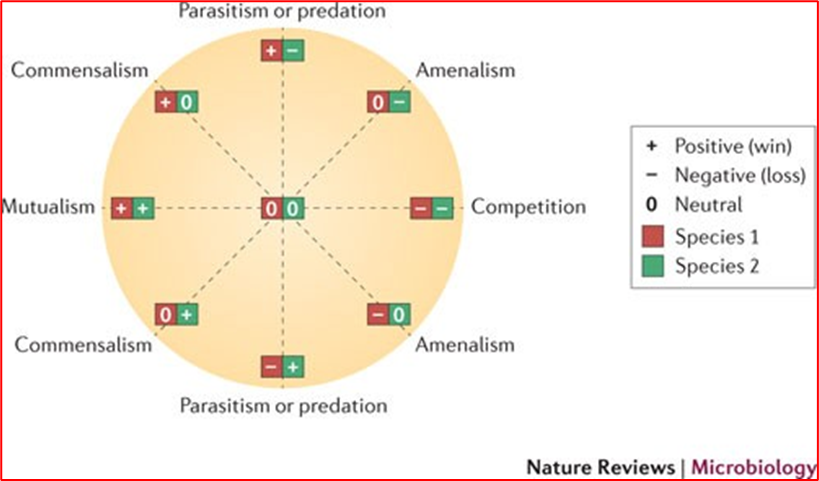
interactions between microbes determine the type of community developing
· positive interaction = plus, negative = minus, neutral is a circle
Mutualism is when both partners benefit, E.g: mycorrhizal fungi – plants feed the fungus and the fungus gives nutrients back to the plant
Cross feeding (example of mutualism) is when a bacteria feeds off something, E.g: sugar and produces metabolites which are needed by another bacterium. This is one of the reasons that culturing bacteria in isolation is so difficult
Commensalism is when one bacteria benefits and the other one is unaffected. E.g: colonised by bacteria and you are unaffected but the bacteria is safe from being killed
Parasitism is when one bacteria benefits and the other one loses out
Amenalsim is when one bacteria has no effect, the other bacterium has a negative effect —> E.g: natural production of antibiotics by bacteria
Competition is when the 2 bacteria are fighting eachother, both lose out
fungal highways
Can either be a commensalism or a mutualism, depends on whether the fungus gets something back
Fungal hyphae provide a surface for bacteria to colonise, sometimes bacteria can provide nutrients like vitamin B1
The way that mycorrhizal fungi give phosporous to the plant is because the bacteria colonising the fungi produce phosphorous
biocrusts
Example of a consortia of microbes algae, fungi, cyanobacteria which associate with lichens or mosses
Generally biocrusts are the first colonisers and they reshape the environment
Add carbon and nitrogen to the environment
They have roles in reducing wind and water erosions, helping water retention and reducing UV pressure (production of scytonemin) the underlying soil
biofilms
Multiple species consortia
Release of extracellular polymetric substances – polysaccharides, DNA etc
Resistant to perturbation and antibiotics, provides predation protection
different environments: soil
One of the most complex environments
High microbial abundance
Rich in organic matter
Lots of carbon —> ideal for colonisers
Microbes essential for recycling nutrients, decomposing organic matter
Microbes found up to 3km deep, could be in a dormant state waiting for water, nitrogen etc.
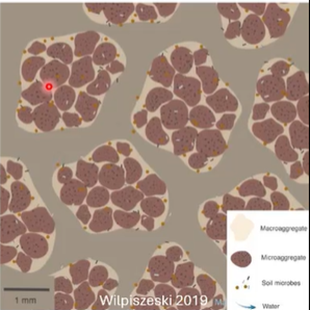
Soil is so complex due to aggregates – micro and macro aggregates
Macroaggregates is a binding of lots of microaggregates
Individual particles are held together by “microbial gums” such as the polysaccharides that make up EPS of biolfim
Between the aggregates are pore spaces which allow the movement of air, water, microbes
pore spaces in soil
Micro and macro aggregates have pores have pores which bacteria can exist in
Can be beneficial as may be protected from other organisms. E.g: protists
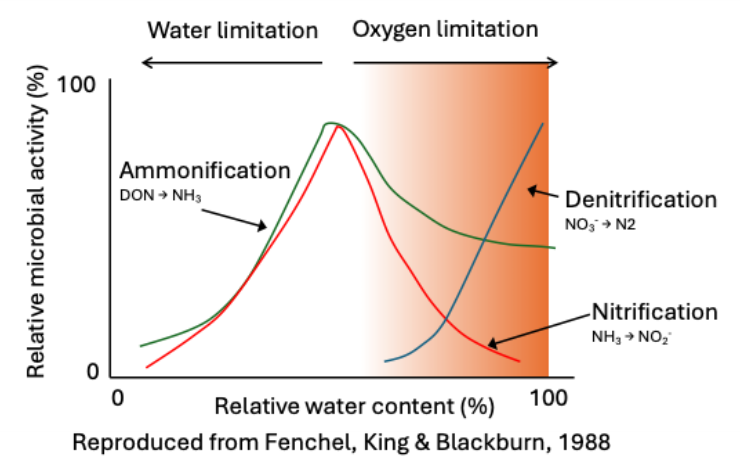
Oxygen and water can limit oxygen diffusion —> more denitrification and less nitrification
Usually water flows around macroaggregates but sometimes water can impact pore spaces between microaggregates
Water dries and created bridges which lock off the oxygen in the pore —> can form an anaerobic environment
water and oxygen relationship
Solid aqueous phase and gas phase in soil
Wet soils have trouble diffusing oxygen
Dry soils have problems diffusing nutrients
Very dry soils limit microbial activity as they need water for metabolism
biogeography
The study of organisms in space and time
Closer to the equator more species diversity for most organisms except bacteria —> they peak in temperate regions
Hypothesis for this is that they avoid competition with fungi by doing this
Different environments: plants
Phyllosphere
Above ground
Bacteria grow on leaves
Infection can occur through the stomata
Also colonise trichomes
Rhizosphere
Below the ground
Hotspot of biogeochemical activity around the roots of the plants
Different from the soil environment as plants change the local environment through oxygen conc, pH, sugars, amino acids, secondary metabolites.
A particular group of bacteria which are enriched —> high turnover, high growth rate
Certain taxa which don’t like that environment
communication with the environment
Plants produce exodates —> carbon compounds that act as food sources for microorganisms
Plants produce volatiles or phenolics which herbivores react to eat —> plants try to avoid releasing these
Plants release strigolactones in phosphorous limiting conditions which triggers arbuscular mycorhhizal fungi to colonise
BUT the germination of parasitic plants is also triggered by strigolactones
mycorrhizal fungi and plant interactions
Ectomycorrhizal and arbuscular mycorrhizal fungi
Ectomycorrhizal – grows outside the fungi
Arbuscular – respond to strigolactones, enter the cells and produce arbusclues which exchange nutrients
Bacteria like rhizobium can infect a legumous plant and form nodules —> forms a mutualism
different environments: oceans
Exist in every element of marine settings
Biological pump – phytoplankton photosynthesise and put carbon into the system, sinks, gets sequestered into deep sediment (never sequestered for ever) at some point gets eaten,
Microbial loop – phytoplankton produce carbon, cells explode and carbon is released, heterotrophic bacteria eat that and produce carbon dioxide which goes back into the atmosphere
Phycosphere
Is a hotspot of microbial activity which surrounds phytoplankton when they die
Analogous to the rhizosphere
Bacteria use chemotaxis to swarm towards the phycosphere
Different environments: animals
Animals associate with microbes
Can be categorised into pathogenic or symbiotic relationship
Can have organ specific microbiomes —> skin microbiome which acts as a physical barrier, gut microbiome
different environments: insects
Infect up to 65% of all insect species
Manipulate insect reproduction by
Cytoplasmic incompatibility
feminisation
Male killing
By releasing uninfected Wolbachia, they will reproduce but their offsring are infertile
termite gut mutualisms
One of the most efficient bioreactors in the planet
Termite gut community has a symbiotic relationship in gut essential for survival
Lignin and cellulose are broken down to provide rich carbon source
However, they do not contain nitrogen so nitrogen fixers required to produce bioavailable nitrogen
Also contain protists within the gut —> protist eats the wood in the gut which causes the breakdown
fungal parasites - zombie ants
Fungi infects insects and hijacks their behaviour – causes the insect to attach to the underside of the leaf for spore dissemination
microbial behaviour
In consortia microbes communicate via quorum sensing mediated by autoinducers
At a certain density of cells will switch on or off a certain behaviour
Density-dependent communication strategy
Cyanobacteria at a certain density produce this structure called heterocysts which is the format needed for nitrogen fixation
extremophiles
Microbes which live in extreme environments that are detrimental for other forms of life
Acidophiles – live between pH 3-5 but can be lower
Pump out protons to counter the acid
Have proteins which are extremely stable
Alkaliphiles – live in alkaline environments
Pump in protons to counter high pH
Halophiles – love high salinity (3-15% moderate halophiles, 15-30% extreme)
High salt levels cause proteins to aggregate which can cause cell dessication from osmosis
As a result produce osmoprotectants (amino acids, sugars, betaines) which accumulate inside cell to balance osmotic difference
Thermophiles – exist in habitats over 100 degrees
Proteins denatures and so have chaperone proteins which can prevent this
Pschrophiles – low temperatures (-20-+10 degrees)
Can produce antifreezes
Lipid membranes which are chemically resistant
Enzymes which retain activity at low temperatures
Xerophiles – arid deserts
Scytonemin is a compound for UV absorption
Has a state of anhydrobiosis (state of low metabolic activity) to counter the low cell water content
 Note
Note  Flashcards (42)